SoWork vs Kumospace Analytics: Which Wins?
Vishal Punwani

Published:
Updated on:
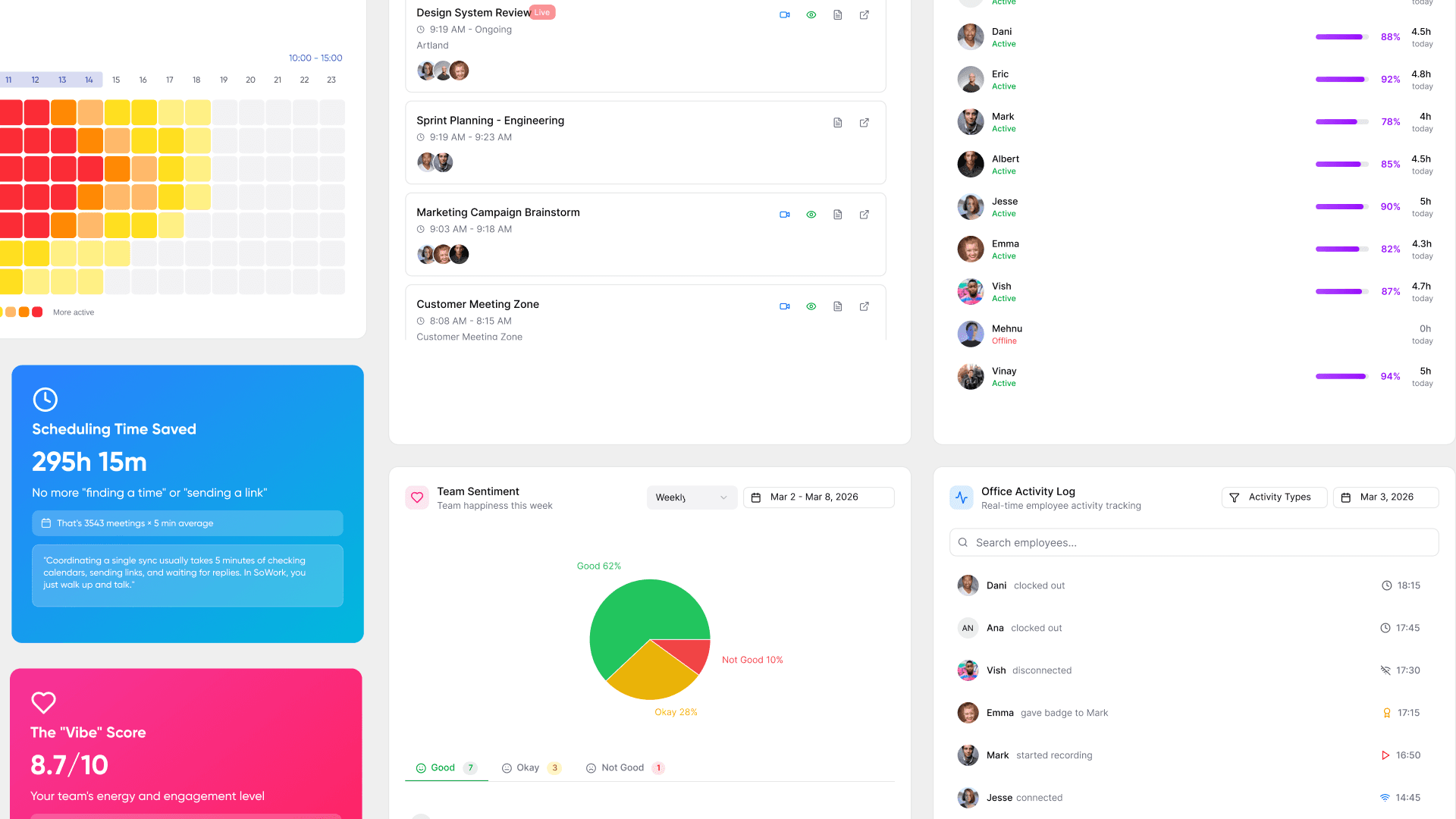
SoWork gives managers deeper visibility into remote team engagement than Kumospace, because it combines real-time presence awareness with AI-powered meeting analytics, attendance trends, and collaboration pattern data, all inside a unified dashboard. Kumospace tracks time-in-space and user presence, but its analytics depth is thinner and locked behind higher-tier plans.
What Is Team Analytics in a Virtual Office, and Why Does It Matter?
Team analytics in a virtual office means measuring collaboration patterns, presence signals, and engagement levels so managers can make informed decisions without micromanaging. For remote teams, it's the closest substitute for the ambient awareness you'd naturally have in a physical office.
Remote managers lose the passive visibility that comes with sharing a physical space. They can't see who's heads-down, who's stuck, or when collaboration drops off. Team analytics fills that gap. It tracks metrics like meeting frequency, participation levels, login habits, and response patterns, surfacing bottlenecks before they cascade into delivery delays. The Owl Labs 2025 report found that managers' top concerns for remote employees are maintaining engagement (29%) and reduced visibility into how their teams are working (27%). [1] Platforms that bake analytics into the virtual office itself, rather than requiring separate tools, give managers the clearest picture.
What Analytics and Engagement Metrics Does SoWork Give Managers?
SoWork tracks attendance, meeting habits, collaboration trends, participation, speaking time, and engagement levels, surfaced through dashboards that managers can review without interrupting anyone.
SoWork's analytics layer covers several dimensions managers actually care about:
Metric Category | What SoWork Tracks |
|---|---|
Presence | Who is free, focused, or in a meeting in real time |
Meetings | Frequency, duration, participation, speaking time |
Collaboration | Interaction patterns, connection density between teammates |
Attendance | Login habits, work-hours overlap across time zones |
AI Outputs | Auto-generated summaries, action items, searchable meeting library |
Managers can spot unnecessary meetings, identify disengaged teammates, and coach individuals using speaking-time data. [2] Detailed team analytics are included in SoWork's Premium plan at $15 per user per month. [3]
What Analytics and Engagement Metrics Does Kumospace Give Managers?
Kumospace's Space Analytics tracks time spent in the virtual office, user presence, and availability, giving owners and admins a daily and weekly view of how long people are in the space.
Kumospace's analytics are presence-first. Space Analytics, available to Business and Enterprise plan subscribers, lets admins track duration of time spent, user presence, and member availability. [4] Its time tracker automatically logs hours based on when users enter and exit the virtual workspace, removing the need for manual timers. [5] Kumospace also tracks engagement and attendance within virtual spaces through its analytics dashboard. [6] What it doesn't surface natively: meeting-level participation data, speaking time, or AI-generated summaries. Its analytics focus more on 'who showed up and for how long' than 'how did the team actually collaborate.'
How Does SoWork Track Presence and Ambient Collaboration?
SoWork tracks presence continuously through automatic calendar sync and visual status indicators, so managers see real-time availability without anyone manually updating their status.
SoWork's presence layer works like the ambient awareness of a physical office. Calendar sync with Google Workspace and Outlook automatically updates a teammate's status when a meeting starts or a focus block begins, no manual input needed. [7] Visual indicators show who is free, focused, or in a meeting across the entire 2.5D office. When someone enters Focus Mode, teammates see they're unavailable for quick conversations. [8] This passive data feeds directly into analytics: presence signals accumulate over time to reveal individual work patterns, time-zone overlap, and collaboration rhythms managers can act on.
How Does Kumospace Track Presence and Team Interaction Data?
Kumospace tracks presence by logging when users enter and exit the virtual space, and managers can see who's collaborating, who's focused, and when rooms are being used, without interrupting anyone.
Kumospace's presence model is spatial and passive. Managers can see who is in which room and whether they're in a conversation, based on proximity in the virtual floor plan. [9] Its time tracker automatically logs hours based on user presence in the workspace, giving team leads visibility into work patterns without requiring manual check-ins. [10] Calendar integration correlates time spent in the virtual office with scheduled meetings and work blocks. [11] The analytics page shows daily and weekly views of duration data, though it's worth noting that Kumospace's analytics page does not display real-time engagement, data may take a few hours to update. [4]
How Do SoWork and Kumospace Compare in Analytics Depth and Granularity?
SoWork goes deeper. It surfaces meeting-level data, participation, speaking time, collaboration trends, and AI-generated summaries, while Kumospace focuses primarily on time-in-space and room presence.
Capability | SoWork | Kumospace |
|---|---|---|
Real-time presence | Yes, automatic | Yes, spatial |
Time-in-space tracking | Yes | Yes |
Meeting participation data | Yes | No |
Speaking time per person | Yes | No |
AI meeting summaries | Yes (Premium) | No |
Collaboration pattern trends | Yes | Limited |
Data export | Yes (spreadsheet) [12] | Customizable reports [13] |
Analytics availability | Premium plan | Business/Enterprise plans |
SoWork's roadmap is explicitly investing in AI functionality and deeper analytics. [14] Kumospace updates lean toward event features and spatial audio improvements. [14]
What Should Managers Look for When Evaluating Virtual Office Analytics?
The best virtual office analytics are outcome-focused, non-invasive, and surfaced inside the tool your team already uses daily, not in a separate dashboard no one opens.
Evaluate analytics quality across five criteria:
Depth: Does it go beyond login times to surface meeting participation, collaboration trends, and engagement signals?
Passivity: Does it collect data automatically, or does it require manual input from employees?
Actionability: Can you identify specific bottlenecks, like a siloed team or an overloaded teammate, and act on them?
Privacy posture: Does it measure outcomes and patterns rather than keystrokes or screen activity?
Integration: Does it pull signals from your calendar, chat, and meetings into one view?
Platforms that identify patterns automatically let managers focus on decisions rather than data processing. [15]
Does SoWork Offer Dashboards, Exports, or Integrations That Extend Analytics?
Yes. SoWork offers activity and engagement dashboards, data export to spreadsheets, and integrations with Slack, Google Calendar, Outlook, Zapier, and GitHub that pull collaboration signals from across your tool stack.
SoWork's analytics don't stop at the virtual office boundary. Its dashboards surface engagement and collaboration data, and managers can export that data to a spreadsheet for deeper analysis. [12] Integrations with Google Workspace, Outlook, Slack, and Zapier extend visibility across the tools teams already use, meaning analytics reflect real collaboration patterns, not just in-office behavior. [16] The AI Meeting Memory feature (Sophia Bot) stores auto-generated summaries and action items in a searchable meeting library, giving managers a searchable record of what was discussed and decided. [17] Enterprise plans add SSO and SCIM for larger organizations. [18]
Does Kumospace Offer Dashboards, Exports, or Integrations That Extend Analytics?
Kumospace offers customizable reports and integrates with tools like Asana and Trello for project tracking, but its native analytics dashboard is limited to space-level presence and time data.
Kumospace supports customizable reports that show time spent in the virtual office for individuals or teams. [19] It integrates with project management tools like Asana and Trello, reducing manual data entry and helping teams maintain consistent workflows. [20] Calendar integration correlates presence with scheduled meetings. [11] However, Kumospace's own documentation acknowledges that it tracks a niche of people analytics that can prove valuable, but may not cover all people analytics categories. [21] Space Analytics, the core reporting feature, is gated behind Business and Enterprise plans, which start at $20 per user per month. [22]
How Do SoWork and Kumospace Differ in Tracking Spontaneous vs. Scheduled Interactions?
SoWork is built specifically to capture spontaneous collaboration, the unscheduled 'walk-up' conversations that are invisible in tools like Zoom, and its analytics reflect that, tracking ambient interaction patterns alongside formal meetings.
This is where the two platforms diverge most sharply. SoWork's Instant Meetings feature lets teammates start conversations in one click with no scheduling, and those interactions feed into collaboration analytics alongside formal meetings. The platform tracks both the frequency of spontaneous conversations and scheduled meeting habits, giving managers a complete picture. Kumospace encourages organic interactions through spatial audio, coffee chats and quick syncs without calendar invites, but doesn't appear to distinguish or separately report spontaneous vs. scheduled interaction data in its analytics. SoWork's analytics dashboards can surface which meetings drive value and which represent coordination waste. [23]
What Privacy and Surveillance Risks Come With Virtual Office Analytics?
The core risk is the line between visibility and surveillance. Analytics that track outcomes and patterns are generally healthy; tools that log keystrokes, screen activity, or emotional state cross into invasive territory that damages trust and creates legal exposure.
A U.S. GAO report found that many employees don't know what data is being collected, how long it's stored, or who has access, and that secrecy is one of the biggest sources of employee stress. [24] Research shows 33% of employees constantly wonder if they're being watched, and 24% take fewer breaks to avoid appearing idle. [25] Both SoWork and Kumospace explicitly avoid invasive monitoring like keystroke logging or screen recording, focusing instead on presence signals and collaboration patterns. The practical rule: analytics should measure team-level trends and outcomes, not surveil individuals. Transparency with your team about what's tracked, and why, is the most important safeguard.
How Do Pricing Tiers Affect Access to Analytics on Each Platform?
SoWork gates detailed team analytics behind its $15/user/month Premium plan, while Kumospace's Space Analytics require a Business plan at $20/user/month, making SoWork the more affordable path to analytics.
Plan | SoWork | Kumospace |
|---|---|---|
Free | Basic presence, no analytics | Available (limited features) |
Entry paid | $6/user/mo, core video/chat | $8.75/user/mo (per some sources) |
Analytics tier | $15/user/mo, detailed analytics, AI summaries | $20/user/mo, Space Analytics |
Enterprise | SSO, SCIM, custom pricing | Custom pricing |
SoWork's free plan supports up to 10 users with presence awareness. [26] Kumospace's Space Analytics are explicitly available only to Business and Enterprise subscribers. [4] For teams that need analytics without enterprise budgets, SoWork's Premium plan is the more cost-effective route.
What Do Real Users Say About SoWork's Analytics for Manager Visibility?
G2 reviewers consistently praise SoWork's ease of communication and engaging virtual environment, with AI meeting summaries highlighted as a standout feature for reducing coordination overhead.
SoWork holds a 4.8/5 rating on G2 across 84 reviews. [27] Users highlight the ease of dropping into conversations without scheduling, and the AI meeting summaries as the feature that most reduces coordination overhead. [28] One reviewer noted that 'performance has held up well, audio and video stay stable with the whole team in the space at once.' [29] On the analytics side, SoWork's activity and engagement dashboards are described as showing how the team collaborates without micromanaging, a key distinction for managers who want visibility without creating a surveillance culture. [12] The free tier's 30-minute meeting cap means most teams move to paid plans quickly. [29]
What Do Real Users Say About Kumospace's Analytics for Manager Visibility?
Kumospace users praise its ease of use and team collaboration features, but reviews flag cost as a concern at scale, and analytics depth isn't cited as a primary strength.
Kumospace holds a 4.7/5 rating on G2 across 264 reviews. [30] Users love the team collaboration features and the spontaneous, office-like feel of spatial audio interactions. [31] One HR professional described it as giving 'managers a platform to connect with remote agents in a more personable way.' [32] However, users find Kumospace expensive as teams grow, which is a real constraint given that Space Analytics require a Business plan. [33] Analytics depth is not cited as a primary differentiator in reviews, the platform's strengths are more about presence and social connection than data-driven management insight.
How Do SoWork and Kumospace Analytics Stack Up Against Gather, Teamflow, and Sococo?
Among the major virtual office platforms, SoWork offers the most built-in analytics depth. Gather, Teamflow, and Sococo don't highlight analytics as core features, and Kumospace sits in the middle with presence-based tracking.
Platform | Analytics Depth | AI Meeting Notes | Presence Tracking |
|---|---|---|---|
SoWork | Deep (meetings, patterns, AI) | Yes (Premium) | Yes, automatic |
Kumospace | Moderate (time-in-space) | No | Yes, spatial |
Gather | Minimal | No | Basic |
Teamflow | Not a primary feature [34] | No | Yes |
Sococo | Not stated publicly [35] | No | Yes |
SoWork is the only platform in this set that combines presence analytics with AI-generated meeting intelligence in a single product. For managers who need to understand both who is present and what was decided, that combination is hard to replicate with the alternatives.
Which Teams Benefit Most from SoWork's Analytics vs. Kumospace's?
SoWork's analytics suit managers who want to reduce meeting overhead and track collaboration quality. Kumospace's presence-based tracking suits teams that primarily want to know who's online and available.
Choose SoWork's analytics if you: - Lead a team where meeting efficiency and alignment are the primary pain points - Want AI-generated summaries and action items alongside engagement data - Need to coach individuals using participation and speaking-time data - Are a founder or COO who wants one dashboard across presence, meetings, and collaboration
Kumospace's analytics fit better if you: - Run virtual events or all-hands where attendance and time-in-space are the key metrics - Want lightweight, passive time tracking without deep meeting-level data - Prioritize spatial audio and social presence over analytical depth
Kumospace's roadmap leans toward event features and spatial audio; SoWork's leans toward AI and organizational insights. [14]
Bottom Line: SoWork or Kumospace for Manager Visibility?
SoWork gives managers better visibility into remote team engagement for most distributed teams. Its combination of real-time presence, meeting-level analytics, AI summaries, and data export, at a lower price point for analytics access, makes it the stronger choice for managers who want to understand how their team actually collaborates, not just who showed up.
Kumospace is a solid platform for presence and social connection, and its time-in-space tracking is genuinely useful for teams that need lightweight accountability. But if your goal is to understand collaboration quality, reduce meeting waste, and coach your team with real data, SoWork's analytics layer is meaningfully deeper. The $15/user/month Premium plan unlocks detailed team analytics, AI meeting summaries, and data export, all in one tool, without stitching together a separate analytics stack. For remote-first teams of 5 to 200 people who want to ship faster and build culture without adding more meetings, SoWork is the clearer pick.
Key Takeaways
SoWork provides deeper analytics than Kumospace, covering meeting participation, speaking time, collaboration trends, and AI-generated summaries, not just time-in-space.
Kumospace's Space Analytics track duration, presence, and availability, but are gated behind Business/Enterprise plans ($20/user/month) and don't surface meeting-level data.
SoWork's detailed team analytics are available on the Premium plan at $15/user/month, making it the more affordable path to manager visibility.
SoWork automatically syncs calendar status and logs presence without manual input, giving managers ambient awareness similar to a physical office.
Kumospace's analytics page does not display real-time engagement, data can take a few hours to update, limiting its use for live monitoring.
Both platforms avoid invasive monitoring (no keystroke logging or screen recording), focusing on presence signals and collaboration patterns instead.
Among virtual office competitors, SoWork is the only platform that combines presence analytics with AI-powered meeting intelligence in a single product.
Managers who need to coach individuals, reduce meeting waste, or understand collaboration quality will find SoWork's analytics layer significantly more actionable than Kumospace's.
Related reading
Kumospace Vs SoWork: Which Virtual Office Is Best For Your Team?
SoWork vs Gather for Team Analytics: Which Virtual Office Gives Managers Better Visibility in 2026?
SoWork vs Teamflow Productivity Tracking Software for Managers
Sources
Detailed team analytics are included in SoWork's Premium plan at $15 per user per month.
Kumospace automatically logs time based on when users enter and exit the virtual workspace.
SoWork Enterprise plans include SSO, SCIM, custom branding, and dedicated support.
SoWork is free for up to 10 users; paid plans run $6 to $15 per user per month.
SoWork's free tier 30-minute meeting cap means most teams move to paid plans quickly.
Kumospace users love team collaboration features and the spontaneous, office-like feel.
Kumospace gives managers a platform to connect with remote agents in a more personable way.
Teamflow does not highlight analytics as a primary feature on its core pages.
FAQ
SoWork vs Kumospace team analytics: which virtual office gives managers better visibility into remote team engagement?
Does Kumospace have a team analytics dashboard?
Is SoWork's team analytics feature worth the Premium plan cost?
Can Kumospace track spontaneous conversations, or only scheduled meetings?
Does SoWork's analytics feel like surveillance to employees?
Which virtual office platform has the best analytics for a small remote startup?
How does SoWork's AI meeting memory connect to its team analytics?
What are the privacy risks of using virtual office analytics to monitor remote teams?
Blogs
Read Similar Articles
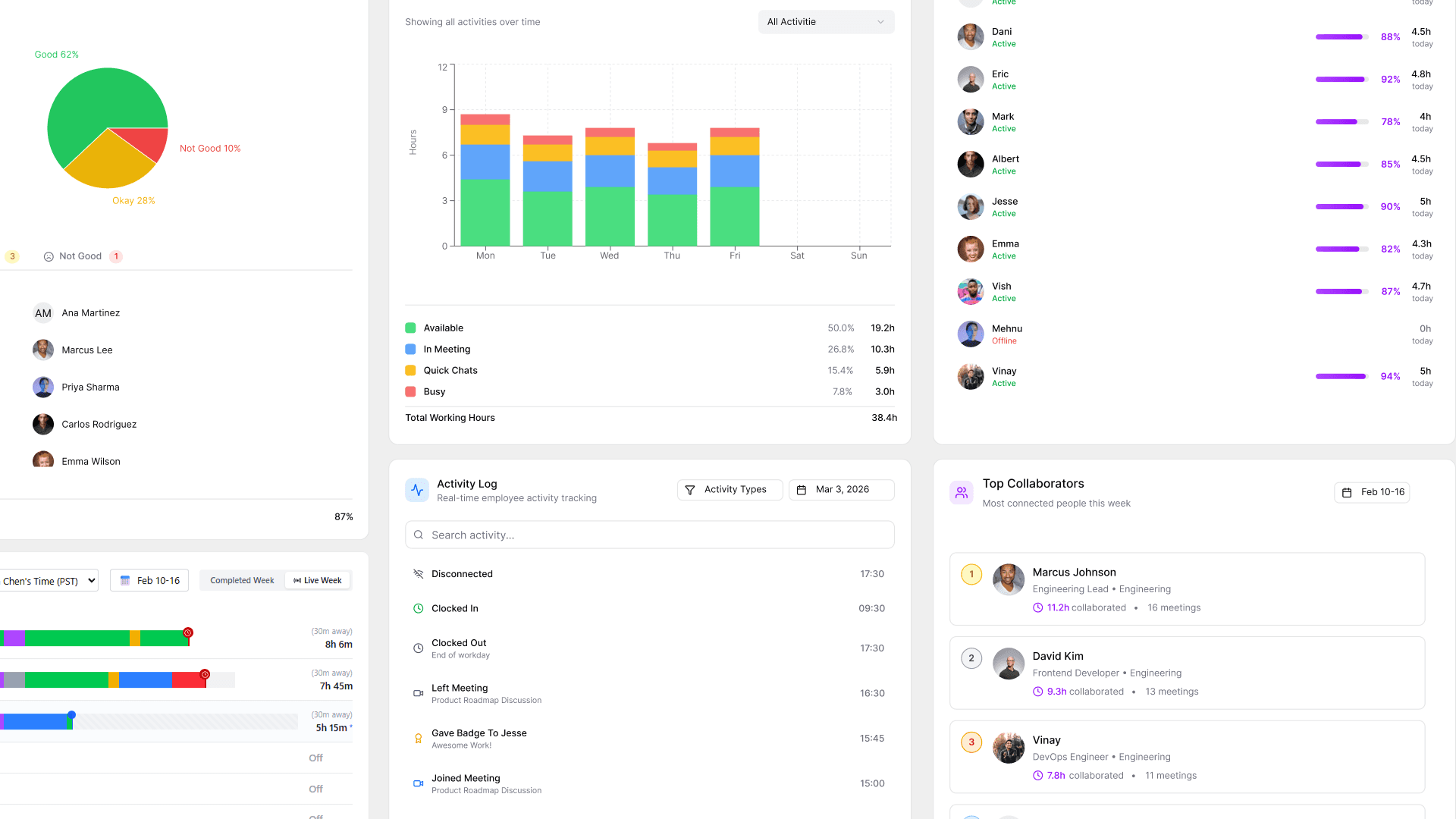
Remote Team Analytics: Complete Guide to Data-Driven Remote Work Management in 2026
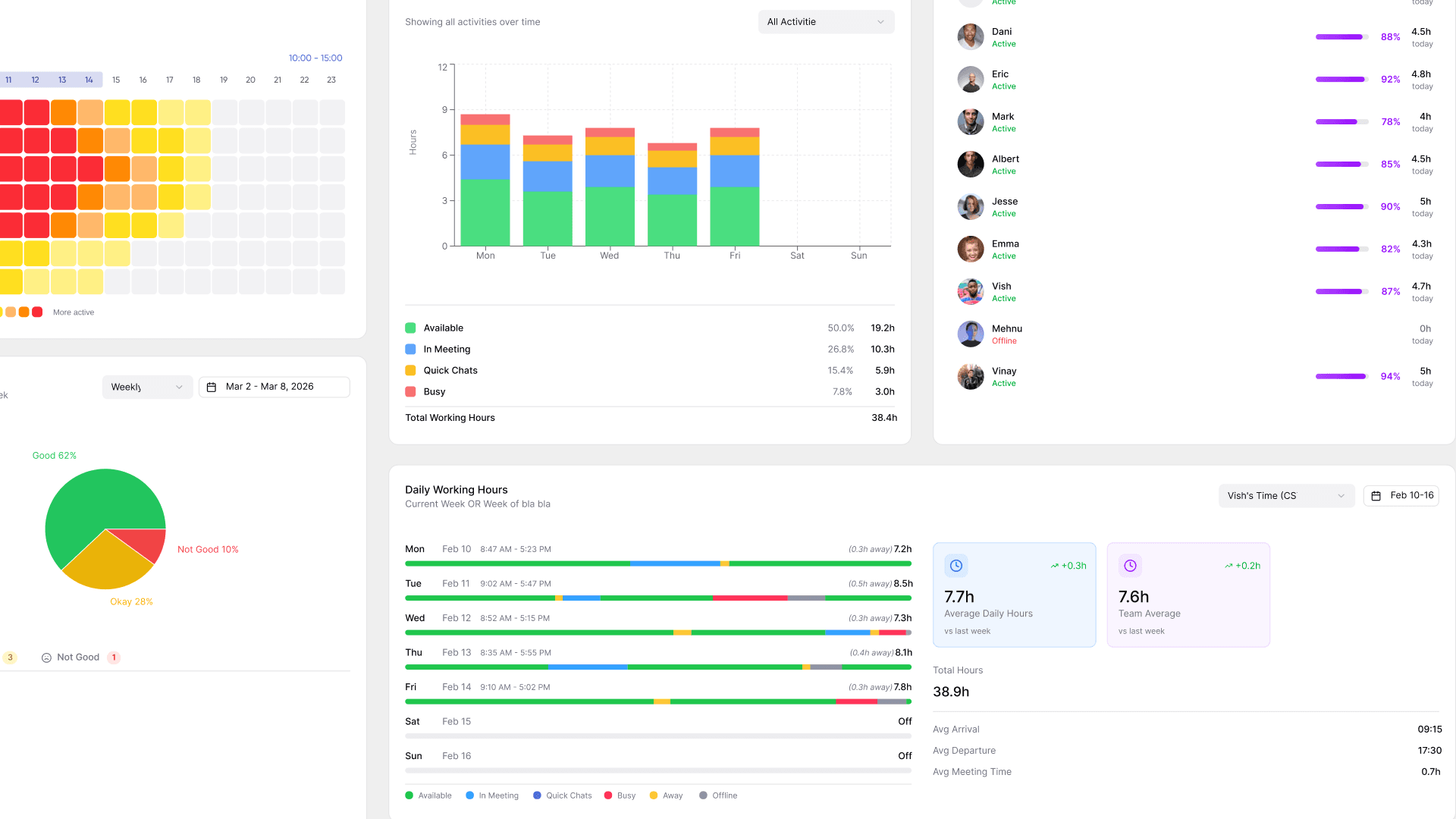
Complete Guide to Gaining Visibility Into Remote Team Performance and Collaboration