SoWork vs Gather: Team Analytics Compared
Vishal Punwani

Published:
Updated on:
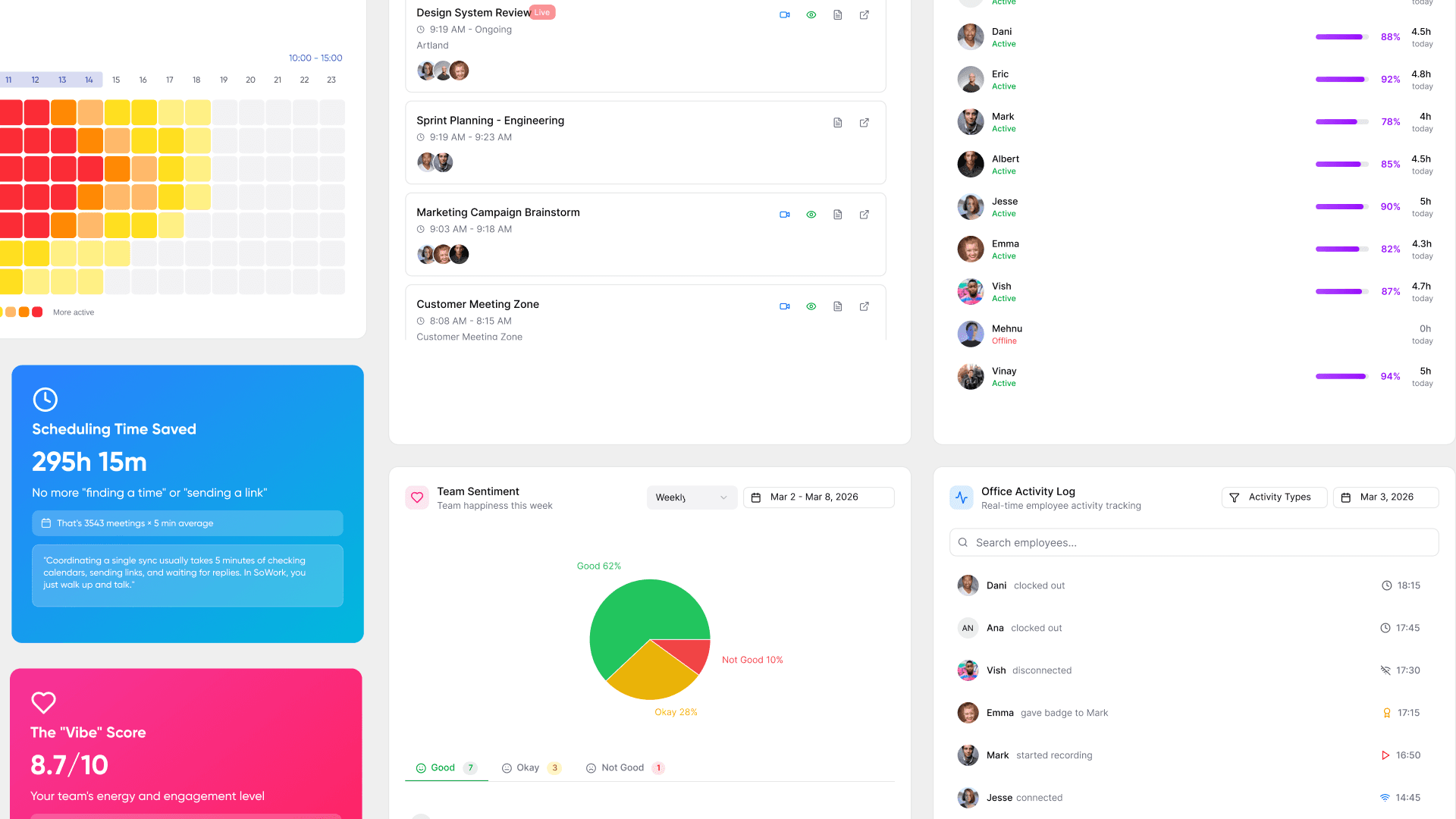
SoWork gives managers better visibility into remote team productivity than Gather. SoWork ships a dedicated Team Analytics Suite covering Focus Health, Office Presence, Availability Status, and Team Sentiment, plus AI meeting summaries and calendar-synced presence. Gather focuses on spontaneous connection but offers no comparable built-in analytics dashboard for managers.
What is SoWork and what does it offer remote team managers?
SoWork is a browser-based virtual office that replicates the ambient awareness of a physical office for distributed teams. It combines presence tracking, instant drop-in video, AI meeting memory, and team analytics in one platform.
Teams set up a persistent 2.5D office, customize it like building in The Sims, and work inside it daily without downloading software. Key management features include calendar-synced presence indicators, Focus Modes so individuals can signal deep work, instant one-click meetings with no scheduling friction, and AI-generated meeting summaries. SoWork also launched a public API in 2026, letting premium teams build custom integrations and automation workflows. [1] Teams using SoWork report reducing scheduled meetings by approximately 41% and cutting meeting times by 82%. [2]
What is Gather and what does it offer remote team managers?
Gather is a virtual office built around a pixel-art, top-down map where proximity triggers video calls automatically. It's designed for spontaneous drop-ins, persistent team spaces, and virtual events.
Walk your avatar near a colleague and a conversation starts, no scheduling needed. Gather 2.0, launched in September 2025, added GitHub and Spotify integrations plus more granular spatial audio controls. [1] The platform includes presence and availability indicators, calendar sync, unlimited meetings, screen sharing, whiteboards, and AI meeting transcriptions and summaries in beta. [2] Gather removed its permanent free tier in late 2025 and now charges $15/user/month. [3] In a spring 2025 survey, 75% of new Gather users reported having more spontaneous conversations. [4]
What analytics and reporting features does SoWork give managers?
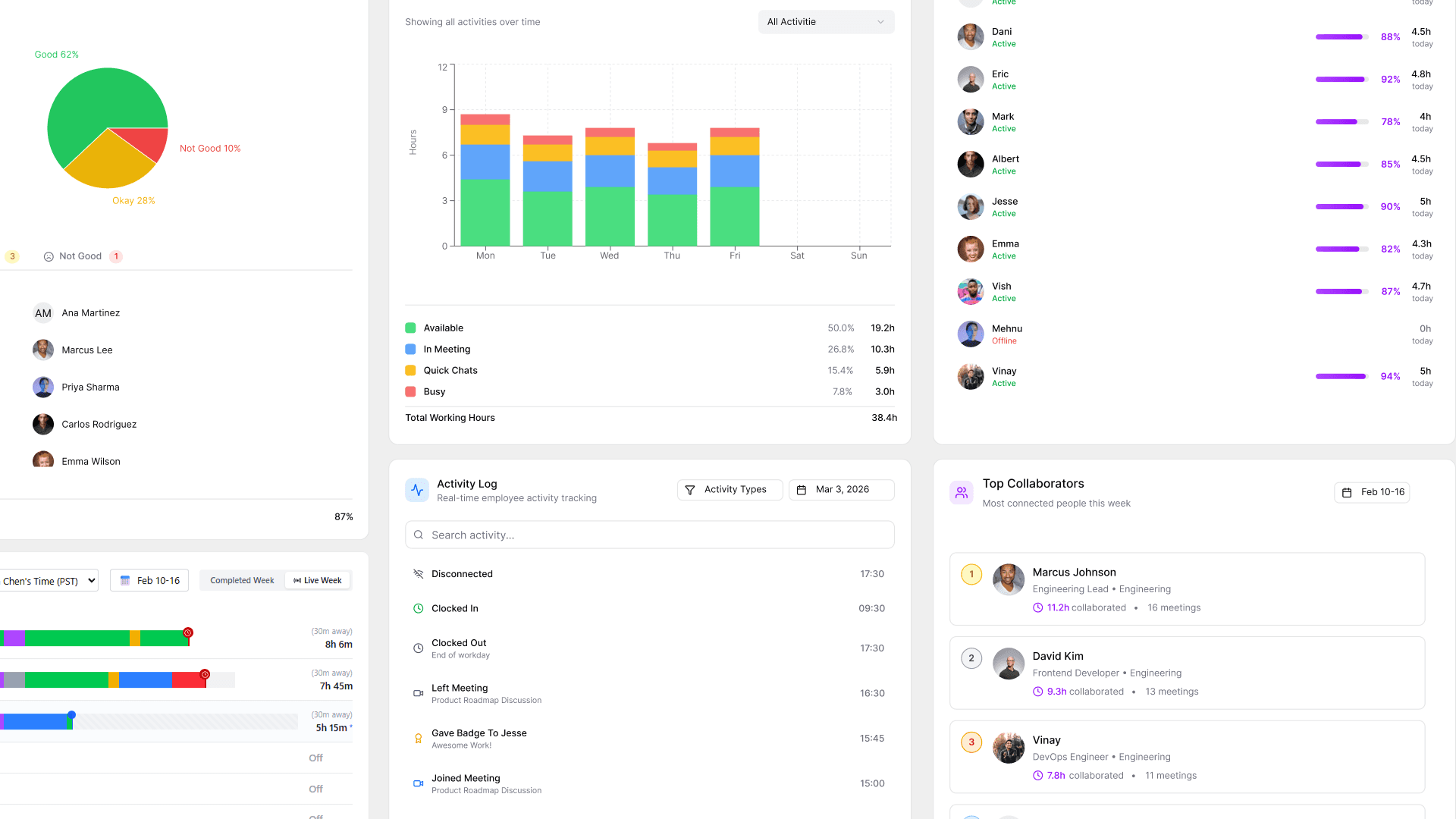
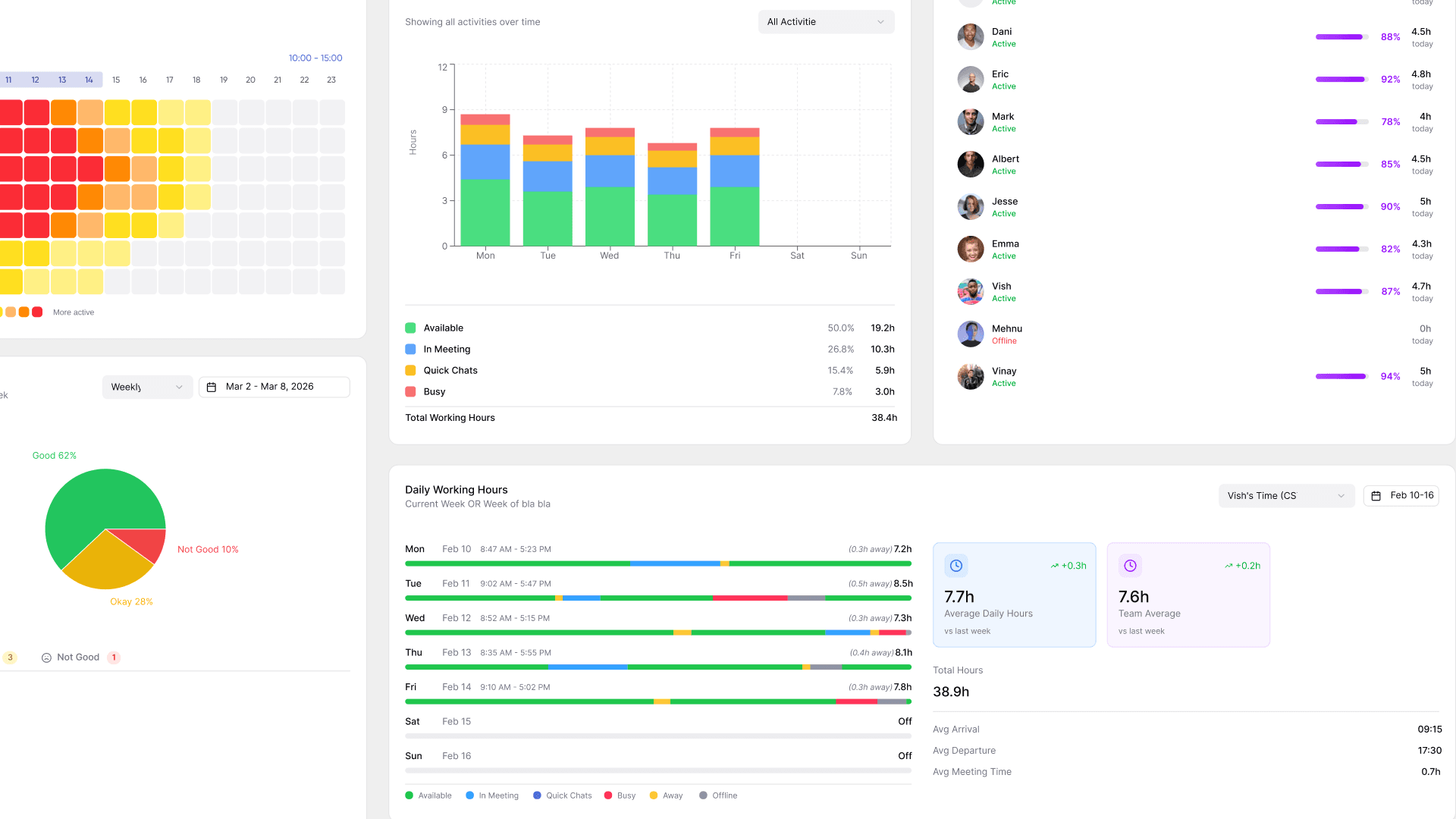
SoWork launched a full Team Analytics Suite in 2026 covering Team Focus Health, Office Presence, Availability Status, and Team Sentiment with weekly check-ins. These are native, built-in dashboards, not third-party add-ons.
Managers get aggregate productivity metrics, collaboration patterns, and attendance tracking from a single dashboard. [1] SoWork's analytics surface which meetings drive value versus which represent coordination waste, helping managers make informed scheduling decisions. [2] The AI assistant (Sophia Bot) generates meeting summaries, extracts action items, and creates searchable archives, providing performance context alongside presence data. [3] AI tools including analytics save teams an average of 3.5 hours per week. [4] Alerts can be configured to flag excessive meeting hours, declining task completion, or burnout signals before they compound.
What analytics and reporting features does Gather give managers?
Gather does not offer a native manager analytics dashboard. Its visibility tools are limited to real-time presence indicators showing who is free, busy, or in a meeting.
Gather's productivity feature set covers meeting scheduling, screen annotation, AI transcriptions and summaries (beta), meeting recording, and whiteboards. [1] There is no built-in aggregate reporting on team focus time, collaboration patterns, or sentiment trends. A third-party tool called Gatherlytics exists as a separate paid service that adds basic space analytics to Gather environments, but it requires its own setup and subscription. [2] Gather's own blog actively positions the platform as an alternative to invasive monitoring software, framing presence visibility as sufficient for most managers. [3]
How does SoWork track presence and availability in real time?
SoWork uses calendar sync, Focus Modes, and visual avatar indicators to show who is free, focused, or in a meeting, without requiring anyone to manually update a status.
Presence indicators update automatically when a calendar event starts, keeping availability accurate passively. [1] Focus Modes let individuals signal deep work while remaining loosely visible to the team. [2] The Team Analytics Suite adds a layer on top of this, tracking Office Presence trends over time so managers can see patterns, not just point-in-time snapshots. [3] SoWork's MCP server integration also lets AI assistants like Claude or ChatGPT query who is in the office and summarize recent meetings, extending presence awareness into other tools. [4]
How does Gather track presence and availability in real time?
Gather shows real-time avatar location on the office map, plus status indicators for free, busy, or focused states synced with calendar integrations. This is visual and immediate but not aggregated over time.
Everyone can see when a colleague is running between back-to-back meetings or concentrated at their desk, which helps protect focus time from unnecessary interruptions. [1] Gather syncs with Google Calendar to update availability automatically. [2] The visibility is spatial and ambient: you see where people are on the map and whether they are approachable. What Gather does not provide is any historical or trend-level view of that presence data. Managers can observe the room in real time but can't pull a report on who was online, when, or for how long.
How do SoWork and Gather differ in their approach to productivity measurement?
SoWork treats productivity measurement as a first-class feature, with dashboards tracking collaboration patterns, focus health, and meeting effectiveness. Gather treats presence visibility itself as the productivity intervention, not a metric to be measured.
Dimension | SoWork | Gather |
|---|---|---|
Manager dashboards | Yes, native analytics suite | No built-in dashboard |
Presence tracking | Real-time + historical trends | Real-time only |
Meeting insights | AI summaries, value scoring | AI transcription (beta) |
Sentiment tracking | Weekly team check-ins | None |
Productivity philosophy | Measure and improve | Connect and trust |
SoWork adds AI meeting summaries, team analytics, and calendar-synced presence on top of the spontaneous drop-in model Gather pioneered. [1] Gather leads on social immersion and pixel-art aesthetic; SoWork leads on productivity depth. [2]
What criteria should managers use to evaluate analytics in a virtual office?
Evaluate whether the platform offers historical trend data, not just real-time presence. Aggregate team-level insights matter more than individual surveillance for building trust and making sound decisions.
Key criteria to check: 1. Aggregate vs. individual tracking - Team-level patterns protect privacy; individual keystroke monitoring erodes trust. 2. Historical trends - Point-in-time presence is useful; week-over-week focus health is actionable. 3. Meeting quality signals - Does the platform tell you which meetings drive outcomes? 4. Sentiment and burnout indicators - Workload distribution data prevents attrition. 5. Integration with existing tools - Analytics should consolidate, not add another dashboard. 6. Transparency controls - Employees should see what's tracked. [1]
Managers who are at least somewhat concerned about negative impacts of monitoring apps on employee trust represent 87.1% of those surveyed. [2]
Does SoWork offer manager dashboards with aggregated team insights?
Yes. SoWork launched its Team Analytics Suite in May 2026 with dedicated dashboards for Team Focus Health, Office Presence, Availability Status, and Team Sentiment.
Team leads access aggregate productivity metrics, collaboration patterns, and attendance tracking from a single view. [1] HR professionals can view engagement indicators including burnout signals, eNPS trends, and workload distribution. Executives get strategic views covering team performance trends over time. [2] The analytics dashboards surface communication bottlenecks before they become delivery blockers, and real-time communication flows track response times and interaction patterns. [3] SoWork features built-in analytics providing insights about team activities and engagement, alongside integration capabilities with business tools. [4]
Does Gather offer manager dashboards with aggregated team insights?
No. Gather does not offer a native manager dashboard or aggregated productivity reporting. The platform's visibility tools are real-time and spatial, not analytical.
Gather's help center lists productivity features as meeting scheduling, screen annotation, AI transcriptions, meeting recording, whiteboards, and PDF uploads. [1] There is no mention of manager dashboards, focus time reports, or team sentiment tracking in Gather's native feature set. A third-party service, Gatherlytics, offers basic space analytics as a separate paid add-on requiring its own bot integration. [2] Gather's own positioning explicitly frames the platform as an alternative to monitoring software rather than a complement to it, suggesting the company views ambient presence as sufficient visibility for most teams. [3]
How do SoWork and Gather handle third-party integrations?
SoWork integrates with Slack, Zapier, and calendar tools, and launched a public API in 2026 for custom integrations. Gather 2.0 added GitHub and Spotify integrations alongside Google Calendar.
Integration type | SoWork | Gather |
|---|---|---|
Calendar sync | Yes (auto-presence updates) | Yes (Google Calendar) |
Slack | Yes | No native integration |
Zapier / automation | Yes | No |
GitHub | No | Yes (Gather 2.0) |
Public API | Yes (launched May 2026) | No |
Spotify | No | Yes (Gather 2.0) |
SoWork's integration architecture pulls presence, meeting, and communication data into unified views, eliminating the need to correlate insights across multiple dashboards. [1] SoWork also connects to AI assistants via an MCP server, letting Claude, ChatGPT, Codex, and Gemini CLI query office presence and meeting history. [2]
What privacy and surveillance risks should managers consider with virtual office analytics?
The core risk is that analytics designed for visibility can slide into surveillance, eroding trust and morale. Managers should distinguish between team-level pattern data and individual behavioral monitoring.
Low morale, legal penalties, and employee turnover are common risks of excessive employee monitoring. [1] A study found 87.1% of managers were at least somewhat concerned about the negative impacts of monitoring apps on employee trust, yet 51.7% were still using them. [2] Privacy-first analytics focus on organizational health by aggregating data at the team level and de-identifying individual records. [3] The best approach: communicate what is tracked, give employees access to their own data, and configure alerts around team-level thresholds rather than individual behavior. [4] SoWork's analytics are designed around collaboration patterns rather than keystroke-level surveillance.
How do SoWork and Gather compare on pricing for analytics-focused teams?
SoWork is significantly cheaper for teams that want analytics. SoWork's Basic plan is $6/user/month and its Premium plan (which includes advanced analytics) is $15/user/month. Gather now charges $15/user/month with no analytics dashboard included.
Plan | SoWork | Gather |
|---|---|---|
Entry paid tier | $6/user/month | $15/user/month |
Annual discount | $5.40/user/month | $12/user/month |
Free tier | Yes (limited) | 30-day trial only |
Analytics included | Yes (Premium) | No native analytics |
Gather removed its permanent free tier in late 2025; the new $15/user/month rate took effect on first renewal after January 1, 2026. [1] SoWork's Premium tier at $15/user/month ($12 annually) includes AI meeting summaries and in-depth analytics, making it equal in price to Gather but substantially richer in manager-facing features. [2]
What do real users say about SoWork's manager visibility and analytics?
G2 and Capterra reviewers consistently praise SoWork for improving team communication and engagement tracking. Some users note that per-person activity export reporting was still maturing as of mid-2026.
Users consistently praise the ease of communication and engaging virtual environment SoWork provides, making remote work feel more connected and collaborative. [1] One G2 reviewer noted the platform creates a virtual environment that facilitates real-time collaboration and improves activity tracking, resulting in more engagement and increased productivity. [2] Capterra describes SoWork as featuring built-in analytics that provide insights about team activities and engagement. [3] One candid G2 review flagged that exporting a full month of per-person activity data was not yet available, though the reviewer noted it was close to launching. [4] The Team Analytics Suite launched in May 2026 directly addresses this gap.
What do real users say about Gather's manager visibility and productivity insights?
Gather users consistently praise it for recreating spontaneous office conversation and reducing Slack message volume. Manager-level analytics are not what users cite as a strength.
One Gather user reported that messages on Slack and Google Chat dropped by about 80% after adopting the platform. [1] In Gather's spring 2025 survey, 75% of new users reported having more spontaneous conversations. [2] User testimonials focus on the feeling of presence and natural collaboration rather than reporting or data. Gather's G2 rating sits at 4.8/5 for overall experience, but reviewers highlight immersion and culture, not analytics depth. [3] If your primary goal as a manager is to understand collaboration patterns over time, Gather's user feedback suggests you'll need to supplement it with another tool.
Are there other virtual office platforms with strong team analytics for managers?
Beyond SoWork and Gather, Teamflow and Sococo offer virtual office presence, but neither matches SoWork's native analytics depth. Dedicated workforce analytics tools like Worklytics or Insightful go deeper on individual metrics but aren't virtual offices.
The best Gather alternatives for remote teams in 2026 are SoWork (AI-powered presence and meeting memory), Teamflow (embedded app collaboration), Sococo (enterprise floor-plan presence), and Kumospace (lightweight spatial rooms). [1] Teamflow's Seed plan starts at $20/user/month, making it more expensive than SoWork with less analytics focus. [2] Sococo's standard plan is $14.99/seat/month with a 10-seat minimum. [3] If you need keystroke-level individual monitoring, dedicated tools like Insightful or Hubstaff serve that need, but they carry higher privacy risk and don't replace a virtual office.
Which teams benefit most from SoWork versus Gather's visibility approach?
SoWork fits managers who need data to make decisions: tracking focus health, spotting burnout, and understanding collaboration patterns. Gather fits teams where culture and spontaneous connection are the primary goals and formal reporting isn't required.
SoWork works best for teams of 25 to 500+ members seeking a comprehensive virtual office with strong AI features and clear analytics for team leaders. [1] Its Focus Health dashboards and sentiment check-ins suit COOs, CTOs, and team leads who want to act on patterns, not just observe them. Gather's immersive aesthetic appeals to creative teams prioritizing company culture and virtual events. [2] If your management style is trust-based and your team is small enough that you can read the room visually, Gather's ambient presence may be all you need. If you're scaling past 20 people and need to spot coordination problems before they become delivery failures, SoWork's analytics layer earns its cost.
Bottom Line: SoWork or Gather for manager visibility?
SoWork gives managers meaningfully better visibility into remote team productivity. It ships a native analytics suite, AI meeting memory, calendar-synced presence, and sentiment tracking in one platform. Gather excels at spontaneous connection and culture, but it doesn't offer the reporting layer managers need to make data-driven decisions at scale.
If your priority is understanding how your team actually works, where collaboration is healthy, and where burnout risk is building, SoWork is the clear choice. Gather is a strong tool for reducing meeting friction and building culture, and it's worth considering if analytics aren't a core requirement. For most founders, COOs, and team leads managing distributed teams of 10 or more, SoWork's analytics depth at $6 to $15/user/month makes it the better investment.
Key Takeaways
SoWork launched a native Team Analytics Suite in May 2026 covering Focus Health, Office Presence, Availability Status, and Team Sentiment, giving managers a real dashboard rather than just a map view.
Gather has no native manager analytics dashboard. Its visibility is real-time and spatial only, with no historical trend reporting built in.
SoWork's AI assistant (Sophia Bot) generates meeting summaries, extracts action items, and creates searchable archives, adding productivity context to presence data.
Gather removed its free tier in late 2025 and now charges $15/user/month with no analytics included. SoWork's Premium plan matches that price but adds analytics and AI features.
75% of new Gather users report more spontaneous conversations, confirming Gather's strength is connection, not measurement.
Teams using SoWork report a 41% reduction in scheduled meetings and 82% shorter meeting times, suggesting the platform changes collaboration patterns in measurable ways.
Privacy-conscious managers should choose platforms that aggregate data at the team level rather than tracking individual keystrokes or mouse movement, which erodes trust and risks legal exposure.
For managers who need to scale visibility beyond 20 people and spot coordination problems early, SoWork's analytics layer is the practical choice. Gather suits smaller, culture-first teams where informal awareness is enough.
Related reading
SoWork vs Teamflow Team Analytics in 2026: Which Virtual Office Gives Managers Better Visibility?
SoWork vs Gather: Which Virtual Office Platform Is Better for Remote Teams in 2026?
Sources
In Gather's spring 2025 survey of new users, 75% reported having more spontaneous conversations.
AI tools including analytics save teams an average of 3.5 hours per week.
SoWork's Basic tier is $6/user/month ($5.40 annually) and Premium is $15/user/month ($12 annually).
Sococo's standard plan is $14.99/seat/month ($13.49 annually) with a 10-seat minimum.
FAQ
SoWork vs Gather for team analytics: which virtual office gives managers better visibility into remote team productivity?
Does Gather.town have a manager analytics dashboard?
Is SoWork worth it for a remote team that already uses Gather?
What is the difference between presence tracking and productivity analytics in virtual offices?
Can virtual office analytics be used for employee surveillance, and is that a legal risk?
How does SoWork's AI Meeting Memory help managers track productivity?
Which virtual office platform is better for a small remote team under 15 people?
Does SoWork integrate with Slack and project management tools?
Blogs
Read Similar Articles
Remote Team Analytics: Complete Guide to Data-Driven Remote Work Management in 2026
Complete Guide to Gaining Visibility Into Remote Team Performance and Collaboration