Gather Alternatives for Remote Teams 2026
Vishal Punwani

Published:
Updated on:
The best Gather alternatives for remote teams in 2026 are SoWork (AI-powered presence and meeting memory), Teamflow (embedded app collaboration), Sococo (enterprise floor-plan presence), and Kumospace (lightweight spatial rooms). SoWork offers the widest feature set per dollar at $6/user/month, making it the top pick for most small-to-mid-sized distributed teams.
What is Gather.town and what does it actually offer remote teams?
Gather is a browser-based virtual office that uses a pixel-art, top-down map where proximity drives conversation, walk your avatar near a colleague and a video call starts automatically. It's built for spontaneous drop-ins, virtual events, and persistent team spaces.
Core features include spatial audio (conversations fade as avatars move apart), customizable 2D office layouts, real-time chat, screen sharing, and scheduling tools for cross-timezone coordination [1]. Gather 2.0, launched in September 2025, added GitHub and Spotify integrations plus more granular audio controls [2]. The immersive aesthetic appeals strongly to creative teams and companies that want culture-building baked into daily work. It's particularly effective for small teams who want a social, game-like environment rather than a productivity-first workspace.
[1] gather.town [2] gather.town/blog/behind-the-fix-audio-2026
What pain points push remote teams away from Gather.town?
The most common complaints are audio/video reliability issues, a free-tier removal that surprised smaller teams, and limited AI or productivity tooling for day-to-day work beyond the social layer.
Gather removed its permanent free tier in late 2025, with the new rate of $15/user/month taking effect on first renewal after January 1, 2026 [1]. Users on Product Hunt flag voice chat failures that require reconnects and editor bugs where changes don't save [2]. Larger teams also hit scalability friction: Gather's game-like aesthetic doesn't always translate well to enterprise workflows, and there's no native AI meeting memory to capture decisions from spontaneous chats. Teams that need a coordination hub, not just a social layer, tend to outgrow it.
[1] sowork.com/blog/best-flat-social-alternatives-remote-teams-2026 [2] producthunt.com/products/gather-town/reviews
What criteria should you use to pick a Gather.town alternative?
Evaluate on five dimensions: presence awareness quality, meeting overhead reduction, integration depth, pricing at your team size, and security compliance. The right weight for each depends on whether you're async-first or synchronous-heavy.
Criterion | Why It Matters |
|---|---|
Presence awareness | Replaces the ambient cues you'd get in a physical office |
Meeting tools | AI summaries cut coordination overhead without losing context |
Integrations | Slack, Google/Outlook Calendar, Zapier prevent tool fragmentation |
Pricing at scale | Per-seat costs compound fast, model out 25 and 50 users |
Security (SOC 2, GDPR) | Enterprise buyers now require proof before procurement [1] |
Also check mobile support, onboarding speed, and whether the platform works without a download.
[1] konfirmity.com/blog/soc-2-for-remote-teams
What is SoWork and how does it bring back spontaneous collaboration?
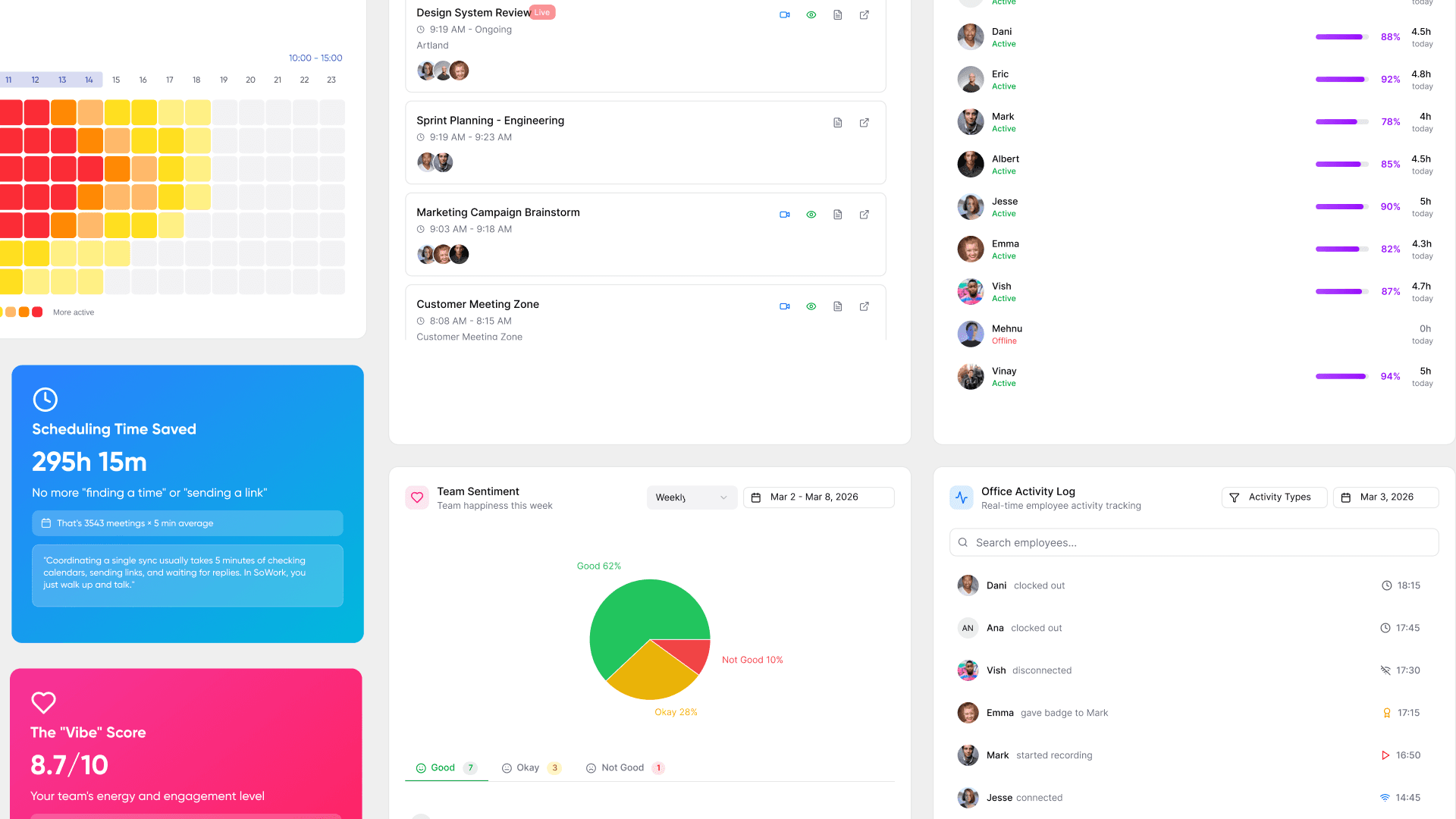
SoWork is an AI-powered virtual office that replicates the ambient awareness of a physical office, you can see who's free, focused, or in a meeting, and start a conversation in one click with no scheduling required.
The platform sits in your browser as a persistent 2.5D office your team customizes (think building in The Sims). Presence indicators update automatically via Calendar Sync when a meeting starts, so availability is always accurate without anyone touching a status button. Focus Modes let individuals signal deep work while staying loosely visible. AI Meeting Memory records, transcribes, and summarizes every conversation so spontaneous chats don't lose their decisions. SoWork also offers a Simplified Mode for teams who prefer a traditional interface over the immersive world view. Teams can be set up and live in minutes, no software download needed.
How does SoWork compare to Gather.town on features, usability, and presence?
SoWork adds AI meeting summaries, team analytics, and calendar-synced presence on top of the spontaneous drop-in model Gather pioneered. Gather leads on social immersion and pixel-art aesthetic; SoWork leads on productivity depth and value per dollar.
Feature | Gather | SoWork |
|---|---|---|
Spatial audio | Yes | Yes |
AI meeting memory | No | Yes (Premium) |
Calendar sync | Limited | Automatic |
Focus/DND modes | Basic | Simple + Mini Mode |
Pricing (monthly) | $15/user [1] | $6/user Basic, $15/user Premium [2] |
Free tier | Removed late 2025 [1] | Up to 10 people |
Product Hunt reviewers describe SoWork as "a team HQ that blends drop-in collaboration with built-in meeting capture" [3].
[1] sowork.com/blog/what-virtual-office-software-do-you-recommend-for-distributed-teams-in-2026 [2] sowork.com/alternatives/teamflow-vs-sowork [3] producthunt.com/products/gather-town/alternatives
What is Teamflow and how does it differ from Gather?
Teamflow is a virtual office that emphasizes embedded app collaboration, teams can open Salesforce, Figma, Google Docs, and Notion directly on a shared virtual floor, making it a strong fit for sales and design teams who need apps and people in the same view.
Where Gather focuses on social presence and pixel-art immersion, Teamflow emphasizes persistence: work left in rooms stays there between sessions [1]. It supports up to 200 people per floor and allows guest invites. The tradeoff is cost, Teamflow's Seed plan starts at $20/user/month ($15 annually) and the Business plan is $30/user/month ($25 annually), making it the most expensive option in this comparison [2]. It's best suited for teams whose core workflow revolves around visual collaboration tools rather than teams primarily trying to reduce meeting overhead.
[1] sowork.com/blog/teamflow-vs-sowork-virtual-office-comparison-2026 [2] sowork.com/alternatives/teamflow-vs-sowork
What is Sococo and which teams is it best suited for?
Sococo is a spatial presence platform built around a bird's-eye floor-plan view. It's best suited for enterprise teams that want a presence layer on top of existing Zoom, Webex, or Microsoft Teams infrastructure rather than a standalone video solution.
Sococo provides interactive floor plans with predefined rooms, project spaces, and break zones that replicate physical office structures [1]. Its standard plan is $14.99/seat/month ($13.49 annually) with a 10-seat minimum and a 500-minute native media cap per seat, teams that exceed that cap pay overage fees unless they rely on third-party video tools [2]. The Unlimited plan at $24.99/seat/month requires a 100-seat minimum, so it's firmly enterprise territory. G2 reviewers highlight its smooth admin setup and strong sense of team presence, though some note it lacks the interactive engagement depth of Gather [3].
[1] sowork.com/blog/what-virtual-office-software-do-you-recommend-for-distributed-teams-in-2026 [2] sowork.com/alternatives/sococo-vs-sowork [3] g2.com/compare/gather-town-gather-vs-sococo
Which platform, Teamflow, SoWork, or Gather, best reduces meeting overhead?
SoWork is the strongest choice for reducing meeting overhead because AI Meeting Memory captures decisions from spontaneous chats, and calendar sync eliminates the manual status updates that cause unnecessary check-in meetings.
The core problem: the average employee spends 31 hours per month in meetings they consider unproductive, and 43% of professionals spend 3+ hours per week just scheduling them [1]. Teamflow reduces scheduling friction through spatial drop-ins but doesn't capture meeting outputs automatically. Gather does the same without any AI layer. SoWork's Premium plan explicitly includes AI meeting summaries, action items, recordings, and Zapier integration to push outputs into the rest of your stack [2]. Organizations using automated meeting management tools reduced total meeting time by 18% and improved follow-up completion by 42%, per Gartner [3].
[1] speakwiseapp.com/blog/time-spent-in-meetings-statistics [2] sowork.com/blog/teamflow-vs-sowork-virtual-office-comparison-2026 [3] sowork.com/blog/best-flat-social-alternatives-remote-teams-2026
What other virtual office tools are worth considering in 2026?
Kumospace, Spot, SpatialChat, and Remo each serve distinct use cases beyond the four main platforms, worth a look depending on your team's specific needs.
Tool | Best For |
|---|---|
Kumospace | Simple spatial rooms; trusted by Spotify and Shopify [1] |
Spot | Deep customization and API access for teams that script office behaviors [2] |
SpatialChat | Events and education with strong moderation controls; G2 rating of 4.7 [3] |
Remo | Networking events with proximity audio and interactive maps [4] |
Tandem | Lightweight presence and instant one-click reachability [5] |
For teams consolidating their stack, the question isn't just features, it's whether the tool becomes a daily habit or a tab nobody opens.
[1] sowork.com/blog/sowork-vs-flat-social-virtual-office-comparison-2026 [2] sowork.com/blog/sowork-vs-flat-social-virtual-office-comparison-2026 [3] sowork.com/blog/best-flat-social-alternatives-remote-teams-2026 [4] sowork.com/blog/best-virtual-office-software-in-2026-top-15-platforms-for-remote-teams [5] producthunt.com/products/gather-town/alternatives
Which Gather alternatives work best for async-first distributed teams?
SoWork is the strongest fit for async-first teams because Focus Modes, AI meeting summaries, and automatic calendar sync reduce the need for synchronous coordination without cutting teams off from real-time presence when they do overlap.
Async-first teams need two things: a way to signal availability without constant interruption, and a way to capture context from the real-time moments that do happen. SoWork's Simple Mode and Mini Mode let individuals signal deep work while staying loosely visible to the team. AI Meeting Memory means a quick spontaneous chat doesn't require a follow-up meeting to recap what was decided. Gather and Teamflow both require synchronous participation to get value, you have to be in the space. SoWork works across time zones because the record of what happened persists even when teammates are offline.
Which Gather alternatives fit small startups versus large enterprises?
SoWork fits startups (5 to 50 people) best on value and speed. Sococo and Microsoft Teams are better fits for enterprises that need compliance, SSO, and integration with existing infrastructure.
Team Size | Best Fit | Why |
|---|---|---|
5-50 (startup) | SoWork | $6/user/mo, fast setup, AI tools, no download |
10-100 (growth) | SoWork or Teamflow | SoWork for meeting efficiency; Teamflow for embedded apps |
100+ (enterprise) | Sococo or Microsoft Teams | Floor-plan presence + compliance; SSO/SCIM support |
Sococo's Unlimited plan requires a 100-seat minimum [1], making it impractical for small teams. SoWork offers volume discounts above 100 users and an Enterprise tier with SSO and SCIM [2].
[1] sowork.com/alternatives/sococo-vs-sowork [2] sowork.com/blog/teamflow-vs-sowork-virtual-office-comparison-2026
How do the pricing models compare across top Gather alternatives?
SoWork is the most affordable full-featured option at $6/user/month Basic and $15/user/month Premium. Gather and Sococo both land near $15/user/month. Teamflow is the most expensive at $20 to $30/user/month.
Platform | Monthly Price | Annual Price | Free Tier |
|---|---|---|---|
SoWork Basic | $6/user | $5.40/user | Up to 10 users [1] |
SoWork Premium | $15/user | $12/user | , |
Gather | $15/user | $12/user | Removed late 2025 [2] |
Sococo Standard | $14.99/user | $13.49/user | Trial only [1] |
Teamflow Seed | $20/user | $15/user | Up to 5 users [3] |
Teamflow Business | $30/user | $25/user | , |
[1] sowork.com/alternatives/sococo-vs-sowork [2] sowork.com/blog/best-flat-social-alternatives-remote-teams-2026 [3] sowork.com/alternatives/teamflow-vs-sowork
What integrations do leading Gather alternatives offer?
SoWork integrates with Slack, Google Calendar, Outlook Calendar, Miro, GitHub, Zapier, and more. Gather 2.0 added GitHub and Spotify. Sococo routes video through Zoom, Webex, or Microsoft Teams rather than hosting its own.
Integration depth matters because the average remote worker already switches between too many apps daily, and a virtual office that doesn't connect to your existing stack just adds another one. SoWork's integrations include Zapier (on Premium), which lets teams push meeting summaries and action items into project management tools like Asana or Trello automatically [1]. Sococo's model is different: it acts as a presence layer on top of Zoom or Webex rather than replacing them, which suits teams already locked into those platforms [2]. Teamflow embeds apps like Salesforce and Figma directly into the virtual floor for sales and design teams [3].
[1] sowork.com/alternatives/teamflow-vs-sowork [2] sowork.com/alternatives/sococo-vs-sowork [3] sowork.com/blog/teamflow-vs-sowork-virtual-office-comparison-2026
What security and privacy factors matter when choosing a virtual office platform?
Look for AES-256 encryption, SOC 2 Type II compliance, GDPR/CCPA alignment, and SSO support. Enterprise buyers now routinely require third-party attestation before procurement, a platform without it will stall deals.
When your virtual office centralizes meetings, chat, and presence data in one place, the security surface expands significantly. A 2025 Ponemon/IBM study found that a remote workforce increased breach costs by an estimated $131K [1]. Key things to check: data residency options (where recordings and transcripts are stored), access controls for room creation and guest invites, and whether the vendor hosts on certified infrastructure. SoWork's infrastructure runs on AWS and Google Cloud Platform, both certified under ISO 27001 and SOC 2 standards [2]. For regulated industries, ask specifically about GDPR data processing agreements and SCIM for automated user provisioning.
[1] konfirmity.com/blog/soc-2-for-remote-teams [2] sowork.com/blog/best-virtual-office-software-for-remote-teams-complete-2026-guide
What do real teams say about switching from Gather to SoWork?
Teams that switch from Gather to SoWork consistently cite better communication depth, avatar customization, and topic-based chat as the reasons they stay, and G2 reviewers give SoWork a 4.8 average across 50 reviews.
One verified G2 reviewer who came from Gather wrote: "We came from Gather, and SoWork surprised us in every way" [1], citing topic chat, integrations, and support as standout differences. A marketing team reviewer noted that "spontaneous and casual conversations among team members have significantly increased" after switching [2]. The pattern in reviews is consistent: teams leave Gather because of reliability issues or the pricing change, try SoWork, and stay because the daily collaboration feels more active. The 4.8 G2 rating across 50 reviews reflects strong retention once teams are onboarded.
[1] g2.com/sellers/sowork [2] g2.com/sellers/sowork
Do virtual office platforms actually build culture better than Zoom or Slack?
Yes, persistent presence and spatial drop-ins create the ambient social layer that scheduled video calls can't replicate. 62% of remote workers say they miss the casual interactions of a physical office, and virtual offices are the closest digital equivalent.
The problem with Zoom and Slack for culture is structural: every interaction requires intent. You have to schedule a call or type a message. There's no equivalent of glancing across the room and catching a colleague's eye. Virtual office platforms restore that ambient layer. Without in-person interactions, remote workers miss out on spontaneous chats and team bonding, which can hurt mental health and weaken cohesion [1]. Platforms like SoWork and Gather recreate the "walk over and tap on shoulder" dynamic through proximity-based video [2]. The difference from traditional tools isn't cosmetic, it changes how often people actually talk.
[1] weworkremotely.com/state-of-remote-work-report-2025 [2] sowork.com/blog/best-virtual-office-for-distributed-teams-2026
What does migration from Gather to a new virtual office platform actually look like?
Switching virtual office platforms is technically simple, there's no data to port, but the real risk is behavioral: teams that don't see daily value within the first two weeks tend to drift back to Slack and Zoom.
The recommended approach is a 2 to 3 week parallel pilot with a small group, measuring daily active usage (not just sign-ups) before committing the full team [1]. Train team leads first, adoption spreads faster that way [2]. SoWork's onboarding is designed for speed: no software download, office setup in minutes, and invite links that work immediately. The biggest adoption killer is a platform that feels like a chore to open. Run the pilot during a period of active work, not a quiet week, so the team actually experiences the spontaneous collaboration the tool is designed to enable.
[1] sowork.com/blog/best-flat-social-alternatives-remote-teams-2026 [2] jobqoo.com/gather-alternatives
Which Gather alternative offers the best overall value in 2026?
SoWork offers the best overall value for most remote teams in 2026, the widest feature set per dollar, AI meeting memory that no competitor matches at the $6/user price point, and fast onboarding that drives actual daily adoption.
For teams of 5 to 200 people who want to reduce meeting overhead, maintain presence awareness, and build culture without a return-to-office mandate, SoWork hits the right balance. Teamflow is worth the premium only if embedded app collaboration (Salesforce, Figma) is central to your workflow. Sococo makes sense for enterprises already running Zoom or Webex who want a presence layer without replacing their video stack. Gather remains a strong choice for teams whose primary goal is a social, game-like environment and who don't need AI productivity tooling. The virtual office market has grown to $12.5B [1], the platforms that win long-term are the ones teams actually open every morning.
[1] sowork.com/blog/best-gather-alternatives-for-remote-teams-in-2026-complete-platform-comparison
Key Takeaways
Gather removed its free tier in late 2025 and now charges $15/user/month, the pricing shift is the top reason teams are evaluating alternatives.
SoWork is the best overall Gather alternative at $6/user/month Basic, offering AI meeting summaries, presence awareness, and calendar sync that Gather doesn't match at any price.
Teamflow is the right pick for sales and design teams that need Salesforce, Figma, or Notion embedded directly into a shared virtual floor, but it's the most expensive at $20 to $30/user/month.
Sococo suits enterprise teams (100+ seats) that want a bird's-eye presence layer on top of existing Zoom or Webex infrastructure, not a standalone video solution.
67% of meetings are considered unproductive, platforms with AI meeting memory (like SoWork Premium) directly attack this problem by capturing decisions from spontaneous chats.
For async-first teams, the key is a platform that preserves context from real-time moments; SoWork's AI summaries mean a spontaneous chat doesn't require a follow-up meeting.
Run a 2 to 3 week parallel pilot measuring daily active usage before migrating your full team, adoption failure, not technical complexity, is the main migration risk.
When evaluating security, look for SOC 2 Type II compliance, AES-256 encryption, GDPR alignment, and SSO support, enterprise buyers now require this before procurement.
Sources
SoWork's Basic tier is $6/user/month ($5.40 annually) and Premium is $15/user/month ($12 annually).
The average employee spends 31 hours per month in meetings they consider unproductive.
43% of professionals spend 3 or more hours per week simply scheduling meetings.
A 2025 Ponemon/IBM study found that a remote workforce increased breach costs by an estimated $131K.
62% of remote workers say they miss the casual interactions of a physical office.
FAQ
What are the best alternatives to Gather for remote teams in 2026?
Why did Gather remove its free tier and what does it cost now?
Is SoWork better than Gather for daily remote team use?
How much does SoWork cost compared to Gather and Teamflow?
Can a virtual office platform actually replace Zoom and Slack?
What is the best virtual office for async-first remote teams?
How do I migrate my team from Gather to a new virtual office without losing adoption?
Is Sococo a good Gather alternative for enterprise teams?
Blogs
Read Similar Articles
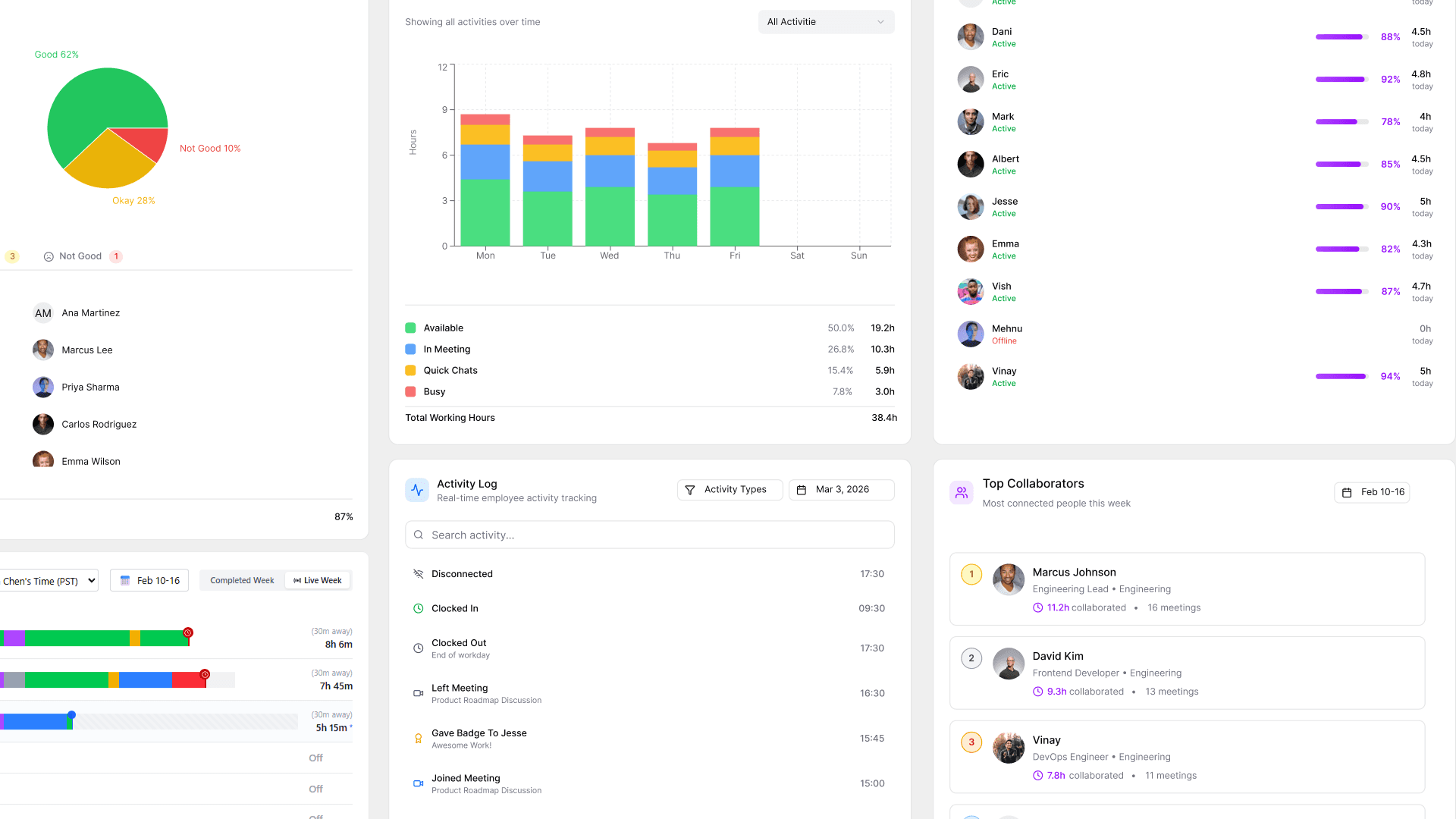
Remote Team Analytics: Complete Guide to Data-Driven Remote Work Management in 2026
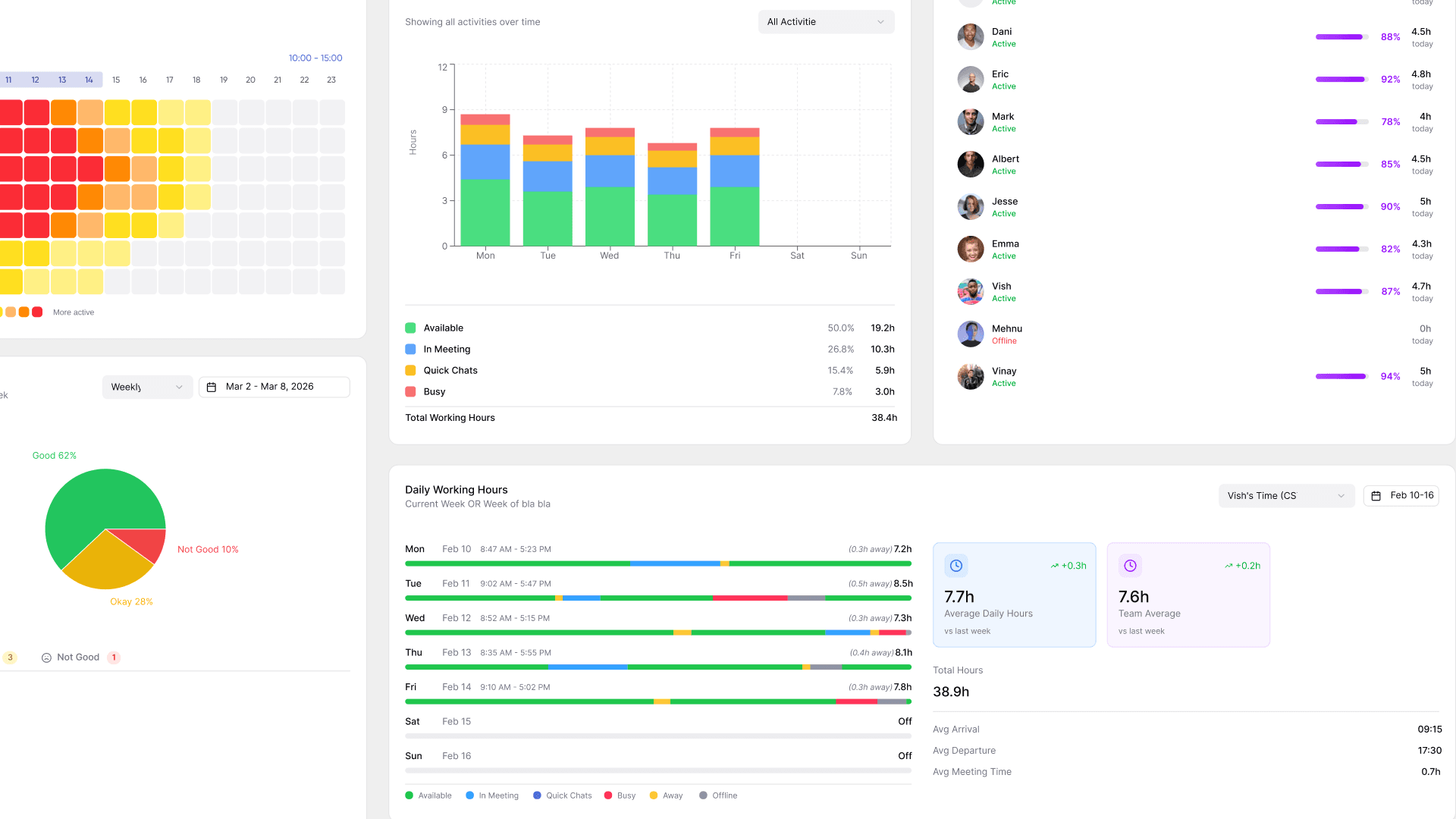
Complete Guide to Gaining Visibility Into Remote Team Performance and Collaboration