Best Flat.social Alternatives in 2026
Vishal Punwani

Published:
Updated on:
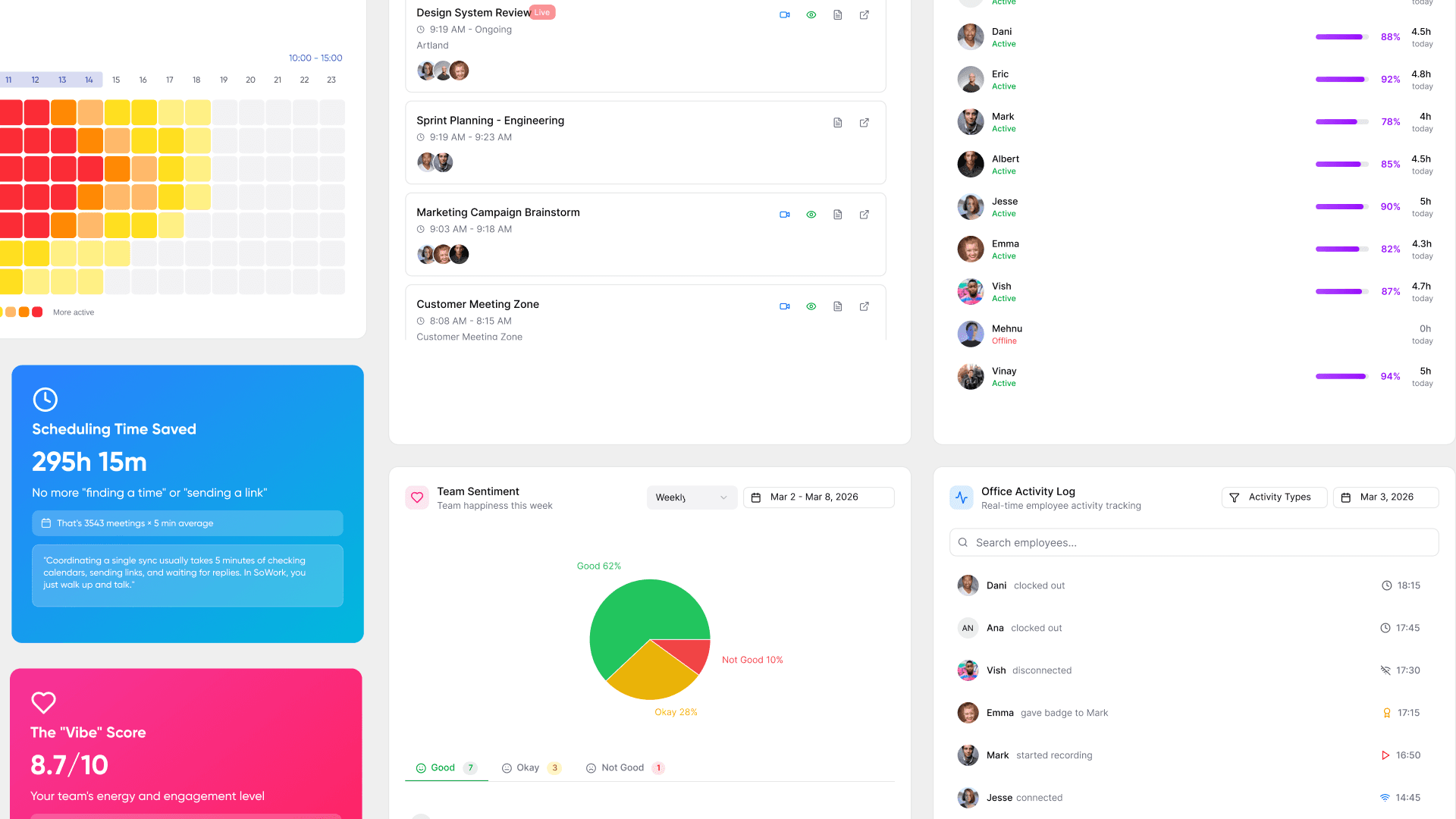
The best Flat.social alternative for remote teams in 2026 is SoWork, because it combines AI meeting memory, real-time presence awareness, and one-click instant meetings in a single platform, replacing not just Flat.social but also the Zoom and Slack overhead that surrounds it. Gather, Teamflow, and Sococo are strong runners-up for specific use cases.
What is Flat.social and what does it actually do?
Flat.social is a spatial virtual office where remote teams move avatars through customizable rooms using proximity-based audio and video, making conversations feel more natural than a standard video grid. It sits at the intersection of a video call, a multiplayer game, and a real-time whiteboard.
Core features include spatial audio and video, collaborative whiteboards with sticky notes, customizable virtual rooms, and a Slack integration that lets teams type /flat in any channel to launch a room instantly [1]. Flat.social explicitly positions itself as 'an addition for when the priorities switch from productivity to human interaction', not a full daily work hub. It has a permanently free plan, with Pro starting at $5 per user per month [2]. Guest access requires no account and no download, making it easy for one-off events or external participants.
Feature | Flat.social |
|---|---|
Spatial audio/video | Yes |
Whiteboard | Yes |
Slack integration | Yes |
AI meeting memory | No |
Presence awareness | Limited |
Daily work hub | No |
Why are teams switching away from Flat.social in 2026?
Flat.social is designed for events and social moments, not as a full-day work environment. Teams that need persistent presence awareness, AI meeting summaries, and calendar integration find it falls short as a daily operating hub.
Remote workers attend 80% more meetings per week than in-office workers [1], which means the tools that only handle social moments aren't enough. Flat.social's recording and deeper integrations sit behind paid tiers, and its own documentation says it's not meant to replace your existing stack. Teams that started with Flat.social for virtual happy hours eventually realize they still need a separate tool for daily coordination, and that's the gap they're trying to close. Meanwhile, 62% of remote workers say they miss the casual interactions of a physical office [2], so the bar for a replacement is high: it needs to handle both work and culture.
What should you look for when evaluating a Flat.social alternative?
Evaluate on five dimensions: presence awareness, spontaneous meeting friction, AI productivity tooling, integration depth, and pricing per seat. The platform your team opens every morning wins, not the one with the most features.
Criterion | Why it matters |
|---|---|
Presence awareness | Reduces 'are you free?' messages and scheduling overhead |
Instant meetings | One-click conversations replace calendar invites |
AI meeting memory | Captures decisions without follow-up emails |
Integrations | Must connect to your calendar, Slack, and existing tools |
Pricing | Sustainable at your team size without hidden minimums |
Onboarding speed | Slow setup kills adoption before it starts |
Unproductive meetings cost U.S. businesses $37 billion annually [1]. A platform that reduces coordination friction pays for itself fast, but only if your team actually uses it daily.
How does SoWork compare to Flat.social?
SoWork is a full-day virtual office built for daily work, while Flat.social is an event-focused social layer. SoWork adds AI meeting memory, automatic calendar sync, and persistent presence that Flat.social doesn't offer.
SoWork's standout features for ambient collaboration are real-time presence indicators, one-click Instant Meetings, AI Meeting Memory, and automatic calendar sync that keeps availability accurate without manual updates [1]. Organizations using automated meeting management tools reduced total meeting time by 18% and improved follow-up completion by 42% per Gartner [2]. SoWork is free for up to 10 users, with Basic at $6/user/month and Premium at $15/user/month [3], competitive against Flat.social's $5/user Pro tier, but with a far wider feature set. SoWork integrates natively with Google Workspace, Outlook, Slack, and Zapier [4], while Flat.social is more self-contained.
How does Gather.town compare to Flat.social?
Gather is the closest spatial alternative to Flat.social, both use proximity audio and avatar movement, but Gather is designed for persistent daily use, while Flat.social leans toward events. Gather holds a 4.8/5 on G2 from 327 reviews.
Gather's 2D pixel-art map, proximity audio, and customizable rooms are similar to Flat.social's approach [1]. Gather 2.0, launched in September 2025, added GitHub and Spotify integrations plus more granular spatial audio controls [2]. The key pricing shift: Gather removed its permanent free tier in late 2025, with the Essential plan now at $15/user/month (billed monthly) or $12/user/month (billed annually) [3]. That change pushed smaller teams to look elsewhere. Gather suits culture-focused teams that want a game-like environment and don't need AI productivity tooling [4]. It supports 25+ integrations including Google Meet and Slack [5].
How does Teamflow compare to Flat.social?
Teamflow offers a polished spatial office with embedded app collaboration, Salesforce, Figma, Google Docs, making it the best fit for sales and design teams. It's the most expensive option at $20/user/month on the Seed plan.
Teamflow provides one-click meetings with strong screen sharing and virtual whiteboards for brainstorming sessions [1]. Its Google Docs embeds enable real-time collaboration within the spatial environment [2]. Unlike Flat.social, Teamflow is built for daily work rather than social events. The tradeoff is cost: Teamflow's Seed plan is $20/user/month ($15 annually) and the Business plan is $30/user/month ($25 annually) [3], the highest price point of any major alternative. Teamflow is worth the premium only if embedded app collaboration is central to your workflow [4]. It requires synchronous participation to get value, so async-first teams may find it limiting.
How does Sococo compare to Flat.social?
Sococo is an enterprise-grade floor-plan presence layer that sits on top of Zoom or Webex, not a replacement for them. It's the right pick for large organizations that want visual office presence without rebuilding their video stack.
Sococo offers the most realistic office floor-plan simulation with dedicated rooms, instant door-knock features, and visual presence across departments [1]. It integrates with Zoom, Webex, and Skype [2], which is its key differentiator from Flat.social. Pricing is $14.99/seat/month ($13.49 annually) with a 10-seat minimum and a 500-minute native media cap per seat [3], that media cap is a recurring friction point in user reviews. Sococo's Unlimited plan requires a 100-seat minimum [4], making it impractical for small teams. G2 reviewers rate it 4.3/5 from 44 reviews, with mid-market teams making up 39% of its user base [5].
What other platforms are worth considering as Flat.social alternatives?
Beyond SoWork, Gather, Teamflow, and Sococo, the next-tier alternatives include Kumospace, SpatialChat, and Spot, each with a distinct niche.
Platform | Best for | Key differentiator |
|---|---|---|
Kumospace | Social events and culture | Illustrated rooms; trusted by Spotify and Shopify [1] |
SpatialChat | Community and education | 4.7/5 on G2 from 130+ reviews; media embeds [2] |
Spot | Developer teams | Deep API customization and scriptable office behaviors [3] |
Remo | Virtual events | Table-based networking format |
Kumospace uses illustrated office designs and focuses on social interaction. SpatialChat supports movable avatars, proximity audio, and multi-role access. Spot leans hard into programmability for teams that want to script office behaviors [4].
Which alternative is best for cutting meeting overhead and enabling spontaneous collaboration?
SoWork is the strongest choice here. Its Instant Meetings, presence indicators, and AI Meeting Memory are specifically built to eliminate the scheduling friction that drives meeting fatigue in remote teams.
The average employee spends 31 hours per month in meetings they consider unproductive [1], and 43% of professionals spend 3 or more hours per week just scheduling meetings [2]. SoWork attacks both problems: presence indicators show who is free, focused, or in a meeting in real time, and Instant Meetings let you start a conversation in one click, no links, no calendar invite. AI Meeting Memory automatically records, transcribes, and summarizes every meeting so decisions don't get lost and you don't need a follow-up meeting to recap [3]. Focus Modes (Simple Mode and Mini Mode) let individuals signal deep work time without going dark to the team [4].
Which platform is best for building remote culture and presence awareness?
SoWork and Gather both excel at culture and presence, but in different ways. SoWork gives you persistent, work-integrated presence all day. Gather gives you a more social, game-like environment that teams enjoy but may not use for actual work.
62% of remote workers say they miss the casual interactions of a physical office [1]. SoWork's customizable virtual office lets teams design their space and avatars to reflect company culture, similar to building in The Sims, while presence indicators replicate the ambient awareness of walking past someone's desk [2]. Gather's pixel-art aesthetic and proximity audio create a fun, social environment that G2 reviewers describe as 'more engaging and interactive than traditional video conferencing' [3]. For culture-building events specifically, Kumospace and Flat.social remain strong options. For day-to-day culture that builds through actual work moments, SoWork's persistent presence wins.
Which platform fits small teams versus large distributed teams?
SoWork fits small-to-mid teams (5 to 200 people) best on value and speed. Sococo and enterprise tools suit larger organizations that need compliance, SSO, and existing infrastructure integration.
Team size | Best fit | Reason |
|---|---|---|
5 to 50 people | SoWork | Free up to 10 users; fast onboarding; AI features at $6/user [1] |
50 to 200 people | SoWork or Gather | Both scale well; Gather suits culture-first teams [2] |
200+ people | Sococo or Teamflow | Floor-plan presence or embedded app collaboration [3] |
Enterprise (500+) | Sococo | SSO, compliance, Zoom/Webex integration; 100-seat minimum [4] |
Sococo's 10-seat minimum and 100-seat Unlimited plan minimum make it impractical for very small teams. Teamflow's $20/user entry point is hard to justify below 20 seats.
How do the pricing models compare across top Flat.social alternatives?
SoWork offers the widest feature range per dollar, with a free tier and paid plans from $6/user/month. Teamflow is the most expensive. Gather removed its free tier in late 2025, making SoWork the strongest free-to-paid value play.
Platform | Free tier | Paid (monthly) | Paid (annual) |
|---|---|---|---|
SoWork | Yes, up to 10 users | $6 / $15 per user | $5.40 / $12 per user [1] |
Flat.social | Yes | $5 per user | , [2] |
Gather | 30-day trial only | $15 per user | $12 per user [3] |
Teamflow | No | $20 per user | $15 per user [4] |
Sococo | No | $14.99 per user | $13.49 per user [5] |
Gather removed its permanent free tier in late 2025 [3], which pushed smaller teams to look elsewhere. Sococo's 10-seat minimum adds a floor to its effective cost.
What are the real risks of switching from Flat.social?
The main risks are adoption failure, a short-term productivity dip during transition, and losing the social habits your team built around Flat.social's event-focused format. The technical migration is simple, there's usually no data to port.
Switching virtual office platforms is less technically complex than migrating a project management tool [1]. The real risk is behavioral. If your team used Flat.social mainly for happy hours and team socials, a productivity-first platform may feel less fun at first [2]. Counter this by running both tools in parallel for two to three weeks, letting the new platform prove its daily value before retiring the old one [3]. Measure daily active usage, not just sign-ups, during the pilot. Teams that adopt collaboration platforms with usage rates above 75% report 42% fewer communication gaps [4], so the goal is genuine daily habit, not a one-week spike.
What do real users say about these platforms?
Gather leads on G2 with a 4.8/5 from 327 reviews. SoWork users cite AI meeting summaries and presence awareness as the features that most change daily workflow. Sococo reviews highlight floor-plan presence but flag the media minute cap as a friction point.
Gather's G2 reviewers say it 'excels in creating a more engaging and interactive virtual workspace' with proximity conversations that 'feel lacking in traditional video conferencing' [1]. SoWork users specifically call out AI meeting summaries and presence awareness as the features that most change daily workflow [2]. Sococo's G2 reviews praise ease of setup and the floor-plan office feel, but flag the 500-minute native media cap per seat as a recurring friction point [3]. SpatialChat holds a 4.7/5 from 130+ G2 reviews [4]. Teamflow earns praise for its polished visual design but draws criticism for its price point relative to smaller teams' budgets.
How well do these platforms integrate with Slack, Zoom, and Google Workspace?
SoWork has the deepest integration stack for daily work tools, connecting natively with Google Workspace, Outlook, Slack, and Zapier. Flat.social has a Slack integration. Sococo integrates with Zoom and Webex. Gather integrates with Google Calendar.
Platform | Slack | Google Calendar | Zoom/Webex | Zapier |
|---|---|---|---|---|
SoWork | Yes | Yes | Via Zapier | Yes [1] |
Flat.social | Yes (slash command) | No | No | No [2] |
Gather | Yes | Yes | No | Limited [3] |
Sococo | No | No | Yes (native) | No [4] |
Teamflow | Yes | Yes | No | Limited [5] |
SoWork's automatic calendar sync updates your status when a calendar event starts, keeping availability accurate without manual input [1]. Sococo's Zoom and Webex integration is its strongest differentiator for enterprise teams already invested in those stacks [4].
How should you migrate your team from Flat.social to a new platform?
Run a 2-to-3 week parallel pilot with a small group first. Measure daily active usage, not sign-ups. Only retire Flat.social once the new platform has proven daily habit.
Pick a pilot group of 5 to 10 people who are open to change and represent your typical use patterns.
Set up the new virtual office and connect your calendar and Slack integrations on day one, friction kills pilots.
Run both platforms in parallel for two to three weeks [1]. Don't force a hard cutover.
Track daily active usage, not just sign-ups. A tool people open every morning is the one worth keeping [2].
Gather feedback at week two. Address objections before rolling out to the full team.
Retire Flat.social only after the new platform has become a genuine daily habit.
There's no data to migrate, the transition is behavioral, not technical [3].
Key Takeaways
SoWork is the best all-around Flat.social alternative for remote teams in 2026, combining AI meeting memory, presence awareness, and instant meetings in one platform at $6/user/month.
Flat.social is designed for events and social moments, not as a full daily work hub, that's the core reason teams look for alternatives.
Remote workers attend 80% more meetings per week than in-office workers (Owl Labs, 2024), making friction-reduction features critical when choosing a replacement.
Gather is the closest spatial alternative to Flat.social but removed its free tier in late 2025; the Essential plan now starts at $12/user/month billed annually.
Teamflow suits sales and design teams needing embedded Salesforce and Figma collaboration but is the most expensive option at $20/user/month.
Sococo works best for enterprises already running Zoom or Webex who want a floor-plan presence layer, but has a 10-seat minimum and a 500-minute media cap.
The biggest migration risk is behavioral, not technical, run a 2-to-3 week parallel pilot and measure daily active usage before retiring Flat.social.
Organizations using automated meeting management tools reduced total meeting time by 18% and improved follow-up completion by 42% (Gartner, 2024).
Sources
Flat.social has a native Slack integration for launching rooms via slash command
Remote workers attend 80% more meetings per week than in-office workers (Owl Labs, 2024)
Unproductive meetings cost U.S. businesses $37 billion annually
SoWork pricing: free for up to 10 users, Basic at $6/user/month, Premium at $15/user/month
SoWork integrates natively with Google Workspace, Outlook, Slack, and Zapier
Teamflow Seed plan is $20/user/month ($15 annually); Business plan is $30/user/month ($25 annually)
Sococo holds a 4.3/5 on G2 from 44 reviews; mid-market teams make up 39% of its user base
The average employee spends 31 hours per month in meetings they consider unproductive
43% of professionals spend 3 or more hours per week simply scheduling meetings
Kumospace is trusted by companies including Spotify and Shopify for remote collaboration
Gather supports 25+ integrations including Google Meet and Slack
FAQ
What are the best Flat.social alternatives for remote teams in 2026?
Is Flat.social good enough for daily remote work, or do teams need a dedicated virtual office?
How does SoWork compare to Gather for remote teams in 2026?
Which virtual office platform is best for a small remote team of under 20 people?
Can a virtual office platform actually replace Zoom and Slack?
What is the risk of switching from Flat.social to a new virtual office platform?
Does Teamflow or Sococo integrate with Zoom and Google Workspace?
How much does it cost to switch from Flat.social to SoWork?
Blogs
Read Similar Articles
Remote Team Analytics: Complete Guide to Data-Driven Remote Work Management in 2026
Complete Guide to Gaining Visibility Into Remote Team Performance and Collaboration