SoWork vs Teamflow: Better Team Analytics?
Vishal Punwani

Published:
Updated on:
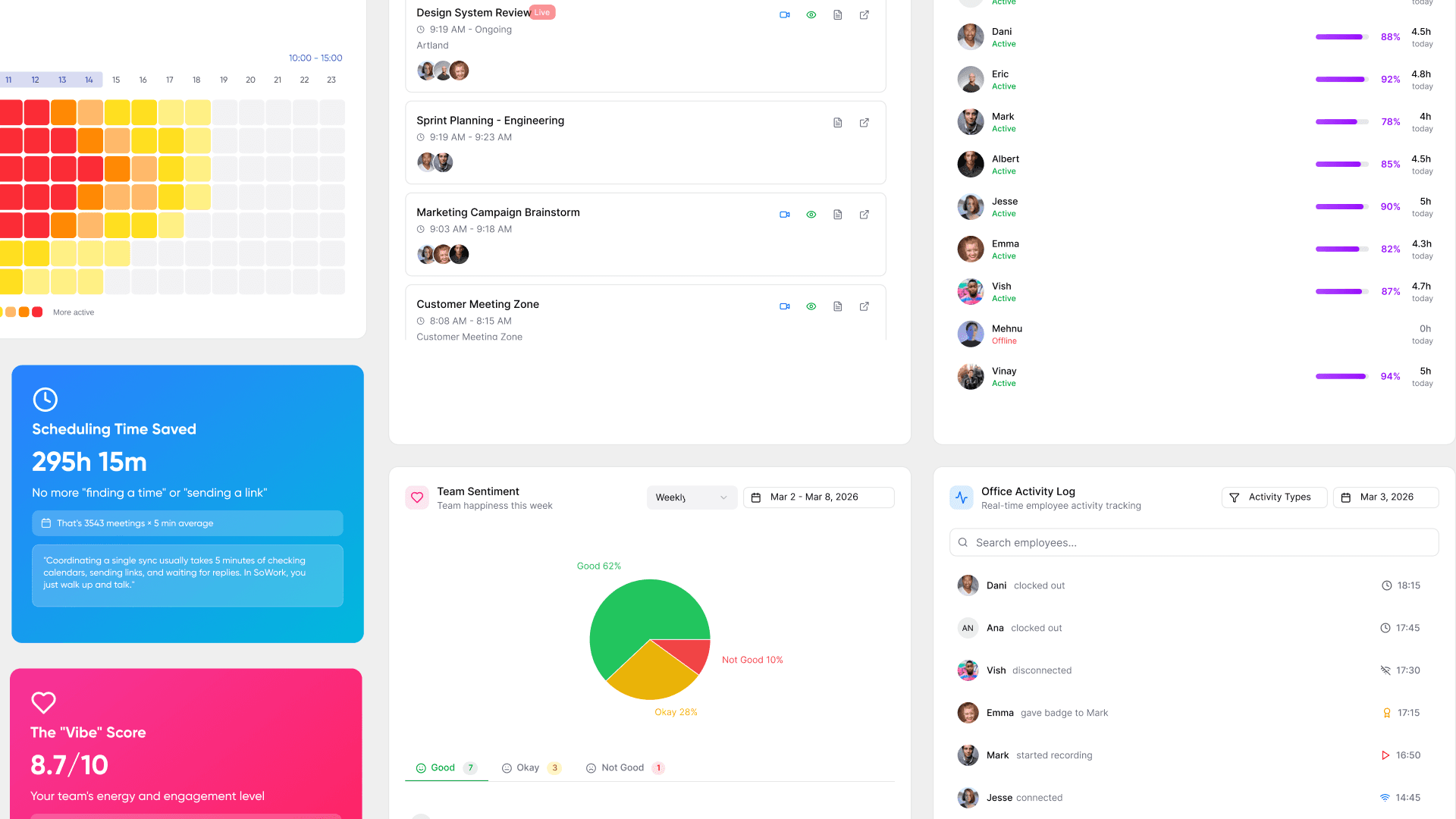
SoWork gives managers more structured analytics visibility than Teamflow in 2026. SoWork's Premium plan includes dedicated team analytics dashboards, AI-powered meeting summaries, calendar-synced presence data, and Zapier integrations. Teamflow focuses on spatial presence and embedded docs but lacks equivalent built-in analytics reporting for managers tracking productivity trends over time.
What Is SoWork and What Does It Offer Remote Managers?
SoWork is an AI-powered virtual office platform that replicates the ambient awareness of a physical office for remote teams. It combines presence, meetings, chat, and analytics into one workspace so managers don't need to juggle multiple tools.
SoWork positions itself as the operational hub that sits above tools like Google Workspace and Microsoft 365, the place where teams start their day, see who's available, and drop in for spontaneous collaboration [1]. Core features include Instant Meetings (one-click, no scheduling), automatic calendar sync, AI Meeting Memory via Sophia Bot (recording, transcription, summarization), Focus Modes for deep work, customizable office spaces, topic-based chat, and team analytics dashboards. Teams using SoWork report reducing scheduled meetings by approximately 41% and cutting meeting times by 82% [2]. SoWork rates 4.8/5 on G2 and holds a 92/100 Net Promoter Score [3].
What Is Teamflow and What Does It Offer Remote Managers?
Teamflow is a virtual office platform built around spatial audio and persistent rooms, designed to make remote work feel like sharing physical space. Its core value is immersive presence and embedded document collaboration rather than deep analytics.
Teamflow uses a floor-plan model where team members appear as video bubbles and can walk up to colleagues using proximity-based audio [1]. Key features include spatial audio, customizable office layouts, embedded apps (Google Docs, Figma, Asana, Salesforce), whiteboards, scratchpads, screen sharing, and meeting agendas [2]. Teamflow integrates with Slack and Zoom and supports app embedding directly in rooms [3]. It's well-suited for teams that want a persistent, always-on office feel with in-space document collaboration. However, Teamflow focuses on real-time presence and spatial meetings and is not typically the system of record for analytics or formal reporting [4].
What Analytics and Productivity Visibility Does SoWork Give Managers?
SoWork's Premium plan includes dedicated team analytics dashboards that surface attendance patterns, meeting habits, collaboration frequency, and engagement levels, giving managers structured data that goes beyond simple presence.
SoWork's analytics track engagement levels, meeting frequency, and login habits without being invasive, and these insights have been shown to boost team productivity by up to 15% [1]. The dashboards surface which meetings drive value and which represent coordination waste, helping managers make data-driven scheduling decisions [2]. Sophia Bot automatically generates meeting summaries, extracts action items, and builds a searchable meeting library, so managers can audit decisions without attending every call [3]. Analytics also uncover optimal collaboration times and show when teams naturally align [4]. These capabilities are gated behind the Premium plan at $15/user/month [5].
What Analytics and Productivity Visibility Does Teamflow Give Managers?
Teamflow's analytics capabilities are limited compared to SoWork. Its primary visibility mechanism is real-time spatial presence, managers can see who is in which room and whether conversations are happening, but it lacks dedicated productivity dashboards or AI-generated meeting summaries.
Teamflow's core manager-facing feature is visual presence: you can see your team on a floor plan, know who is in a meeting, and observe spontaneous interaction patterns [1]. Reviewers highlight that it reduces meeting scheduling times and improves staff availability visibility [2]. However, organizations prioritizing advanced analytics may find gaps in Teamflow's reporting capabilities and often still need separate tools for project management and formal performance tracking [3]. Teamflow's SOC 2 compliance is listed as 'coming soon,' which may matter to managers in regulated industries [4]. For structured productivity reporting over time, Teamflow's offering is thinner than SoWork's.
How Does SoWork Track Presence, Availability, and Activity?
SoWork uses automatic calendar sync, visual status indicators, and a real-time 'What's Happening' tab to give managers ambient awareness of who is free, focused, or in a meeting, without requiring manual check-ins.
Status updates automatically when a calendar event starts, keeping availability accurate without manual input [1]. The platform supports defined working hours so teammates know when colleagues are reachable, and Focus Mode temporarily signals deep work time [2]. The 'What's Happening' tab provides real-time visibility into team activity, and managers can see if someone is signed in but away from their desk [3]. G2 reviewers note that this solved the core management problem of knowing who is actually at work and when, without micromanaging [4]. Simple Mode and Mini Mode let individuals stay loosely connected without the full office view.
How Does Teamflow Track Presence, Availability, and Activity?
Teamflow tracks presence through its spatial floor plan, managers see team members as video bubbles in real time and can observe who is in which room, in a conversation, or working alone. There's no calendar-synced status or automated availability signal.
Teamflow's proximity-based audio model means conversations open automatically when avatars are near each other, mimicking walk-up office interactions [1]. Managers can visually observe which rooms are occupied and who is meeting with whom, a richer signal than a simple 'online' indicator [2]. The platform supports open areas, meeting rooms, and focused zones to separate collaboration modes [3]. However, Teamflow doesn't offer automatic calendar sync or AI-driven status updates. Presence awareness is real-time and visual but not aggregated into historical reporting, meaning managers get a live snapshot rather than trend data.
SoWork vs Teamflow: Which Gives Managers Better Real-Time Presence Awareness?
Both platforms provide real-time spatial presence, but SoWork adds calendar-synced status automation and a dedicated 'What's Happening' feed, making its presence layer more reliable for managers who need accurate availability data without asking people to update their status manually.
Feature | SoWork | Teamflow |
|---|---|---|
Calendar sync for status | Yes, automatic | No |
Visual floor plan | Yes | Yes |
Focus/DND mode | Yes (Simple + Mini Mode) | Partial (room types) |
'Away from desk' detection | Yes | No |
Historical presence data | Yes (analytics dashboard) | No |
Teamflow's spatial model is immersive and natural, but its presence signals are purely real-time. SoWork's calendar integration means status reflects actual calendar state, reducing false 'available' signals that frustrate managers of distributed teams.
What Reporting and Dashboard Capabilities Does SoWork Offer Over Time?
SoWork's Premium plan includes team analytics dashboards that aggregate meeting frequency, collaboration patterns, engagement levels, and attendance data over time, giving managers a longitudinal view of how their team works, not just a live snapshot.
The dashboards surface team productivity trends including meeting frequency, duration, and effectiveness scores alongside tool usage analytics [1]. Managers can identify bottlenecks in workflows and measure context-switching frequency that erodes focus time [2]. AI-generated meeting summaries are stored in a searchable meeting library, creating an audit trail of decisions and action items [3]. Through Zapier connections, meeting action items push directly into project management tools, connecting the analytics layer to actual work outputs [4]. Calendar sync provides meeting load analytics, and chat history surfaces communication patterns, all within one platform rather than across fragmented tools [5].
What Reporting and Dashboard Capabilities Does Teamflow Offer Over Time?
Teamflow does not offer dedicated productivity reporting dashboards or longitudinal analytics for managers. Its reporting capability is essentially the live visual floor plan, useful for real-time awareness but not for tracking trends across days, weeks, or months.
Teamflow's design centers on real-time collaboration rather than historical data collection. Managers can observe who is present and active right now, but the platform lacks the structured analytics layer that would let them review meeting load trends, collaboration frequency, or engagement patterns over time [1]. Third-party reviewers note that organizations prioritizing advanced analytics often look for alternatives that provide these capabilities more robustly [2]. Teamflow complements rather than replaces project management and reporting tools [3]. For managers who need trend data, Teamflow would need to be paired with a separate analytics tool, adding the tool fragmentation it's supposed to reduce.
Which Platform Better Surfaces Spontaneous Collaboration Data to Managers?
Teamflow's spatial audio model is arguably better at enabling spontaneous interactions in the moment, but SoWork is better at capturing and surfacing data about those interactions afterward through AI summaries and analytics.
Teamflow's proximity audio means hallway conversations happen naturally, team members walk up and talk without creating a meeting link [1]. These interactions are visible on the floor plan in real time but leave no data trail for managers to review later. SoWork also enables spontaneous walk-up interactions and additionally logs collaboration patterns, meeting frequency, and engagement trends in its analytics dashboards [2]. SoWork's Sophia Bot captures even informal meetings as summaries and action items [3]. For managers who want to understand not just whether collaboration is happening but how often and between whom, SoWork's data layer provides the edge. Teamflow shows you the moment; SoWork shows you the pattern.
How Do SoWork and Teamflow Compare on Third-Party Integrations?
SoWork offers broader workflow integrations including Zapier, Slack, Google Calendar, Microsoft Outlook, Miro, and GitHub. Teamflow integrates with Slack, Zoom, and embeds apps like Google Docs, Figma, Asana, and Salesforce directly into rooms.
Platform | Key Integrations |
|---|---|
SoWork | Slack, Zapier, Google Calendar, Outlook, Miro, GitHub, Notion |
Teamflow | Slack, Zoom, Google Docs, Figma, Asana, Salesforce (embedded) |
SoWork's Zapier connection is particularly useful for managers: meeting action items can push directly into project management tools automatically [1]. Teamflow's embedded app approach is strong for in-meeting collaboration, you can work on a Figma file or Asana board without leaving the room [2]. SoWork's integration depth is better for workflow automation and analytics pipelines; Teamflow's is better for in-session document collaboration.
How Should Managers Evaluate Productivity Visibility vs. Surveillance?
Meaningful productivity visibility focuses on outcomes, collaboration patterns, and meeting effectiveness, not keystrokes, screenshots, or minute-by-minute activity logs. The distinction determines whether analytics build trust or erode it.
Effective remote analytics should focus on outcomes rather than hours worked, emphasizing project completion and collaboration frequency as key indicators [1]. Research from MIT Sloan and UC San Diego found that surveillance alone had no significant effect on productivity, what mattered was managerial clarity and communication about monitoring practices [2]. Managers should look for platforms that track meeting load, engagement trends, and collaboration frequency at the team level rather than individual behavior surveillance. Transparency is critical: 85% of workers say employers should be legally required to disclose when monitoring tools are in use [3]. SoWork's approach tracks engagement and collaboration patterns without invasive individual monitoring.
What Privacy and Trust Risks Come With Manager-Facing Analytics?
Over-monitoring breaks down trust, increases employee stress, and ultimately lowers the productivity it aims to protect. The key risk is treating presence data as a proxy for performance, a mistake that damages culture faster than any tool can fix it.
Monitoring can negatively affect employee morale, trust, and retention, particularly where employees perceive constant surveillance or lack transparency about how data is collected [1]. In one study, 43% of employees said monitoring negatively affected company morale [2]. Over 73% of employers now monitor remote or hybrid workers, yet 72% of employees disagree that it improves productivity [3]. The legal risk is real too: several U.S. states including California, Connecticut, and New York impose notice or consent requirements for electronic monitoring [4]. SoWork's analytics are designed around collaboration patterns and meeting effectiveness rather than individual keystroke-level surveillance, which keeps it on the right side of this line. Transparency about what's tracked and why is non-negotiable.
How Do SoWork and Teamflow Pricing Compare for Analytics Features?
SoWork is significantly cheaper than Teamflow, especially for teams that need analytics. SoWork's analytics are included in its $15/user/month Premium plan, while Teamflow's Business plan, which unlocks unlimited apps, runs $25/user/month billed annually.
Plan | SoWork | Teamflow |
|---|---|---|
Free tier | Up to 10 users | Up to 5 users, 45-min limit |
Entry paid | $6/user/month | $15/user/month (Seed) |
Analytics tier | $15/user/month (Premium) | $25/user/month (Business) |
Enterprise | SSO, SCIM, custom pricing | Custom |
SoWork's Premium plan includes recordings, AI summaries, analytics, and Zapier at $15/user/month [1]. Teamflow's analytics capabilities are not explicitly tiered the same way, its Business plan at $25/user/month unlocks unlimited apps [2]. For a 25-person team needing analytics, SoWork costs $375/month vs. Teamflow's $625/month, a 67% premium for Teamflow.
What Do Real Users Say About SoWork Analytics for Manager Visibility?
G2 reviewers and SoWork testimonials consistently highlight that the platform solved the core manager problem of knowing who is at work and when, while the analytics dashboards provide visibility that physical offices can't match.
One verified G2 reviewer noted that their team made it a procedure to sign into SoWork whether in office or remote, so managers could see availability in real time, and that the fun interface made adoption easy even for employees resistant to monitoring tools [1]. SoWork testimonials describe managers being able to see who is available without micromanaging, and analytics dashboards offering visibility that physical workplaces cannot replicate [2]. The platform's interactive features and customization options create a sense of presence and community, which reviewers say significantly improved communication, productivity, and team morale [3]. SoWork holds a 4.8/5 rating on G2 across verified reviews [4].
What Do Real Users Say About Teamflow for Manager Visibility?
Teamflow user reviews focus primarily on the quality of presence and spontaneous collaboration rather than manager-facing analytics. Users consistently praise how the platform makes teams feel connected, but specific analytics-driven productivity improvements are not a prominent theme in reviews.
G2 reviewers describe Teamflow as making teams feel truly connected, with one reviewer noting it made the 'virtual meeting world feel like something of the past' and helped recover work culture [1]. Another reviewer highlighted that reducing meeting scheduling times and improving staff availability visibility were the most significant benefits [2]. However, reviewers also flag a desire for more user management settings and note that Teamflow works best as a complement to existing tools rather than a standalone analytics solution [3]. The consensus: Teamflow excels at presence and spontaneous collaboration but isn't the tool managers reach for when they need productivity trend data.
What Other Virtual Office Platforms Offer Strong Manager Analytics?
Sococo, Gather, and Kumospace are the main virtual office alternatives. For deeper workforce analytics beyond virtual offices, platforms like ActivTrak and Insightful specialize in productivity dashboards, though they carry higher surveillance risk.
Sococo targets enterprise organizations with analytics dashboards, compliance-focused features, and admin controls for large teams [1]. Gather offers immersive 2D workspaces with spatial audio and a free tier for up to 25 users, though its analytics depth is limited [2]. Kumospace focuses on spatial audio and visual presence but has not materially expanded its analytics features and appears to be in maintenance mode as of 2026 [3]. For dedicated workforce analytics, ActivTrak and Insightful offer productivity dashboards with workload balance insights, though these carry greater surveillance risk and should be deployed with clear employee communication policies [4]. SoWork remains the strongest combination of virtual office presence and built-in analytics for most remote teams.
SoWork vs Teamflow: Which Fits Your Team Size and Management Style?
SoWork is the better choice for managers who need structured productivity visibility, AI-assisted meeting documentation, and analytics dashboards. Teamflow fits teams that prioritize immersive spatial presence and in-session document collaboration over longitudinal reporting.
SoWork works best for teams of 25 to 500+ members where managers need clear analytics for participation, productivity, and meeting effectiveness, and where AI meeting summaries reduce coordination overhead [1]. Its free tier supports up to 10 users, making it accessible for early-stage startups. Teamflow suits smaller, creative, or developer-focused teams that want an always-on office feel with embedded tools and spatial audio, and where the manager's primary need is knowing who is present right now rather than reviewing trend data [2]. If your management style leans toward outcome-based coaching with data to back it up, SoWork's analytics layer is the practical choice. If you want your team to feel like they're sharing a room, Teamflow delivers that experience well.
Key Takeaways
SoWork's Premium plan ($15/user/month) includes dedicated team analytics dashboards, AI meeting summaries, and Zapier integrations, Teamflow has no equivalent built-in analytics layer.
Teamflow excels at real-time spatial presence and in-session document collaboration but doesn't aggregate productivity data over time for manager reporting.
SoWork's automatic calendar sync keeps availability status accurate without manual updates; Teamflow relies on visual floor-plan presence only.
Teams using SoWork report a 41% reduction in scheduled meetings and 82% shorter meeting times through walk-up spatial interactions.
SoWork is significantly more affordable for analytics-focused teams: $15/user/month vs. Teamflow's $25/user/month Business plan.
Over-monitoring erodes trust, 43% of employees say monitoring negatively affects company morale. Both platforms are better than invasive surveillance tools, but SoWork's analytics are explicitly designed around collaboration patterns, not individual behavior tracking.
For managers who need trend data, Teamflow must be paired with a separate analytics tool, adding the tool fragmentation both platforms are supposed to solve.
Sococo, Gather, and ActivTrak are worth evaluating as alternatives if neither SoWork nor Teamflow fits your team's specific size or compliance requirements.
Sources
FAQ
SoWork vs Teamflow team analytics: which virtual office gives managers better visibility into remote team productivity?
Does Teamflow have analytics or reporting features for managers?
Is SoWork analytics invasive or surveillance-based?
How much does SoWork cost compared to Teamflow for a team of 25?
Can SoWork replace Slack and Zoom for a remote team?
Which virtual office platform is better for small teams under 15 people?
What are the privacy risks of using virtual office analytics tools?
Is Teamflow good for developer teams specifically?
Blogs
Read Similar Articles
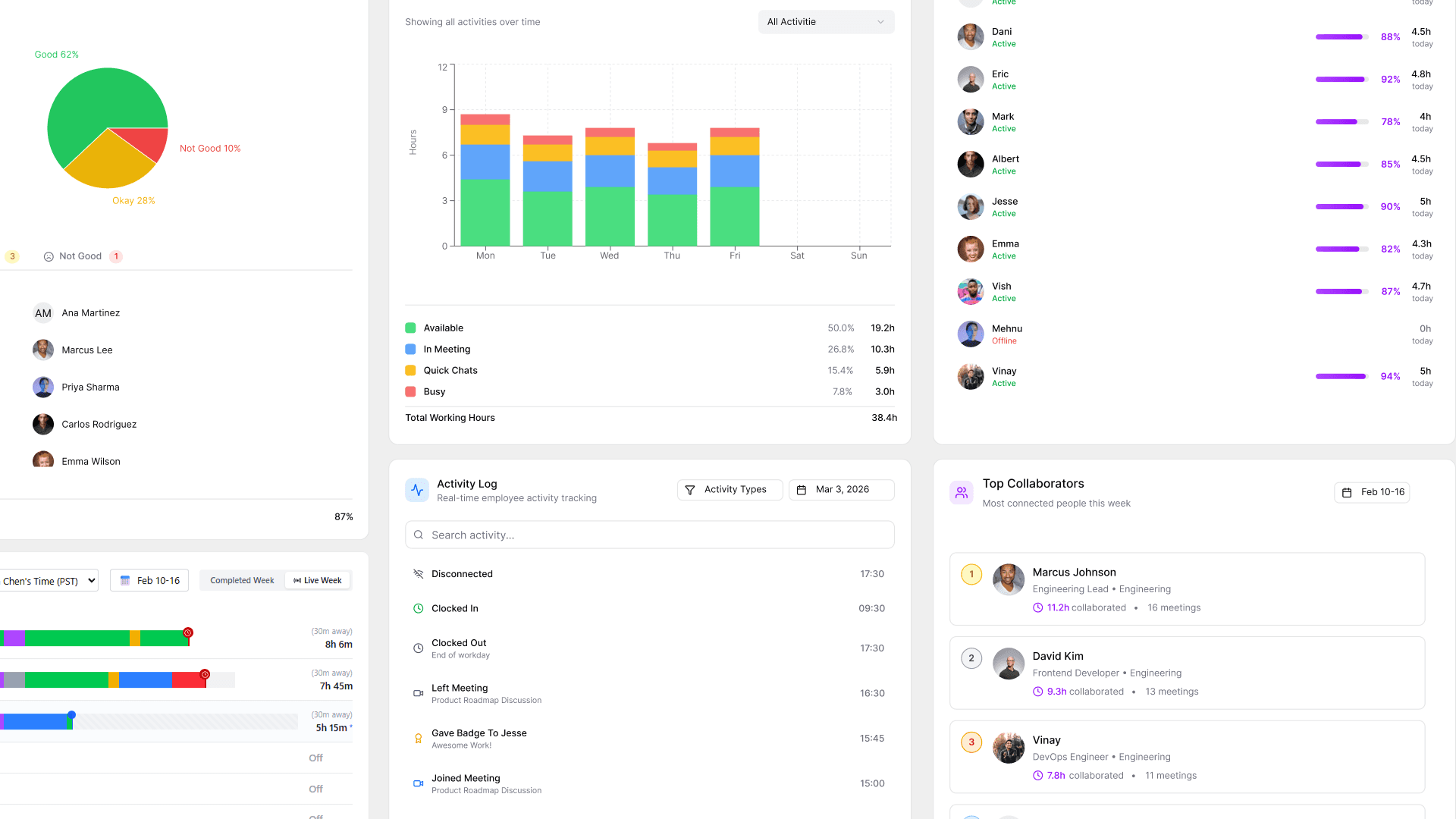
Remote Team Analytics: Complete Guide to Data-Driven Remote Work Management in 2026
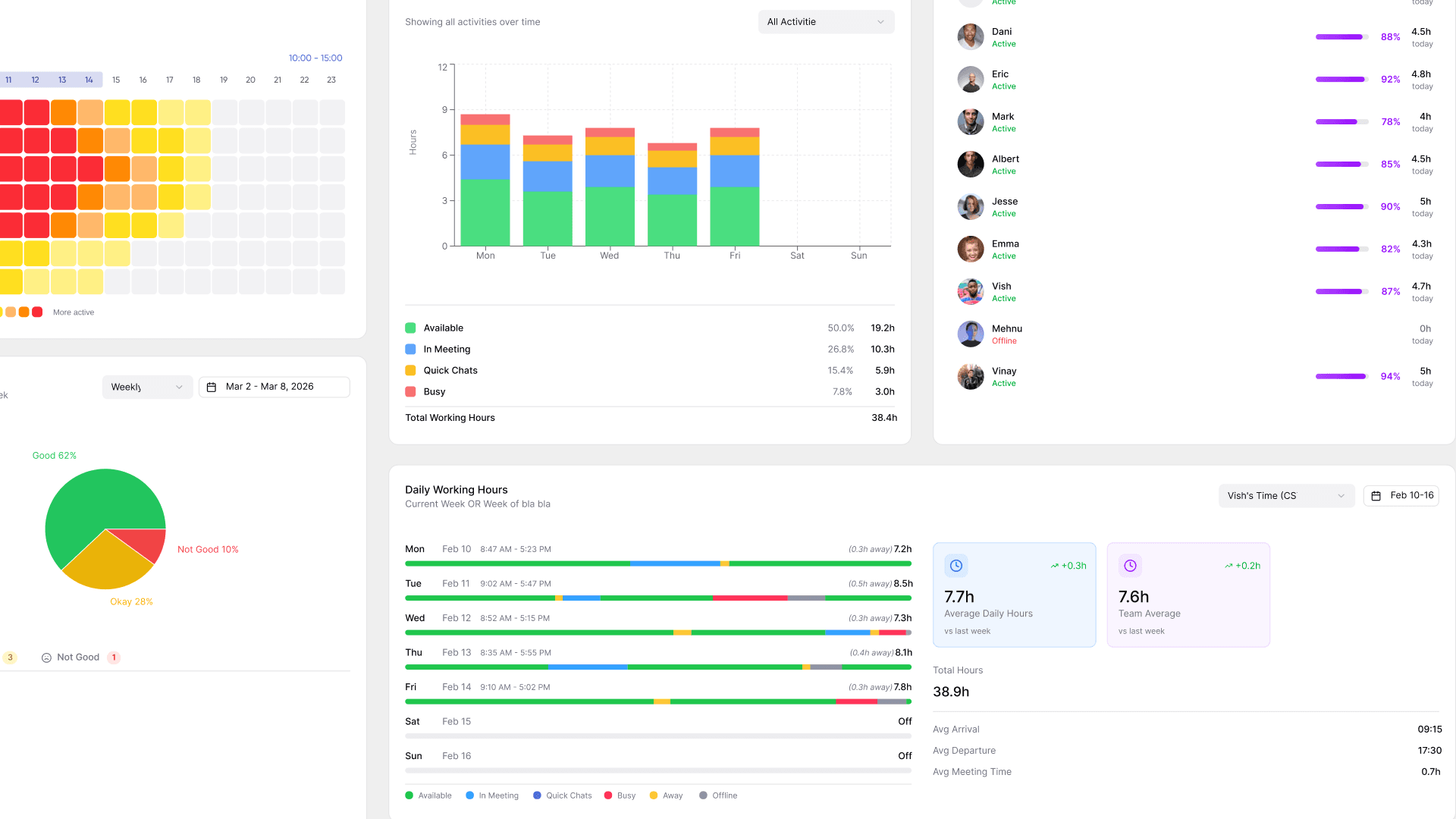
Complete Guide to Gaining Visibility Into Remote Team Performance and Collaboration