SoWork vs Gather: Best Virtual Office in 2026
Vishal Punwani

Published:
Updated on:
SoWork is the stronger choice for remote teams that need AI-powered meeting documentation, deep presence awareness, and a scalable all-in-one platform. Gather suits teams that want a simple, social virtual office with proximity audio and minimal setup. SoWork starts free for up to 10 users; Gather 2.0 starts at $12/user/month annually with no permanent free tier.
What Is SoWork and What Problem Does It Solve?
SoWork is an AI-powered virtual office platform that solves the coordination overhead and disconnection that plague remote teams relying on Slack and Zoom. It replaces the constant scheduling, link-sharing, and context-switching with a persistent digital workspace where presence, meetings, and chat all live in one place.
Remote employees now spend roughly 28% of their entire workweek in meetings, about 11.3 hours per week, and remote workers attend 50% more meetings than their in-office peers [1]. SoWork directly attacks that problem. Its Instant Meetings feature lets you start a conversation with one click, no calendar invite needed. AI Meeting Memory automatically records, transcribes, and summarizes every conversation. Automatic Calendar Sync keeps availability accurate without manual status updates. The result is a platform built to reduce meeting fatigue and rebuild the ambient connection that disappears when a team goes remote.
What Is Gather and What Problem Does It Solve?
Gather is a virtual office platform built around a 2D pixel-art map where teammates move avatars to trigger proximity-based conversations, no links, no scheduling. Its core problem to solve is the awkwardness and isolation of traditional video calls for remote teams.
Gather 2.0, launched in late 2025, rebuilt the platform from the ground up with real-time presence, AI meeting notes, and a simpler member-based pricing model [2]. Teams move through customizable office spaces and conversations start naturally as avatars get close, mimicking the feel of walking up to a colleague's desk. Gather holds a 4.8/5 rating on G2 from 317+ reviewers, frequently praised for making remote collaboration feel more personal and less transactional [3]. It's particularly strong for teams that want a social, game-like environment with minimal configuration.
How Does SoWork Replicate Spontaneous Office Collaboration?
SoWork replicates ambient office collaboration through real-time presence indicators, one-click Instant Meetings, and persistent visual availability, so you always know who's free without sending a message first.
The platform shows each teammate's status (free, focused, or in a meeting) on a shared office floor plan that updates automatically via calendar sync. You don't need to ask if someone is available, you can see it. Focus Modes let people signal deep work without going dark entirely. Simple Mode and Mini Mode keep individuals loosely connected without the visual weight of a full avatar map. This combination of ambient awareness and frictionless entry into conversations is what SoWork users most often cite as the feature that changes their daily workflow [4].
How Does Gather Replicate Spontaneous Office Collaboration?
Gather uses proximity-based spatial audio so that conversations start automatically as avatars move near each other, the closest digital equivalent to walking up to someone's desk.
When your avatar enters another person's range on the 2D map, audio and video activate without any button press. Move away and the call fades out naturally. Gather also supports "overhear" functionality in Gather 2.0, letting you catch the edge of a nearby conversation and jump in with a click [5]. Interactive objects like whiteboards, TVs, and games turn casual drop-ins into brainstorming sessions. One Gather user reported that messages on Slack and Google Chat dropped by about 80% after adopting the platform [6], a strong signal that proximity-based interaction genuinely replaces async pileup.
SoWork vs Gather: Presence Awareness and Team Visibility
Both platforms show real-time availability, but SoWork's presence system is more automated and data-rich, while Gather's is more visual and spatially intuitive.
Feature | SoWork | Gather |
|---|---|---|
Auto calendar sync | Yes | Yes |
Status types | Free, Focused, In Meeting | Free, Busy, Focus Mode |
Team analytics dashboard | Yes (Premium) | Limited |
Spatial map view | 2.5D immersive + Simple Mode | 2D pixel-art map |
Live App Status (what you're working on) | No | Yes (Gather 2.0) [5] |
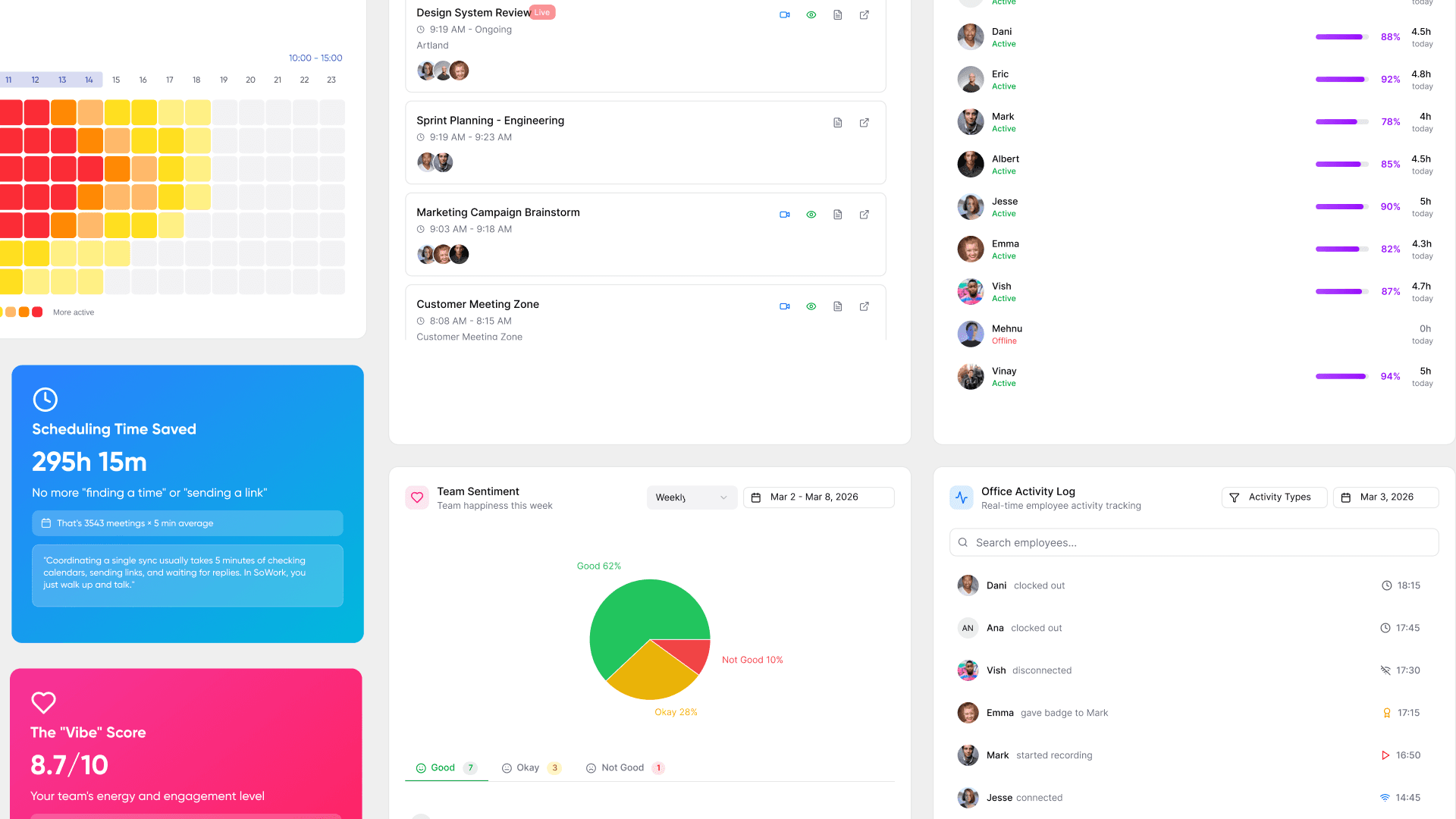
SoWork's analytics layer gives team leads visibility into participation patterns over time, useful for managers who need more than a snapshot of who's online right now.
SoWork vs Gather: Video and Audio Quality
Both platforms offer built-in spatial video and audio, but SoWork adds AI meeting documentation on top of every call, while Gather's proximity audio is more refined for spontaneous drop-in conversations.
SoWork includes screen sharing, spatial video calls, and AI-generated transcripts and summaries automatically, no add-on required. Gather's proximity audio is its standout feature: conversations fade in and out naturally as avatars move, which feels more organic than clicking to join. Gather 2.0 also added AI meeting notes to close that gap [5]. One practical caveat: some SoWork users note that built-in video isn't quite as polished as dedicated tools like Google Meet or Zoom [7], though SoWork also supports bringing your own Zoom or Webex account at no extra cost.
SoWork vs Gather: Workspace Customization
Gather has a longer history of deep map customization with 200+ objects and a tile-based builder. SoWork's customization is more brand-focused, letting teams personalize office aesthetics and avatars in a style compared to building in The Sims.
Gather's build tools let you design spaces from scratch, offices, event venues, classrooms, rooftops, and its object library is extensive [8]. Teams can embed whiteboards, games, and media directly into the map. SoWork focuses its customization on company culture: branded office spaces, custom avatars, and a 2.5D environment that feels more like a professional workspace than a game. SoWork also offers a Simplified Mode for teams who find the immersive view distracting. If creative map-building matters to you, Gather wins on depth. If brand coherence and a polished office feel matter more, SoWork is the better fit.
SoWork vs Gather: Integrations
SoWork integrates with Google Workspace, Outlook, Slack, Zapier, Miro, and GitHub, and supports bring-your-own Zoom or Webex. Gather 2.0 added GitHub and Spotify integrations alongside calendar sync.
Integration | SoWork | Gather 2.0 |
|---|---|---|
Google Calendar | Yes | Yes |
Outlook / Microsoft 365 | Yes | Yes |
Slack | Yes | Limited |
Zapier | Yes | No |
GitHub | Yes | Yes [5] |
Zoom / Webex (BYO) | Yes | No |
Miro | Yes | No |
SoWork's Zapier connection opens up hundreds of workflow automations that Gather can't match natively. For teams already deep in the Google or Microsoft ecosystem, both platforms cover the basics well.
SoWork vs Gather: Onboarding and Daily Usability
Both platforms are browser-based and require no software download. SoWork gets teams set up in minutes via an invite link; Gather's setup takes under 10 minutes and includes a 30-day trial with up to 50 teammates.
SoWork's Simple Mode and Mini Mode are specifically designed for non-technical users who find immersive 2.5D environments overwhelming, they can stay connected without navigating a virtual map at all. Gather's 2D pixel-art interface is intuitive for most people within minutes, but the map-building tools have a steeper learning curve for admins. For day-to-day use, Gather's spatial movement is immediately natural; SoWork's automatic status updates reduce the friction of manually managing your availability. Both platforms score well on ease of use in third-party reviews [9].
SoWork vs Gather: Pricing and Value
SoWork offers a free tier for up to 10 users and paid plans from $6/user/month. Gather 2.0 removed its permanent free tier in late 2025 and now starts at $12/user/month billed annually.
Plan | SoWork | Gather 2.0 |
|---|---|---|
Free tier | Up to 10 users, forever | 30-day trial only [10] |
Entry paid plan | $6/user/month ($5.40 annually) [11] | $12/user/month (annual) [10] |
Premium / full AI | $15/user/month ($12 annually) [11] | $15/user/month (monthly) [10] |
Volume discounts | Yes, 100+ users | Not publicly listed |
For small teams (under 10), SoWork is free. For teams of 10 to 50, SoWork's Basic tier is meaningfully cheaper than Gather. At scale, both become comparable in price, but SoWork's volume discounts give larger teams more negotiating room.
Which Teams Should Choose SoWork?
SoWork is best for remote-first startups and scale-ups that want an all-in-one platform combining presence, AI meeting documentation, and team analytics, without stitching together Zoom, Slack, and a separate transcription tool.
It's a strong fit for founders and team leads who are frustrated by meeting overhead and want to reduce coordination friction without mandating a return to office. Teams that need detailed analytics on participation and productivity benefit from SoWork's Premium tier. It's also the right call for companies scaling past 10 people who want predictable per-user pricing with volume discounts at 100+ seats. If your team switches between deep focus work and collaborative bursts throughout the day, SoWork's Focus Modes and automatic status sync handle that context without manual effort.
Which Teams Should Choose Gather?
Gather is best for teams that prioritize a social, spatially immersive office experience, especially those who want spontaneous proximity-based conversations and a highly customizable virtual space for both daily work and events.
It's particularly well-suited for smaller teams (under 100 members) that want a single, straightforward plan with minimal configuration [12]. Gather also shines for virtual events, onboarding sessions, and team socials where the game-like environment creates genuine engagement. Companies that host external guests frequently will appreciate Gather's guest-friendly model, you pay for your team, not your visitors [13]. If your team is happy with the current Gather 2.0 feature set and doesn't need deep analytics or Zapier-powered automations, it's a solid, well-reviewed choice.
How to Choose Between SoWork and Gather
The decision comes down to three things: whether you need AI meeting documentation, how important pricing flexibility is, and whether your team wants a social/spatial experience or a productivity-first workspace.
Ask yourself these questions before deciding:
Do you need AI meeting notes and team analytics? SoWork wins here.
Is your team under 10 people on a tight budget? SoWork's free tier is the obvious choice.
Do you host virtual events or need deep map customization? Gather is stronger.
Does your team resist new tools? Both are browser-based, but SoWork's Simple Mode lowers the learning curve further.
Do you need Zapier or Miro integrations? SoWork only.
Is social, game-like culture a priority? Gather's proximity audio and object library win.
What Are SoWork's Known Limitations?
SoWork's built-in video quality isn't yet at the level of dedicated tools like Zoom or Google Meet, and its AI and analytics features are locked behind the Premium tier at $15/user/month.
Some users note that the 2.5D immersive environment takes adjustment for teammates who prefer a minimal interface, though Simple Mode addresses this directly. Volume discount details aren't publicly listed, which makes budget planning harder for teams approaching 100+ seats without a sales conversation. SoWork is also a younger platform than Gather, so its object library and map-building depth are less mature. Teams that rely heavily on Zoom for external client calls may still need to run both tools in parallel, though SoWork's BYO Zoom integration reduces that friction.
What Are Gather's Known Limitations?
Gather removed its permanent free tier in late 2025, making it more expensive for small teams. Its product roadmap has also slowed, with the CEO publicly signaling limited future development.
Gather's Trustpilot score sits at 2.1/5, with a notable cluster of billing-related complaints following the 2025 pricing changes [14]. The platform's analytics and workflow automation capabilities are thin compared to SoWork, there's no Zapier integration and limited team reporting. Gather 2.0 is still catching up to Gather 1.0's full feature set, and the mobile experience is still in progress as of mid-2026 [15]. For teams that need enterprise-grade analytics, deep integrations, or a clear product growth trajectory, these are real risks worth weighing.
What Do Real Users Say About SoWork vs Gather?
Gather users consistently report that the platform reduces Slack message volume and improves person-to-person communication. SoWork users highlight AI meeting summaries and presence awareness as the features that most change their daily workflow.
Gather holds a 4.8/5 on both G2 and Product Hunt, with reviewers praising its ability to make remote collaboration feel personal [3]. One Gather customer reported an 80% drop in Slack and Google Chat messages after adoption [6]. SoWork users specifically cite AI meeting summaries and real-time presence as the features that shift how their teams operate day to day [4]. A G2 reviewer called SoWork's customization options the most extensive of any virtual office on the market [7]. Both platforms show strong culture outcomes, the difference is Gather users feel more connected socially, while SoWork users feel more operationally aligned.
SoWork vs Gather: Security and Enterprise-Readiness
SoWork is GDPR-compliant with data minimization and controlled retention policies. Gather offers SSO support on paid plans. Neither platform is positioned as a heavy enterprise security product, but both cover the basics for SMB and mid-market teams.
SoWork fully adheres to GDPR principles, implementing lawful, secure, and minimal data processing practices, including controlled retention policies and robust data safeguards [16]. SoWork also supports SSO and SCIM for user provisioning on its Premium tier. Gather offers SSO on paid plans but hasn't published detailed SOC 2 compliance documentation publicly. For teams in regulated industries requiring SOC 2 Type II, HIPAA, or advanced audit logging, neither platform is a primary enterprise security tool, you'd want to evaluate both carefully against your compliance requirements before committing.
What Are the Best Alternatives to SoWork and Gather?
The main alternatives are Kumospace, Teamflow, Sococo, Spot, and Remo, each with a distinct angle on the virtual office problem.
Platform | Best For | Starting Price |
|---|---|---|
Kumospace | Immersive environments, large events | Free tier available |
Teamflow | Simple 2D collaboration, small teams | $15/user/month (annual) [17] |
Sococo | Floor-plan presence, enterprise feel | $13.49/seat/month (annual) [17] |
Spot | Lightweight presence, async-first teams | Free tier available |
Remo | Virtual events and conferences | $19.50/user/month [18] |
Kumospace is the strongest Gather alternative for immersive experience. Sococo suits teams that want a realistic floor-plan feel. Teamflow is the easiest to adopt for non-technical teams who find avatar maps too gamified.
Key Takeaways
SoWork offers a free tier for up to 10 users; Gather 2.0 removed its permanent free tier in late 2025 and now starts at $12/user/month annually.
SoWork's AI Meeting Memory automatically records, transcribes, and summarizes every meeting, Gather added basic AI notes in 2.0 but with less depth.
Gather's proximity-based spatial audio is its strongest differentiator, making spontaneous conversations feel more natural than any other platform.
Remote employees now spend 28% of their workweek in meetings; both platforms are designed to reduce that overhead through ambient presence and instant conversations.
SoWork supports Zapier, Miro, and BYO Zoom/Webex integrations; Gather does not, a meaningful gap for teams with complex workflows.
Gather's Trustpilot score (2.1/5) reflects billing complaints after its 2025 pricing changes; its G2 score (4.8/5) remains strong for product experience.
For teams over 10 people who need AI documentation, analytics, and predictable scaling, SoWork offers better long-term value.
If your priority is a social, game-like office culture with deep map customization and virtual events, Gather is still the most refined option.
Sources
Gather's workspace customization includes templates, rooms, desks, and over 200 objects.
Gather scores 9.5/10 on ease of use and 9.4/10 on ease of setup on G2.
Gather 2.0 uses a member-based model, you pay for your team, not your guests.
Gather's mobile experience for 2.0 is still in progress as of mid-2026.
Roam charges a flat rate of $19.50 per active member per month with no discounts.
FAQ
SoWork vs Gather: which virtual office platform is better for remote teams?
Does Gather still have a free plan in 2026?
Is SoWork worth it for a small remote team?
How is SoWork different from Zoom or Slack?
Can Gather be used for virtual events and conferences, not just daily office use?
What happens to my Gather 1.0 office after Gather 2.0 launched?
Which virtual office platform is better for a team that hates video calls?
Are there good alternatives to both SoWork and Gather for virtual offices?
Blogs
Read Similar Articles
Remote Team Analytics: Complete Guide to Data-Driven Remote Work Management in 2026
Complete Guide to Gaining Visibility Into Remote Team Performance and Collaboration