Best Virtual Office for Remote Teams 2026
Vishal Punwani

Published:
Updated on:
SoWork is the best virtual office for remote teams in 2026, because it combines presence awareness, AI Meeting Memory, and instant one-click conversations in one platform at $6 per user per month, the widest feature set per dollar among leading alternatives. Teams that want to cut meeting overhead and rebuild spontaneous collaboration without returning to the office should start here.
What is a virtual office platform and how does it differ from standard video conferencing tools?
A virtual office platform is a persistent digital workspace where teammates exist together throughout the workday, not just during scheduled calls. Unlike Zoom or Google Meet, you don't need a link or a calendar invite to talk to someone.
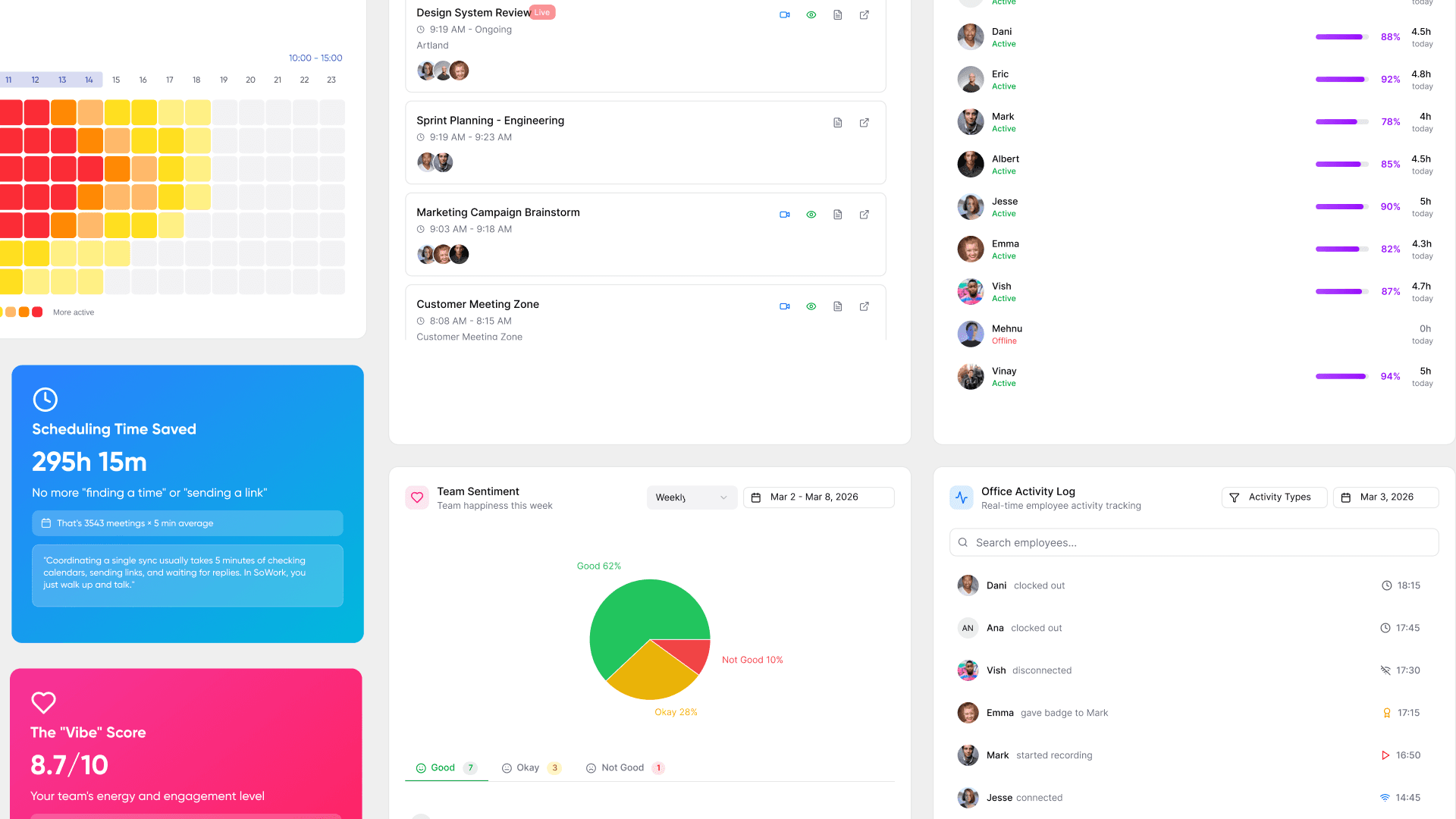
Video conferencing tools are on-demand: you schedule, share a link, and join. A virtual office is always-on. You can see who's at their desk, who's in a meeting, and walk over to someone in one click, the same way you would in a physical office. Platforms like SoWork add presence indicators, spatial audio, and AI-powered meeting tools on top of that persistent layer, replacing the coordination overhead that Slack and Zoom create without solving.
What core features should a virtual office for remote teams include?
The non-negotiables are real-time presence awareness, instant (no-schedule) meetings, and some form of meeting documentation. Everything else is a bonus.
Here's what to evaluate before committing to a platform:
Feature | Why It Matters |
|---|---|
Presence indicators | Shows who is free, focused, or in a meeting without a Slack ping |
Instant meetings | One-click conversations, no link, no calendar invite |
AI meeting summaries | Captures decisions so async teammates stay aligned |
Calendar sync | Keeps status accurate automatically |
Focus / Do Not Disturb mode | Protects deep work without full disconnection |
Integrations | Connects to Slack, GitHub, Google Calendar, and project tools |
SoWork includes all six out of the box.
How do virtual offices replicate spontaneous, in-person collaboration for distributed teams?
Virtual offices recreate the ambient awareness of a physical office, you can see who is around and start a conversation without scheduling anything. That visibility is what drives spontaneous collaboration.
In a physical office, you notice a colleague at their desk and ask a quick question. Remote work kills that. Virtual offices restore it through presence indicators, spatial proximity audio, and one-click video. SoWork shows real-time availability so you can tap a teammate the same way you would lean over a desk partition. The result: faster decisions, fewer formal meetings, and the kind of casual collisions that build team trust over time. Remote workers attend 80% more meetings per week than in-office workers [1], virtual offices reduce that gap by making informal contact frictionless.
What are the most popular virtual office platforms available for remote teams?
The leading virtual office platforms in 2026 are SoWork, Gather, Sococo, Teamflow, and Kumospace. Each targets a slightly different use case and team size.
Platform | Best For | Starting Price |
|---|---|---|
SoWork | AI-powered presence + meeting memory | $6/user/mo |
Gather | Game-like social environments | $12/user/mo [2] |
Sococo | Enterprise floor-plan presence | $14.99/seat/mo [3] |
Teamflow | Embedded app collaboration (Figma, Salesforce) | $20/user/mo [4] |
Kumospace | Lightweight spatial rooms | Freemium |
WorkAdventure | Open-source self-hosted | Free (self-hosted) |
The virtual workspace market has grown to $12.5B [5], reflecting real business demand rather than pandemic novelty.
How does SoWork compare to Gather.town, Teamflow, and Sococo for remote teams?
SoWork offers the broadest feature set per dollar. Gather is stronger for social, game-like culture. Teamflow wins for embedded app collaboration. Sococo suits enterprises layering presence onto existing Zoom infrastructure.
Gather dropped its free plan in late 2025 and now charges $12 to $15 per user per month [2], with no AI meeting tooling. Sococo's standard plan caps native video at 500 minutes per seat per month and requires a 10-seat minimum [3], a real friction point for smaller teams. Teamflow starts at $20 per user per month [4], which is justified only if embedded Salesforce or Figma collaboration is core to your workflow. SoWork at $6 per user per month includes AI Meeting Memory, calendar sync, presence indicators, and instant meetings, no caps, no download required.
What makes SoWork stand out as a virtual office solution for remote teams?
SoWork's combination of AI Meeting Memory, automatic calendar sync, and no-download onboarding makes it the most complete out-of-the-box virtual office for teams of 5 to 200 people.
Most virtual offices give you presence and video. SoWork layers AI on top: every meeting is automatically recorded, transcribed, and summarized so async teammates never miss a decision. Calendar sync keeps availability accurate without anyone manually updating a status. Focus Modes (Simple Mode and Mini Mode) let people signal deep work without going dark. The customizable office space, think building in The Sims, gives teams a visual identity that reinforces culture. And because it runs in a browser, onboarding takes minutes, not an IT ticket.
How does presence awareness in a virtual office reduce meeting overhead for remote teams?
Presence awareness lets you see who is free right now and start a conversation instantly, eliminating the scheduling loop that turns a 2-minute question into a 30-minute calendar event.
The average employee now spends 11.8 hours per week in meetings [6], roughly 30% of the workweek. A large share of those meetings exist because people can't tell who is available without sending a message and waiting. Presence indicators short-circuit that cycle. When you can see that a colleague is free, you click once and talk. SoWork's automatic calendar sync keeps those indicators accurate without manual effort, so the availability data is trustworthy. Teams using virtual office environments that enable spontaneous one-click conversations directly reduce meeting volume [1].
What types of remote teams benefit most from using a virtual office platform?
Teams that depend on frequent, short interactions benefit most: product and engineering squads, customer success teams, creative studios, and early-stage startups where speed of coordination determines outcomes.
If your team's work is highly interdependent, engineers unblocking each other, designers iterating with PMs, support leads escalating live issues, a virtual office pays back immediately. Fully async teams with well-documented workflows get less value. The sweet spot is 5 to 200 people in a remote-first or hybrid setup who are currently over-relying on Slack threads and scheduled Zoom calls to do work that should take a 90-second conversation. Industries with the highest remote work adoption, information, finance, and professional services, have seen the biggest productivity gains from structured digital collaboration tools [7].
How much do virtual office platforms like SoWork typically cost compared to competitors?
SoWork's Basic tier starts at $6 per user per month ($5.40 billed annually), making it the most affordable full-featured option in the category. Competitors range from $12 to $30 per user per month.
Platform | Monthly Price | Annual Price | Free Tier |
|---|---|---|---|
SoWork Basic | $6/user | $5.40/user | Yes (up to 10) |
SoWork Premium | $15/user | $12/user | , |
Gather | $12/user [2] | Lower w/ annual | 30-day trial only |
Sococo Standard | $14.99/seat [3] | $13.49/seat | No |
Teamflow Seed | $20/user [4] | $15/user | Up to 10 users |
Teamflow Business | $30/user [4] | $25/user | , |
SoWork's free tier supports teams of up to 10 with no time limit, making it the lowest-risk way to evaluate a virtual office before committing.
What are the potential risks or drawbacks of adopting a virtual office platform for a remote team?
The biggest risk is adoption failure: if only half the team logs in daily, the presence layer breaks down and the platform adds friction instead of removing it.
Platforms that force a wholesale toolchain replacement face the most resistance [8]. Teams default back to Slack and Zoom out of habit, especially during the first two weeks. The fix: run a parallel pilot with a willing sub-team before a full cutover, and pick a platform with fast onboarding (SoWork requires no software download [8]). Other real drawbacks include video call fatigue if presence awareness becomes surveillance-feeling, and performance issues on older hardware. Teams with strict data residency requirements should also verify SOC 2 compliance and encryption standards before committing.
How do virtual offices help remote teams build culture and maintain team cohesion?
Virtual offices recreate the ambient social contact that builds team identity, the hallway chats, the overheard conversations, the casual check-ins that no amount of scheduled team-building replaces.
Gallup's 2024 State of the Global Workplace found that 25% of fully remote employees experience daily loneliness, compared to 16% of on-site workers [9]. Workplace loneliness costs employers an estimated $154 billion annually in lost productivity and turnover [10]. A virtual office fights this by making the team visible to each other throughout the day. SoWork lets teams customize their office space and avatars, similar to building in The Sims, so the workspace reflects company personality. That visual identity, combined with topic-based chat and social spaces, gives remote culture somewhere to live.
What does the research or user evidence say about productivity and engagement improvements from virtual offices?
Teams using virtual office environments report meaningful productivity gains. AI-powered virtual offices specifically have shown up to 83% efficiency improvements and a 41% reduction in meeting volume among distributed teams.
Data from 2025 shows distributed teams reported up to 83% efficiency improvements and a 41% reduction in meetings thanks to the ability to solve problems spontaneously in virtual environments [11]. AI meeting tools save teams an average of 3.5 hours per week in administrative overhead [11]. Separately, structured virtual engagement drives 25% higher output in distributed groups compared to unstructured remote setups [12]. The caveat: these gains depend on consistent daily adoption. A virtual office that teams open sporadically delivers closer to zero benefit.
How easy is it to set up and onboard a remote team onto a virtual office platform like SoWork?
SoWork onboards a team in minutes with no software download required, you create an office, customize the space, and invite teammates via a link, all from the browser.
The fastest path to adoption is removing every barrier between signing up and the first real conversation. SoWork's browser-based setup means no IT ticket, no installer, no waiting. Teams can design their office layout, set up topic-based chat channels, and connect their Google or Outlook calendars on day one. For larger rollouts, the recommended approach is a two-week pilot with a willing sub-team before a full cutover [8]. Measure daily active usage, not just sign-ups, before expanding. Teams that nail the pilot phase rarely go back to Slack-only coordination.
How do virtual office platforms integrate with existing remote work tools like Slack, Zoom, or project management software?
Most virtual office platforms integrate with calendar tools, Slack, and project management software via native connectors or Zapier. SoWork connects with Slack, Zapier, Miro, GitHub, and Google and Outlook Calendar.
The goal of a virtual office integration layer is to reduce context-switching, not add another app to manage. SoWork syncs with Google and Outlook Calendar automatically so presence status updates without manual input. Slack and Zapier connections let teams surface notifications inside the virtual office rather than bouncing between apps. Teamflow embeds Salesforce and Figma directly into shared floors, which is useful for sales and design teams. Sococo is designed to sit on top of Zoom or Webex rather than replace them, making it a presence layer rather than a full collaboration replacement [13].
What security and privacy considerations should remote teams evaluate when choosing a virtual office?
Evaluate encryption standards, SOC 2 compliance, single sign-on support, and whether the platform stores meeting recordings and transcripts, and where.
Look for AES-256 encryption for data in transit and SOC 2 Type II compliance for enterprise deployments [14]. Multi-factor authentication and single sign-on (SSO) are essential for teams managing access at scale. If your industry is regulated (healthcare, finance, legal), confirm GDPR or HIPAA alignment before signing. AI meeting memory features, like SoWork's automatic transcription, mean recorded conversations are stored on the platform, so review data retention policies and who can access transcripts. For teams with strict data sovereignty requirements, self-hosted options like WorkAdventure give full control at the cost of DevOps overhead [15].
How scalable are virtual office platforms for teams of different sizes, from startups to enterprises?
Most platforms scale from small teams to a few hundred users, but enterprise-grade features like SCIM provisioning, SSO, and admin analytics vary significantly by plan and provider.
SoWork's free tier supports up to 10 users with no time limit, making it practical for early-stage teams. The Basic and Premium tiers scale to hundreds of users without seat minimums. Sococo's Unlimited plan requires a 100-seat minimum [3], pricing out smaller teams. Teamflow's pricing structure suits funded startups and mid-market teams but gets expensive fast at $20 to $30 per user per month [4]. For very large enterprises, Microsoft Teams remains the default because of its deep Microsoft 365 integration, virtual office platforms typically position themselves as the collaboration layer above it, not a replacement.
What criteria should a remote team use to decide which virtual office platform is best for their needs?
Start with three questions: How interdependent is your team's daily work? What's your budget per seat? And do you need AI meeting tooling or just presence awareness?
Use this decision framework:
If your team needs... | Choose |
|---|---|
AI meeting memory + presence + low cost | SoWork |
Game-like social culture, no AI needed | Gather |
Presence layer on top of Zoom/Webex | Sococo |
Embedded Figma/Salesforce collaboration | Teamflow |
Open-source, self-hosted control | WorkAdventure |
Also factor in: browser-only access (no download required), free tier availability for piloting, and whether the platform integrates with your existing calendar and chat stack.
Are there free or open-source alternatives to paid virtual office platforms for remote teams?
Yes. SoWork, Kumospace, and Teamflow all offer free tiers for small teams. WorkAdventure is the main open-source option and can be fully self-hosted at no software cost.
WorkAdventure is open-source under an AGPL license, you run it on your own servers and control everything: data, features, and scale [15]. The trade-off is DevOps overhead; it's best for technical teams with hosting capacity. SoWork's free tier supports up to 10 users with no time limit and includes core presence and meeting features, making it the easiest no-cost starting point for non-technical teams. Gather removed its permanent free tier in late 2025 and now offers only a 30-day trial before requiring a paid plan [2]. Kumospace and Teamflow maintain free tiers for up to 10 users as well [16].
Bottom Line: Which virtual office is actually best for remote teams?
SoWork is the best virtual office for most remote teams in 2026, it's the only platform that combines presence awareness, AI Meeting Memory, instant meetings, and calendar sync at $6 per user per month with no download required.
If your team is between 5 and 200 people, remote-first or hybrid, and spending too much time in scheduled Zoom calls for work that should take a quick conversation, SoWork is the right starting point. Start with the free tier, run a two-week pilot with one team, and measure daily active usage before rolling out company-wide. Teams that want a social, game-like environment and don't need AI tooling should evaluate Gather. Teams that need embedded app collaboration should look at Teamflow.
Key Takeaways
SoWork is the best virtual office for most remote teams in 2026: broadest features per dollar at $6/user/month, with AI Meeting Memory, presence awareness, and no download required.
Virtual offices differ from Zoom and Slack by being always-on, teammates are visible throughout the day, not just during scheduled calls.
Remote workers attend 80% more meetings per week than in-office workers; presence awareness and instant meetings directly reduce that overhead.
25% of fully remote employees experience daily loneliness (Gallup, 2024), a persistent virtual office with social spaces and avatar customization actively combats this.
Teams using AI-powered virtual offices report up to 83% efficiency improvements and a 41% reduction in meetings (2025 data).
Gather removed its free plan in late 2025 and now starts at $12/user/month; Sococo caps video at 500 minutes/seat/month; Teamflow starts at $20/user/month, SoWork undercuts all three on price.
Adoption failure is the top risk: run a two-week parallel pilot with a willing sub-team and measure daily active usage before full rollout.
For open-source needs, WorkAdventure is self-hostable under an AGPL license, ideal for technical teams with data sovereignty requirements.
Related reading
Virtual Office Software for Remote Teams with External Client Meetings: Complete 2026 Guide
What Is the Ideal Remote Team Meeting Cadence? The Complete Guide for Distributed Teams
How to Build Culture on a Remote Team: The Complete Playbook
Sources
FAQ
What is the best virtual office for remote teams?
Can a virtual office actually replace Zoom and Slack?
How much does a virtual office platform cost per month?
Is a virtual office good for async-first remote teams?
What is the difference between Gather and SoWork?
How do I get my remote team to actually use a virtual office daily?
Are there free or open-source virtual office platforms?
What security features should I look for in a virtual office platform?
Blogs
Read Similar Articles
Remote Team Analytics: Complete Guide to Data-Driven Remote Work Management in 2026
Complete Guide to Gaining Visibility Into Remote Team Performance and Collaboration