Remote Team Meeting Cadence: How Often Should You Meet
SoWork Editorial

Published:
Updated on:
The ideal remote team meeting cadence is 3 to 5 structured meetings per week per person: a daily or every-other-day standup, weekly team sync, biweekly one-on-ones, monthly retrospective, and a quarterly all-hands. Anything beyond two hours of meetings per day consistently harms productivity, per Slack's Workforce Index survey of 10,000+ desk workers.
What Is Meeting Cadence and Why Does It Matter for Remote Teams?
Meeting cadence is the deliberate rhythm of recurring meetings a team holds, covering who meets, how often, and for how long. For remote teams, it's the primary structural substitute for the ambient coordination that happens naturally in a shared office.
Without physical proximity, remote teams lose the hallway conversation and the quick desk-side check-in. Scheduled meetings fill that gap, but only if they're intentional. Remote employees now attend 80% more meetings per week than in-office workers (25.6 vs. 14.2 per week) [1], yet 67% of those meetings are considered unproductive [2]. A well-designed cadence gives teams enough touchpoints to stay aligned without consuming the focus time that makes remote work worth doing in the first place.
What Are the Core Types of Recurring Meetings Remote Teams Need?
Most remote teams need five meeting types: daily or every-other-day standups, weekly team syncs, biweekly manager one-on-ones, monthly retrospectives, and quarterly all-hands meetings. Each serves a distinct purpose and should not be collapsed into one another.
Meeting Type | Recommended Frequency | Purpose |
|---|---|---|
Standup / Sync | Daily or 3x/week | Blockers, priorities |
Team Sync | Weekly | Project alignment |
1:1 (Manager) | Biweekly | Growth, feedback |
Retrospective | Monthly | Process improvement |
All-Hands | Quarterly | Company direction |
Keep standups under 15 minutes. Team syncs should have a written agenda shared in advance, GitLab requires this for every meeting [3]. The rest of the week belongs to deep work.
How Does Meeting Cadence Differ by Team Size for Remote Organizations?
Smaller remote teams (under 15 people) can meet more frequently with less overhead because coordination costs are lower. Larger teams need stricter cadence discipline to avoid meeting sprawl that kills individual focus time.
Team Size | Standup | Team Sync | All-Hands |
|---|---|---|---|
5 to 15 | Daily | Weekly | Monthly |
16 to 50 | 3x/week | Weekly | Quarterly |
51 to 200 | Async or 2x/week | Biweekly | Quarterly |
At enterprise scale, 59% of employees log 5+ meeting hours per week, compared to just 32% at smaller firms [4]. Smaller teams can absorb daily standups without damage. Larger ones can't, async updates should replace many of them.
How Does Meeting Cadence Vary Across Remote Team Functions?
Sales and HR teams naturally run higher meeting volumes because their work is relationship-driven. Engineering and design teams need longer stretches of uninterrupted focus, so their cadences should be lighter and more async-leaning.
Research on scheduling patterns shows that human resources and sales roles have higher weekly meeting dispersion, while engineers, designers, and scientists cluster meetings to protect focus blocks [5]. A practical starting point:
Engineering: Async standup, weekly sprint sync, biweekly retro
Sales: Daily pipeline standup, weekly forecast call, monthly team review
Design: Biweekly critique, weekly sync with product
Ops/HR: Weekly team sync, biweekly cross-functional
Match the cadence to the work, not to a generic template.
How Often Should Remote Teams Hold All-Hands or Company-Wide Meetings?
Quarterly all-hands is the most common and effective cadence for remote companies. Monthly works for teams under 30 people. Weekly company-wide calls almost always become a waste of time at any meaningful scale.
High-performing remote-first companies treat all-hands as a strategic alignment moment, not a status update. GitLab holds quarterly kickoff meetings and a separate annual assembly [6]. The goal is to reinforce direction, celebrate wins, and give every employee line-of-sight to company priorities. Keep them under 60 minutes, record them for async review, and follow up with a written summary. Skipping the recording means 70% of decisions shared in the meeting will be forgotten within 24 hours [7].
How Often Should Remote Teams Hold Team-Level Standups or Syncs?
Three times per week is the sweet spot for most remote team standups. Daily works for fast-moving sprints; every-other-day works for steadier workflows. Five-day-a-week standups often become rote and are the first meeting people stop paying attention to.
A standup should answer three questions: what did you ship, what are you working on, what's blocking you. Keep it to 15 minutes or less. If your team spans time zones, an async written standup (posted in a shared channel) can replace the live call entirely without losing alignment. Slack's Workforce Index found that workers who spend more than two hours per day in meetings are more than twice as likely to report not having enough focus time [8]. Protecting that focus time starts with the standup.
What Is the Ideal Cadence for One-on-One Meetings on Remote Teams?
Biweekly one-on-ones are the right default for most remote managers and direct reports. Weekly works during onboarding or performance issues. Monthly is too infrequent to build the trust and feedback loops remote work requires.
One-on-ones are the highest-leverage meeting a remote manager runs. They're where you catch burnout early, unblock career growth, and build the relationship that makes everything else work. Keep them to 30 minutes, use a shared running doc for agenda items, and resist the urge to cancel them when things get busy. Canceling a 1:1 sends a clear signal to the employee that they're not a priority. For new hires, weekly 1:1s for the first 90 days dramatically improve retention and ramp time.
How Often Should Remote Teams Run Retrospectives and Health Check-Ins?
Monthly retrospectives work well for most remote teams. Engineering teams running two-week sprints should retro at the end of each sprint. Quarterly team health surveys (separate from retros) give managers a broader view of morale and engagement trends.
Retrospectives are where remote teams improve their process, not just their output. Without them, the same friction points recur indefinitely. Buffer uses Culture Amp surveys to track team health, including personal happiness and job satisfaction, giving leadership a holistic view of how people are doing [9]. A good retro takes 45 to 60 minutes and covers three questions: what worked, what didn't, what do we change. Document the action items or the meeting is theater.
Should a Meeting Be Recurring or Async? Here's How to Decide.
A meeting should be recurring only if it requires real-time discussion, decision-making, or relationship-building that async cannot replicate. If the goal is information sharing or status updates, async is almost always better.
Use this test before scheduling any recurring meeting:
Does it require live back-and-forth? If not, use a written update.
Will a decision be made? Decisions need meetings. Status updates don't.
Is the output time-sensitive? Async works fine for non-urgent alignment.
Does it build team connection? Some meetings earn their place for culture alone.
Over 55% of remote workers say most meetings could have been an email [10]. That's not cynicism, it's a signal that recurring meetings accumulate without ever being re-evaluated.
What Are the Risks of Too Many Meetings for Remote Teams?
Too many meetings fragment focus time, drive burnout, and push real work into evenings. Remote workers already attend 80% more meetings per week than in-office peers, and 49% report significant video call fatigue on a weekly basis.
Remote employees attend 80% more meetings per week than in-office workers [1], and 49% of remote professionals report significant video call fatigue weekly [11]. The downstream effects are real: back-to-back video calls increase stress biomarkers by up to 20% compared to in-person meetings [11], and workers who exceed two hours of daily meetings are more than twice as likely to say they lack focus time [8]. Meetings, email, and chat already consume 57% of the average workday [12], leaving less than half for actual output.
What Are the Risks of Too Few Meetings on a Remote Team?
Under-meeting creates silos, erodes trust, and leaves remote workers feeling disconnected. Only 36% of remote workers report being able to maintain strong interactions with colleagues when working remotely.
A 2022 analysis of 60,000 Microsoft employees found that fully remote work caused professional networks to become more siloed over time, with employees forming fewer connections outside their immediate teams, and that network insularity correlates with lower innovation output [13]. Moving from full-time office to full-time remote increases loneliness by 67% [14]. Without enough structured touchpoints, remote teams drift. People stop raising blockers, managers lose visibility, and culture quietly erodes. The fix isn't more meetings, it's the right meetings at the right frequency.
How Can a Virtual Office Replace Some Recurring Meetings?
A virtual office platform replicates the ambient awareness of a physical office, letting teammates see who's available and start a conversation instantly, without a calendar invite. This restores the spontaneous interaction that remote teams lose and eliminates a whole category of unnecessary recurring check-ins.
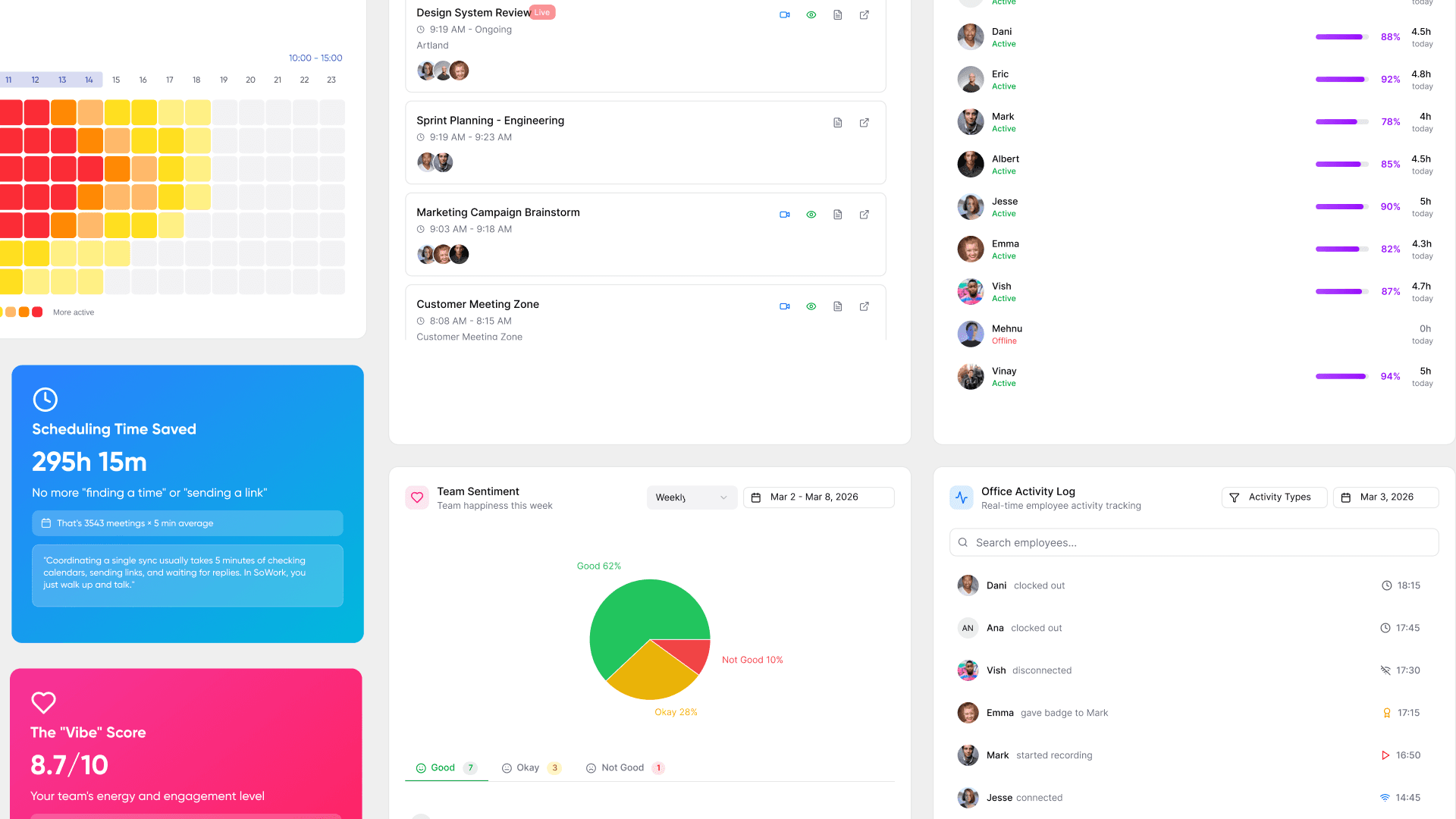
SoWork's Presence Awareness shows who is free, focused, or in a meeting in real time, mimicking the visual cues of a shared office. Instant Meetings let you start a conversation in one click with no scheduling, no link-sharing, no friction. That's the remote equivalent of tapping someone on the shoulder. When teams can see each other's availability and connect spontaneously, the recurring "quick sync" meeting often becomes unnecessary. AI Meeting Memory automatically records, transcribes, and summarizes any conversation that does happen, so nothing falls through the cracks.
Async-First vs. Synchronous Meetings: Which Keeps Remote Teams More Aligned?
Async-first tools handle information sharing, status updates, and non-urgent decisions better than synchronous meetings. Synchronous meetings win for complex decisions, sensitive conversations, and relationship-building. The best remote teams use both deliberately.
Automattic runs almost entirely on async text-based communication, with meetings reserved for situations that genuinely require live conversation [9]. GitLab places a high burden on any meeting, requiring a shared written agenda and documented outcomes that go back into the company handbook [3]. The key insight: async scales across time zones and protects focus time, but it can't fully replace the trust and speed of a live conversation. Teams that go async-only often find alignment degrades quietly over weeks. The goal is async by default, synchronous by exception.
What Does Research Say About the Optimal Number of Meetings per Week?
Slack's Workforce Index, based on 10,000+ desk workers, found that two hours of meetings per day is the tipping point where a majority of workers feel overburdened. Remote workers currently average 25.6 meetings per week, far above what research supports for sustained productivity.
Remote workers average 25.6 meetings per week, 80% more than in-office workers [1]. Slack's survey of 10,000+ workers found that two hours of daily meetings is the tipping point at which most workers feel overburdened [8], and those who exceed it are more than twice as likely to lack focus time [8]. Employees average 392 hours per year in meetings, equivalent to over 16 full workdays [15]. High-performing remote companies like Buffer target roughly 2 to 3 hours of meetings per week total for individual contributors [9], a fraction of what most remote workers currently experience.
How Should Remote Teams Audit and Fix a Broken Meeting Cadence?
Start by listing every recurring meeting, its stated purpose, and who actually needs to attend. Cancel any meeting that hasn't produced a documented decision or action item in the last 30 days. Then rebuild from zero with only the meetings that pass the async test.
Run a meeting audit in four steps:
List all recurring meetings with owner, attendees, and stated purpose.
Review the last 4 weeks, did each one produce a decision or clear action?
Kill or convert any meeting that's primarily status sharing. Make it async.
Set a 90-day review to evaluate what's left.
Only 43% of remote meeting attendees feel their meetings consistently produce clear outcomes [16]. That means more than half of your recurring calendar is probably ripe for cancellation or conversion. Start there.
What Meeting Cadence Do High-Performing Remote-First Companies Use?
GitLab and Automattic both default to async communication and treat meetings as a last resort. GitLab requires a written agenda for every meeting and documents all decisions back into its handbook. Automattic runs almost entirely on text, with meetings used sparingly.
GitLab places a high burden on any synchronous meeting, requiring a shared agenda in advance and documented outcomes afterward [3]. Automattic eliminated email entirely and runs on async text communication, with the occasional video call for situations that genuinely need it [9]. Buffer targets roughly 2 to 3 hours of total meeting time per week for individual contributors [9]. All three companies hold annual in-person retreats, which Automattic describes as the one week that makes the other 51 work [9]. The pattern is consistent: async by default, documented always, synchronous rarely.
How Does Time Zone Distribution Affect Remote Meeting Cadence?
Teams spanning more than 4 time zones should shift most recurring meetings to async and reserve synchronous calls for a narrow overlap window. Forcing off-hours meetings to accommodate a cadence built for one time zone is a fast path to burnout and resentment.
More than 70% of companies with remote workers have employees in multiple time zones [14], and organizing urgent meetings across those gaps is a persistent pain point [14]. A practical framework:
Same time zone (within 3 hours): Live standups and syncs work fine.
Spread across 4 to 8 hours: Find a 1 to 2 hour overlap window; protect it for high-value sync meetings only.
Fully distributed (8+ hours apart): Go async-first. Use recorded video updates, written standups, and AI-summarized meeting recaps for anyone who can't attend live.
Rotate meeting times so the same people don't always take the early or late slot.
What Tools and Features Help Remote Teams Manage Meeting Cadence?
The best tools reduce the friction of scheduling, capture meeting outcomes automatically, and give teams ambient awareness of each other's availability so not every interaction requires a formal meeting.
Look for these capabilities when evaluating your remote collaboration stack:
Feature | Why It Matters |
|---|---|
Presence awareness | See who's free without scheduling |
Instant meetings | Start a conversation in one click |
AI meeting summaries | Capture decisions without manual notes |
Calendar sync | Keep availability accurate automatically |
Async standup support | Replace live standups across time zones |
Focus mode signaling | Protect deep work without going dark |
SoWork combines all of these in one platform, including AI Meeting Memory that automatically records and summarizes conversations, and Focus Modes that let teammates signal deep work time without disappearing from the team entirely.
Bottom Line: What's the Right Meeting Cadence for Your Remote Team?
The ideal remote team meeting cadence is lean, intentional, and built around async-first defaults. Aim for under two hours of meetings per day per person, anchor your week with a standup and a team sync, hold biweekly 1:1s, and run a monthly retro. Every other recurring meeting should justify its existence or get cut. The teams that ship fastest aren't the ones with the most meetings, they're the ones who've replaced unnecessary scheduling with genuine presence awareness and spontaneous collaboration.
Key Takeaways
Remote workers average 25.6 meetings per week, 80% more than in-office workers, but research supports far fewer for sustained productivity.
Two hours of meetings per day is the tipping point where a majority of workers feel overburdened, per Slack's Workforce Index of 10,000+ desk workers.
The core cadence for most remote teams: daily or 3x/week standup, weekly team sync, biweekly 1:1s, monthly retro, quarterly all-hands.
Async-first companies like GitLab and Automattic treat meetings as a last resort, require written agendas, and document all decisions, targeting roughly 2 to 3 hours of meetings per week for individual contributors.
Teams spanning more than 4 time zones should default to async standups and protect a narrow overlap window for high-value synchronous calls only.
67% of remote meetings are considered unproductive, audit your recurring calendar every 90 days and cancel anything that hasn't produced a documented decision.
Virtual office platforms that provide presence awareness and instant meetings can eliminate entire categories of unnecessary recurring check-ins.
70% of meeting decisions are forgotten within 24 hours without notes, AI meeting summaries are no longer optional for distributed teams.
Sources
67% of meetings are deemed unproductive (Flowtrace State of Meetings Report, 2025)
59% of enterprise employees log 5+ meeting hours per week, vs. 32% at smaller firms (Calendly, 2024)
GitLab holds quarterly kickoff meetings and a separate annual all-company assembly
70% of meeting decisions are forgotten within 24 hours without notes (Laxis, 2026)
Over 55% of remote workers think that a majority of meetings could have been an email
FAQ
What is the ideal remote team meeting cadence?
How often should remote teams hold standups?
How often should managers hold one-on-ones with remote direct reports?
How do you know if your remote team has too many meetings?
Can a virtual office platform reduce the need for scheduled meetings?
Blogs
Read Similar Articles
Remote Team Analytics: Complete Guide to Data-Driven Remote Work Management in 2026
Complete Guide to Gaining Visibility Into Remote Team Performance and Collaboration