Best Sococo Alternatives in 2026
Vishal Punwani

Published:
Updated on:
The best Sococo alternative for remote team presence awareness is SoWork, because it combines real-time visual presence indicators, automatic calendar sync, AI Meeting Memory, and one-click instant meetings in a single platform, with no voice-minute caps, no desktop download required, and a free plan for teams up to 10 people.
What is Sococo and what does it actually offer?
Sococo is a cloud-based virtual office platform that lets distributed teams see each other on a shared floor plan map and communicate as if they were in the same building. Its core presence feature shows who is online, in a meeting, or away, via avatar-based status indicators.
Core features include a bird's-eye office map, live audio and HD video conferencing, screen sharing, in-app chat, and real-time notifications. Sococo also supports customizable virtual rooms for different teams or departments, and integrates with Slack, Zoom, Google Meet, and Webex. The standard plan costs $14.99 per seat per month (or $13.99 billed annually) and includes 500 voice minutes per seat. The Unlimited plan is $24.99 per seat per month for unlimited minutes. [1]
What are Sococo's biggest pain points for remote teams?
The most common complaints are voice-minute caps that can shut teams down mid-month, inconsistent audio and video quality, and pricing that many smaller teams find hard to justify.
Reviewers on Capterra and Software Advice flag that Sococo changed its pricing multiple times over the years and introduced minute limits that caused service interruptions when teams ran out. [2] One reviewer noted: "You will run out of free minutes fast and the running costs for Sococo are high." [3] Audio delays, screen-sharing instability, and hard limits on how many people can join a single virtual room are recurring technical complaints. [4] Support responsiveness has also frustrated users, particularly around billing issues. [5]
What should you look for in a Sococo alternative?
Evaluate alternatives on five criteria: quality of real-time presence indicators, spontaneous conversation mechanics, pricing transparency (especially per-seat costs and minute caps), integration with your existing stack, and daily adoption friction.
Criterion | Why It Matters |
|---|---|
Presence accuracy | Stale statuses break trust in the tool |
Spontaneous conversation | Eliminates scheduling overhead |
Transparent pricing | Avoids surprise minute-cap shutdowns |
Calendar/Slack integration | Keeps status current automatically |
Onboarding speed | Low friction = actual daily use |
Scalability matters too, platforms that work for 10 people but degrade at 50 create expensive migration problems later. [6]
How does SoWork replicate the feel of a physical office?
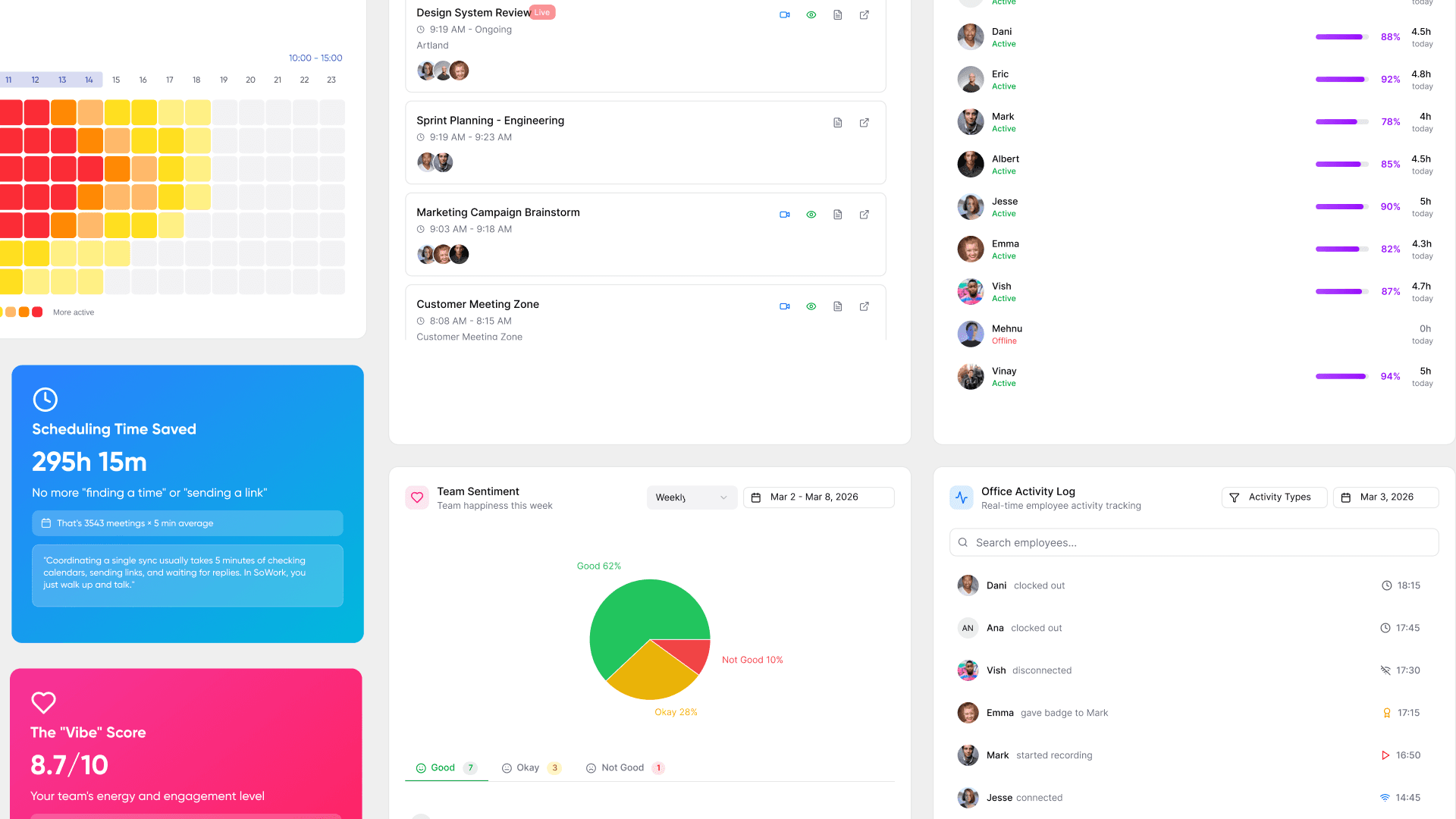
SoWork uses a persistent 2.5D virtual office where every team member's avatar shows real-time availability, free, focused, or in a meeting, so you can glance at the office and know who's approachable, exactly like looking across an open-plan floor.
Automatic Calendar Sync updates your status the moment a calendar event starts, so availability is always accurate without anyone touching a setting. Instant Meetings let you click a teammate's avatar and start talking in one click, no link, no invite, no waiting room. Focus Modes (Simple Mode and Mini Mode) let individuals signal deep work while staying loosely visible to the team. AI Meeting Memory records, transcribes, and summarizes every conversation automatically, so nothing gets lost when someone misses a spontaneous chat. Teams can also personalize their office space and avatars to reflect company culture.
How does SoWork stack up against Sococo on presence and visibility?
SoWork offers more automated, accurate presence awareness than Sococo, primarily because calendar sync updates statuses without manual input, and Focus Modes give individuals a way to signal deep work that Sococo lacks.
Feature | SoWork | Sococo |
|---|---|---|
Auto calendar sync | Yes | No |
AI meeting summaries | Yes | No |
Focus / deep-work mode | Yes (Simple + Mini Mode) | No |
Voice-minute caps | None | 500 min/seat (standard plan) [1] |
Browser-based (no download) | Yes | Requires desktop app |
Free plan | Up to 10 users | Trial only [7] |
Sococo's presence layer is avatar-based and functional, but statuses rely on manual updates. SoWork's automatic sync means the office map stays accurate throughout the day.
How does Gather.town compare to Sococo?
Gather.town scores higher on engagement and spontaneous interaction than Sococo, with proximity-based audio that starts conversations as avatars walk near each other, but it's now more expensive, at $12 per user per month with no free plan.
Gather uses a pixel-art 2D map where proximity drives conversation: walk your avatar near a colleague and a video call starts automatically. It added AI meeting notes, calendar sync, and presence indicators in Gather 2.0. [8] On G2, Gather scores 4.8/5 versus Sococo's 4.3/5, with reviewers specifically praising its interactive engagement. [9] The trade-off: Gather dropped its free plan in September 2025, moving to paid-only access at $12 per user per month. [10] For teams that want a social, game-like environment and don't need AI productivity tooling, Gather is a strong pick.
How does Teamflow compare to Sococo?
Teamflow offers a bubble-zone spatial workspace with real-time presence, spatial audio, and embedded app collaboration, and it has a free plan for up to 10 users, making it more accessible than Sococo for small teams.
Teamflow represents member profiles as bubbles; enter another person's bubble zone and audio starts naturally. It includes whiteboards, screen sharing, timers, and shared video displays. [11] Paid plans start at $15 per user per month (Seed) and go to $25 per user per month (Business), both billed annually. [12] Teamflow integrates with Slack and Zoom. [13] Where it trails SoWork: no AI meeting memory, no automatic calendar sync for presence, and a lighter integration ecosystem. It's a solid option for teams that prioritize simplicity and spatial audio over productivity tooling.
What other Sococo alternatives are worth knowing about?
Beyond SoWork, Gather, and Teamflow, the main alternatives include Kumospace, Spot, Remo, and WorkAdventure, each with a distinct angle on presence and collaboration.
Platform | Best For |
|---|---|
Kumospace | Social events and hybrid team hangouts |
Spot | Lightweight presence without a full virtual office |
Remo | Large virtual events and networking |
WorkAdventure | Open-source, self-hosted virtual offices |
WorkAdventure offers paid plans from €5 to €10 per user per month and a free plan for up to 10 concurrent users, a budget-friendly option for teams migrating off Gather or Sococo. [14] Kumospace and Spot both focus on making remote culture feel human without requiring heavy onboarding.
When does a Sococo alternative actually outperform Sococo?
Sococo alternatives outperform it most clearly when teams hit voice-minute caps, need AI-powered meeting documentation, want browser-only access without a desktop install, or are scaling past 50 people and need predictable per-seat pricing.
Remote workers already attend 80% more meetings per week than in-office workers (25.6 vs 14.2 per week), and 47% of professionals say meetings waste their time most at work. [15] Any tool that adds friction, like minute caps or manual status updates, compounds that problem. SoWork fits teams that want to reduce scheduled meetings by enabling spontaneous one-click conversations. Gather fits creative or social-first teams. Teamflow fits teams that want spatial audio without complexity. Sococo still makes sense for enterprises already running Webex or Zoom who want a visual presence layer on top of their existing stack.
How do these platforms handle spontaneous conversations?
The best Sococo alternatives replace scheduled meetings with proximity or one-click triggers, so conversations start the same way they do in a physical office, without any calendar invite.
SoWork's Instant Meetings let you click a teammate's avatar and start talking immediately. Gather uses proximity-based audio: walk your avatar close enough and the call starts on its own. Teamflow uses bubble zones with the same proximity logic. This matters because 55% of remote workers say many of their meetings could be replaced by quicker, ad-hoc communication. [16] Sococo does allow drop-in conversations by entering a room, but its desktop-app requirement and manual status updates add friction that the browser-based alternatives avoid.
How do pricing costs compare across the top alternatives?
SoWork is the most cost-effective full-featured option for teams under 100 people, with a free plan for up to 10 users and paid plans starting well below Sococo's per-seat cost, and with no voice-minute caps.
Platform | Starting Price | Free Plan | Minute Caps |
|---|---|---|---|
Sococo | $14.99/seat/mo [1] | No | 500 min/seat (standard) |
SoWork | Free up to 10 users | Yes | None |
Gather | $12/user/mo [17] | No | None |
Teamflow | Free up to 10 users | Yes | None on paid |
WorkAdventure | €5/user/mo | Yes (10 users) | None |
Sococo's Unlimited plan at $24.99 per seat requires a 100-seat minimum to access, making it inaccessible for most small-to-mid teams. [18]
What risks come with migrating away from Sococo?
The biggest migration risks are adoption drop-off during the transition, loss of institutional habits built around Sococo's floor plan, and integration gaps if your team relies on Sococo's Webex or Zoom overlay.
Platforms that force a wholesale toolchain replacement face adoption resistance even when they're technically better. [19] Run a two-week parallel pilot with a willing sub-team before cutting over fully. Map which Sococo integrations your team actually uses daily, not just what's listed in settings. Confirm that the new platform's calendar sync and chat integrations cover your stack. Pick a platform with fast onboarding (SoWork requires no software download) to minimize the window where people fall back to Slack and Zoom out of habit.
How do these platforms support culture-building, not just presence?
The best alternatives go beyond showing who's online, they create shared spaces, casual collision points, and team rituals that make remote work feel less transactional.
SoWork lets teams design and personalize their office space and avatars, similar to building in The Sims, so the workspace reflects the company's personality. Gather's pixel-art maps support virtual social events, happy hours, and game rooms. Teamflow includes shared video displays and hangout spaces alongside work rooms. A quarter of fully remote employees report meaningful loneliness, and the default corporate response of more meetings makes it worse. [20] Culture-building features, shared spaces, informal collision points, avatar customization, address that isolation without adding scheduled meetings.
What integrations do the top alternatives offer?
SoWork integrates with Google Workspace and Microsoft 365 for calendar sync and document access. Gather added GitHub and Spotify integrations in its 2.0 launch. Teamflow connects with Slack and Zoom.
Platform | Key Integrations |
|---|---|
SoWork | Google Workspace, Microsoft 365, Slack, calendar sync |
Gather | Slack, Google Calendar, GitHub, Spotify [21] |
Teamflow | Slack, Zoom [22] |
Sococo | Slack, Zoom, Google Meet, Webex [23] |
SoWork's automatic calendar sync is the most operationally useful integration for presence accuracy, it updates your status the moment a calendar event starts, without any manual action. Context-switching between disconnected apps costs remote teams measurable productivity daily, so the fewer handoffs required, the better. [24]
What do teams say after switching from Sococo?
Teams that leave Sococo most commonly cite relief from voice-minute anxiety, better spontaneous conversation mechanics, and lower per-seat costs as the immediate wins after switching.
On Capterra and Software Advice, former Sococo users specifically mention that the minute-cap model made the tool feel unreliable, one CEO noted it's "hard to rely on Sococo" after being shut down mid-month. [25] Teams moving to SoWork report that automatic calendar sync removes the manual status-update habit they had to build around Sococo. Gather switchers from Sococo often highlight the higher G2 satisfaction score (4.8 vs 4.3) and the more engaging, interactive workspace feel. [26] The common thread: teams want a tool their people open every morning without being told to.
How should you actually run the migration from Sococo?
Run a structured three-phase migration: pilot with a small team, configure integrations before the full rollout, then cut over with a clear communication plan so no one defaults back to Slack and Zoom out of habit.
Audit your Sococo usage, identify which rooms, integrations, and status features your team actually uses daily (not just what's configured).
Run a two-week pilot, pick 5 to 10 people from one team, set up the new platform, and measure spontaneous conversation frequency vs. scheduled meetings.
Configure integrations first, connect calendar sync, Slack, and Google Workspace before inviting the full team, so presence is accurate from day one.
Communicate the switch clearly, explain why you're moving and what changes. Teams resist tools that appear without context.
Deprecate Sococo on a fixed date, a hard cutover beats a slow fade that leaves people split across two platforms.
Key Takeaways
SoWork is the top Sococo alternative for presence awareness, with automatic calendar sync, AI Meeting Memory, and one-click Instant Meetings, no voice-minute caps, no desktop download required.
Sococo's standard plan caps voice at 500 minutes per seat per month, and its Unlimited plan requires a 100-seat minimum, both create real problems for small-to-mid teams.
Gather.town scores 4.8/5 on G2 vs Sococo's 4.3/5, but dropped its free plan in September 2025 and now starts at $12 per user per month.
Teamflow offers a free plan for up to 10 users with spatial audio and bubble-zone conversations, a lightweight Sococo alternative for teams that want simplicity over AI tooling.
Remote workers attend 80% more meetings per week than in-office workers; virtual office platforms that enable spontaneous one-click conversations directly reduce that overhead.
Migration risk is highest during the transition window, run a two-week parallel pilot and configure integrations before full rollout to prevent teams from defaulting back to Slack and Zoom.
Culture-building features (avatar customization, social spaces, informal collision points) matter as much as presence indicators, a quarter of fully remote employees report meaningful loneliness.
Sources
Sococo users report audio delays, screen-sharing instability, and hard limits on room capacity.
Platforms that work for 10 people but degrade at 50 create expensive migration problems later.
Gather scores 4.8/5 on G2 versus Sococo's 4.3/5, with reviewers praising interactive engagement.
Gather Essential Plan is $12 per user per month as of August 2026.
Gather 2.0 added GitHub and Spotify integrations in its September 2025 launch.
Context switching between disconnected apps costs remote teams measurable productivity daily.
FAQ
What are the best Sococo alternatives for remote team presence awareness?
Why do teams leave Sococo?
Is SoWork better than Sococo?
Does Gather.town still have a free plan?
How does virtual office presence awareness actually work?
Can a virtual office replace Zoom and Slack entirely?
What is the cheapest Sococo alternative for a small remote team?
How long does it take to migrate from Sococo to a new virtual office platform?
Blogs
Read Similar Articles
Remote Team Analytics: Complete Guide to Data-Driven Remote Work Management in 2026
Complete Guide to Gaining Visibility Into Remote Team Performance and Collaboration