Best Virtual Office Software in 2026: Top 15 Platforms for Remote Teams
SoWork Editorial Team
![Best Virtual Office Software in 2026: Top 15 Platforms for Remote Teams [July, 2026]](https://framerusercontent.com/images/T0dC5sa4a5KCa32NWHPhZbDZbIg.png?width=1536&height=1024)
Published:
Updated on:
Introduction
The best virtual office software platforms for 2026 include SoWork, Gather, Microsoft 365, and Google Workspace, each addressing distinct remote work challenges with specialized features. Virtual office software has evolved from basic video conferencing into comprehensive digital workspaces that replicate the spontaneity and collaboration of a physical office.
This guide covers enterprise-grade virtual office platforms designed for remote teams of 10-500 employees seeking measurable productivity enhancement. We exclude standalone video conferencing tools and basic project management apps, focusing instead on integrated virtual workspace solutions that combine communication, collaboration, and presence management in one platform. Throughout this guide, we compare these solutions to other virtual office platforms like Gather and Kumospace, highlighting the unique features, such as advanced collaboration, customization, and automation—that set them apart.
Direct answer: The top 5 virtual office software platforms are SoWork for AI-powered collaboration with automated meeting summaries in an immersive digital world, Gather for immersive 2D workspaces, Microsoft 365 for enterprise integration with familiar tools, Sococo for spatial presence and availability indicators, and Teamflow for real-time collaboration during brainstorming sessions.
By the end of this article, you will:
Compare 15+ virtual office platforms across features, pricing, and scalability.
Understand pricing models from free plan options to enterprise tiers.
Identify key features that enhance collaboration and boost productivity.
Learn implementation best practices for successful team adoption.
Choose the right tools for your team size, budget, and remote work experience.
Understanding Virtual Office Software
Virtual office software encompasses platforms that replicate physical office functions through persistent digital workspaces, integrated video conferencing, and collaboration tools. These solutions enable remote teams to stay connected, maintain company culture, and achieve seamless collaboration regardless of geographic distribution.
For companies managing distributed employees, virtual office platforms solve the biggest challenges of remote work: isolation, fragmented communication, and diminished team cohesion. Rather than juggling multiple disconnected apps, teams access unified environments where spontaneous interaction and structured meetings coexist naturally.
Core Components
Modern virtual office space solutions integrate three essential elements: spatial video conferencing that simulates proximity-based conversations, persistent virtual workspaces where team members maintain visible presence, and unified communication channels combining chat, video, and document collaboration. These components work together to create cohesive remote work environments.
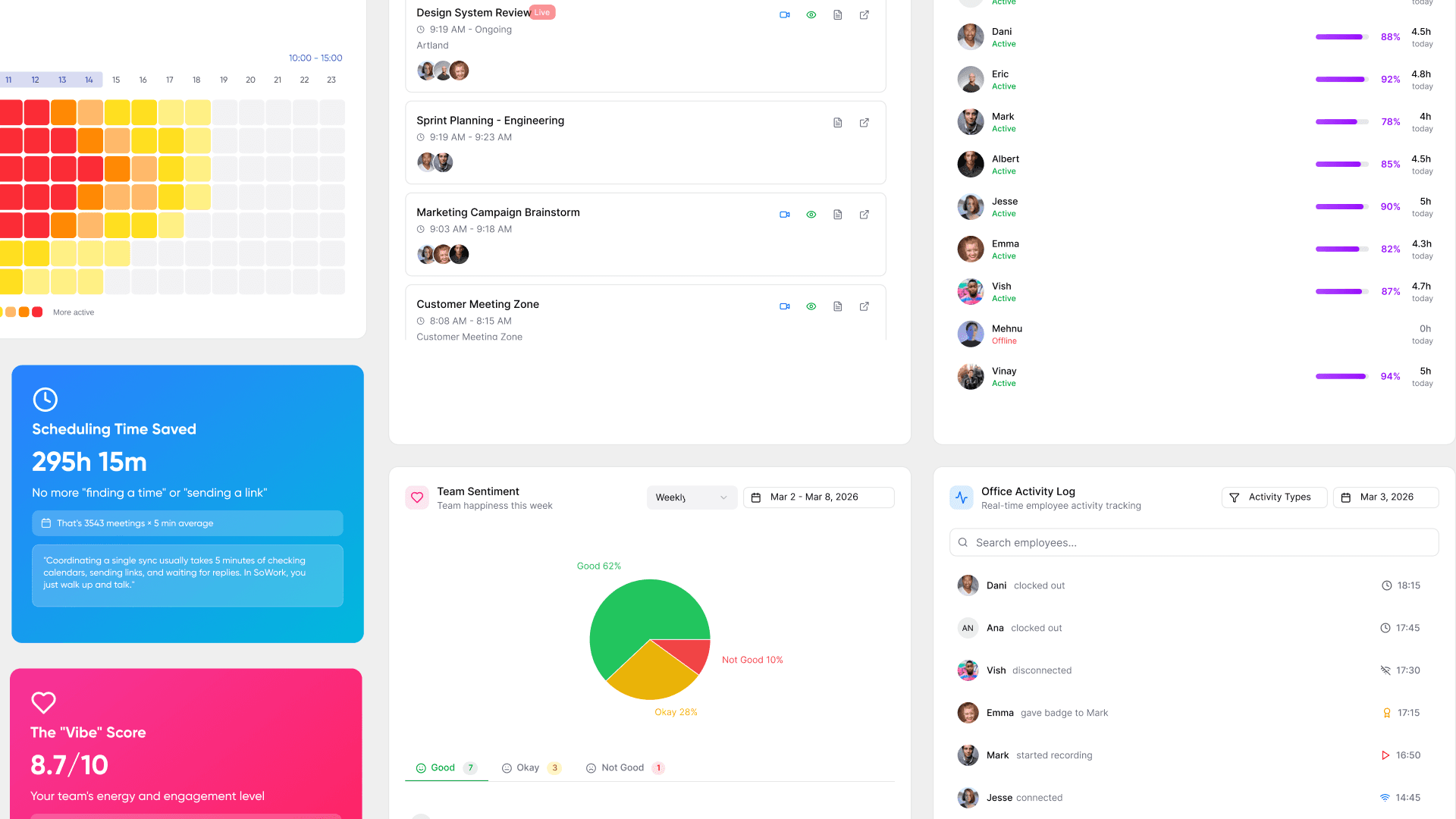
SoWork is an AI-native virtual headquarters that integrates seamless video and chat with deep, automated team analytics. Persistent presence indicators show when teammates are available, focused, or in meetings—recreating the awareness you’d have in a physical office.
Virtual vs Traditional Office Tools
Virtual office software differs fundamentally from standalone video conferencing or project management tools. While Zoom or Google Meet handle scheduled meetings and Asana manages tasks, virtual office platforms create always-on environments where social interaction happens organically between structured work.
This distinction matters for team performance and employee engagement. When employees move between virtual rooms, encounter colleagues unexpectedly, and collaborate in shared spaces, they replicate the relationship-building that traditional offices facilitate naturally. Understanding this comprehensive approach helps organizations select platforms matching their collaboration needs rather than accumulating disconnected tools.
Essential Features and Benefits
Building on the foundational understanding of virtual office software, evaluating specific features reveals why certain platforms outperform others for different use cases. The right features directly impact whether remote teams can enhance collaboration and maintain productivity at scale.
Spatial Communication Features
Spatial communication transforms how remote teams interact daily. Proximity-based conversations allow users to approach colleagues’ avatars for quick discussions without scheduling formal meetings, reducing communication friction by up to 32% according to case studies from mid-sized tech firms.
Avatar interactions create interactive elements that make virtual presence tangible—team members see colleagues at their desks, in huddle rooms, or collaboration spaces. This visibility supports spontaneous connections that traditional video conferencing miss entirely, directly addressing the isolation that undermines company culture in distributed teams.

AI-Powered Productivity Tools
AI meeting notes and AI meeting summaries have become essential features in leading virtual office platforms. These tools automatically transcribe discussions, extract action items, and distribute summaries to participants—eliminating manual documentation that consumes productive hours.
Smart scheduling leverages analytics to identify optimal meeting times across time zones, while AI-driven presence detection helps teams understand availability patterns. SoWork and similar platforms use these capabilities to boost productivity by automating administrative overhead, allowing employees to focus on substantive work rather than coordination tasks.
Integration and Scalability
Enterprise virtual office software connects with existing collaboration tools through robust APIs and native integrations. SoWork, Slack, Trello, Jira, and calendar apps sync seamlessly, preventing the workflow friction that occurs when platforms operate in isolation.
Scalability encompasses user management, permission structures, and resources allocation as organizations grow. Platforms supporting 10 users must also accommodate 500+ without performance degradation. The ability to create custom virtual spaces, add departments, and maintain security protocols ensures businesses can scale their virtual office without platform migration.
Company Culture in Virtual Offices
Company culture is the backbone of any successful virtual office, shaping how remote teams interact, collaborate, and achieve shared goals. In a virtual workspace, fostering a strong sense of community and team cohesion is essential to counteract the isolation that can come with remote work. Leading virtual office platforms like SoWork and Gather are designed with features that actively support company culture, such as customizable virtual office spaces, interactive elements, and real-time collaboration tools.
These platforms enable teams to create virtual environments that reflect their unique identity, making it easier to build a sense of belonging and shared purpose. Features like AI meeting notes help capture and share important discussions, ensuring everyone stays aligned and informed. Real-time collaboration tools allow for spontaneous brainstorming and problem-solving, while social interaction features—such as virtual lounges or team-building games—encourage informal connections that are vital for team cohesion.
By prioritizing company culture within their virtual office, businesses can enhance collaboration, boost productivity, and drive business growth. A vibrant virtual community not only supports employee engagement but also helps remote teams stay motivated and connected, ultimately leading to better outcomes for both individuals and the organization as a whole.
Team Member Experience in Virtual Workspaces
The experience of individual team members is at the heart of a productive virtual workspace. Virtual office platforms must offer intuitive, user-friendly environments that empower team members to collaborate seamlessly and stay connected, regardless of location. Features like spatial audio create a more natural communication flow, allowing users to engage in conversations as they would in a physical office, while simplified views and mini modes help reduce distractions and support deep focus.
To further enhance the team member experience, leading virtual office platforms incorporate tools that promote employee engagement, such as recognition systems and interactive feedback features. These tools motivate team members, foster a sense of achievement, and contribute to a positive virtual office culture. The ability to easily collaborate, share ideas, and access the right tools in real time ensures that team performance remains high and that employees feel valued and supported.
By focusing on the needs and experiences of their team members, businesses can create virtual workspaces that not only drive productivity but also support well-being and job satisfaction. This, in turn, leads to stronger collaboration, higher retention, and greater overall success for remote team
User Experience and Interface Design
A seamless user experience and thoughtful interface design are critical for the success of any virtual office platform. Remote teams rely on these platforms to create a virtual office space that is both functional and inviting. Platforms like SoWork excel by offering customizable interfaces, allowing businesses to design virtual environments that reflect their company culture and brand identity.
Key features such as drag-and-drop tools, real-time collaboration, and AI-powered meeting notes make it easy for teams to organize their work and communicate effectively. Accessibility is also a top priority—virtual office platforms should ensure that all team members, regardless of technical expertise, can access and navigate the platform with ease. This includes providing clear navigation, responsive design, and support for multiple devices.
By investing in user experience and interface design, businesses can create virtual office platforms that not only meet the needs of remote teams but also encourage adoption and sustained engagement. A well-designed virtual workspace enables teams to collaborate efficiently, stay organized, and maintain a strong sense of connection, no matter where they are working from.

Top 15 Virtual Office Software Platforms
With features and benefits established, evaluating specific platforms reveals which solutions deliver the best virtual office experience for different organizational contexts. This comparison synthesizes user experience, feature completeness, pricing, and scalability across leading options.
Platform Comparison Methodology
Each platform was evaluated against remote teams’ primary needs: enabling real-time collaboration, maintaining team cohesion, and supporting business growth through productivity gains. User reviews from G2, Product Hunt, and industry analysts inform these rankings alongside feature analysis.
SoWork – AI-powered virtual office with interactive 2.5D environments that brings meetings, communication, and team collaboration into one platform. It combines virtual offices, online and external meetings, screen sharing, Slack-like chat, team games, and virtual events. The built-in AI assistant records and summarizes meetings, extracts action items, and provides insights into team activity, while integrations with tools like Google, Outlook, Slack, and Zapier ensure seamless workflow integration. Start with the free plan today or book a demo to experience how SoWork improves remote collaboration.
Gather – Immersive 2D workspace with gaming-inspired navigation and spatial audio for natural conversations.
Microsoft 365 – Enterprise integration combining Teams, SharePoint, and Office apps in a unified platform.
Google Workspace – Cloud-native collaboration suite with real-time document editing and Google Meet integration.
Sococo – Spatial presence platform with live whiteboards and event modes at $15/host/month.
Teamflow – 2D office floors with embedded document collaboration for creative teams.
Remo – Interactive maps with proximity audio designed for networking events and distributed groups.
Tandem – Hybrid virtual spaces with app integrations for seamless room transitions.
NexGen Virtual Office – Customizable floor plans with centralized admin consoles.
AgilityPortal – Virtual hubs with custom intranets.
ONLYOFFICE – Self-hostable alternative to Google Workspace with CRM and cross-platform access.
Wurkr – Video-based platform combining Slack integrations with simulated physical adjacency.
Pesto – Avatar-focused workspace with HD screen sharing for creative remote teams.
Miro – Visual collaboration platform with infinite whiteboards and templates.
Notion – Wiki-style workspace with databases ideal for startup documentation.
Detailed Feature Comparison
Platform | Spatial Audio | AI Features | Max Users | Mobile Apps | Integrations |
SoWork | Yes 1 | AI meeting notes, analytics 2 | Unlimited 3 | Yes 4 | 9 5 |
Gather | Yes 6 | Limited 7 | 500+ 8 | Yes 9 | 25+ 10 |
Microsoft 365 | No 11 | Copilot AI 12 | Unlimited 13 | Yes 14 | 200+ 15 |
Google Workspace | No 16 | Gemini AI 17 | Unlimited 18 | Yes 19 | 150+ 20 |
Sococo | Yes 21 | No 22 | 500 23 | Limited 24 | 15+ 25 |
Teamflow | Yes 26 | Yes 27 | 200 28 | No 29 | 30+ 30 |
Remo | Yes 31 | No 32 | 800 33 | Yes 34 | 20+ 35 |
Pricing Analysis
Platform | Free Plan | Starting Price | Enterprise Tier | User Minimum |
SoWork | Yes (limited) 1 | $6/user/month 2 | Custom 3 | 1 4 |
Gather | No 5 | $15/user/month 6 | Custom 7 | 1 8 |
Microsoft 365 | No 9 | $4/user/month 10 | $12/user/month 11 | 10 12 |
Google Workspace | No 13 | $6/user/month 14 | $18/user/month 15 | 1 16 |
Sococo | No 17 | $15/host/month 18 | Custom 19 | 1 20 |
Teamflow | Yes (limited) 21 | $15/user/month 22 | Custom 23 | 5 24 |
While platforms like Microsoft 365 and Google Workspace offer robust bundles for documents and email, they often leave remote teams feeling fragmented. SoWork solves this not by competing, but by connecting: it integrates directly with your existing calendars and Slack to create a shared context layer. Instead of paying a premium for a mere 'spatial interaction,' investing in SoWork delivers a centralized AI-powered operating system that visualizes work and automatically captures meeting intelligence, ensuring your team gets maximum value out of the tools they already use.
Remote Team Management Strategies
Managing remote teams effectively is one of the biggest challenges in the virtual office landscape. To ensure team performance and business success, companies must adopt strategies that prioritize clear communication, seamless collaboration, and ongoing employee engagement. Virtual office platforms like SoWork provide a suite of tools—ranging from video conferencing and project management to AI-powered meeting notes—that support these management goals.
Establishing clear goals, expectations, and workflows is essential for remote teams to stay aligned and productive. Regular check-ins, feedback sessions, and performance evaluations help managers monitor progress and address any issues promptly. Leveraging the project management and collaboration tools built into virtual office platforms allows teams to track tasks, share updates, and work together in real time, regardless of location.
By implementing effective remote team management strategies and utilizing the right virtual office software, businesses can overcome the unique challenges of remote work. This approach not only enhances team performance but also creates a supportive environment where remote teams can thrive and achieve their objectives.
Customer Support and Service Considerations
Exceptional customer support is a cornerstone of successful virtual office platforms. For businesses and teams relying on these tools for daily operations, timely and effective support can make all the difference in user satisfaction and long-term adoption. Leading platforms like SoWork understand this, offering dedicated customer support teams, comprehensive knowledge bases, and active community forums to assist users.
Multiple support channels—such as live chat, email, and community resources—ensure that users can access help whenever they need it. Prompt responses and efficient issue resolution build trust and confidence in the platform, encouraging teams to fully embrace the virtual office experience. Additionally, a strong focus on customer service helps businesses maintain a positive reputation and foster a loyal user community.
By prioritizing customer support and service, virtual office platforms not only enhance the user experience but also drive business growth and long-term success in the competitive remote work market.
Common Implementation Challenges and Solutions
Successful virtual office adoption requires addressing predictable obstacles that derail many deployments. Understanding these challenges before implementation enables proactive solutions that accelerate time-to-value.
User Adoption and Training
Many remote teams resist transitioning from familiar tools to comprehensive virtual office platforms. The solution involves phased rollouts: introduce the platform for specific use cases, such as daily standups or informal collaboration, before expanding to full-time presence.
Create virtual office champions within each department who receive advanced training and provide peer support. Schedule dedicated onboarding sessions demonstrating how new features replace fragmented workflows. Most importantly, communicate the “why”—employees adopt new tools faster when they understand how virtual workspace features address their specific pain points.
Technical Performance Issues
Virtual office software with spatial audio and real-time video demands stable bandwidth and sufficient processing power. Organizations should establish minimum technical requirements, such as 10+ Mbps connections, updated browsers, and hardware meeting platform specifications.
For teams experiencing latency or performance issues, consider platforms offering mini mode or simplified view options that reduce resource consumption. Some tools, like Gather, allow users to disable visual effects while maintaining functionality. IT teams should monitor network analytics to identify bottlenecks before they impact team performance.
Security and Compliance Concerns
Data protection remains critical when communication and collaboration centralize on one platform. Evaluate each virtual office software’s encryption standards—look for AES-256 for data transmission and SOC 2 compliance for enterprise deployments.
For organizations under regulatory requirements, self-hosted solutions like ONLYOFFICE provide data sovereignty, while platforms like Microsoft 365 offer FedRAMP compliance. Implement access controls limiting who can create rooms, invite external users, or access sensitive projects. Regular security audits and employee training on virtual workspace security practices complete the protection framework.
Conclusion and Next Steps
The virtual office software market offers distinct solutions for varied organizational needs. SoWork leads for AI features including automated meeting summaries and productivity analytics. Gather excels in user experience through immersive 2D environments that foster spontaneous collaboration. Microsoft 365 dominates the enterprise market where integration with existing tools matters most.
P.S. Curious about what sets us apart? See the full comparison: SoWork vs. Gather.
Choosing the best virtual office platform requires matching features to your team’s specific challenges, budget constraints, and technical expertise requirements.
Immediate Next Steps
Assess your team size, technical requirements, and primary collaboration pain points.
Trial your top 3 platform choices for 7 days using actual team workflows.
Gather structured feedback from users across departments and roles.
Implement the chosen platform with a phased rollout—starting with volunteer teams before organization-wide deployment.
Establish metrics to measure impact on team cohesion and productivity over the first 90 days.
Related topics worth exploring include remote team management strategies that complement virtual office adoption, hybrid work policies for organizations balancing physical office and remote presence, and productivity measurement tools that integrate with your chosen platform.
Additional Resources
Platform trial links:
SoWork free trial – 7-day access to AI features.
Evaluation checklist for virtual office platforms:
Spatial communication capabilities (audio, presence indicators, spontaneous interaction).
Integration with current project management and collaboration tools.
Security certifications and compliance with industry requirements.
Scalability path from current team size to projected future growth.
Mobile accessibility for team members working across devices.
Implementation resources:
Change management frameworks for remote tool adoption.
Virtual office etiquette guidelines for maintaining company culture.
Analytics dashboards for measuring employee engagement in digital workspaces.
FAQ
What is the best virtual office software for remote teams in 2026?
Which virtual office platforms offer a free plan?
How much does virtual office software typically cost?
What AI features should I look for in a virtual office platform?
How does virtual office software differ from tools like Zoom or Asana?
What are the most common challenges when implementing virtual office software?
Which virtual office platform is best for enterprise teams?
What security standards should a virtual office platform meet?
Blogs
Read Similar Articles
Remote Team Analytics: Complete Guide to Data-Driven Remote Work Management in 2026
Complete Guide to Gaining Visibility Into Remote Team Performance and Collaboration