SoWork vs Spot Analytics: Qual vence em 2026?
Vishal Punwani

Publicado em:
Atualizado em:
O SoWork oferece aos gestores uma visibilidade mais profunda da equipe remota em 2026. Ele combina rastreamento de presença, análise de reuniões, resumos gerados por IA e painéis de engajamento em uma única plataforma. O Spot foca na recriação e personalização imersiva do escritório, mas não publica uma profundidade analítica comparável. Para gestores que precisam de dados acionáveis de produtividade, o SoWork é a escolha mais forte.
O que é o SoWork e o que ele oferece aos gestores de equipes remotas?
O SoWork é uma plataforma de escritório virtual que replica a colaboração espontânea e de ambiente de escritório para equipes distribuídas. Ele combina percepção de presença, reuniões instantâneas, memória de reunião por IA e análises de equipe em uma única plataforma.
O SoWork se enquadra na categoria de espaço de trabalho virtual, ao lado do Gather, Teamflow e Sococo. Seus recursos principais incluem indicadores de presença em tempo real, reuniões instantâneas com um clique, sincronização automática de calendário, Modos de Foco para sinalizar trabalho profundo, espaços de escritório personalizáveis, chat baseado em tópicos e compartilhamento de tela integrado. O recurso AI Meeting Memory grava, transcreve e resume automaticamente todas as reuniões. Os planos começam gratuitos para até 10 usuários, com planos pagos a US$ 6/usuário/mês (Basic) e US$ 15/usuário/mês (Premium). [1]
O que é o Spot e o que ele oferece aos gestores de equipes remotas?
O Spot é um escritório virtual focado na web onde as equipes criam um local de trabalho digital sempre ativo, com salas imersivas baseadas em avatares 3D, áudio espacial e objetos de colaboração de arrastar e soltar. Ele prioriza a recriação e a personalização do escritório em detrimento da profundidade analítica.
O Spot foi projetado para uma experiência puramente no navegador, permitindo que qualquer pessoa participe instantaneamente sem downloads. Os recursos principais incluem conversas por proximidade com áudio espacial, compartilhamento simultâneo de várias telas, quadros brancos, salas bloqueáveis para reuniões privadas e funções e permissões de nível corporativo (SAML). Ele oferece um plano gratuito permanente. O Spot também disponibiliza uma API beta para programabilidade e automação. Seus planos Growth e Enterprise adicionam SSO e integrações personalizadas. [2] A principal força do Spot é recriar o clima presencial, não expor dados de produtividade.
Como o SoWork define e mede a produtividade da equipe?
O SoWork mede a produtividade por meio de padrões de colaboração, eficácia das reuniões e sinais de presença, e não por horas brutas registradas. O foco está nos resultados e na qualidade da coordenação, em vez de vigilância.
O SoWork monitora a frequência, a duração e as taxas de participação das reuniões para revelar padrões de comunicação. Ele monitora o tempo gasto em reuniões em relação ao trabalho focado para ajudar os gestores a identificar quando a comunicação síncrona ajuda ou prejudica o rendimento. Os sinais de presença mostram se alguém está disponível, no modo de foco ou ocupado, oferecendo aos líderes uma leitura dos padrões de trabalho sem o registro de teclas digitadas. A plataforma exclui explicitamente práticas invasivas, focando em métricas baseadas em resultados, como a conclusão de projetos e a velocidade de coordenação. [3]
Como o Spot define e mede a produtividade da equipe?
O Spot não publica uma estrutura dedicada de análise de produtividade. Sua abordagem de produtividade é ambiental; a plataforma facilita a conexão e colaboração das equipes, mas não apresenta painéis de gestão estruturados ou métricas de engajamento.
O posicionamento do produto Spot gira em torno da recriação do clima presencial: conversas espontâneas de aproximação, sessões de quadro branco e momentos sociais. [4] Recursos como indicadores de humor e áudio espacial apoiam a conexão, mas o Spot não divulga análises de reuniões, mapas de calor de colaboração ou relatórios de tendências de engajamento. Os gestores que usam o Spot ganham visibilidade por meio da presença (quem está em uma sala), mas não por meio de painéis de produtividade orientados por dados. Para equipes onde a cultura e a conexão são o objetivo principal, isso é excelente; para gestores focados em dados, é uma lacuna.
Quais painéis de análise o SoWork oferece aos gestores?
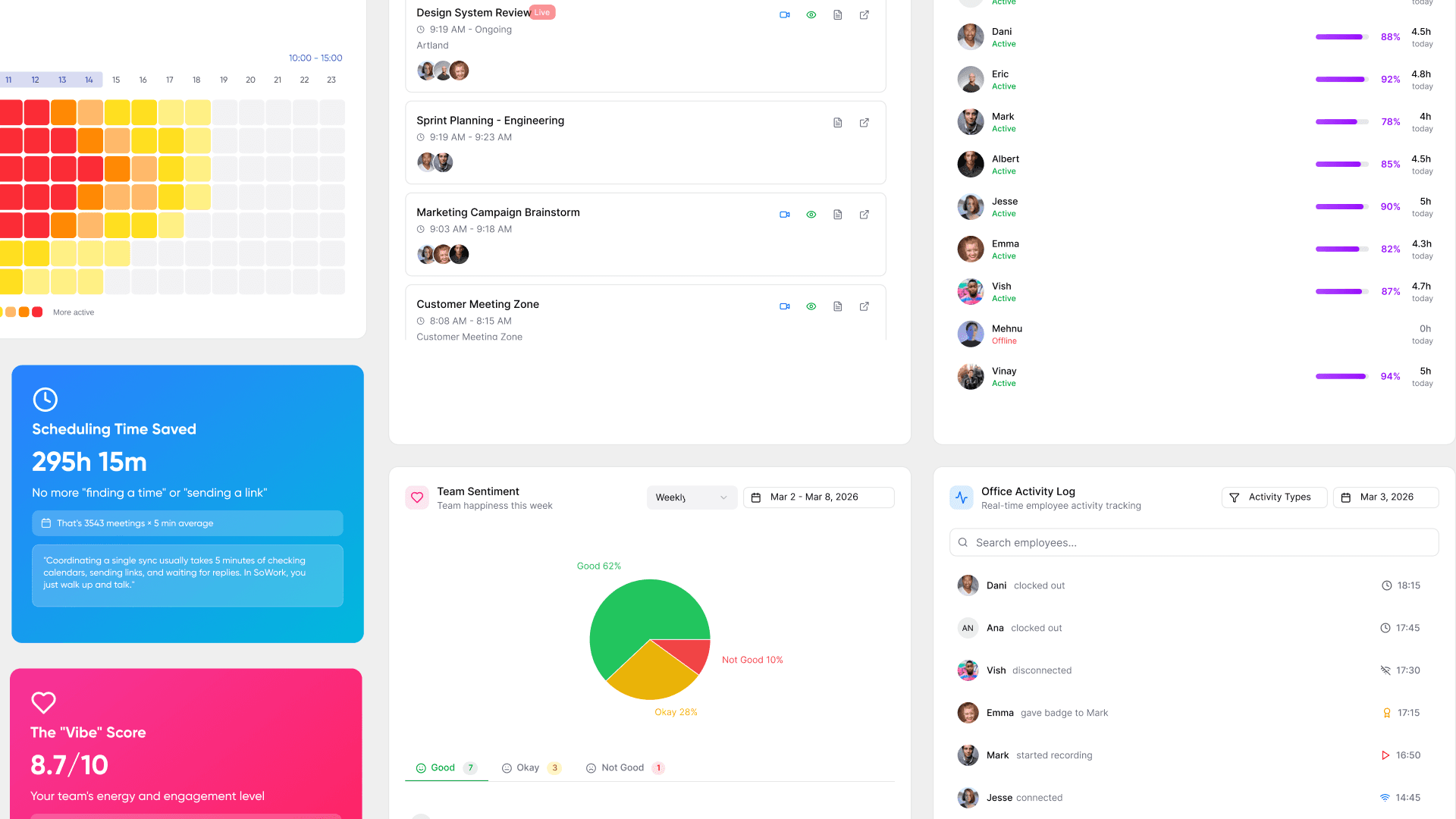
O plano Premium do SoWork inclui painéis de análise dedicados que cobrem participação em reuniões, tempo de fala, tendências de engajamento, padrões de presença e mapas de calor de colaboração, todos acessíveis sem sair do escritório virtual.
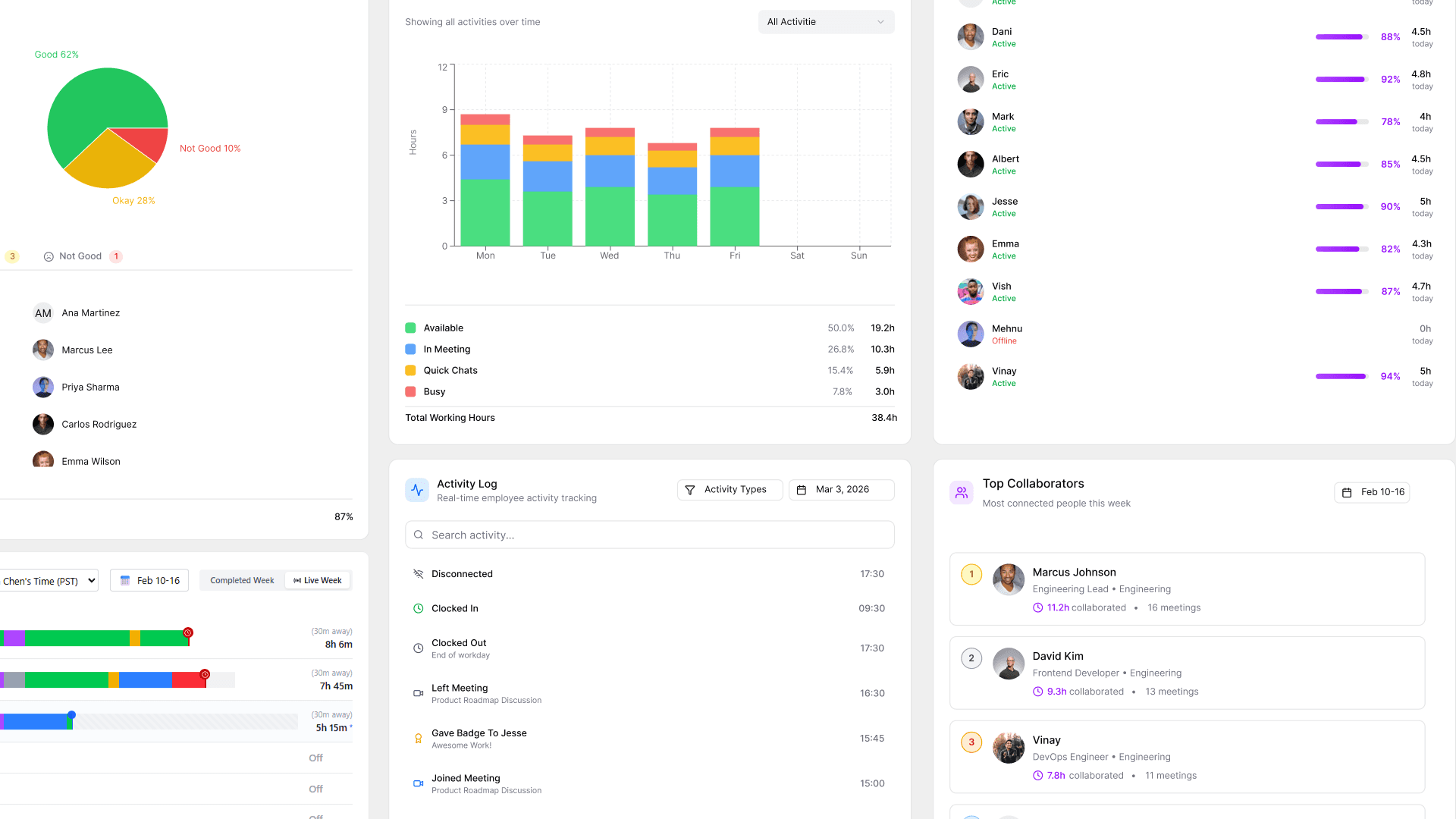
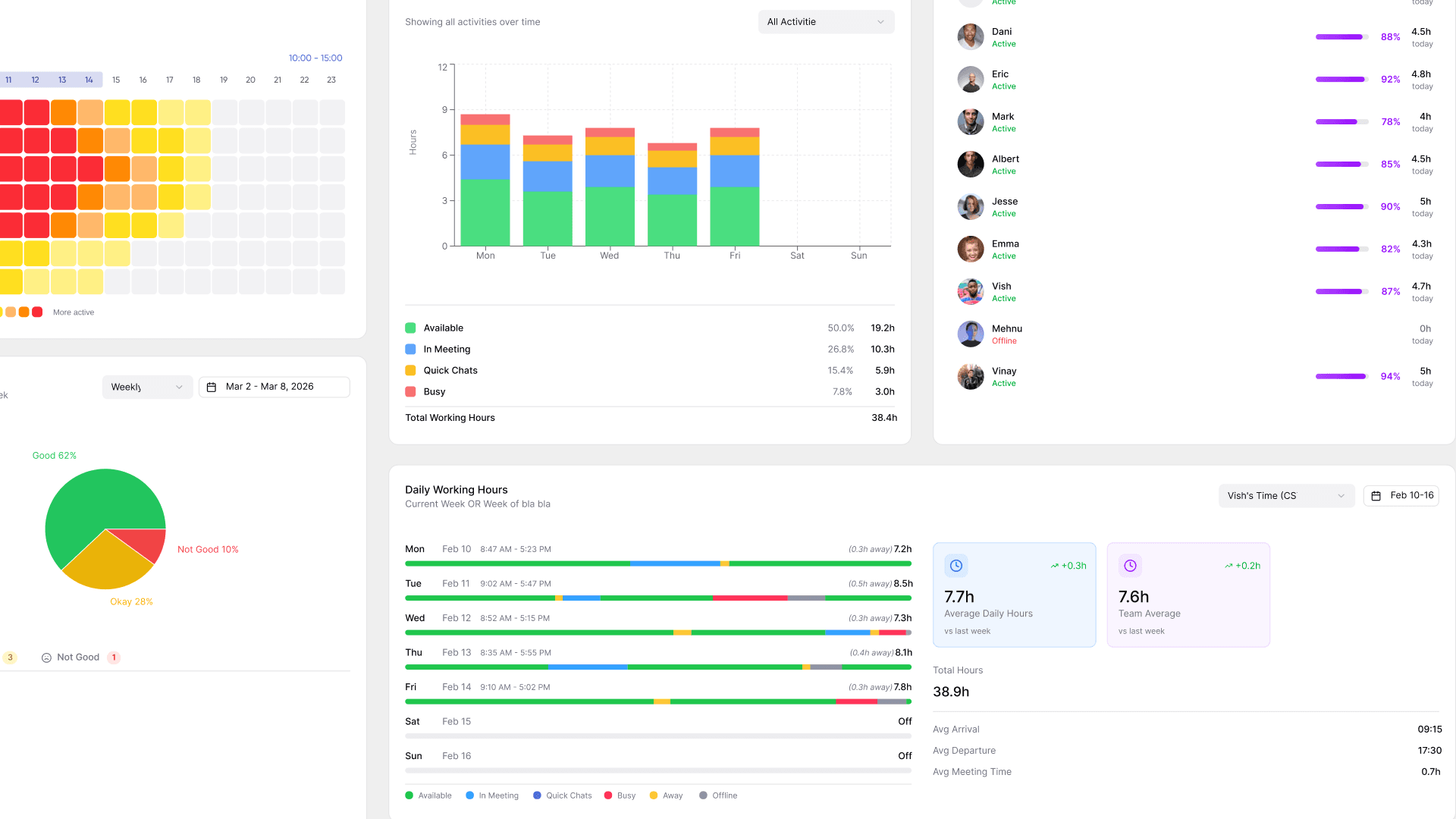
O SoWork integra a coleta de dados diretamente no escritório virtual para oferecer aos líderes insights acionáveis. O Meeting Analytics monitora a participação, o tempo de fala e as tendências de engajamento por chamada. Os Sinais de Presença registram os estados de disponibilidade (livre, focado, em reunião) ao longo do tempo para que os gestores identifiquem tendências de padrões de trabalho. A Biblioteca de Reuniões armazena todos os resumos e análises gerados por IA para mentoria e avaliação. Painéis e mapas de calor mostram como a atividade do escritório é distribuída pela equipe. [5] Análises mais profundas e insights de IA são limitados ao plano Premium.
Quais painéis de análise o Spot oferece aos gestores?
O Spot não documenta publicamente um painel de análise voltado para o gestor ou pacote de relatórios. Suas ferramentas de visibilidade limitam-se à presença em salas em tempo real; os gestores podem ver quem está em qual sala, mas não há relatórios de tendências ou métricas de engajamento.
Com base no conjunto de recursos publicados do Spot, a plataforma oferece percepção de presença no nível da sala (quem está onde), salas bloqueáveis para privacidade e permissões baseadas em funções. [6] Não há equivalente anunciado para as análises de reuniões, mapas de calor ou painéis de engajamento do SoWork. A API do Spot (beta) poderia teoricamente permitir pipelines de análises personalizadas, mas isso exige esforço de engenharia e não é uma ferramenta de gestão integrada. Equipes que precisam de relatórios estruturados precisarão complementar o Spot com uma camada de análise separada.
Como o SoWork rastreia a presença e os padrões de colaboração?
O SoWork rastreia a presença por meio de indicadores visuais de status sincronizados com eventos de calendário, sinais de Modo de Foco e posição espacial no escritório virtual, tudo atualizado automaticamente sem a necessidade de entrada manual dos colaboradores.
A sincronização automática com o calendário atualiza o status do membro da equipe no momento em que um evento começa, mantendo a disponibilidade precisa em tempo real. Os Modos de Foco (Modo Simples e Mini Modo) permitem que as pessoas sinalizem trabalho profundo enquanto permanecem sutilmente visíveis. O mapa visual do escritório mostra quem está disponível, quem está em reunião e quem está em uma zona de trabalho focado. [7] O SoWork também monitora sessões de colaboração ativas — quem está trabalhando junto e quando — dando aos gestores o contexto sobre os padrões de coordenação, não apenas a presença individual.
Como o Spot rastreia a presença e os padrões de colaboração?
O Spot rastreia a presença por meio da ocupação de salas; os gestores podem ver em quais salas os membros da equipe estão e quem está ativamente em uma conversa via proximidade de áudio espacial. Não há documentação de sincronização automática de calendário ou equivalente a modo de foco.
O modelo de presença do Spot é espacial: conforme os avatares se movem pelo escritório 3D, a proximidade ativa as conexões de áudio e vídeo. [8] Os gestores podem observar quem está em qual sala a qualquer momento. O Spot também oferece suporte a indicadores de humor, que dão um sinal leve de como alguém está se sentindo. No entanto, o Spot não parece oferecer sincronização automatizada de status de calendários externos ou sinalização estruturada de modo de foco. A percepção de presença é em tempo real e visual, mas o rastreamento do histórico de padrões de colaboração não é um recurso documentado.
Como o SoWork e o Spot se comparam em profundidade e granularidade de análise?
O SoWork é significativamente mais profundo em análises. Ele oferece painéis estruturados, métricas ao nível de reunião, mapas de calor e resumos gerados por IA. O Spot oferece visibilidade de presença ao nível de sala, mas nenhuma camada de relatórios comparável.
Recurso | SoWork | Spot |
|---|---|---|
Rastreamento de presença | Tempo real + histórico | Apenas tempo real |
Análise de reuniões | Participação, tempo de fala, tendências | Não documentado |
Mapas de calor de colaboração | Sim (Premium) | Não |
Resumos de reunião por IA | Sim (automático) | Não |
Sinalização de modo de foco | Sim | Não |
Sincronização de calendário | Automática | Não documentado |
Painel do gestor | Painel dedicado | Apenas visualização de sala |
Para gestores que precisam de dados para orientar equipes ou identificar o esgotamento (burnout) precocemente, a camada de análise do SoWork é a escolha óbvia. [9]
Qual plataforma transforma dados de atividade em insights acionáveis?
O SoWork converte sinais de atividade em insights acionáveis por meio de IA: resumos, itens de ação e painéis de tendências que indicam aos gestores o que fazer a seguir. O Spot exibe a atividade (quem está onde), mas deixa a interpretação inteiramente a cargo do gestor.
As análises do SoWork extraem dados de aplicativos conectados por meio de integrações nativas com Slack, Google Calendar, Outlook e Zapier, exibindo em seguida insights de conexão, padrões de atividade e lacunas de coordenação em uma única visualização. [10] A camada AI Meeting Memory faz com que cada conversa produza um registro pesquisável com decisões e próximos passos, não apenas um registro de presença. O Spot oferece aos gestores uma imagem ao vivo do escritório, mas sem análise de tendências, sem síntese por IA e sem detecção de gargalos. Dados brutos de presença exigem interpretação manual; o SoWork faz esse trabalho automaticamente.
Quais riscos de privacidade e vigilância essas ferramentas de análise representam para os colaboradores?
Ambas as plataformas apresentam riscos de vigilância se mal utilizadas, mas as análises do SoWork são explicitamente projetadas em torno de sinais agregados e baseados em resultados, em vez de monitoramento invasivo, como registro de teclas ou gravação de tela.
O guia de análises do SoWork exclui explicitamente práticas invasivas, focando em padrões de colaboração e eficácia de reuniões, em vez de vigilância de atividades individuais. [11] Sinais de equilíbrio entre vida profissional e pessoal surgem por meio de dados de presença agregados, não de rastreamento individual. Dito isso, qualquer ferramenta que registre estados de disponibilidade e participação em reuniões pode parecer vigilância se os gestores a utilizarem de forma punitiva. O risco principal é cultural: análises criadas para orientação podem se transformar em ferramentas de microgestão. A comunicação clara com a equipe sobre o que é rastreado e por que é essencial para ambas as plataformas.
Como o SoWork e o Spot lidam com a conformidade com a LGPD e o GDPR?
O plano Enterprise do SoWork inclui conformidade com SOC 2, SSO e provisionamento SCIM. O Spot lista a certificação SOC 2 como "em andamento". Para equipes com colaboradores na UE, o GDPR se aplica a qualquer plataforma que colete dados de presença ou reuniões.
Globalmente, estruturas como GDPR, CCPA e PIPEDA exigem transparência, proporcionalidade e minimização de dados no monitoramento de colaboradores. [12] O GDPR exige que os empregadores demonstrem interesse legítimo e forneçam aviso transparente; o consentimento do colaborador por si só geralmente é insuficiente devido ao desequilíbrio de poder. [13] O plano Enterprise do SoWork aborda a conformidade com SOC 2 e SCIM. O SOC 2 do Spot ainda está em andamento em 2026. [14] Qualquer equipe com colaboradores baseados na UE deve confirmar a residência de dados, as políticas de retenção e os mecanismos de consentimento do fornecedor do escritório virtual antes de implantar recursos de análise.
Quais critérios os gestores devem usar para avaliar ferramentas de análise de escritório virtual?
Avalie com base em cinco critérios: profundidade analítica (painéis vs. presença bruta), foco nos resultados (insights vs. vigilância), amplitude de integração, postura de conformidade e atrito de adoção. A melhor ferramenta é aquela que sua equipe realmente usará diariamente.
Critério | O que procurar |
|---|---|
Profundidade das análises | Métricas de reuniões, mapas de calor, relatórios de tendências |
Qualidade do insight | Síntese por IA vs. registros de atividades brutos |
Amplitude de integração | Calendário, Slack, Jira, Zapier |
Conformidade | SOC 2, residência de dados GDPR, SSO |
Atrito de adoção | Sem download, integração rápida, interface intuitiva |
Postura de privacidade | Sinais agregados, não dados ao nível de teclas digitadas |
Uma ferramenta que rastreia tudo, mas que ninguém usa, não tem valor. Priorize plataformas com baixo atrito de integração e uma filosofia analítica clara que priorize os resultados. [15]
Como o SoWork e o Spot se integram ao Slack, Jira e Google Workspace?
O SoWork se integra nativamente ao Slack, Google Calendar, Outlook e Zapier, e envia decisões de reuniões para tarefas do Jira de forma automática. O Spot oferece SSO e integrações personalizadas no plano Enterprise, além de uma API beta para fluxos de trabalho personalizados.
O SoWork se integra ao Google Calendar e ao Outlook para agendamento de reuniões, enquanto as conexões do Zapier enviam itens de ação e resumos para ferramentas externas como Notion ou Asana. As decisões das reuniões fluem para as tarefas do Jira sem transferência manual. [16] Isso significa que as análises são enriquecidas por dados reais do fluxo de trabalho, não apenas pela presença no escritório. A proposta de integração do Spot é mais voltada para desenvolvedores: sua API beta permite automação personalizada, e o plano Enterprise adiciona SSO e integrações personalizadas. [17] Para gestores que desejam análises que reflitam o trabalho real do projeto, as integrações nativas do SoWork entregam mais sem exigir esforço de engenharia.
O que os usuários reais dizem sobre as análises do SoWork para gestores?
Os usuários reais destacam consistentemente os painéis de análise do SoWork como um recurso de destaque, observando que eles oferecem uma visibilidade que os escritórios físicos não conseguem igualar e facilitam ver quem está disponível sem fazer microgestão.
Depoimentos de usuários no site do SoWork observam que "os painéis de análise oferecem uma visibilidade que você não consegue em locais de trabalho físicos" e que "os gestores podem ver facilmente quem está disponível sem fazer microgestão". [18] Uma análise de terceiros do iGrow descreve o SoWork como uma ferramenta de gestão e transparência para líderes, enfatizando como os painéis e mapas de calor tornam a produtividade da equipe visível sob a perspectiva de um CEO. [19] Os usuários também destacam que os resumos de reunião por IA economizam um tempo significativo e que até mesmo os membros da equipe resistentes a novas ferramentas estavam dispostos a adotar o SoWork. [20]
O que os usuários reais dizem sobre as análises do Spot para gestores?
As avaliações de usuários sobre o Spot focam em sua experiência social e de colaboração, reuniões espontâneas, quadros brancos e clima presencial, em vez de análises voltadas para o gestor. A satisfação com análises não é um tema de destaque no feedback disponível dos usuários.
As avaliações do Spot no G2 e Slashdot enfatizam recursos como compartilhamento de tela simultâneo, colaboração em quadro branco e a capacidade de recriar momentos presenciais da equipe. [21] A plataforma é descrita como projetada para "recriar online aquele clima do presencial" em vez de ser uma ferramenta de análise ou medição de produtividade. [22] Sites de avaliação de terceiros observam a atratividade do Spot para interação espontânea e alinhamentos rápidos, mas nenhum destaca as análises de gestão como um ponto forte. Para as equipes que escolhem o Spot, a visibilidade do gestor vem de estar presente no espaço, não de painéis de controle.
Como se compara o preço do SoWork e do Spot para equipes que precisam de análises?
Os recursos de análise do SoWork estão disponíveis a partir de US$ 6/usuário/mês (Basic), com painéis mais profundos e insights de IA a US$ 15/usuário/mês (Premium). O Spot lista os planos Basic, Growth e Enterprise, sem que a profundidade analítica esteja claramente documentada em nenhum plano.
O plano Basic do SoWork custa US$ 6/usuário/mês (US$ 5,40 no faturamento anual), enquanto o Premium custa US$ 15/usuário/mês (US$ 12 no faturamento anual). [23] Um plano gratuito cobre até 10 usuários. Para uma equipe de 50 pessoas no plano Premium, isso custa aproximadamente US$ 750/mês, o que pode substituir gastos separados com videoconferência e serviços de transcrição. O Spot oferece um plano gratuito permanente e planos pagos Growth e Enterprise, mas não lista publicamente os preços por usuário para recursos específicos de análise. [24] Se a profundidade das análises é o seu principal critério de compra, a estrutura de preços do SoWork é mais transparente e o retorno sobre o investimento (ROI) das análises é mais fácil de calcular antecipadamente.
Quais tipos de equipe são mais adequados para o SoWork em comparação com o Spot?
O SoWork atende aos gestores que precisam de dados para orientar equipes, reduzir o excesso de reuniões e monitorar a saúde da colaboração. O Spot atende às equipes cuja principal necessidade é recriar a cultura do escritório e a conexão social, sem exigir profundidade nas análises.
Caso de Uso | SoWork | Spot |
|---|---|---|
Visibilidade da produtividade para o gestor | Altamente adequado | Pouco adequado |
Resumos de reuniões e itens de ação por IA | Sim | Não |
Cultura e conexão social | Forte | Forte |
Fluxos de trabalho programáveis/via API | Via Zapier | API Beta |
Pequenas equipes criativas (cultura primeiro) | Bom | Excelente |
Fundadores/COOs monitorando a saúde da equipe | Excelente | Limitado |
O SoWork funciona melhor para equipes de 25 a mais de 500 membros que buscam um escritório virtual abrangente com recursos robustos de IA e análises claras para os líderes de equipe. [25] O Spot atende melhor a equipes menores e integradas que desejam conexão sem a complexidade das análises.
Quais alternativas os gestores devem considerar além do SoWork e do Spot em 2026?
As alternativas mais fortes são o Gather (2D espacial com notas de reunião por IA), Teamflow (colaboração com apps integrados), Sococo (presença em planta baixa corporativa) e Kumospace (salas espaciais leves com algumas análises). Cada uma se adapta a diferentes tamanhos de equipe e prioridades.
As melhores alternativas ao Gather para equipes remotas em 2026 incluem SoWork, Teamflow, Sococo e Kumospace. [26] O Gather atende a equipes criativas que desejam ambientes espaciais em pixel-art por cerca de US$ 12 a US$ 15/usuário/mês. O Sococo foca em grandes empresas que precisam de conformidade e SSO, mas exige um mínimo de 10 licenças e limita os minutos de mídia nos planos padrão. O Kumospace combina gravação e análises com espaços personalizáveis e possui nota 4.7/5 no G2, embora sua equipe de fundadores tenha foco dividido. [27] Para equipes que desejam controle de código aberto, vale a pena avaliar o WorkAdventure. Escolha com base no tamanho da equipe, necessidades de integração e se a prioridade principal são as análises ou a cultura.
Conclusão: Qual plataforma oferece melhor visibilidade aos gestores e como decidir?
O SoWork oferece uma visibilidade significativamente melhor para o gestor em 2026. Sua combinação de rastreamento de presença, análise de reuniões, resumos gerados por IA, mapas de calor e integrações de terceiros oferece aos gestores uma camada de dados que o Spot simplesmente não disponibiliza. Se sua principal necessidade é visibilidade de produtividade e alinhamento de equipe, escolha o SoWork. Se sua principal necessidade é recriar a cultura do escritório e a espontaneidade social sem requisitos de análise, o Spot é uma boa opção, mas complemente-o com uma ferramenta de análise separada.
Use este modelo de decisão: se você é um fundador, COO ou líder de equipe que precisa orientar sobre padrões de colaboração, reduzir o excesso de reuniões e monitorar a saúde da equipe sem fazer microgestão, as análises do SoWork foram feitas para você. Se a dor da sua equipe é a falta de conexão e o desânimo, e você não precisa de relatórios estruturados, o ambiente imersivo do Spot pode ser suficiente. O sinal mais claro é este: o SoWork publica seu conjunto de recursos analíticos e preços de forma transparente; o Spot não. A transparência no cronograma de desenvolvimento de análises de um fornecedor geralmente prevê a transparência no próprio produto.
Principais pontos a destacar
O SoWork fornece painéis de análise dedicados com métricas de reuniões, mapas de calor de presença e resumos gerados por IA; o Spot não publica uma camada de análise comparável.
O recurso AI Meeting Memory do SoWork grava, transcreve e resume automaticamente todas as reuniões, criando uma base de conhecimento pesquisável que os gestores podem usar para orientação.
O ponto forte do Spot é a recriação imersiva do escritório e a conexão social, não relatórios de produtividade estruturados.
O SoWork se integra nativamente com Slack, Google Calendar, Outlook, Zapier e Jira, enriquecendo as análises com dados reais de fluxo de trabalho, sem necessidade de esforço de engenharia.
Os preços do SoWork começam gratuitos para até 10 usuários, com recursos de análise disponíveis a partir de US$ 6/usuário/mês (Basic) e insights completos de IA a US$ 15/usuário/mês (Premium).
O GDPR e o CCPA se aplicam a qualquer escritório virtual que colete dados de presença ou reuniões; o plano Enterprise do SoWork inclui conformidade SOC 2, enquanto o SOC 2 do Spot ainda está em andamento.
Ambas as plataformas apresentam riscos de vigilância se as análises forem usadas de forma punitiva; sinais agregados e baseados em resultados são o padrão ético em 2026.
Para gestores que precisam de visibilidade orientada por dados sobre a produtividade da equipe remota, o SoWork é a escolha mais forte; para equipes focadas primeiro na cultura e na conexão, o Spot é uma alternativa razoável.
Fontes
Perguntas Frequentes
SoWork vs Spot team analytics: qual escritório virtual oferece aos gestores melhor visibilidade sobre a produtividade da equipe remota em 2026?
O escritório virtual do Spot possui recursos de análise ou relatórios para gestores?
A análise de dados do SoWork é uma ferramenta de vigilância ou uma ferramenta de produtividade?
Quanto custa o SoWork para uma equipe que deseja análises avançadas?
O SoWork se integra ao Slack, Jira ou Google Workspace para análises mais detalhadas?
O escritório virtual do Spot está em conformidade com a LGPD?
Quais plataformas de escritório virtual devo considerar se nem o SoWork nem o Spot atendem à minha equipe?
Os gestores de equipes remotas podem usar a análise de escritórios virtuais sem microgerenciar os funcionários?
Blogs
Leia artigos semelhantes
Análise de Equipes Remotas: O Guia Completo para Gestão do Trabalho Remoto Baseada em Dados em 2026
Guia Completo para Obter Visibilidade sobre o Desempenho e a Colaboração de Equipes Remotas