Kumospace to SoWork Migration Guide 2026
Vishal Punwani

Published:
Updated on:
SoWork is the top destination for teams migrating from Kumospace in 2026, because it combines AI meeting memory, real-time presence awareness, and an all-in-one workspace at $6/user/month, roughly half Kumospace's Business plan rate. Migration takes one to two weeks: audit Kumospace, export data, build your SoWork office, invite members, and run both tools in parallel before cutting over.
What is SoWork and how does it compare to Kumospace?
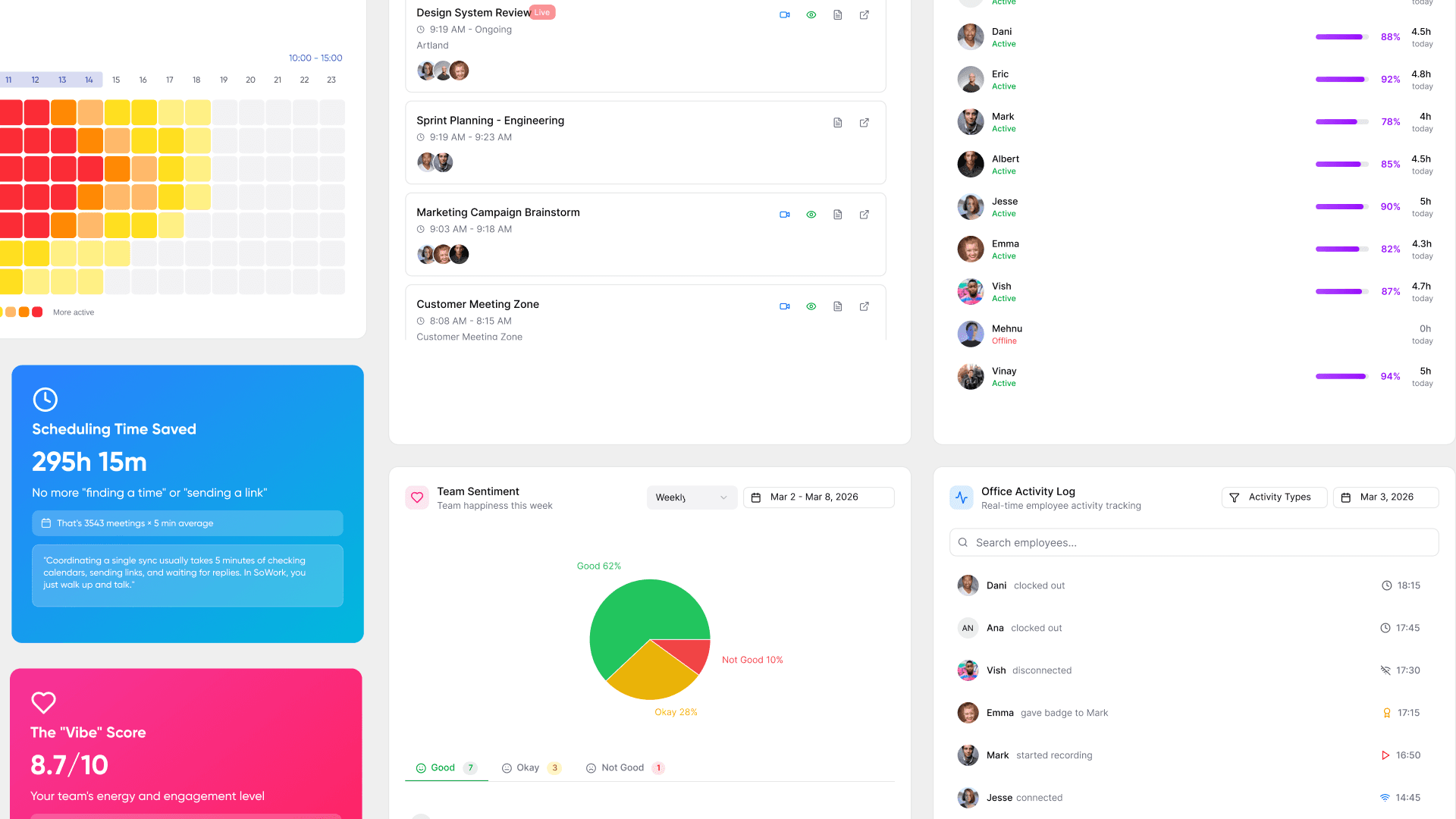
SoWork is an AI-powered virtual office where remote teams see each other's presence, start instant video calls, and get automatic meeting summaries, all without leaving one app. Kumospace is a strong spatial-audio platform that leans toward social presence and events rather than deep AI workflow automation. [1]
Both tools give your team a persistent virtual office with avatar navigation and proximity-based conversations. The key difference is what sits on top. SoWork layers in AI Meeting Memory (auto-transcription and summaries), calendar-synced presence, and a Simplified Mode for teammates who don't want the immersive view. [1] Kumospace focuses on polished spatial audio, room customization, and event hosting. [2] On G2, SoWork scores 4.8/5 vs. Kumospace's 4.7/5, and reviewers prefer SoWork for feature direction and ongoing product support. [8] If your priority is AI-assisted productivity and presence awareness, SoWork is the stronger fit.
Why do remote teams migrate from Kumospace to SoWork in 2026?
The most common reasons are cost savings, built-in AI meeting tools, and a desire for a single platform that covers presence, chat, video, and meeting notes without stitching together extra apps.
SoWork's Basic plan starts at $6/user/month versus Kumospace Business at $16/user/month, a meaningful gap for teams of 20 or more. [1][12] Beyond price, teams report that SoWork's AI meeting summaries let anyone who missed a call catch up in two minutes instead of sitting through a full recording. [25] SoWork also integrates calendar sync automatically, so presence status stays accurate without manual updates. Teams that outgrow Kumospace's event-first model and need daily work infrastructure, not just a place to gather, tend to make the switch.
What should you audit in Kumospace before migrating?
Before you touch SoWork, document everything your team actively uses in Kumospace so nothing gets rebuilt from memory, or skipped by accident.
Run through this audit checklist:
Audit Area | What to Document |
|---|---|
Room/floor layout | Floor names, room types, door settings |
Integrations | Connected apps (Slack, calendar, Zapier) |
User roster | Names, emails, roles, guest access |
Chat history | Download before subscription lapses [14] |
Recordings | Download all saved recordings [14] |
Analytics | Export usage reports for baseline comparison |
Custom branding | Logos, signs, custom links [15] |
Kumospace's Business plan stores unlimited chat history and recordings, but that data is not automatically portable, you need to export it manually before canceling. [14]
How do you export or back up data from Kumospace?
Kumospace doesn't offer a one-click full export, so you need to manually download recordings, take screenshots of room layouts, and export analytics before your subscription ends.
Follow these steps in order:
Download recordings via the Space dashboard before canceling, recordings are a paid-plan feature and disappear if you downgrade. [14]
Export Space Analytics (floor, user, duration breakdown) from the analytics tab. [14]
Screenshot every floor layout including furniture placement, door settings, and custom signs. [15]
Note all integrations, Kumospace connects via Zapier and calendar links; record each webhook URL or API key.
Copy custom links and branding assets (logos, custom signs) to a shared folder your team can access during setup.
Export the member list with emails and roles for use when inviting to SoWork.
How do you set up a new SoWork workspace?
SoWork requires no software download, you can create a workspace, configure rooms, and invite your first members in under 30 minutes directly in the browser.
Sign up at sowork.com and choose your plan. Basic ($6/user/month) covers most teams; Premium ($15/user/month) adds AI summaries, recordings, and Zapier. [19]
Name your workspace to match your company branding.
Connect your Google or Outlook calendar so presence syncs automatically.
Enable AI Meeting Memory in workspace settings if you're on Premium.
Set your default availability status rules (Free, Focused, In Meeting).
Invite an admin co-pilot, someone from your team who can help configure rooms and support colleagues during onboarding.
SoWork offers self-serve signup and free migration support, so you're not doing this alone. [19]
How do you recreate your office layout in SoWork?
Use the screenshots and notes from your Kumospace audit to rebuild your floor plan in SoWork's customizable office editor, treating it as an upgrade rather than a copy.
SoWork's office builder lets you design spaces the way you'd build a house in The Sims, place rooms, add furniture, and personalize with logos and team photos. [1] Don't replicate Kumospace exactly. Instead, use the migration as a chance to rationalize your layout:
Create one room per functional team (Engineering, Marketing, etc.)
Add a dedicated Watercooler or Lounge zone for informal chat
Build a Focus Room with Do Not Disturb defaults for deep work
Set up a Conference Room for structured meetings
Use SoWork's Simple Mode for teammates who prefer a non-map interface [1]
Label rooms to match how your team already talks about spaces, familiar names reduce the learning curve.
How do you migrate team members and user accounts?
Kumospace doesn't export accounts directly to SoWork, so migration is a manual re-invite process, but it's fast if you prepared your member list during the audit.
Use the member list you exported from Kumospace (names + emails).
In SoWork, go to Workspace Settings and bulk-invite via email.
Assign roles: Admin, Member, or Guest, SoWork supports detailed admin roles and SSO/SCIM on Enterprise plans. [19]
Ask members to set up their avatars and connect their calendars on first login.
For Enterprise teams, configure SSO so members authenticate through your existing identity provider rather than creating new passwords.
Plan for a 48-hour window where some teammates are in Kumospace and others are in SoWork, that's normal during a parallel run and is why you keep both active temporarily.
How do you integrate SoWork with Slack, Google Workspace, and other tools?
SoWork connects with Slack, Google Calendar, Outlook, and Zapier out of the box, so most teams can keep their existing tool stack and add SoWork as the presence and meeting layer on top.
Key integrations to configure on day one:
Tool | Integration Type | What It Does |
|---|---|---|
Google Calendar | Native sync | Auto-updates presence when meetings start |
Outlook Calendar | Native sync | Same as Google, no manual status updates |
Slack | Zapier or native | Pushes SoWork status to Slack and vice versa |
Zapier | Premium plan [23] | Connects SoWork events to 5,000+ apps |
GitHub / Miro | Via Zapier | Links work tools to meeting triggers |
Slack integration is especially important during migration, teammates who haven't fully switched yet can still see SoWork status updates in Slack, reducing the coordination gap. [25]
How do Kumospace and SoWork pricing compare?
SoWork costs $6/user/month on its Basic plan and $15/user/month on Premium. Kumospace's Business plan is $16/user/month (or $20 month-to-month). For most teams, SoWork is meaningfully cheaper for equivalent or better features.
Plan | SoWork | Kumospace |
|---|---|---|
Free tier | Yes (up to 10 users) [24] | Yes (up to 5 users) [14] |
Entry paid | $6/user/mo (Basic) [19] | $16/user/mo (Business) [12] |
Mid tier | $15/user/mo (Premium) [19] | $16/user/mo (Business) [12] |
Annual discount | 10-20% [19] | 20% [14] |
Enterprise | Custom + SSO/SCIM [23] | Custom + HIPAA/SSO [15] |
For a 25-person team on annual billing, SoWork Basic costs roughly $1,620/year versus Kumospace Business at ~$3,840/year. Kumospace adds HIPAA compliance at Enterprise, relevant for healthcare teams, while SoWork's Enterprise includes SOC 2. [19][15]
How do you run a phased migration to minimize disruption?
Run both platforms in parallel for one to two weeks, starting with a volunteer pilot group before moving the full team. This lets you catch configuration issues without disrupting everyone at once.
A proven four-phase approach:
Pilot (Week 1): Invite 5-10 volunteers to SoWork. Run real work there, not just demos. Collect feedback daily.
Soft launch (Week 2): Expand to all teams. Keep Kumospace active. Announce a cutover date so people aren't surprised.
Cutover (Day 1 of Week 3): Make SoWork the default. Kumospace stays read-only for data retrieval.
Decommission (Week 4): Cancel Kumospace subscription after confirming all recordings and chat history are saved.
Communicate the reason for the switch early and clearly, teams that understand the why adopt faster than teams that just receive a new login link. [34]
What are the biggest risks and pitfalls in this migration?
The most common failure modes are losing Kumospace data before export, canceling too early, and underestimating how much of your team's culture lived in informal room norms that need to be deliberately rebuilt.
Watch out for these specific traps:
Canceling Kumospace before downloading recordings and chat history. Paid features disappear on downgrade. [14]
Skipping the pilot phase. Rolling out to 50 people at once with no feedback loop guarantees a rocky week.
Forcing a hard cutover with no parallel run. If SoWork has a configuration gap, your team has no fallback.
Not setting calendar sync on day one. Without it, presence statuses are wrong and teammates stop trusting the tool.
Ignoring low-adoption members. One or two holdouts who stay in Kumospace fragment the team's presence layer, address them directly. [29]
Rebuilding the layout too literally. A migration is a chance to fix bad room structures, not replicate them.
How do you onboard your team to SoWork after migration?
Keep onboarding to three things: a live 20-minute walkthrough, a written quick-start doc, and a designated internal champion your team can ask questions without feeling embarrassed.
Structure it like this:
Pre-boarding (Day before launch): Send a short video or doc showing the three actions everyone needs to do on day one, log in, set avatar, connect calendar.
Day one walkthrough: A 20-minute live session covering the office layout, how to start an instant meeting, and how to use Focus Mode. Record it for async teammates.
Buddy system: Pair less tech-comfortable members with a SoWork-confident colleague for the first week. [38]
30-day check-in: Survey the team on what's working and what's confusing. SoWork's founders are known to respond directly to product questions. [25]
Avoid overwhelming people with every feature at once. Presence and instant meetings are the core habit, everything else follows.
How do you rebuild team culture touchpoints inside SoWork?
Culture in a virtual office lives in named spaces and recurring rituals, not in the platform itself. Deliberately recreate both.
SoWork's customizable office lets you build culture into the environment: a Watercooler room with casual decor signals that dropping in is welcome, the same way a kitchen does in a physical office. [46] Specific tactics that work:
Name rooms after your culture ("The Campfire," "War Room") not just functions
Schedule recurring virtual coffees in the Lounge, put them on the shared calendar so they show in SoWork's presence layer
Use avatar customization to let teammates express personality, SoWork's avatar editor supports this directly [1]
Announce wins in the Watercooler room rather than Slack, to build the habit of showing up there
Host a first-week all-hands in SoWork so the platform's first memory is a positive, high-energy event
How do you validate SoWork is ready before shutting down Kumospace?
Run a structured readiness checklist at the end of your parallel-run week, don't decommission Kumospace until every item is green.
Validation checklist before canceling Kumospace:
Check | Pass Criteria |
|---|---|
All members logged in | 100% of team has active SoWork account |
Calendar sync active | Presence updates automatically for all members |
Rooms configured | All functional spaces exist and are named |
Integrations live | Slack, calendar, Zapier all confirmed working |
AI Meeting Memory on | At least one test meeting summarized correctly |
Recordings downloaded | All Kumospace recordings saved externally |
Chat history exported | Kumospace chat saved before subscription cancel [14] |
Pilot feedback addressed | No critical usability issues outstanding |
Only after every row is green should you cancel the Kumospace subscription. Keep the export files in a shared drive for 90 days.
What do real teams say about switching to SoWork?
Real users consistently highlight AI meeting summaries and the ease of spontaneous communication as the features that make SoWork feel different from what they used before.
On G2, one reviewer noted that "recorded calls come back as notes we can actually skim, so anyone who missed a call catches up in two minutes instead of sitting through a 40-minute recording." [25] Another highlighted that Slack integration meant "nobody had to abandon a tool they already depended on." [25] Teams also call out founder responsiveness, one reviewer noted the CEO answered pricing questions directly in the app within minutes, which mattered for small startups making real budget decisions. [25] The most common complaint is reporting gaps: there's no built-in end-of-day check-in or per-person activity export, so teams that need granular productivity tracking still handle that outside SoWork. [25]
What alternatives to SoWork should you weigh before deciding?
SoWork is the strongest all-in-one pick for most small-to-mid-sized teams, but Gather, Teamflow, and Sococo are worth evaluating depending on your specific priorities.
Platform | Best For | Starting Price |
|---|---|---|
SoWork | AI presence + meeting memory, all-in-one | $6/user/mo [19] |
Gather | Gamified pixel-art office, budget teams | ~$7/user/mo [17] |
Teamflow | Embedded app collaboration in the office | $15/user/mo [20] |
Sococo | Enterprise floor-plan presence, 10-seat min | $14.99/seat/mo [22] |
Spot | 3D aesthetic, strong customization | $6/user/mo [19] |
If your team is primarily event-driven and doesn't need daily AI workflow tools, staying on Kumospace or moving to Gather may make more sense. SoWork wins when daily presence awareness and automatic meeting documentation are the core need. [1][3]
Key Takeaways
SoWork's Basic plan starts at $6/user/month, roughly 60% less than Kumospace's Business plan at $16/user/month, making it the most cost-effective upgrade for most teams. [12][19]
Before canceling Kumospace, manually download all recordings, export chat history, and screenshot every floor layout, these don't transfer automatically. [14]
Run a one-to-two week parallel period with both platforms active before cutting over. This catches configuration gaps without disrupting the whole team.
Connect Google or Outlook calendar on day one in SoWork, without it, presence statuses are inaccurate and teammates stop trusting the tool.
SoWork's AI Meeting Memory (available on Premium at $15/user/month) auto-summarizes calls so missed meetings take two minutes to catch up on, not 40. [25]
Rebuild culture deliberately: name rooms to match how your team talks, schedule recurring virtual coffees, and host your first all-hands in SoWork to create a positive first memory.
Don't replicate your Kumospace layout exactly, use the migration as a chance to rationalize room structure and fix what wasn't working.
Keep Kumospace exports in a shared drive for 90 days after decommissioning, in case teammates need to reference old recordings or chat threads.
Related reading
Kumospace Vs SoWork: Which Virtual Office Is Best For Your Team?
How to Migrate from Gather to SoWork: A Step-by-Step Guide for Remote Teams in 2026
How to Migrate from Teamflow to SoWork: A Step-by-Step Guide for Remote Teams in 2026
Sources
FAQ
How to migrate from Kumospace to SoWork: a step-by-step guide for remote teams in 2026?
Can you export chat history and recordings from Kumospace?
Is SoWork cheaper than Kumospace for a team of 20 people?
Does SoWork work without downloading software?
How long does it take to set up a SoWork workspace?
What happens to Kumospace data if I cancel my subscription?
Does SoWork integrate with Slack and Google Workspace?
What are the biggest mistakes teams make when switching virtual office platforms?
Blogs
Read Similar Articles
Remote Team Analytics: Complete Guide to Data-Driven Remote Work Management in 2026
Complete Guide to Gaining Visibility Into Remote Team Performance and Collaboration