Spot vs SoWork: Virtual Office Comparison (2026)
TLDR verdict
For teams seeking an AI‑driven virtual office with flexible immersive graphics, integrated chat/meetings, and built‑in analytics, SoWork is the better choice. SoWork also has a Simplified mode (non‑world UI) for teams who prefer a traditional interface. When Spot (Spot Virtual) is a fit, it is typically for teams wanting a highly customizable 3D web-based workspace with API programmability for building custom office behaviors.

Fast comparison
SoWork is best for
Teams needing spatial video calls, instant text chats, and integrated AI‑meeting summaries.
Leaders who require detailed team analytics to monitor participation and productivity.
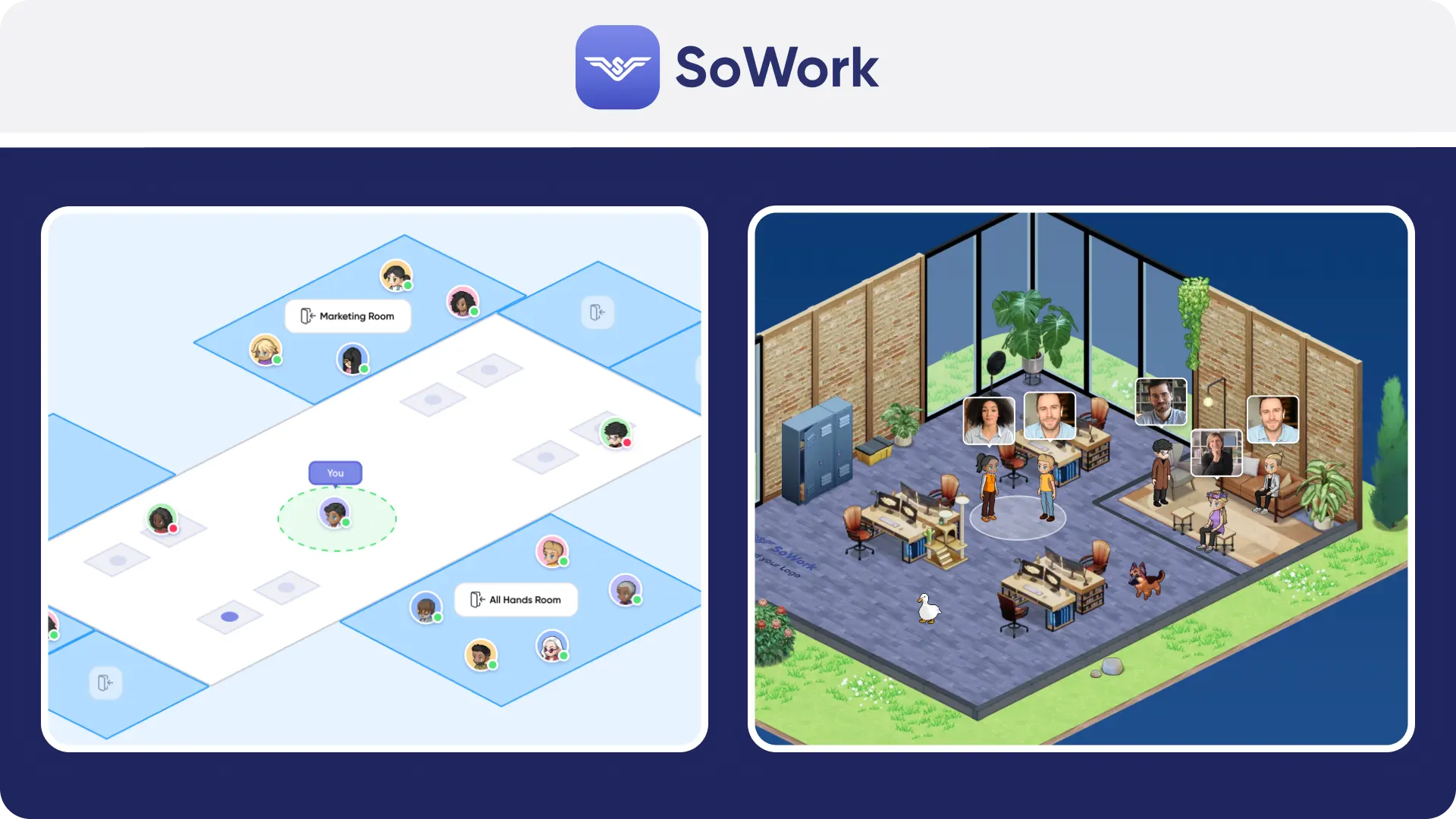
Companies wanting to switch between an immersive 2.5D view and a Simplified Mode.
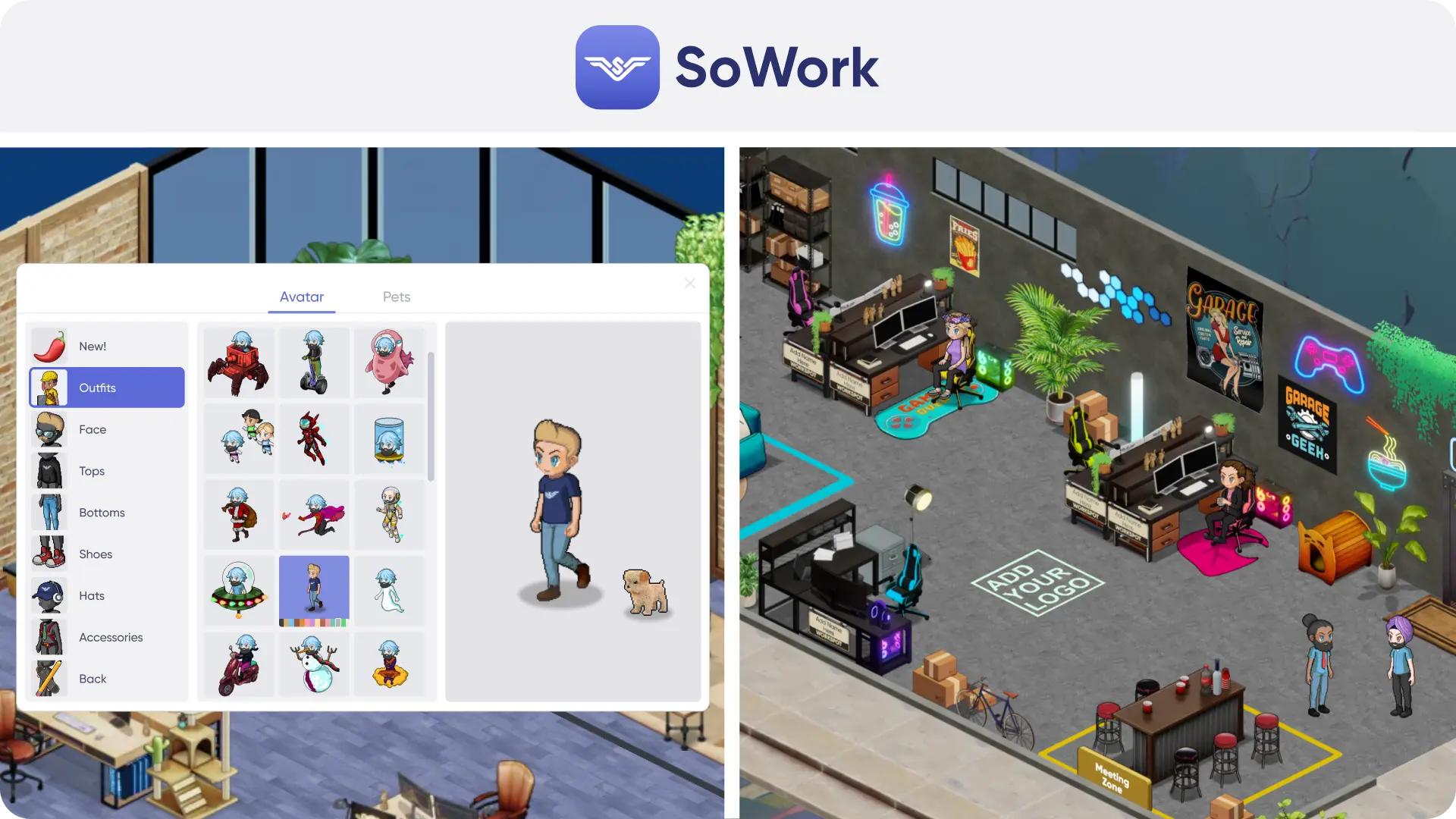
Teams valuing customizable environments inspired by The Sims.
Organizations seeking integrations via Zapier, Slack, Miro, GitHub, Google & Outlook Calendar and more.
Large teams expecting volume discounts when scaling beyond 100 users.
Spot is best for
Teams that want a customizable online workspace with drag-and-drop collaboration objects and a strong “built for the web” posture.
Teams that want programmability and automation via a Beta API.
Organizations prioritizing 3D web-based environments over AI meeting productivity tools.
Feature comparison table
Feature | SoWork | Spot | Notes / source |
|---|---|---|---|
Simplified Mode (non‑world UI) | Yes – users can toggle between immersive 2.5D and Simplified modes. | No – primarily relies on the web-based spatial office view. | SoWork emphasizes switching for adoption; Spot focuses on the spatial experience. |
AI meeting outputs | SoWork AI automatically captures meeting minutes and action items. | Not stated publicly/Not a core feature. | SoWork AI summaries are built-in; Spot focuses on workspace customization. |
Max active members | Unlimited seats; pricing scales with user count; volume discounts for >100 users. | Unlimited / Custom for Enterprise. | Spot supports teams of 50+ in Enterprise pricing. |
Integrations | Zapier, Slack, Google & Outlook Calendar, GitHub and more. | Custom integrations (Enterprise), Beta API. | SoWork offers broader workflow automation via Zapier; Spot offers an API. |
Customization | Custom maps, furniture, décor; free custom map for Premium teams >30. | Full-service space design, custom assets, and environments. | Both offer deep layout customization. |
SSO & SCIM | Available in Enterprise plan (publicly stated in SoWork docs). | Available in Enterprise plan. | Both restrict advanced identity management to Enterprise tiers. |
Mobile / desktop apps | Mobile & desktop apps available. | Web-based; Desktop app available on download page. | Spot emphasizes its "Built for the web" architecture. |
Pricing (per user) | Basic $6/user/mo; Premium 15/user/mo(12 billed annually). | Basic $6/user/mo; Growth $10/user/mo. | Spot offers a 20% discount on annual plans. |

Perks
SoWork perks (always present)
Free migration from other virtual offices – SoWork rebuilds your map for free.
Free custom map for Premium teams over 30 users.
Free logo on avatar apparel (hoodies, hats, T‑shirts) for Premium teams over 30 users.
Volume discounts for 100+ users (list price for 100 users shown as upper bound).
Teamflow perks
Free 30-day trial for Basic and Growth plans,.
Free plan available with customization limitations.
Definitions
Active member vs seat – An active member is a user currently logged into the platform; a seat is a licensed slot that may or may not be active at any given time.
AI meeting notes – SoWork AI creates a transcript of the meeting and summarizes decisions and action items. Spot does not highlight this feature on core pages.
SSO vs SCIM – SSO (single sign‑on) allows users to log in with a single identity provider; SCIM automates user provisioning. Both are Enterprise features in SoWork and Spot.
Pricing + price math (10, 25, 50 users)
Below is a sample calculation for 10, 25 and 50 users, assuming all seats are active. SoWork’s Basic tier is priced at $6 per user per month or $5.40 per user per month billed annually (10% discount), while its Premium tier costs $15 per user per month or $12 per user per month when billed annually (roughly a 20 % discount). Spot offers a Basic plan starting at $6 per user per month and a Growth plan at $10 per user per month; both Spot plans include a 20% discount when billed annually.
Plan | Billing | 10 users | 25 users | 50 users | Assumptions |
|---|---|---|---|---|---|
SoWork Basic | Monthly | 10×$6=$60 | 25×$6=$150 | 50×$6=$300 | All seats active. |
Annual | 10×$5.40=$54/mo | 25×$5.40=$135/mo | 50×$5.40=$270/mo | Pay annually, 10% discount. | |
SoWork Premium | Monthly | 10×$15=$150 | 25×$15=$375 | 50×$15=$750$ | Premium includes AI meeting notes. |
Annual (–20%) | 10×$12=$120/mo | 25×$12=$300/mo | 50×$12=$600/mo | Premium’s annual rate is discounted to $12/user/month. | |
Spot Basic | Monthly | 10×$6=$60 | 25×$6=$150 | 50×$6=$300 | Includes standard AV and starter layouts. |
Annual (–20%) | 10×$4.80=$48/mo | 25×$4.80=$120/mo | 50×$4.80=$240/mo | Annual rate discounted to $4.80/user/month. | |
Spot Growth | Monthly | 10×$10=$100 | 25×$10=$250 | 50×$10=$500 | Includes premium assets and live support. |
Annual (–20%) | 10×$8=$80/mo | 25×$8=$200/mo | 50×$8=$400/mo | Annual rate discounted to $8/user/month. |
100‑user list price note: for SoWork, the list price for 100 users is $600/month for Basic and $1 500/month for Premium when billed monthly (or $1 200/month when billed annually) before volume discounts. SoWork offers volume discounts above 100 users; details are not publicly stated, so contact sales.

UI / UX
Onboarding flow – SoWork allows teams to create a workspace and invite colleagues via link; there is a free plan for up to 10 people with limited features. Spot allows users to "create your office" instantly and offers a 30-day free trial for paid tiers.
Navigation clarity – SoWork’s immersive 2.5D interface includes avatars and rooms; the Simplified Mode simplifies navigation for first‑time users. Spot utilizes a "built for the web" 3D spatial interface where users move between rooms and drag-and-drop objects.
Time to start a meeting – In SoWork, walk up to a colleague’s avatar or click their name to start a video call. In Spot, users navigate to meeting rooms or walk up to colleagues' desks to start talking instantly.
Admin clarity – SoWork’s Enterprise tier includes role‑based admin controls and SSO/SCIM; roles are clearly defined for admin, member, and guest. Spot defines roles as Guest, Member, Admin, and Custom Roles, with permissions management available in the Enterprise tier.

Artistic direction
SoWork – Offers a 2.5D isometric world inspired by The Sims and Animal Crossing, vibrant and customizable. It includes a Simplified Mode for teams preferring a classic UI.
Spot – Presents a web-first 3D aesthetic that allows for fully customizable floor plans, from furniture to external environments like mountains and trees. It emphasizes a "digital office" feel where users can decorate with premium assets.

9. Ease of use
Simplified Mode is the key adoption lever: users can start with the simplified interface and later graduate to the immersive world. SoWork also minimizes friction by integrating chat, meetings, and AI notes into one application; there is no need to juggle multiple tools. Spot mitigates friction by being "built for the web," allowing anyone to join instantly via a browser without mandatory downloads. However, Spot lacks a stated "non-spatial" toggle for users who may dislike the virtual map interface.
10. Ease of doing business with
Pricing clarity – SoWork clearly lists Basic ($6/user/mo) and Premium ($15/user/mo) with clear annual discounts. Spot lists Basic ($6/user/mo) and Growth ($10/user/mo) pricing clearly on their site, with Enterprise requiring a sales call.
Procurement readiness – SoWork offers self‑serve signup and free migration; volume discounts require contacting sales. Spot offers a 30-day free trial and contact-sales for Enterprise plans.
Admin controls – SoWork provides detailed admin roles, SSO/SCIM, and analytics. Spot offers Guest, Member, and Admin roles, with Custom roles available to help manage permissions.
Security & compliance – SoWork’s Enterprise includes SOC 2 compliance. Spot’s trust page states SOC 2 certification is “in progress”.
11. Customer support / service
SoWork – Premium plan includes priority live support. Support channels include chat and email, with direct access to the founding team (as stated in SoWork marketing).
Spot – Live customer support is included in the Growth plan ($10/user/mo), while Enterprise includes dedicated customer support.
Verify during trial – Test response times via chat or email to ensure they meet your team's SLAs.
12. CPU/GPU performance and battery
SoWork’s immersive 2.5D world uses more GPU/CPU resources than a flat UI; switching to Simplified Mode reduces the load. Spot is engineered specifically for a web experience, but 3D browser-based environments generally require significant resources. SoWork strictly allows users to choose Simplified Mode (Lite Mode) to save battery and resources.
13. Future direction
Public signals show SoWork investing heavily in AI functionality (meeting summaries, action items, team analytics). The product roadmap emphasizes deeper integrations and analytics, suggesting a focus on productivity and organizational insights. Spot emphasizes programmability via its Beta API and custom integrations for Enterprise, leaning towards a highly customizable, programmable digital workspace rather than an AI-first meeting tool.
FAQ
You can also see our Help Center, book a demo, or visit our office to ask us in (virtual) person. We'd love to meet you!
SoWork vs Spot: what is each product?
SoWork vs Spot: which is better for remote culture?
SoWork vs Spot: which is better for daily work beyond meetings?
SoWork vs Spot: which has the better virtual office experience?
SoWork vs Spot: which is easier to onboard and adopt company‑wide?
SoWork vs Spot: which has better integrations?