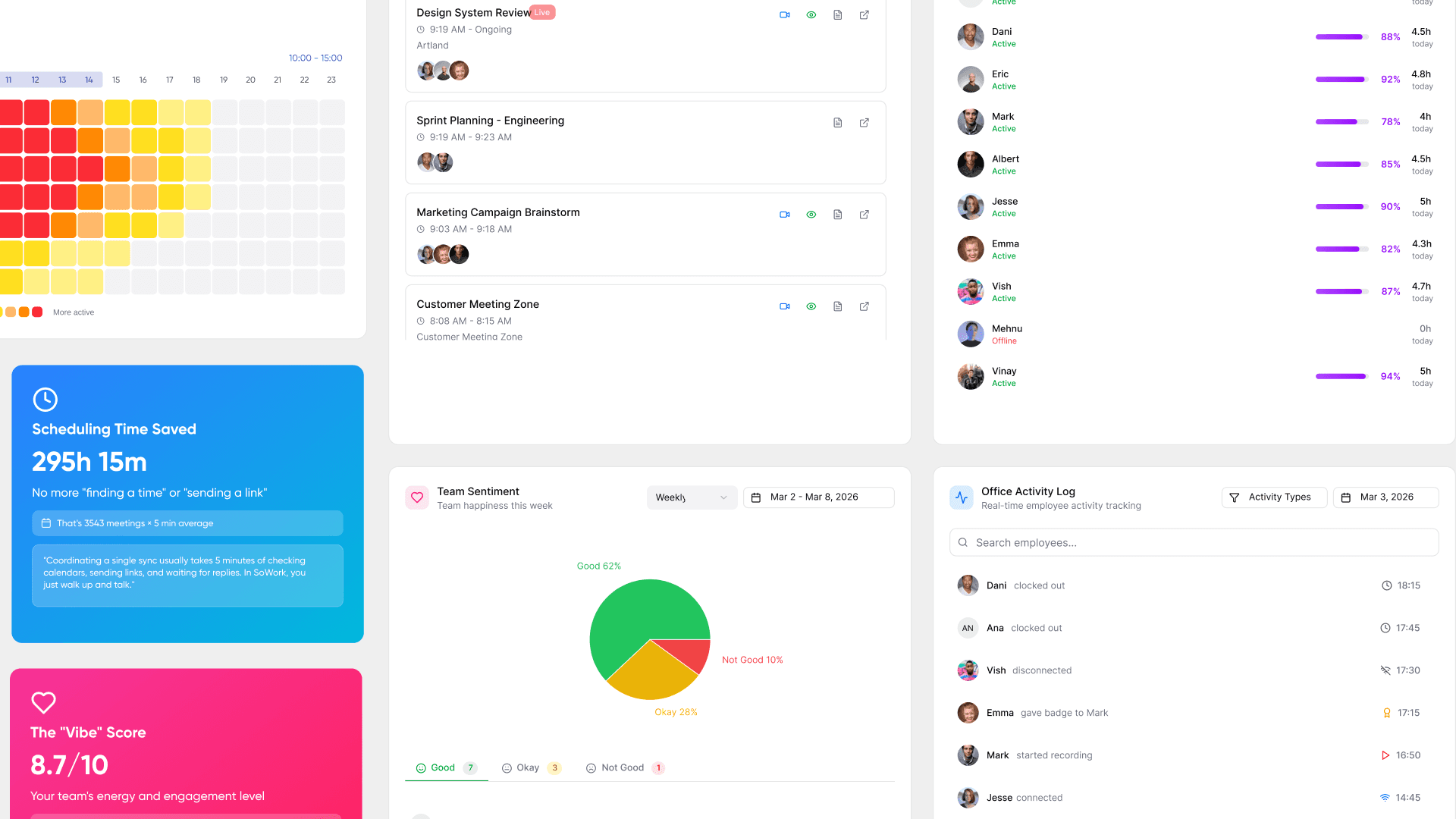
HyHyve to SoWork Migration Guide (2026)
Vishal Punwani

Published:
Updated on:
To migrate from HyHyve to SoWork, audit your HyHyve spaces and usage, set up a SoWork office (free for up to 10 users), rebuild rooms around how your teams work, invite members by link or SSO, connect Slack and your calendars, then pilot with one team before cancelling HyHyve. Most teams of 10 to 100 people finish in 2 to 6 weeks.
What is SoWork, and how does it compare to HyHyve?
SoWork is a browser-based virtual office built for always-on daily team presence, with AI meeting memory and AI agents working in the same space as your people. HyHyve is a German, GDPR-focused spatial platform that covers both online events and virtual offices, and it integrates closely with Microsoft Teams.
SoWork | HyHyve | |
|---|---|---|
Core focus | Daily virtual office for remote teams | Online events plus virtual offices |
Pricing model | Per user: free up to 10, Basic $6, Premium $15/user/month [4] | Per participant-video-minute, from €29.90/month for 2,000 minutes [1] |
Microsoft Teams | Outlook calendar sync | Runs inside Teams, from €8/user/month [2] |
AI | Meeting summaries, MCP/API, AI agents in the office | Recording for bubbles, broadcasts and meeting areas [2] |
Capacity | About 200 per floor, unlimited floors | 200 concurrent participants per space by default [3] |
Why do remote teams migrate from HyHyve to SoWork in 2026?
Teams usually switch for three reasons: they want per-seat pricing they can predict, a space designed for everyday work instead of events, and AI that records what got decided in unplanned conversations.
Predictable cost. HyHyve bills by video minute, and every minute over your plan costs €0.03 [1]. A team that talks all day keeps adding to that bill.
Daily use, not events. HyHyve does events very well. SoWork is built for the 9-to-5 office.
Meeting overload. Microsoft's data shows the average worker gets 153 Teams messages every weekday [5], and 57% of meetings are ad hoc with no calendar invite [6]. SoWork's AI Meeting Memory makes sure those quick calls still leave a record.
AI agents. SoWork puts your agents in the office next to your people.
What does SoWork offer that HyHyve doesn't?
SoWork's biggest differentiators are AI Meeting Memory, an MCP/API that lets tools like Claude query your office, AI agents working as characters in the office, and weekly Insights reports. We couldn't find equivalents on HyHyve's public feature pages.
SoWork feature | What it does for you |
|---|---|
AI Meeting Memory | Records, transcribes and summarizes meetings |
MCP/API | Claude can ask who's around, what happened in a meeting, or what the team decided |
AI agents in the office | Agents sit in the office as characters alongside your teammates |
Insights | A weekly report on meeting time, focus time and who works with whom |
Focus Modes | Simple Mode and Mini Mode for deep work |
Automatic Calendar Sync | Your status changes when a calendar event starts |
Topic-Based Chat | Chat organized into topic channels |
Agent Desks are on the roadmap but haven't shipped yet.
What should you audit in HyHyve before migrating?
Write down your spaces, who actually uses them, your monthly minute usage, your integrations, and the date your billing renews. That list becomes your migration checklist.
Spaces and maps. Screenshot every room, zone and label.
Active users. List who logs in every day and who only shows up for events.
Minute usage. Note your monthly participant-video-minutes and any overage charges.
Integrations. Record the Teams, Miro and embedded tools you rely on.
Recordings. Download any bubble, broadcast or meeting recordings you need to keep.
Access rules. Document passwords, allow-lists and guest policies.
Event use. If you run big external events in HyHyve, decide whether to keep a small plan just for those.
Renewal date. Plan your cutover so you don't pay for an extra cycle.
How do you set up a SoWork office from scratch?
You can create a SoWork office and invite people in minutes, and nobody has to download anything. Start on the free plan, then upgrade when the pilot proves the team will use it.
Sign up and create your company office. The free plan covers up to 10 users [4].
Pick a layout and design your floors. Each floor holds about 200 people, and you can add as many floors as you need.
Have everyone customize their avatar so the office feels like your company.
Connect Google Calendar or Outlook so statuses update on their own.
Create topic chat channels for each team.
Choose a plan. Basic is $6/user/month and Premium is $15/user/month, and Premium adds AI summaries and analytics [4].
Turn on SSO if you're on Premium or Enterprise.
How do you recreate HyHyve rooms and zones in SoWork?
Map each HyHyve area to the SoWork space that serves the same purpose, but lay it out around daily work instead of copying an event floor plan. Desks for each team, a few meeting rooms and one social area cover most companies.
HyHyve element | SoWork equivalent |
|---|---|
Bubbles (proximity chats) | One-click Instant Meetings at desks |
Meeting areas | Named meeting rooms |
Broadcast stage | An all-hands room |
Lounge or networking zone | A social area for casual chat |
Room labels and topics | Room names plus topic-based chat channels |
Give each department its own cluster of desks so people can see who's free at a glance. Keep the layout simple. Remove any room nobody used in HyHyve.
How do you move team members from HyHyve to SoWork?
Accounts don't carry over from one platform to the other, so you re-invite people to SoWork. Small teams can share an invite link. Larger teams should use SSO, or SCIM on Enterprise.
Export your active user list from your HyHyve audit, or pull it from your Microsoft Teams directory.
Invite the pilot group first using a shared invite link.
Turn on SSO (Premium and Enterprise) so people sign in with the credentials they already use.
If you need automated provisioning and deprovisioning, use SCIM. It's only available on Enterprise.
Assign desks and admin roles before the first full day.
Remove people's HyHyve access only after they've logged into SoWork.
How do you connect SoWork to Slack, Google Workspace, Zoom and other tools?
Connect your calendar first, because automatic status sync is what makes presence accurate. Then add Slack, Zapier and Miro, and plug your AI tools into SoWork's MCP server.
Tool | How it connects |
|---|---|
Google Calendar / Outlook | Native sync. Your status flips to busy when an event starts |
Slack | Native integration |
Zapier | Automations (Premium) [4] |
Miro | Native integration |
Claude and other AI tools | SoWork's MCP server |
Zoom isn't on SoWork's native integration list. If you still use it for external calls, keep it, and calendar sync will mark you as in a meeting while the call runs. Pin the SoWork office link in Slack so people find it quickly.
How do you run a SoWork pilot before shutting down HyHyve?
Run a two-week pilot with one team of 5 to 10 people on SoWork's free plan, then roll out department by department. Cancel HyHyve only after the last group has been active in SoWork for a full week.
Pick an eager pilot team. One manager and up to 10 people fit the free plan [4].
Agree on norms. Everyone logs in at the start of the day and starts quick chats in SoWork.
Track two numbers. Daily logins and scheduled meetings per week.
Collect feedback at the end of week one and week two.
Expand one department per week.
Decommission. Set HyHyve's cancellation date to match your renewal date.
What are the main risks of a HyHyve to SoWork migration?
The biggest risk is that people stop showing up. In a 2025 Yooz survey, 1 in 7 employees said they'd refused a new tool at least once [7]. Most other risks come down to planning.
Risk | Mitigation |
|---|---|
Low adoption | Leaders log in first and stay visible all day |
Split presence across two tools | Set a firm cutover date |
Lost recordings | Export HyHyve recordings before you cancel |
Teams-native users lose embedded access | Connect Outlook calendar sync and pin the SoWork link |
Large external events | Keep a minimal HyHyve plan for events if you need it |
Paying for both tools | Line up the pilot end date with HyHyve's renewal |
How do you train your team to use SoWork's ambient presence?
Teach the habits, not the buttons. A 20-minute kickoff and visible behavior from leaders do more than any written manual.
Run a short kickoff. Show presence indicators, one-click Instant Meetings and Focus Modes live.
Set a simple rule. Someone who shows as free is open to a quick question. Someone in Focus Mode isn't.
Swap scheduled calls. Replace one recurring sync per week with an ad hoc chat.
Show the payoff. Share an AI meeting summary in Slack so people can see that nothing gets lost.
Offer Mini Mode to anyone who finds the full office distracting.
Name a champion on each team to answer questions for the first two weeks.
What does SoWork cost in 2026 compared to HyHyve?
SoWork is free for up to 10 users. Basic is $6/user/month and Premium is $15/user/month, or $5.40 and $12 billed annually [4]. HyHyve charges by video minute, from €29.90/month for 2,000 minutes, or from €8/user/month for its Teams-based office [1][2].
Here's how that looks for a 25-person team.
Plan | Estimated monthly cost |
|---|---|
SoWork Basic | $150 |
SoWork Premium (annual) | $300 [4] |
HyHyve for Teams | €200 [2] |
HyHyve minutes plan | About €745* |
*This is our estimate from HyHyve's published rates [1]. It assumes each person spends one hour a day in calls for 21 workdays, which adds up to 31,500 minutes. That's the €99.90 plan for 10,000 minutes plus 21,500 extra minutes at €0.03. Teams that talk less will pay much less.
How do you manage the period when some people are still on HyHyve?
Keep the overlap short and make it clear which tool is in charge. Two weeks of running both is plenty for most teams.
Pick one home for presence. Once a department moves, its daily presence happens only in SoWork.
Bridge with Slack. Post the SoWork office link and a weekly migration update in a shared channel.
Use calendar invites across groups. For meetings between moved and unmoved teams, send a normal invite with a SoWork link.
Save HyHyve for scheduled events until the cutover date.
Publish the end date at kickoff and stick to it.
How do you measure whether the SoWork migration worked?
Judge success by daily usage, fewer scheduled meetings and more focus time. SoWork's weekly Insights report tracks the last two for you.
Metric | Where to find it | Good sign at 30 days |
|---|---|---|
Daily active users | SoWork admin | Most of the team logs in every workday |
Time in meetings | Insights weekly report | Trending down |
Focus time | Insights weekly report | Trending up |
Cross-team collaboration | Insights (who works with whom) | New connections forming |
Cost per seat | Billing | Equal to or lower than HyHyve |
Team sentiment | Short pulse survey | Majority prefer SoWork |
Write down your HyHyve numbers before you switch so you have something to compare against.
What alternatives to SoWork should you consider?
Gather, Spot, Sococo, Kumospace and Teamflow are the main virtual office alternatives, and Remo is worth a look for events. SoWork is still our top pick for daily remote offices because it combines presence, AI meeting memory and AI agents at a lower per-seat price than most of them.
Platform | Entry price | Best for |
|---|---|---|
SoWork | Free up to 10, then $6/user/month [4] | Daily office plus AI meeting memory |
Gather | $15/user/month, no free tier since late 2025 [8] | Social, culture-first teams |
Spot | Basic $6, Growth $10/user/month [9] | Budget mid-tier |
Sococo | $14.99/seat/month [10] | Floor-plan style offices |
Kumospace | See vendor | Lightweight spatial rooms |
Teamflow | See vendor | Embedded app collaboration |
Remo | See vendor | Networking events |
How long does a HyHyve to SoWork migration take for 10 to 100 people?
Plan on 1 to 2 weeks for teams under 25 people and 4 to 6 weeks for teams of 50 to 100. These are planning estimates, not measured benchmarks. Most of the time goes into the pilot and building habits, not technical setup.
Team size | Audit + setup | Pilot | Full rollout | Total |
|---|---|---|---|---|
10 to 25 | 1 to 2 days | 1 week | Same week | 1 to 2 weeks |
25 to 50 | 2 to 3 days | 2 weeks | 1 week | 2 to 4 weeks |
50 to 100 | 1 week | 2 weeks | 2 to 3 weeks | 4 to 6 weeks |
If you need SSO or SCIM, configure them before the pilot. Adding identity setup in the middle of a rollout is the most common cause of delays.
Bottom line
If your team uses HyHyve mainly as a daily office, SoWork is the stronger home. You get predictable per-seat pricing, AI Meeting Memory, and AI agents working in the same space as your people.
Audit first, pilot with one team on the free plan, and set a hard cutover date that lines up with your HyHyve renewal. If you also run large external events, keep a small HyHyve plan for those and move everyday work to SoWork.
Key Takeaways
SoWork is free for up to 10 users. Basic is $6/user/month and Premium is $15/user/month ($12 billed annually).
HyHyve bills by video minute (from €29.90 for 2,000 minutes, €0.03 per extra minute), so teams that talk a lot see their bill grow.
Before you switch, export HyHyve recordings and write down your spaces, active users and renewal date.
Accounts don't transfer between platforms. Re-invite people by link, SSO (Premium and Enterprise) or SCIM (Enterprise only).
Pilot with one team of up to 10 people for two weeks before rolling out to each department.
Connect calendar sync first so presence is accurate from day one.
Track daily logins, meeting time and focus time with SoWork's weekly Insights report.
Most teams of 10 to 100 people finish the move in 2 to 6 weeks.
Related reading
How to Migrate from Gather to SoWork: A Step-by-Step Guide for Remote Teams in 2026
How to Migrate from Spot to SoWork: A Step-by-Step Guide for Remote Teams in 2026
How to Migrate from Kumospace to SoWork: A Step-by-Step Guide for Remote Teams in 2026
Sources
HyHyve supports up to 200 concurrent participants per space by default
57% of meetings are ad hoc with no calendar invite, per Microsoft's 2025 Work Trend Index
A 2025 Yooz survey found 1 in 7 employees have refused a new workplace tool at least once
Gather removed its permanent free tier in late 2025, with a $15/user/month rate
HyHyve's broadcast feature supports up to 200 speakers and 400 viewers
FAQ
How to migrate from HyHyve to SoWork: a step-by-step guide for remote teams in 2026
Is SoWork cheaper than HyHyve?
Can I import my HyHyve map, recordings or users into SoWork?
Does SoWork work with Microsoft Teams like HyHyve does?
Can SoWork handle large virtual events the way HyHyve can?
Do team members need to download anything to use SoWork?
Is SoWork secure enough for a growing company?
Will my team actually use a virtual office every day?
Blogs
Read Similar Articles
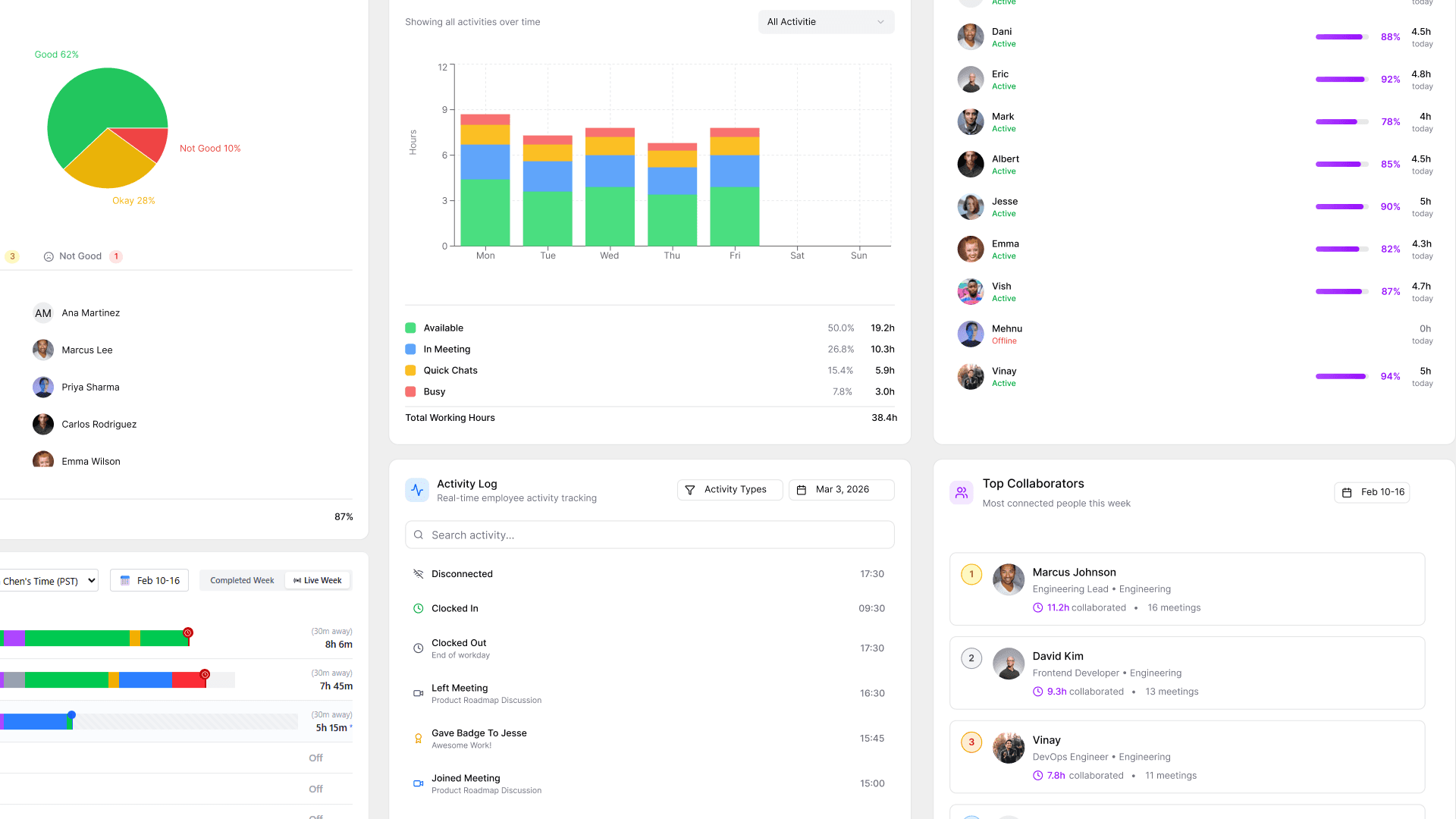
Remote Team Analytics: Complete Guide to Data-Driven Remote Work Management in 2026
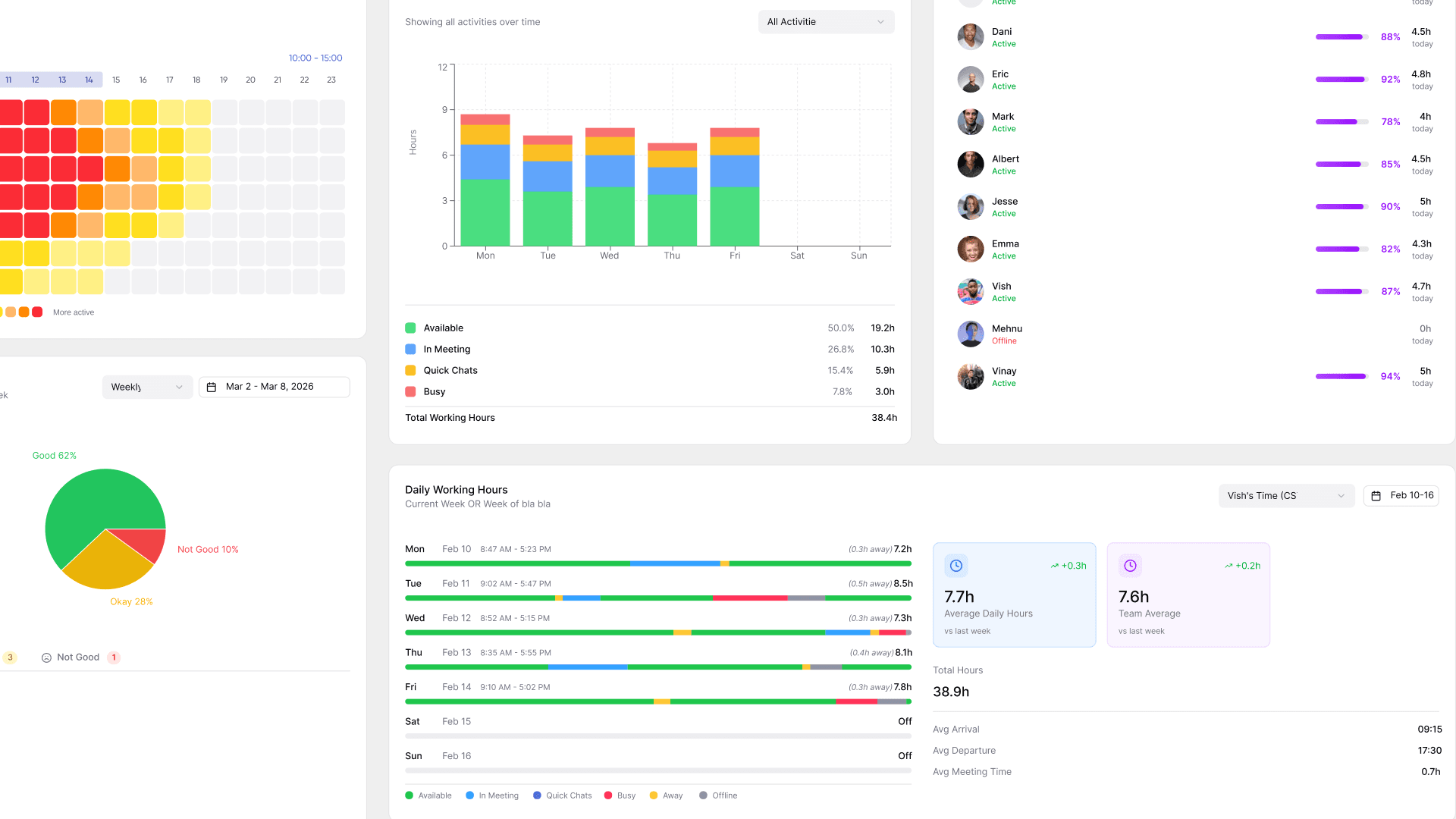
Complete Guide to Gaining Visibility Into Remote Team Performance and Collaboration