How to Migrate from Spot to SoWork in 2026
Vishal Punwani

Published:
Updated on:
The best way to move from Spot to SoWork is a phased rollout over three to four weeks. Back up your Spot workspace, run a SoWork pilot with one team, rebuild your floor plan and integrations, then move everyone over with a one-week overlap. Make the switch if you want AI meeting summaries and presence that updates itself.
What is SoWork and how does it compare to Spot?
SoWork is a virtual office where your remote team and your AI agents share one space. It's built around one-click meetings, presence that updates itself, and AI meeting memory. Spot is a web-first virtual office that you can customize heavily and program through an API.
Area | SoWork | Spot |
|---|---|---|
Core strength | AI meeting summaries, presence, team insights | Deep space customization, browser join |
Interface | 2.5D office plus a Simplified Mode [3] | Spatial office view only [3] |
Developer access | Live MCP/API for tools like Claude | API in beta [3] |
Entry price | Free for up to 10 users, Basic at $6/user/month [2] | Basic at $6/user/month, no ongoing free plan [1] |
Security | SOC 2; Enterprise adds SSO and SCIM | SSO and enhanced permissions on Enterprise [1] |
Why are remote teams moving from Spot to SoWork in 2026?
Mostly because they want meetings to leave a record (summaries, decisions, action items) and want their AI tools in the same place as their people. Price usually isn't the reason, since both platforms start at $6 per user.
Spot is built around customizing your workspace, not around AI meeting output [3]. SoWork records, transcribes, and summarizes calls, so decisions don't disappear when someone forgets to take notes. Calendar sync changes your status the moment a meeting starts. The MCP/API lets Claude ask who's around or what the team decided. Teammates who don't like avatars can switch to Simplified Mode. Some G2 reviewers also say Spot can run slowly on lower-end devices [8].
What does SoWork offer that Spot doesn't?
SoWork's biggest differences are built-in AI meeting memory, a live MCP/API that connects AI agents to your office, and a Simplified Mode for people who'd rather not use the spatial view. Spot doesn't market AI summaries or recordings as core features [3].
SoWork capability | What it does for you |
|---|---|
AI Meeting Memory | Records, transcribes, and summarizes calls with action items |
MCP/API | Claude or your own tools can ask who's around and what was decided |
AI agents in the office | Agents work in the same office as your teammates |
Simplified and Mini Mode | Lighter views for deep work [3] |
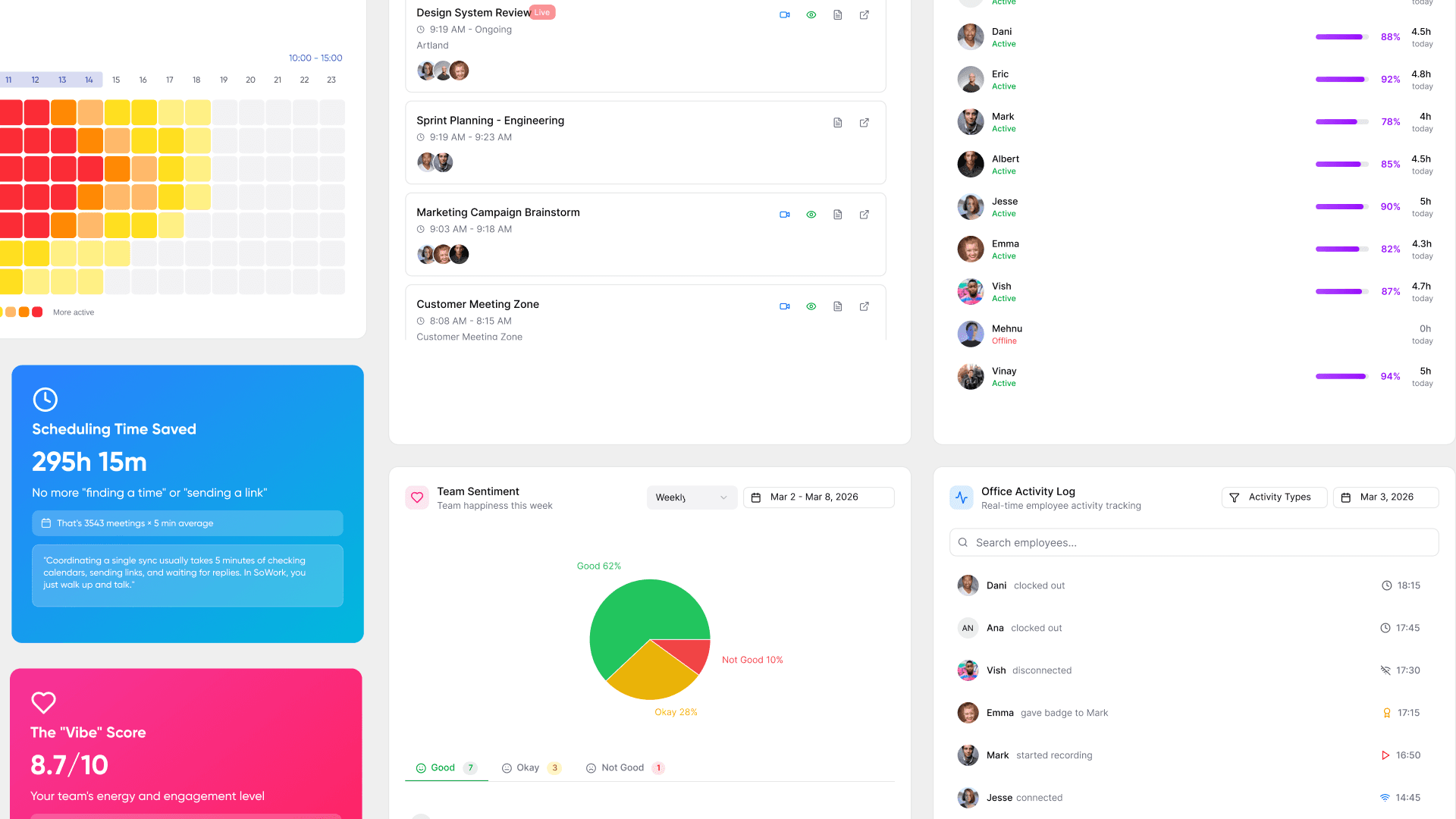
Weekly Insights | Shows meeting time, focus time, and who works with whom |
Calendar sync | Status updates automatically when an event starts |
Agent desks are coming soon and aren't available yet.
How do you decide if SoWork is the right fit before migrating?
Score SoWork on five things: what your meetings currently cost you, how much you rely on presence, your AI plans, your integrations, and your security needs. If at least three of them clearly favor SoWork, migrate.
Criterion | Question to answer |
|---|---|
Meeting output | Do decisions get lost after calls? |
Presence | Does your team rely on seeing who's free right now? |
AI agents | Do you want Claude or other agents working with the team? |
Integrations | Do you need Slack, Zapier, Miro, Google Calendar, or Outlook? |
Security | Do you need SOC 2, SSO, or SCIM? |
Customization | Is scripting custom office behavior through an API a must? (If yes, Spot may suit you better [3].) |
How does SoWork pricing compare to Spot, and what does migrating cost?
SoWork Basic and Spot Basic both cost $6 per user per month. SoWork Premium, which adds AI summaries, costs more than Spot Growth. The main extra cost of migrating is paying for both tools during the overlap month.
Plan | Monthly price | Notes |
|---|---|---|
SoWork Free | $0 | Up to 10 users, audio only, 30-minute meetings [2] |
SoWork Basic | $6/user ($5.40 annual) | Core office [2] |
SoWork Premium | $15/user ($12 annual) | Recordings, AI summaries, analytics, Zapier [2] |
Spot Basic | $6/user | 30-day free trial [1] |
Spot Growth | $10/user | 20% off yearly [1] |
For 25 people on annual billing, SoWork Premium comes to about $300 a month.
How do you back up your data from Spot before migrating?
Ask Spot support exactly what can be exported before you cancel anything. Then save everything that can't be exported by hand: layouts, member lists, shared files, and chat context.
Ask Spot support in writing which exports are available on your plan.
Screenshot every floor, room, and desk layout.
Export your member list with roles and teams from the admin settings.
Download shared files, images, and stickies pinned in rooms.
Copy important decisions from chat into a doc or wiki.
List every integration and API script you depend on.
Keep Spot active until the cutover date so nothing gets cut off mid-migration.
How do you set up a SoWork workspace that matches your team structure?
You can create a SoWork office in your browser in minutes, with no download. Set it up so it mirrors your org chart: floors for departments, desk clusters for teams.
Create the workspace and choose your plan.
Plan your floors. Each floor holds about 200 people, and you can add as many floors as you need.
Connect Google Calendar or Outlook so status changes on its own.
Set up topic-based chat channels that match your Slack structure.
Assign admin roles.
On Enterprise, turn on SSO and SCIM provisioning before you invite anyone [2].
How do you recreate your Spot rooms and layouts in SoWork?
Work from your Spot screenshots and recreate each room by what it's for, not what it looked like. Keep the spots people actually used and drop the ones nobody visited.
Start with desks grouped by team, because those clusters are what make presence useful. Then add meeting rooms that match your recurring meetings. Build one or two social spaces for informal chat. Use SoWork's furniture and decor to show off your company culture, a bit like building in The Sims. Premium teams with more than 30 people can get a custom map built for free [3]. Keep the room names from Spot so nobody has to learn new directions.
How do you invite and onboard your team to SoWork?
Invite a few champions first, then the pilot team, then everyone else. You can send everyone an invite link, and they join from the browser without installing anything [3].
Pick one champion per team and onboard them a week early.
Send invite links in batches, not all at once.
Run a 15-minute live tour inside SoWork itself.
Show people how Simplified Mode and Focus Modes work so nobody feels watched.
Move one daily ritual, like standup, into SoWork on day one.
Post a short FAQ thread in Slack for questions.
How does SoWork integrate with Slack, Google Workspace, and Zoom?
SoWork connects natively with Slack, Zapier, Miro, Google Calendar, and Microsoft Outlook. It has its own video and screen sharing, so most teams stop using Zoom for internal calls.
Tool | How it works with SoWork |
|---|---|
Slack | Native integration for notifications |
Google Calendar / Outlook | Auto-updates status when a meeting starts |
Zapier | Sends meeting outputs to other apps (Premium) [2] |
Miro | Whiteboarding inside your workflow |
Zoom | Not needed internally; keep it for external webinars if you want |
Claude and AI tools | Connect through SoWork's MCP/API |
What's the recommended timeline for migrating from Spot to SoWork?
Plan on three to four weeks for a team of 5 to 200 people. Run a pilot first, roll out to everyone in stages, and keep a one-week overlap before you shut Spot off.
Week | Phase | Goal |
|---|---|---|
0 | Audit and backup | Spot data saved, success metrics defined |
1 | Pilot | One team works fully in SoWork |
2 | Build | Layout, integrations, and calendar sync done |
3 | Company rollout | Everyone invited, rituals moved over |
4 | Overlap and cutover | Spot set to read-only, then cancelled |
Time your cutover around Spot's billing date so you don't pay for an extra month.
What are the biggest risks when migrating, and how do you avoid them?
Most failures come from people, not technology. In Prosci's research, 41% of IT software implementations only partially met their objectives and another 4% failed outright [6].
Pitfall | Fix |
|---|---|
Running two offices indefinitely | Set a hard cutover date |
Lost history | Back up Spot before you cancel |
Low adoption | Have leaders work in SoWork every day |
"Surveillance" worries | Explain Focus Modes and Simplified Mode up front |
Broken workflows | List integrations before you switch |
Projects with excellent change management are seven times more likely to meet their objectives [5].
How do you keep team culture and presence alive during the transition?
Pick one office as "home" each week so people always know where to find each other. Move social rituals over first, since they're what keeps a remote team connected.
Isolation is a real risk for distributed teams. Gallup's 2025 report found that 27% of fully remote employees felt lonely a lot of the previous day [4]. Don't split the team across two tools for weeks. Move coffee chats, demos, and celebrations into SoWork early so the new office feels lived in. Turn on calendar sync on day one so presence is accurate right away. Have managers sit at their desks visibly and make it normal to wave someone over.
What training and resources does SoWork provide after you migrate?
Most teams don't need formal training, because SoWork runs in the browser and uses familiar actions like clicking a teammate to talk. Enterprise customers also get assisted rollout and dedicated support [9].
Everyone else can rely on SoWork's onboarding flow, its blog guides on remote collaboration, and in-app support. The quickest way to train people is by example. A 15-minute live tour, plus one real meeting where people see AI Meeting Memory produce a summary, teaches more than a slide deck. Write down your own house rules too: which rooms are for what, when to use Focus Mode, and where meeting summaries get posted.
How do you measure whether the migration worked?
Set three to five measurable goals before you migrate, then check them at 30 and 60 days. In Prosci's research, 80% of respondents with well-defined objectives met or beat them, compared with 25% of those who didn't measure [7].
Metric | Where to find it |
|---|---|
Daily active users | SoWork admin data |
Hours in scheduled meetings | SoWork weekly Insights |
Focus time per person | SoWork weekly Insights |
Collaboration across teams | Insights collaboration map |
Decisions captured | Count of AI meeting summaries |
Team sentiment | Short pulse survey |
What do teams who've switched from Spot to SoWork report?
We couldn't find a large public body of reviews from teams that moved specifically from Spot to SoWork, so be skeptical of sweeping claims. Comparison reviews do show a consistent trade-off between the two tools.
Spot users on G2 praise its customization and intuitive interface [8]. SoWork's advantage is turning meetings into summaries and action items, plus Simplified Mode for people who don't want the spatial view [3]. The fastest way to know how your own team will react is a one-week pilot with a short survey at the end. Ask three things. Did you find people faster? Did you lose any decisions? Would you go back?
What alternatives should you consider if SoWork isn't the right fit?
If SoWork doesn't fit, consider Gather, Kumospace, Teamflow, Sococo, or Roam, or simply stay on Spot if API-driven customization is what matters most to you.
Platform | Best for | Price signal |
|---|---|---|
Gather | Playful 2D spatial offices | Check current pricing |
Kumospace | Spatial audio and events | Check current pricing |
Teamflow | App-based collaboration | Check current pricing |
Sococo | Floor-plan presence | $14.99 to $24.99/seat/month [10] |
Roam | Room-based HQ with AI | $19.50/active user/month [11] |
Spot | Programmable custom spaces | $6 to $10/user/month [1] |
Bottom line: should you migrate from Spot to SoWork?
Migrate if your team needs meetings that produce summaries, presence that updates itself, and a place where AI agents work alongside people. Stay on Spot if scripting custom office behavior through its API is essential to you.
Back up Spot first, pilot SoWork with one team, set a hard cutover date, and measure meeting hours and adoption at 30 days. A disciplined three-to-four-week rollout beats a slow drift between two tools.
Key Takeaways
Plan on a three-to-four-week phased migration: audit, pilot, build, roll out, then cut over with a one-week overlap.
Back up Spot layouts, member lists, files, and key chat decisions before cancelling, and confirm in writing which exports Spot supports.
SoWork Basic and Spot Basic both cost $6 per user per month. SoWork Premium ($15, or $12 billed annually) adds AI summaries and recordings.
Recreate rooms by what they're for, starting with team desk clusters, and keep the room names your team already knows.
Connect Google Calendar or Outlook on day one so presence is accurate from the start.
Projects with excellent change management are seven times more likely to meet objectives, so have leaders work in SoWork visibly every day.
Measure success at 30 and 60 days using SoWork's weekly Insights on meeting time, focus time, and collaboration.
Related reading
How to Migrate from Gather to SoWork: A Step-by-Step Guide for Remote Teams in 2026
How to Migrate from Kumospace to SoWork: A Step-by-Step Guide for Remote Teams in 2026
How to Migrate from Teamflow to SoWork: A Step-by-Step Guide for Remote Teams in 2026
Sources
FAQ
How to migrate from Spot to SoWork: a step-by-step guide for remote teams in 2026
Does Spot have a free plan?
Is SoWork worth paying for over Spot?
Can SoWork replace Zoom and Slack?
Will my team actually use a virtual office after the first week?
Can AI agents work alongside my team in SoWork?
Do my teammates need to download anything to join SoWork?
Can we run Spot and SoWork at the same time during migration?
Blogs
Read Similar Articles
Remote Team Analytics: Complete Guide to Data-Driven Remote Work Management in 2026
Complete Guide to Gaining Visibility Into Remote Team Performance and Collaboration