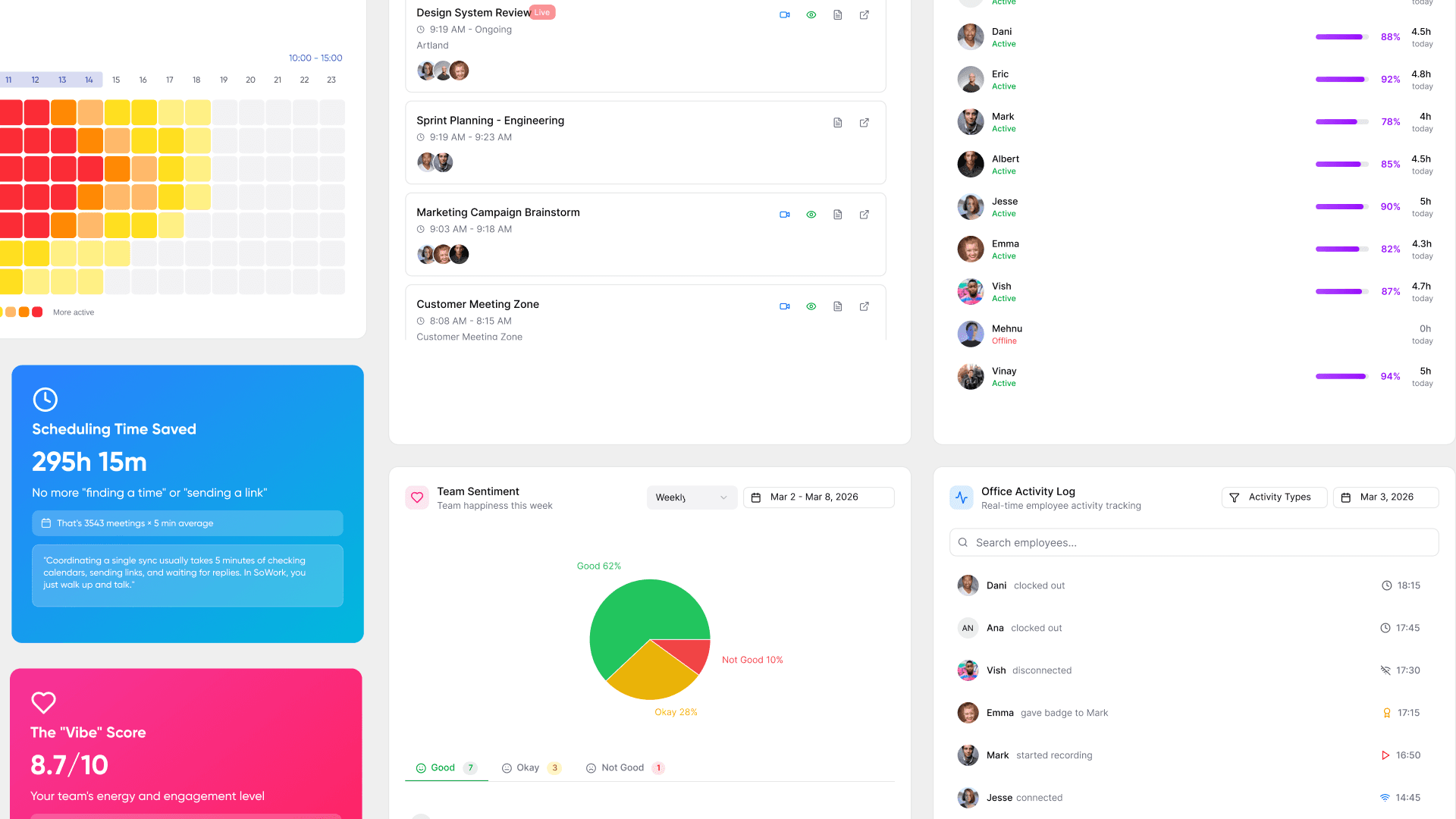
Escritório Virtual Sempre Ativo vs. Ferramentas de Acesso Rápido
Vishal Punwani

Publicado em:
Atualizado em:
Para a maioria das equipes remotas, um escritório virtual sempre ativo como o SoWork é melhor do que ferramentas de reunião pontuais, pois substitui a dependência do calendário pela percepção de presença em tempo real e conversas com um clique. Ferramentas pontuais como o Zoom funcionam para chamadas estruturadas e agendadas, mas não conseguem replicar a colaboração espontânea. Equipes que precisam de ambos podem executá-los em paralelo.
O que é um escritório virtual sempre ativo e como ele difere de uma ferramenta de reunião pontual?
Um escritório virtual sempre ativo é um espaço de trabalho digital persistente onde sua equipe está visivelmente presente ao longo do dia de trabalho, sem necessidade de agendamento para iniciar uma conversa. Uma ferramenta de reunião pontual, como Zoom ou Google Meet, é uma plataforma baseada em sessões que você abre apenas quando uma reunião já está planejada.
Em um escritório virtual sempre ativo, os colegas de equipe aparecem como avatares ou ícones de status em uma planta compartilhada. Você pode ver rapidamente quem está livre, focado ou em uma reunião, e iniciar uma conversa com um único clique. O SoWork, por exemplo, sincroniza eventos do calendário de forma automática para que o status permaneça correto sem atualizações manuais. Ferramentas pontuais exigem um link, um convite de calendário e um horário agendado. Elas são feitas para comunicação estruturada, não para presença de ambiente. A principal diferença: escritórios sempre ativos replicam a sensação de trabalhar na mesma sala; ferramentas pontuais replicam a experiência de reservar uma sala de reuniões.
O que são ferramentas de reunião pontuais e como funcionam para equipes remotas?
Ferramentas de reunião pontuais são plataformas de videoconferência baseadas em sessões, como Zoom, Google Meet e Microsoft Teams, onde os participantes entram em uma chamada por meio de um link, geralmente a partir de um convite de calendário.
Funcionam bem para colaboração estruturada: reuniões diárias rápidas (standups), chamadas com clientes, reuniões gerais. O fluxo de trabalho é: agendar um horário, compartilhar um link, entrar quando o relógio bater. Funcionários remotos agora participam de uma média de 25,6 reuniões por semana, 80% a mais do que os trabalhadores de escritório [1]. Ferramentas pontuais lidam bem com esse volume para interações planejadas. O que elas não conseguem fazer é apoiar aquela dúvida não planejada, a revisão rápida de um design ou a conversa de cinco minutos que costumava acontecer ao caminhar até a mesa de alguém. Cada interação, por menor que seja, exige um evento no calendário.
Quais problemas de colaboração específicos os escritórios virtuais sempre ativos resolvem que as ferramentas de reunião agendada não conseguem?
Os escritórios virtuais sempre ativos resolvem o problema do "calendário para tudo": a tendência de agendar uma reunião formal para perguntas que deveriam levar 90 segundos.
Trabalhadores remotos participam de 50% mais reuniões do que a equipe de escritório, em grande parte porque as conversas informais de corredor foram substituídas por chamadas agendadas [2]. Escritórios sempre ativos resgatam essas microinterações. Você pode ver que um colega está livre e chamá-lo sem tocar no calendário. O recurso AI Meeting Memory do SoWork também resolve um problema relacionado: mesmo quando as reuniões acontecem, 54% dos funcionários desejam resumos pós-reunião, mas apenas 39% os recebem [3]. A transcrição e os resumos automáticos eliminam essa lacuna. Ferramentas pontuais não oferecem presença de ambiente ou alinhamento passivo: ou você está em uma reunião ou está invisível.
Como a percepção de presença em um escritório virtual sempre ativo replica a colaboração espontânea de um escritório físico?
A percepção de presença mostra, em tempo real, quem está livre, focado ou em reunião — o equivalente digital a olhar para o outro lado de um escritório em plano aberto.
68% dos gerentes afirmam que os funcionários remotos perdem feedbacks informais e improvisados cruciais, o que é um resultado direto da perda dessa visibilidade de ambiente [4]. Em um escritório físico, você absorve essa informação passivamente. No SoWork, indicadores visuais de status cumprem a mesma função: verde significa disponível, o modo de foco sinaliza trabalho concentrado, um ícone de reunião significa volte mais tarde. A sincronização com o calendário mantém os status corretos de forma automática. Essa camada de ambiente é o que torna a colaboração espontânea possível sem interromper ninguém. Ferramentas pontuais não têm equivalente; não há como saber se um colega está livre sem enviar uma mensagem e esperar.
Que tipos de equipes remotas se beneficiam mais de um escritório virtual sempre ativo em comparação com uma ferramenta de reunião pontual?
Os escritórios virtuais sempre ativos funcionam melhor para equipes integradas que colaboram com frequência ao longo do dia. As ferramentas pontuais são mais adequadas para equipes com ritmos de reunião previsíveis e estruturados.
Tipo de Equipe | Melhor Opção |
|---|---|
Startups em estágio inicial (5 a 50 pessoas) | Escritório virtual sempre ativo |
Equipes de engenharia que fazem trabalho em dupla | Escritório virtual sempre ativo |
Equipes de vendas com chamadas de pipeline estruturadas | Ferramentas pontuais |
Equipes totalmente distribuídas, com múltiplos fusos horários | Modelo híbrido de ambos |
Equipes de atendimento ao cliente com reuniões externas | Ferramentas pontuais para clientes, sempre ativo internamente |
Equipes de design/criativas que precisam de feedback rápido | Escritório virtual sempre ativo |
Equipes que entregam rápido e iteram diariamente se beneficiam ao máximo da percepção de presença. Equipes cuja colaboração principal é externa se beneficiam mais de vídeos confiáveis baseados em links.
Como os escritórios virtuais sempre ativos reduzem a sobrecarga de reuniões e a dependência do calendário para equipes distribuídas?
Os escritórios virtuais sempre ativos cortam a sobrecarga de reuniões ao possibilitar responder a uma dúvida ou alinhar uma decisão sem precisar abrir o calendário.
O funcionário médio gasta 392 horas por ano em reuniões, mais de 16 dias inteiros de trabalho, e 67% dessas reuniões são consideradas improdutivas [5]. Uma parte significativa desse tempo é sobrecarga de coordenação: agendamento, espera e troca de contexto. Quase 43% dos trabalhadores gastam mais de 3 horas por semana apenas agendando ou organizando reuniões [6]. Escritórios sempre ativos eliminam a maior parte desse atrito. No SoWork, você vê que um colega está livre e inicia uma conversa com um clique. Sem link, sem convite, sem margem de 15 minutos. Os Modos de Foco permitem que as pessoas sinalizem períodos de trabalho concentrado, protegendo sua atenção enquanto permanecem sutilmente visíveis para a equipe.
Quais são os principais critérios que as equipes remotas devem usar para decidir entre um escritório virtual sempre ativo e uma ferramenta de reunião pontual?
A escolha certa depende de como sua equipe realmente colabora no dia a dia: de forma espontânea e frequente, ou em blocos estruturados e agendados.
Critérios | Escritório Virtual Sempre Ativo | Ferramenta de Reunião Pontual |
|---|---|---|
Estilo de colaboração | Espontâneo, frequente | Planejado, estruturado |
Tamanho da equipe | 5 a 200 pessoas | Qualquer tamanho |
Volume de reuniões | Alto e crescente | Gerenciável |
Prioridade de construção de cultura | Alta | Baixa |
Reuniões externas com clientes | Secundária | Primária |
Equilíbrio assíncrono/síncrono | Ambos suportados | Forte foco síncrono |
Orçamento | $6, $15/usuário/mês | Gratuito a $30+/usuário/mês |
Se a maior queixa da sua equipe é o excesso de reuniões ou a sensação de isolamento, um escritório sempre ativo ataca a causa raiz. Se a sua maior necessidade é vídeo confiável para chamadas externas, uma ferramenta pontual é suficiente.
Quais são os riscos ou desvantagens de depender exclusivamente de ferramentas de reunião pontuais para a colaboração de equipes remotas?
Depender apenas de ferramentas pontuais gera uma cultura de colaboração onde toda interação, por menor que seja, exige uma reunião formal, aumentando o volume de reuniões, o cansaço e o distanciamento da equipe.
49% dos profissionais remotos relatam cansaço significativo devido a chamadas de vídeo semanalmente [7]. Quando as ferramentas pontuais são sua única opção, o instinto de agendar uma reunião substitui formas mais eficientes de colaboração. As equipes perdem visibilidade sobre a disponibilidade dos outros, de modo que as dúvidas se acumulam até o próximo alinhamento agendado. 36% dos trabalhadores remotos sentem falta de conversas espontâneas e da integração da equipe, o que enfraquece a coesão ao longo do tempo [8]. Há também um problema de documentação: sem transcrição automática, decisões tomadas em chamadas pontuais muitas vezes ficam sem registro. As taxas de conclusão de tarefas de acompanhamento são 34% menores para reuniões remotas quando nenhum sistema de rastreamento é utilizado [7].
Quais são os riscos ou desvantagens de usar uma plataforma de escritório virtual sempre ativo?
Os principais riscos são o atrito na adoção, a percepção de vigilância e o fato de que ambientes sempre ativos podem misturar os limites entre vida pessoal e profissional se não forem configurados com cuidado.
Mudar do Zoom e Slack para um escritório sempre ativo é uma mudança comportamental, não apenas uma troca de ferramenta. As equipes costumam apresentar uma queda de 10% a 20% na adoção inicialmente antes que o engajamento se estabilize [9]. Alguns funcionários sentem-se desconfortáveis com a visibilidade persistente, pois isso pode soar como monitoramento em vez de presença. A solução é uma comunicação clara: os Modos de Foco no SoWork permitem que as pessoas sinalizem o trabalho concentrado sem desaparecer por completo. Há também o risco de escolher uma plataforma que a equipe não abre de fato diariamente. Plataformas que não entregam valor real ao fluxo de trabalho são abandonadas em semanas. O processo de integração importa: implementações graduais com defensores do projeto nos departamentos superam consistentemente os lançamentos gerais imediatos [10].
Como os escritórios virtuais sempre ativos se comparam às ferramentas pontuais para construir cultura e conexão em equipes remotas?
Os escritórios virtuais sempre ativos são significativamente melhores para a construção de cultura porque criam a camada social de ambiente que as ferramentas pontuais são estruturalmente incapazes de fornecer.
62% dos trabalhadores remotos dizem que sentem falta das interações casuais de um escritório físico [11]. Ferramentas pontuais são projetadas especificamente para a conclusão de tarefas, não para conexão. Você entra, se reúne e sai. Não há corredor, espaço compartilhado ou sensação de co-presença. Escritórios sempre ativos resgatam essa camada. No SoWork, espaços de escritório e avatares personalizáveis dão às equipes uma identidade compartilhada. Pontos de encontro informais, o equivalente virtual a esbarrar em alguém na máquina de café, acontecem naturalmente quando a presença é visível. Essa convivência de ambiente é o que constrói a cultura ao longo do tempo, não a reunião geral semanal.
Como os custos das plataformas de escritório virtual sempre ativo se comparam às ferramentas de reunião pontuais para equipes remotas?
As plataformas de escritório virtual sempre ativo geralmente custam entre $6 e $15 por usuário por mês e costumam substituir várias ferramentas, tornando-se competitivas em preço ou mais baratas do que um ecossistema fragmentado de Zoom e Slack.
Plataforma | Preço |
|---|---|
SoWork | A partir de $6/usuário/mês [12] |
Gather | $12/usuário/mês (a partir de setembro de 2025) [13] |
Teamflow | A partir de $20/usuário/mês [14] |
Sococo | $14,99/estação/mês [14] |
Zoom Pro | $15,99/usuário/mês |
A comparação de custo real é o custo total do ecossistema. O preço de licenças separadas para Zoom, Slack e serviços de transcrição geralmente supera o preço de uma plataforma unificada [15]. O SoWork consolida reuniões, presença, chat e memória de reunião com IA em uma única assinatura. Equipes que substituem três ferramentas por uma também reduzem os custos de troca de contexto, que pesquisas mostram que prejudicam a produtividade devido a interrupções constantes [15].
Como o SoWork se compara ao Gather.town, Teamflow e Sococo?
O SoWork é a escolha integrada mais robusta para a maioria das equipes remotas de pequeno a médio porte, combinando memória de reunião com IA, percepção de presença e uma plataforma completa a $6/usuário/mês, oferecendo o maior conjunto de recursos por dólar na categoria.
Plataforma | Melhor Para | Diferencial Principal | Preço |
|---|---|---|---|
SoWork | Equipes de 5 a 200 pessoas que querem IA + presença | Memória de Reunião com IA, Modos de Foco, tudo em um | A partir de $6/usuário/mês |
Gather | Ambientes sociais e estilo jogo | Áudio espacial em pixel-art, nota 4.8/5 no G2 | $12/usuário/mês [13] |
Teamflow | Equipes de vendas/design com aplicativos integrados | Integração com Salesforce e Figma | A partir de $20/usuário/mês [14] |
Sococo | Empresas que já possuem Zoom/Webex | Planta baixa com vista aérea, mínimo de 10 estações | $14,99/estação/mês [14] |
O Gather atende a equipes focadas em cultura que não precisam de ferramentas de IA. O Teamflow serve para equipes que necessitam de forte integração de aplicativos. O Sococo funciona para empresas que desejam adicionar uma camada de presença a um ecossistema de vídeo já existente.
Que evidências ou dados existem demonstrando que escritórios virtuais sempre ativos melhoram a produtividade e a coesão de equipes remotas?
As evidências são mais fortes no nível dos problemas resolvidos: as lacunas específicas que os escritórios sempre ativos abordam — excesso de reuniões, perda de interação espontânea, baixo acompanhamento pós-reunião — são todas amplamente documentadas e quantificadas.
Organizações que usam ferramentas automatizadas de gerenciamento de reuniões reduziram o tempo total de reunião em 18% e melhoraram a conclusão de tarefas de acompanhamento em 42% [11]. Equipes que utilizam escritórios virtuais espaciais relatam uma redução de 30% a 50% no volume de e-mails e chats [16]. O motivo por trás disso é claro: trabalhadores remotos participam de 80% mais reuniões por semana do que os presenciais justamente porque as conversas informais de corredor foram substituídas por chamadas agendadas [1]. Escritórios sempre ativos resgatam essas microinterações. Pesquisas de Stanford mostram que trabalhadores remotos com 2 horas ou menos de reuniões agendadas por dia realizam 17% mais trabalho focado [7]. Reduzir a dependência do calendário é o mecanismo; a percepção de presença é a ferramenta.
As equipes remotas podem usar tanto um escritório virtual sempre ativo quanto ferramentas de reunião pontuais juntas?
Sim, e para muitas equipes essa é a configuração ideal: usar um escritório virtual sempre ativo para colaboração interna e presença, e manter uma ferramenta pontual para chamadas externas com clientes.
A divisão é clara e prática. Trabalho interno, perguntas rápidas, revisões de design, alinhamentos diários e sincronizações espontâneas acontecem dentro do escritório sempre ativo. Trabalho externo, demonstrações para clientes, chamadas com fornecedores e entrevistas acontecem via Zoom ou Meet, onde os convidados não precisam instalar nada. O SoWork cuida da colaboração interna nativamente, incluindo vídeo, chat e resumos de reuniões com IA, mantendo o escopo da ferramenta externa bem delimitado. O risco de usar ambos é a dispersão de ferramentas: se o escritório sempre ativo não se tornar o padrão diário para o trabalho interno, as equipes voltam para o Slack e o Zoom para tudo. A disciplina na adoção é essencial.
Que alternativas existem além de escritórios virtuais sempre ativos e ferramentas de reunião pontuais para a colaboração de equipes remotas?
As principais alternativas são ferramentas focadas no assíncrono (Loom, Notion, Linear), plataformas de mensagens de equipe (Slack, Teams) e softwares de gerenciamento de projetos, resolvendo cada um uma parte do problema, mas sem a camada de presença.
Ferramentas assíncronas como o Loom permitem que os colegas gravem atualizações em vídeo em vez de agendar chamadas, útil para fusos horários muito distantes. Notion e Confluence cuidam da documentação e compartilhamento de conhecimento. Ferramentas de gestão de projetos como Linear ou Asana rastreiam o trabalho sem exigir alinhamentos síncronos. Equipes que dominam atualizações assíncronas mantêm uma consistência de entrega 18% maior do que aquelas que dependem apenas de reuniões ao vivo [17]. A lacuna compartilhada por todas essas alternativas: nenhuma oferece percepção de presença em tempo real. Você continua sem saber se um colega de equipe está livre. Elas funcionam melhor como camadas dentro de um ecossistema mais amplo, e não como substitutos independentes para um escritório virtual.
Como os escritórios virtuais sempre ativos lidam com estilos de trabalho assíncrono versus síncrono?
Bons escritórios virtuais sempre ativos suportam ambos: tornam a colaboração síncrona simples e direta, ao mesmo tempo que dão aos indivíduos ferramentas para proteger o tempo de trabalho focado e assíncrono.
Os Modos de Foco do SoWork (Modo Simples e Mini Modo) permitem que os membros da equipe sinalizem o trabalho profundo sem desaparecer. O status fica visível, mas a conversa é pausada. Canais de chat organizados por tópicos gerenciam a comunicação assíncrona sem interromper o trabalho ao vivo. O recurso AI Meeting Memory significa que, mesmo que alguém perca uma conversa síncrona, poderá se atualizar rapidamente pelo resumo gerado automaticamente. Esta é a grande vantagem sobre as ferramentas puramente assíncronas: você tem a flexibilidade do assíncrono com a opção de se tornar síncrono instantaneamente quando for necessário. Ferramentas pontuais forçam uma escolha binária: ou você está em uma reunião ou não está.
Quais desafios de integração e adoção as equipes remotas enfrentam ao mudar para um escritório virtual sempre ativo?
O maior desafio não é técnico, é comportamental. As equipes têm anos de memória muscular usando Zoom e Slack, e a transição exige mudar hábitos diários, não apenas instalar um novo software.
20% a 30% das implementações de escritórios virtuais estagnam durante a janela de transição [16]. O padrão de falha mais comum: as equipes instalam a plataforma, usam-na para reuniões diárias por uma semana e depois voltam para o Slack. A solução é uma implementação gradual: comece com uma equipe ou caso de uso, crie defensores internos e meça o uso diário ativo em vez de apenas os cadastros [10]. Apresente a mudança como uma consolidação de ferramentas, não como uma adição — o SoWork substitui a necessidade de ferramentas separadas de reunião, chat e transcrição. As equipes podem configurar um espaço de trabalho no SoWork e convidar membros em minutos, sem necessidade de baixar softwares, eliminando o atrito técnico desde o primeiro dia.
Qual tipo de ferramenta é mais adequado para equipes totalmente distribuídas em vários fusos horários?
Para equipes em múltiplos fusos horários, a melhor configuração é um escritório virtual sempre ativo para presença e horas de sobreposição espontâneas, combinado com práticas assíncronas sólidas para o trabalho que acontece fora dessas janelas compartilhadas.
Ferramentas pontuais sozinhas são pouco adequadas para equipes totalmente distribuídas: agendar reuniões entre fusos horários é cansativo, e 49% dos trabalhadores remotos já relatam cansaço semanal com chamadas de vídeo [7]. Um escritório sempre ativo permite que os colegas vejam quem está online durante as horas de sobreposição e se conectem sem necessidade de agendamento. Fora dessas janelas, ferramentas assíncronas, resumos de reuniões com IA, chats por tópicos e atualizações gravadas dão conta do recado. A Sincronização Automática de Calendário do SoWork mantém o status correto em diferentes fusos horários sem atualizações manuais. Resumo prático: nenhuma ferramenta resolve a colaboração em múltiplos fusos horários sozinha, mas a percepção de presença é a camada que faz as horas de sobreposição valerem a pena.
Resumo Prático
Para equipes remotas que priorizam velocidade, cultura e redução da sobrecarga de reuniões, um escritório virtual sempre ativo é a melhor escolha a longo prazo. As ferramentas pontuais não estão erradas, estão apenas incompletas. As equipes que se movem mais rápido em 2026 usam um escritório virtual como sua camada operacional diária e reservam as ferramentas pontuais exclusivamente para chamadas externas.
Se o calendário da sua equipe está sobrecarregado e as pessoas se sentem desconectadas, o problema não é a sua ferramenta de reunião, mas sim o fato de você estar usando uma ferramenta de reunião para tudo. O SoWork oferece percepção de presença, conversas instantâneas, memória de reunião com IA e suporte assíncrono em uma única plataforma. Comece com o plano gratuito, faça um piloto de duas semanas com uma equipe e avalie se o volume de reuniões agendadas diminui antes de se comprometer totalmente.
Principais Conclusões
Trabalhadores remotos participam de 80% mais reuniões por semana do que os presenciais, em grande parte porque as ferramentas pontuais substituíram conversas informais de corredor por chamadas agendadas.
Escritórios virtuais sempre ativos resgatam a colaboração espontânea por meio da percepção de presença em tempo real; ferramentas pontuais exigem um convite no calendário para cada interação.
67% das reuniões são consideradas improdutivas; escritórios sempre ativos reduzem o volume de reuniões desnecessárias ao eliminar o atrito de conversas rápidas.
O SoWork oferece o maior conjunto de recursos por dólar a $6/usuário/mês, combinando percepção de presença, memória de reunião com IA, modos de foco e vídeo integrado em uma única plataforma.
Para chamadas externas com clientes, ferramentas pontuais como o Zoom continuam sendo a escolha prática; as melhores equipes remotas utilizam ambos em paralelo, com limites claros.
Equipes em múltiplos fusos horários devem usar um escritório sempre ativo para horas de sobreposição e ferramentas assíncronas (resumos de IA, chat por tópicos) para o trabalho fora das janelas compartilhadas.
A adoção é o maior risco ao mudar para um escritório sempre ativo; implementações graduais com defensores nos departamentos superam lançamentos gerais imediatos em todos os casos.
Equipes que utilizam escritórios virtuais espaciais relatam uma redução de 30% a 50% no volume de e-mails e chats assim que a percepção de presença se torna o padrão diário.
Fontes
Funcionários remotos participam de 50% mais reuniões do que a equipe presencial.
54% dos funcionários desejam resumos e itens de ação pós-reunião, mas apenas 39% relatam recebê-los.
O SoWork oferece o maior conjunto de recursos por dólar a $6/usuário/mês.
O Gather encerrou seu plano gratuito em setembro de 2025 e agora começa em $12 por usuário por mês.
Perguntas Frequentes
Escritório virtual sempre ativo vs. ferramentas de reuniões rápidas: qual é o melhor para equipes remotas?
Um escritório virtual sempre ativo é apenas mais uma ferramenta de videochamada?
Um escritório virtual sempre ativo parece vigilância?
Uma equipe remota pequena (com menos de 20 pessoas) consegue justificar o custo de um escritório virtual permanentemente ativo?
O que acontece com os trabalhadores assíncronos em um escritório virtual sempre ativo?
Quanto tempo leva para uma equipe remota adotar totalmente um escritório virtual sempre ativo?
O Zoom está sendo substituído por plataformas de escritório virtual?
Como os escritórios virtuais sempre ativos lidam com equipes em vários fusos horários?
Blogs
Leia artigos semelhantes
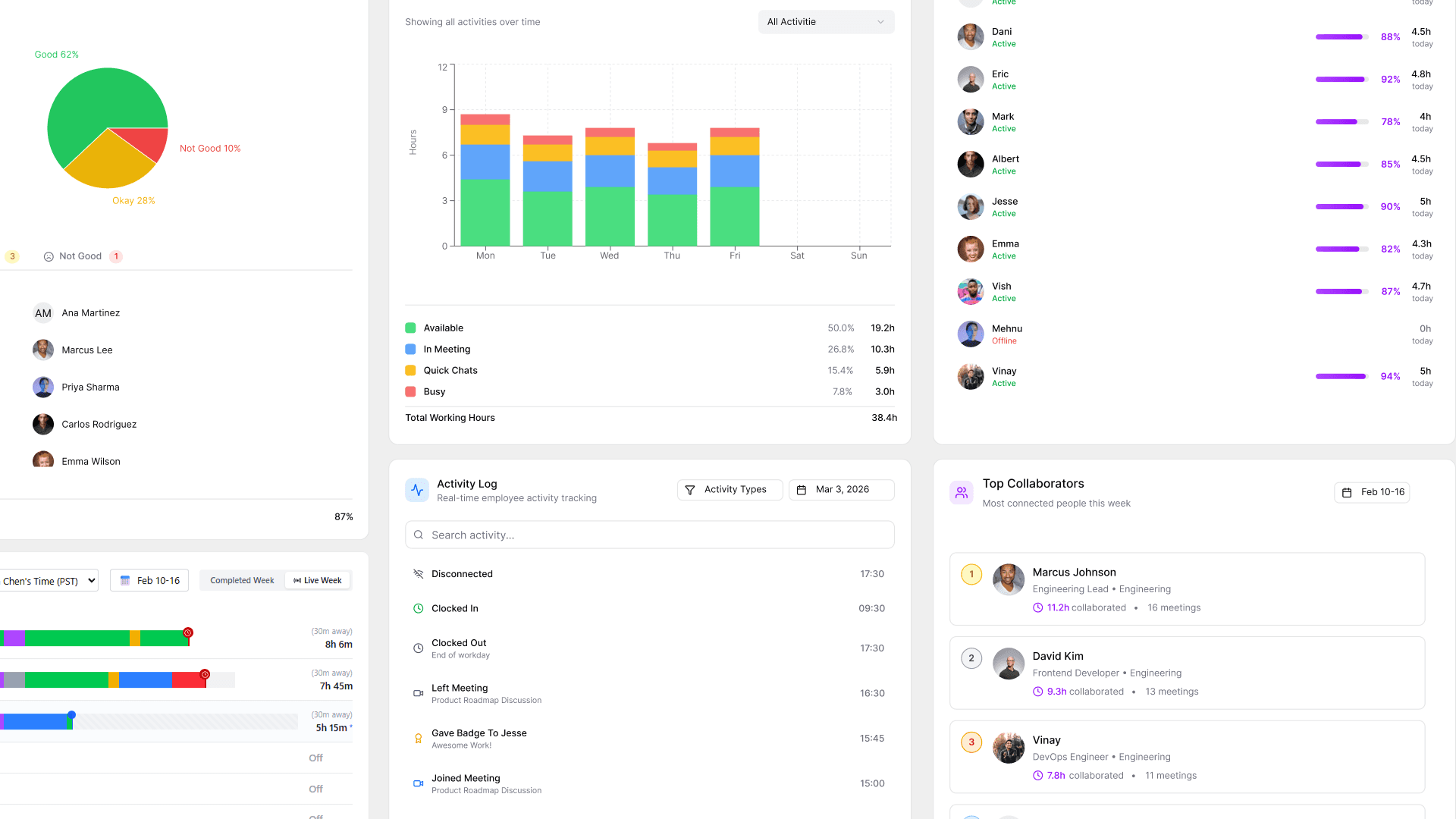
Análise de Equipes Remotas: O Guia Completo para Gestão do Trabalho Remoto Baseada em Dados em 2026
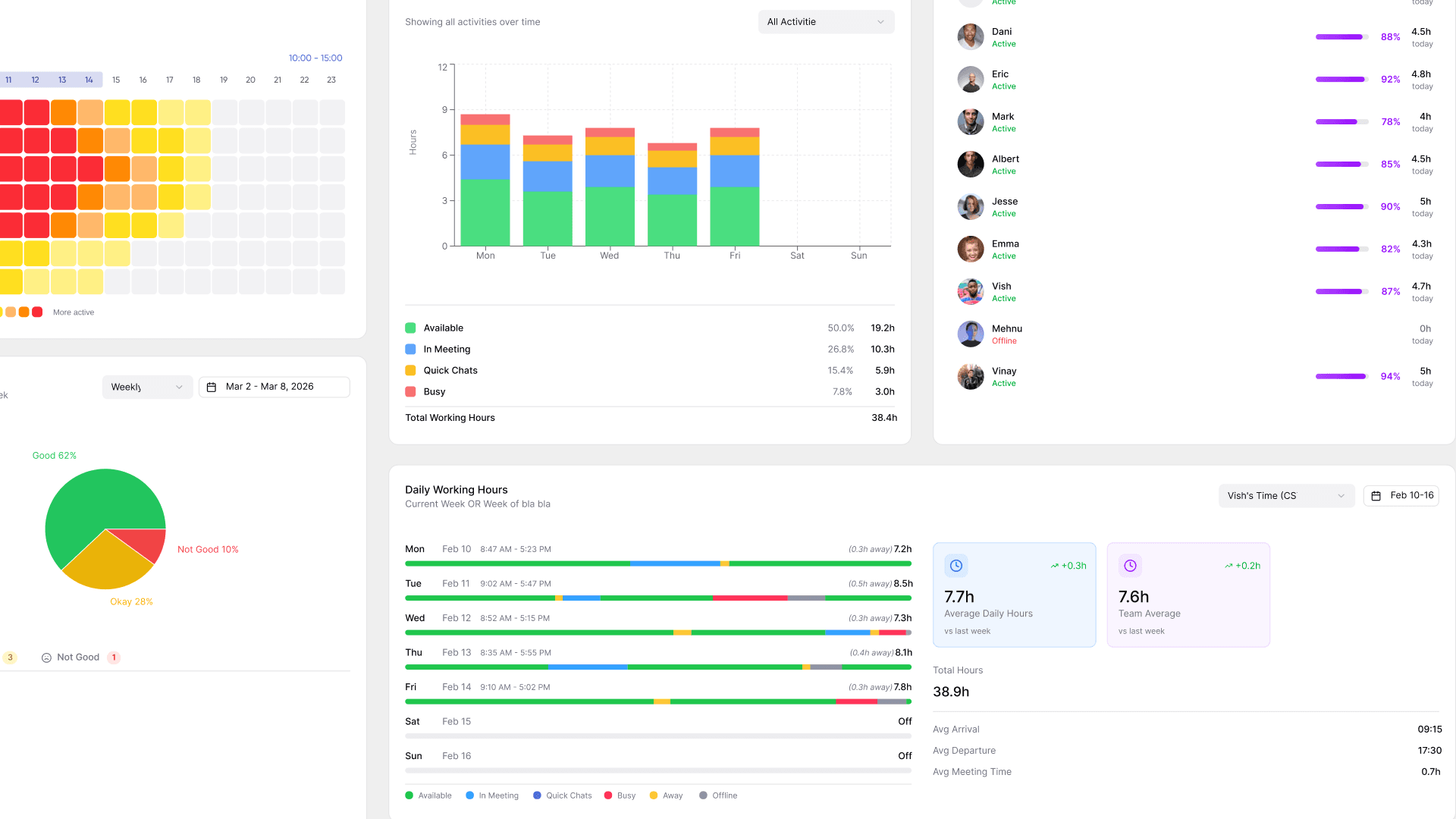
Guia Completo para Obter Visibilidade sobre o Desempenho e a Colaboração de Equipes Remotas