SoWork vs Remo: Which Is Cheaper in 2026?
Vishal Punwani

Published:
Updated on:
SoWork is significantly cheaper than Remo for daily remote team use in 2026. SoWork's Basic plan starts at $6 per user per month ($5.40 annually), while Remo Conference starts at $270 per month flat. For a 25-person daily-use team, SoWork costs roughly $150 per month versus Remo's $270 minimum, and SoWork is purpose-built for persistent, always-on office use.
What is SoWork's pricing structure in 2026?
SoWork offers a free plan for up to 10 users, a Basic tier at $6 per user per month, and a Premium tier at $15 per user per month. Annual billing cuts those to $5.40 and $12 respectively.
SoWork's Basic tier is priced at $6 per user per month or $5.40 per user per month billed annually (a 10% discount), while its Premium tier costs $15 per user per month or $12 per user per month when billed annually (roughly a 20% discount). [1] Volume discounts kick in above 100 users, but you'll need to contact sales for exact figures. [1] Guests can join meetings via link at no additional cost, and there's no charge for integrating existing Zoom or Webex accounts. [1] All plans are self-serve with no minimum seat requirement.
What is Remo's pricing structure in 2026?
Remo Conference starts at $270 per month (billed annually at $3,240), while Remo Virtual Office starts at $20 per user per month. Neither option is cheap for a small daily-use team.
Remo comes in two products: Remo Conference (event-focused, flat-rate plans) and Remo Virtual Office (per-seat). Remo Conference starts at $270 per month on the Essentials plan, billed annually, with a Pro plan at $680 per month annually. [2] One-time event plans start at $700. [2] Remo Virtual Office is priced at $20 per user per month. [3] Reviewers consistently flag the pricing as high, with odd tier jumps and annual billing requirements that make flexibility difficult. [2]
What is SoWork designed for, and what does it offer daily users?
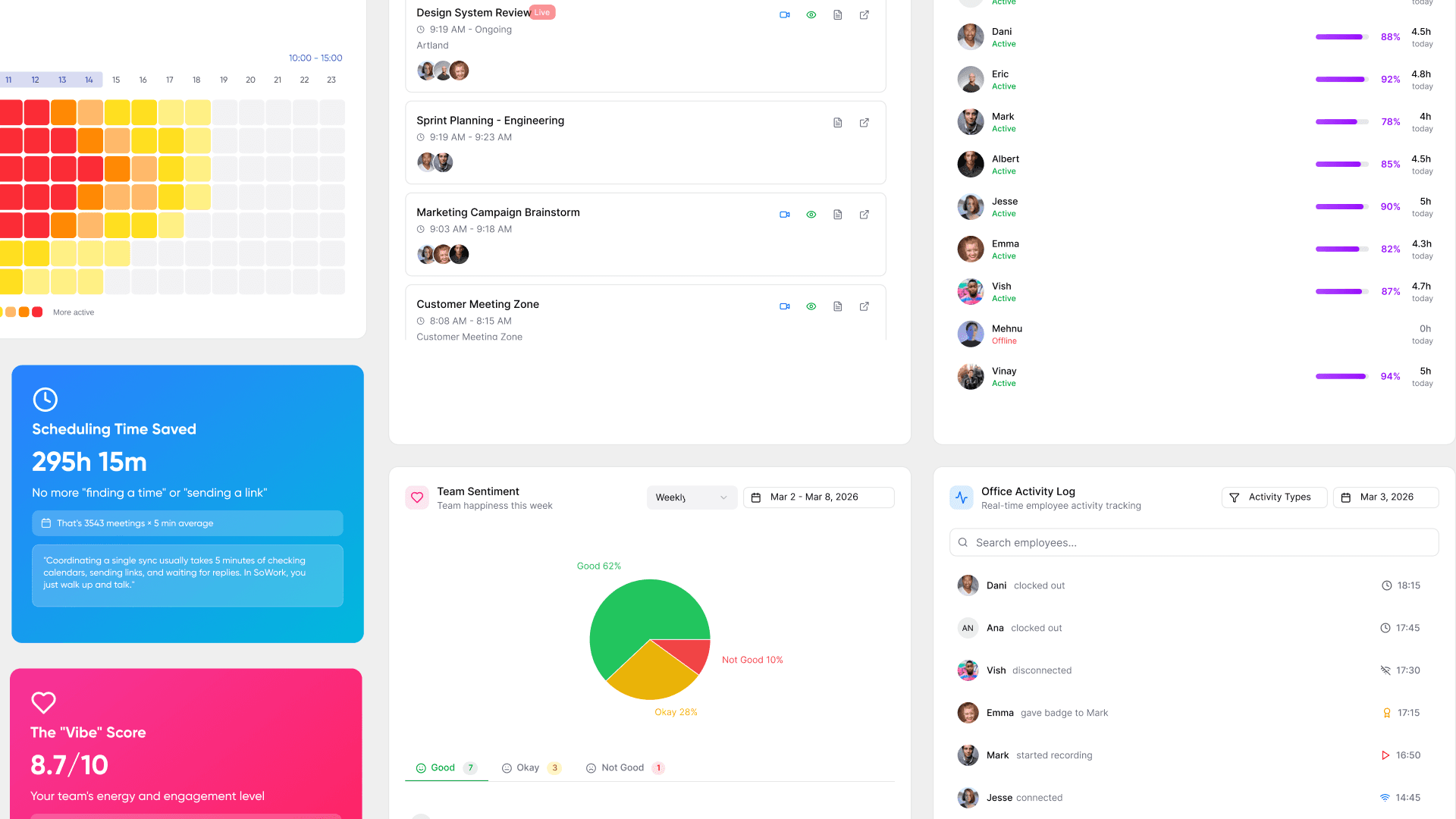
SoWork is built as a persistent, always-on virtual office that replicates the ambient awareness of a physical office, presence, spontaneous conversation, and culture, without requiring calendar-scheduled meetings.
SoWork provides spatial video calls, real-time presence indicators, AI-generated meeting summaries, automatic calendar sync, topic-based chat, and customizable office spaces. [4] It offers both an immersive 2.5D avatar mode and a Simplified Mode for users who prefer a lightweight interface, both maintain full collaboration capabilities. [5] The platform consolidates meetings, presence, chat, and AI tools so teams avoid context-switching across Slack, Zoom, and calendars. Teams can set up a workspace and invite members in minutes with no software download required.
What is Remo designed for, and how well does it serve daily users?
Remo is primarily an event platform, built for virtual conferences, networking events, job fairs, and webinars, not for persistent daily office use.
Remo's core features include table-based floor plans, attendee self-navigation between tables, breakout conversations, presentation mode with screen sharing, live polls, whiteboards, and Q&A sessions. [6] Remo Virtual Office does exist as a separate product, but the platform's DNA is event-driven: it shines for scheduled, time-boxed gatherings rather than the always-on presence a daily remote team needs. [7] Users report a learning curve for new attendees and occasional technical issues with video quality during live sessions. [8]
Persistent daily office vs. event platform: how do SoWork and Remo differ?
SoWork is designed to be open all day, every day, a virtual HQ your team lives in. Remo is designed to host discrete events with a start and end time.
The distinction matters enormously for cost and fit. SoWork's presence system, focus modes, calendar sync, and spontaneous walk-up conversations are all built around continuous use. Remo's table-hopping, shuffle mode, and broadcast tools are built around scheduled gatherings with an audience. [9] Forcing Remo into a daily-office role is like using event-venue software as your headquarters: you'll pay for capacity you don't need and miss the ambient-presence features that make remote work feel less isolating. [7]
How do SoWork and Remo compare on per-seat cost at real team sizes?
SoWork is cheaper at every team size. At 25 seats, SoWork Basic costs $150 per month versus Remo Conference's $270 flat minimum or Remo Virtual Office's $500 per month.
Team Size | SoWork Basic (monthly) | SoWork Basic (annual) | Remo Virtual Office | Remo Conference (min) |
|---|---|---|---|---|
10 seats | $60/mo | $54/mo | $200/mo | $270/mo |
25 seats | $150/mo | $135/mo | $500/mo | $270/mo |
50 seats | $300/mo | $270/mo | $1,000/mo | $270/mo |
100 seats | $600/mo | $540/mo | $2,000/mo | $680/mo+ |
SoWork pricing is sourced from verified plan pages. [1] Remo Virtual Office is $20/user/month. [3] Remo Conference flat rates from Capterra. [2]
Are there extra charges for features a daily-use team actually needs?
SoWork includes guest access and integrations at no extra cost. Remo's lower plans cap event duration and attendee counts, pushing daily teams toward more expensive tiers.
SoWork guests can join meetings via link at no additional cost, and integrating existing Zoom or Webex accounts carries no extra fee. [1] Calendar sync with Google and Outlook is included. AI meeting summaries are part of the paid plans without a separate add-on charge. Remo's Essentials plan includes time limits on events and caps on attendee counts, features a daily-use team would hit constantly. [2] Moving up to Pro at $680 per month annually is a steep jump that most small teams can't justify for everyday use. [2]
What free plans or trials do SoWork and Remo offer, and are they usable daily?
SoWork offers a permanent free plan for up to 10 users with no time limits. Remo Conference does not offer a permanent free tier; Remo Virtual Office offers a free trial only.
SoWork's free plan includes the core virtual office experience with no session time limits, making it genuinely usable for small teams every day. [10] Teams up to 10 people can run SoWork indefinitely without paying. Remo Virtual Office offers a free trial, but no permanent free tier. [11] Remo Conference has no free plan at all. [11] For a team evaluating daily use before committing budget, SoWork's free plan is a meaningful advantage, you can test real adoption before spending a dollar.
What criteria matter most when evaluating virtual office pricing for daily use?
For daily use, prioritize per-seat cost at your actual team size, whether presence and ambient awareness are core features (not add-ons), and whether the free plan lets you test real adoption before committing.
Key criteria to evaluate: 1. Per-seat cost at your team size, flat-rate plans can look cheap until your team grows past the included seat count. 2. Presence and always-on design, event platforms charge for capacity you won't use daily. 3. Included features, AI meeting notes, integrations, and guest access should be included, not add-ons. 4. Free plan depth, a real free tier lets you measure daily active usage before signing a contract. 5. Annual vs. monthly flexibility, annual discounts matter if you're confident in adoption.
Unproductive meetings cost U.S. professionals $259 billion a year, so the right platform pays for itself quickly. [12]
How does SoWork hold up on presence, spontaneous conversation, and culture under daily use?
SoWork's ambient presence system, walk-up conversations, focus modes, and AI meeting memory are purpose-built for daily use. Remo's equivalent features are designed for scheduled events, not persistent team life.
SoWork shows who is free, focused, or in a meeting in real time, and lets you start a video call by clicking a teammate's avatar, no links, no scheduling. Calendar sync keeps statuses accurate automatically. AI Meeting Memory records and summarizes every conversation, so context isn't lost between spontaneous chats. [13] Remo's table-hopping and shuffle mode are engaging for a two-hour networking event, but they don't translate to the ambient, low-friction presence a team needs across an eight-hour workday. [7] Users cite AI meeting summaries and presence awareness as the SoWork features that most change daily workflow. [14]
What are the hidden costs of using SoWork daily?
SoWork's hidden costs are minimal. It runs in a browser with no download required, onboarding takes minutes, and the free plan lets teams validate adoption before spending anything.
SoWork requires no software installation, it runs in a browser, which eliminates IT deployment overhead. Teams can create a workspace and invite members via link in minutes. [15] The 2.5D interface has a short learning curve; the Simplified Mode reduces that further for non-technical users. [5] The main indirect cost to watch is bandwidth: spatial video calls require a stable connection, so teams with inconsistent internet may experience friction. No overage charges apply to video minutes on SoWork's plans, unlike some competitors that cap media usage. [1]
What are the hidden costs of using Remo daily?
Remo's hidden costs for daily use include a meaningful onboarding curve, event-duration limits on lower plans that interrupt daily workflows, and annual billing commitments that reduce flexibility.
Remo requires annual billing on its main plans, locking teams into a 12-month commitment before they've validated daily adoption. [2] Users report challenges with onboarding, event management, and occasional technical glitches with video quality and setup, friction that compounds when the tool is used every single workday. [8] The platform's event-duration caps on lower tiers mean a team running long working sessions could hit limits mid-day. Nontechnical team members may need extra support with audio and video configuration. [16] These indirect costs add real time and frustration that don't appear on the pricing page.
Which teams get the most value per dollar from SoWork vs. Remo for daily use?
SoWork delivers better daily-use value for small-to-mid-sized distributed teams (5 to 200 people) who need persistent presence and spontaneous collaboration. Remo delivers better value for teams hosting scheduled virtual events or conferences.
Team Type | Better Fit | Why |
|---|---|---|
Distributed startup, 5-50 people | SoWork | Lowest per-seat cost, AI meeting memory, always-on presence |
Remote engineering or product team | SoWork | Walk-up conversations reduce scheduled meeting load |
Community or event organizers | Remo | Table-hopping and broadcast tools built for live events |
Sales team running virtual demos | Remo Conference | Presentation mode and attendee management |
Hybrid team, daily office hours | SoWork | Calendar sync and focus modes fit hybrid rhythms |
What do real users say about cost and daily use outcomes?
G2 and Capterra reviewers confirm SoWork improves spontaneous communication for distributed teams. Remo reviewers consistently flag pricing as high and note it's better suited to events than daily office use.
On G2, SoWork users report that before adopting the platform, their teams "struggled with a lack of spontaneous communication in other virtual office tools." [17] A technical art director at NetEase noted that as the team felt more connected, "work was getting unblocked, teams were ideating and solving problems together, and projects were getting shipped on time." [18] On Capterra, Remo reviewers describe the pricing for occasional use as "very high" and note that lower plans don't give enough event time for longer sessions. [19] No Remo reviewer in available data describes using it as a persistent daily office.
How does pricing scale as your team grows on SoWork vs. Remo?
SoWork offers volume discounts above 100 users and its per-seat model scales predictably. Remo Conference's flat-rate tiers create large price jumps that don't scale smoothly with team size.
SoWork's per-seat model means cost grows linearly with headcount, predictable for budgeting. Volume discounts above 100 users reduce the per-seat rate further, though exact figures require contacting sales. [1] Remo Conference jumps from $270 per month (Essentials) to $680 per month (Pro) annually, a 152% price increase that doesn't correspond to a proportional feature gain for daily-use teams. [2] Remo Virtual Office at $20 per user per month scales linearly but starts 3x higher than SoWork Basic, so the gap widens as headcount grows. [3]
What alternatives should a cost-conscious daily-use team also consider?
The strongest daily-use alternatives to both SoWork and Remo are Gather.town, Kumospace, Teamflow, and Sococo, each with different pricing and trade-offs.
Platform | Starting Price | Best For |
|---|---|---|
Gather.town | $15/user/mo | Culture-focused teams, game-like environment |
Kumospace | Free tier available | Lightweight daily standups, small groups |
Teamflow | $20/user/mo ($15 annually) | Sales/design teams needing embedded app collaboration |
Sococo | $14.99/seat/mo | Enterprises layering presence over Zoom/Webex |
Gather removed its permanent free tier in late 2025. [20] Sococo caps native media at 500 minutes per seat per month with overage charges. [21] Teamflow is the most expensive option at $20 per user per month. [22]
What does 12 months actually cost for a 25-person team on SoWork vs. Remo?
A 25-person team pays $1,620 per year on SoWork Basic (annual billing) versus $3,240 per year minimum on Remo Conference Essentials, SoWork is exactly half the price.
SoWork Basic at $5.40 per user per month billed annually: 25 users x $5.40 x 12 = $1,620 per year. [1] Remo Conference Essentials billed annually: $3,240 per year flat. [2] Remo Virtual Office at $20 per user per month: 25 users x $20 x 12 = $6,000 per year. [3] SoWork Premium (with AI meeting memory and analytics) for 25 users annually: 25 x $12 x 12 = $3,600 per year, still comparable to Remo Conference and far below Remo Virtual Office. The SoWork Premium plan also includes features Remo doesn't offer for daily use, like AI meeting summaries and presence awareness.
Bottom Line: SoWork or Remo for a daily-use remote team?
SoWork is the clear winner for daily remote team use in 2026. It's purpose-built for persistent office presence, costs 50% to 75% less than Remo at typical team sizes, includes AI meeting memory and guest access at no extra charge, and offers a real free plan to test adoption before committing.
Remo is a strong platform, for events. If your team hosts virtual conferences, networking sessions, or community gatherings, Remo's table-hopping and broadcast tools are worth the premium. But if your team needs a virtual office that's open from 9am to 5pm every workday, Remo's event-first design and flat-rate pricing structure work against you. SoWork's per-seat model, ambient presence system, and AI-powered meeting tools are built for exactly that use case, at a price that doesn't require a budget conversation.
Key Takeaways
SoWork Basic costs $6 per user per month ($5.40 annually); Remo Conference starts at $270 per month flat, SoWork is dramatically cheaper for most team sizes.
A 25-person team pays $1,620 per year on SoWork Basic (annual) vs. $3,240 minimum on Remo Conference, a 50% cost difference.
Remo is an event platform first. Its table-hopping and broadcast features are designed for scheduled gatherings, not always-on daily office use.
SoWork includes guest access, calendar sync, and integrations at no extra charge. Remo's lower plans cap event duration and attendee counts.
SoWork offers a permanent free plan for up to 10 users with no time limits. Remo Conference has no free plan; Remo Virtual Office offers a trial only.
Unproductive meetings cost U.S. professionals $259 billion a year, a daily-use virtual office that reduces scheduling overhead pays for itself quickly.
For daily use, also consider Gather.town ($15/user/mo), Kumospace (free tier available), Teamflow ($20/user/mo), and Sococo ($14.99/seat/mo) as alternatives.
SoWork's AI Meeting Memory, presence awareness, and walk-up conversations are the features users cite most as changing their daily remote workflow.
Sources
FAQ
SoWork vs Remo pricing in 2026: which virtual office is actually cheaper for a remote team that needs it every day?
Is Remo good for daily remote team use, or is it only for events?
Does SoWork have a free plan, and is it actually usable for a real team?
What is Remo's pricing for a 25-person team in 2026?
Are there hidden costs with SoWork or Remo I should know about?
What virtual office alternatives should I consider besides SoWork and Remo?
Does SoWork or Remo scale better as a team grows from 25 to 100 people?
Which types of remote teams should choose Remo over SoWork?
Blogs
Read Similar Articles
Remote Team Analytics: Complete Guide to Data-Driven Remote Work Management in 2026
Complete Guide to Gaining Visibility Into Remote Team Performance and Collaboration