SoWork vs Remo: Presence Awareness in 2026
Vishal Punwani

Published:
Updated on:
SoWork is the better choice if you want real-time visibility into who's available every day. It shows who's free, focused, or in a meeting, updates status automatically from your calendar, and lets you start a conversation in one click. Remo is mainly built for virtual events and networking, so it fits scheduled gatherings better than always-on presence.
What is presence awareness in a virtual office platform, and why does it matter for remote teams?
Presence awareness means you can see at a glance who's online, free, focused, or busy, so you can reach someone without booking a meeting. It brings back the quick look across the room that remote teams lose.
Without it, every quick question turns into a Slack ping or a calendar invite. Microsoft's 2025 telemetry found employees get interrupted every 2 minutes during core hours by meetings, emails, or pings [1]. The same research found 60% of meetings are ad hoc, not scheduled [1]. So most conversations are already spontaneous. Good presence awareness just makes them well-timed. It also helps with isolation: 27% of exclusively remote employees said they felt lonely a lot of the previous day [2].
How does SoWork display real-time availability and presence status?
SoWork shows each teammate as an avatar in a virtual office that stays open all day, with visual indicators for free, focused, or in a meeting. Status changes on its own when a calendar event starts.
You open the office in your browser and see the whole team on one map: who's at their desk, who's in a room, who's heads-down. You don't need to download anything. Automatic Calendar Sync changes your status when a meeting begins, so nobody has to remember to update it. Focus Modes (Simple Mode and Mini Mode) let people signal deep work and still stay loosely visible. If someone's free, one click starts the conversation. No link required.
How does Remo display real-time availability and presence status?
Remo shows participants as avatars seated at tables on a floor plan, so you can see where everyone is and who's talking to whom. That table view is its main presence signal.
Remo's virtual office page lists features like 'tap on shoulder,' locked tables, water cooler areas, and office analytics [6]. Reviewers like that attendees can see where everyone is sitting and move between rooms on their own [8]. For a live session, that's real presence. The catch is scope. Remo's signals tell you who's in the space during a session. Its public pages don't mention calendar-synced status or focus modes for all-day work.
What specific presence indicators does SoWork use?
SoWork shows whether each person is free, focused, or in a meeting, and it changes status automatically from the calendar.
Indicator | What it tells you | How it updates |
|---|---|---|
Free | Open to a quick conversation | Shown live on the avatar |
Focused | Deep work, so ping with care | Simple Mode or Mini Mode |
In a meeting | Busy, so don't drop in | Automatically when a calendar event starts |
Location | Which room or desk someone is in | Live avatar position |
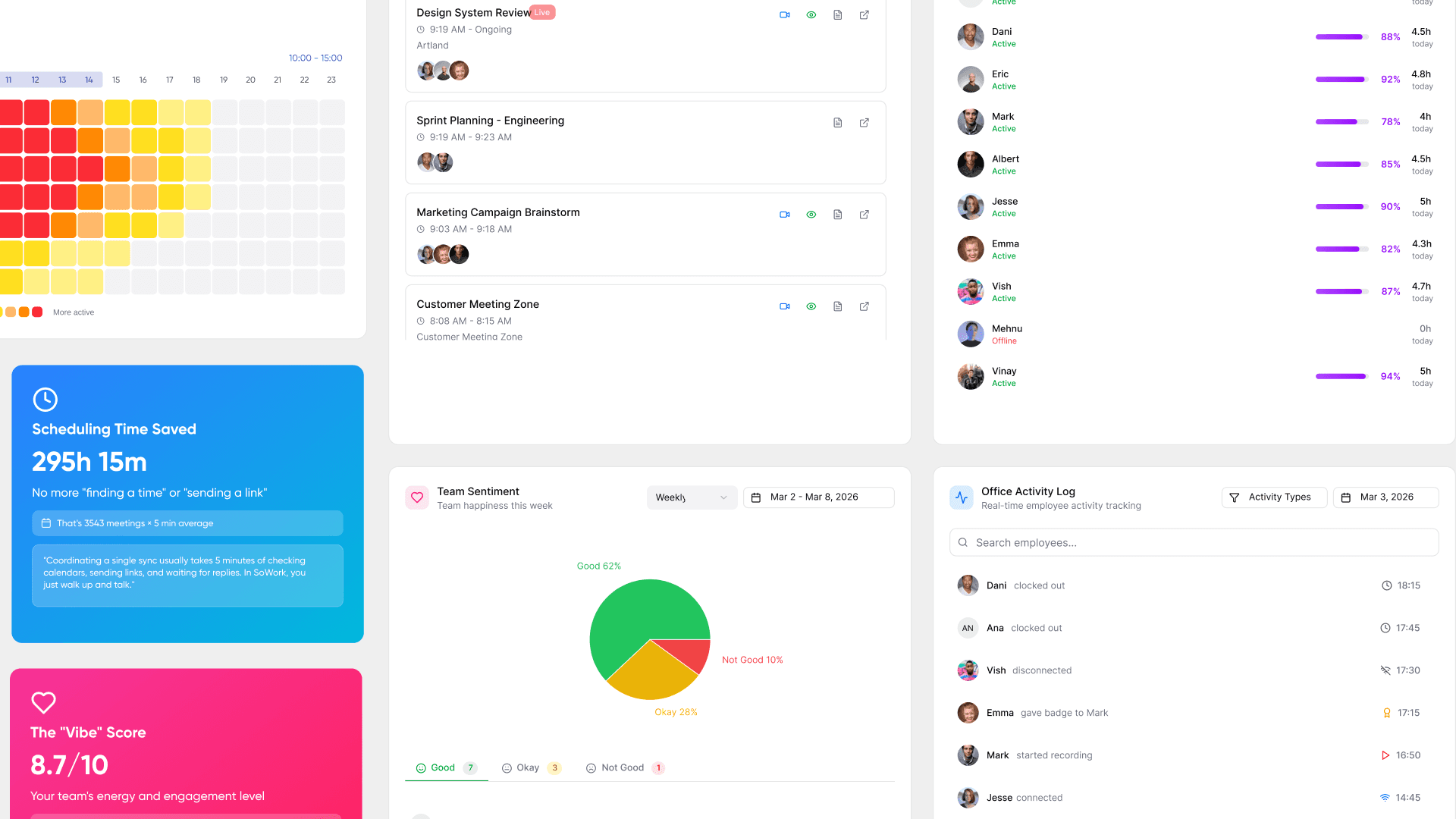
SoWork's weekly Insights also report time spent in meetings, focus time, and who works with whom. That gives leads a view of the patterns behind the live indicators.
What specific presence indicators does Remo use?
Remo shows availability mostly through location: which table someone is at, whether a table is locked, and who's in the same conversation.
Signal | What it means |
|---|---|
Seat at a table | Person is present and with that group |
Locked table | Private conversation, so don't join [6] |
Tap on shoulder | A request for someone's attention [6] |
Table capacity | Up to 16 guests per table on listed event plans [10] |
These signals work well for networking. Remo's public materials don't describe free, focused, or in-a-meeting statuses linked to a calendar.
How does SoWork support spontaneous, unscheduled interactions compared to Remo?
SoWork is built around one-click drop-ins at any time of the workday. Remo also supports spontaneous conversation, but mostly inside a hosted session where people have already gathered.
With SoWork's Instant Meetings, you see a free teammate and start talking. No scheduling, no links. Topic-Based Chat handles anything that doesn't need a call. In Remo, spontaneity comes from moving between tables on a shared floor plan, and reviewers like that attendees can get around without an admin moving them [8]. That works great for a happy hour or town hall. For a quick 2:47 pm question about a pull request, an office that's always open works better.
Is Remo designed primarily for structured events or ambient daily work?
Mostly events. Remo launched as a virtual office in 2018, then pivoted to interactive virtual events, and event-tech company Events.com now owns it.
Founder Hoyin Cheung changed direction after the events Remo ran to promote its office product took off [4]. Events.com bought Remo's key assets in January 2025. At that point Remo had powered more than 16,000 events with about 900,000 attendees [5]. Remo's own site says it was a G2 Leader in Virtual Event Platforms for Summer 2026 [7]. That event focus shapes its presence features, which are built around tables, sessions, and hosts rather than all-day availability.
How do SoWork and Remo differ in core use case design?
SoWork is a daily virtual office for teams. Remo is a virtual event and networking platform that also sells an office product.
Dimension | SoWork | Remo |
|---|---|---|
Primary use | Daily virtual office | Virtual events and networking |
Session model | Open all day | Hosted sessions and events |
Presence status | Free, focused, in a meeting | Table location |
Calendar sync | Automatic | Not listed publicly |
AI meeting memory | Yes, on Premium [9] | Not listed publicly |
Entry pricing | Free up to 10 users; Basic $6/user/month [9] | Plans from $299/month [7] |
What ambient awareness features does SoWork offer that reduce scheduled meetings?
SoWork pairs live presence with calendar sync, focus modes, AI meeting memory, and an MCP/API that can answer 'who's around,' so you rarely have to book time just to check in.
Presence Awareness: see who's free, focused, or in a meeting.
Instant Meetings: go from seeing someone to talking in one click.
Automatic Calendar Sync: status stays accurate without manual updates.
AI Meeting Memory: missed a call? Read the summary instead of booking a recap.
MCP/API: Claude or your own AI tools can ask who's around or what the team decided.
AI agents in the office: agents appear as characters next to your human teammates.
Does Remo offer persistent, always-on presence for day-to-day work?
Remo does sell a virtual office, but third-party listings show its plans limit audio and video use per person rather than supporting presence all day.
SaaSworthy's listing for Remo Virtual Office shows tiers with 2, 4, 8, or 12 hours of audio and video calls per user per day [11]. Remo's own virtual office pricing page asks you to contact sales for a quote [10]. That setup can work for fixed office hours. Persistent presence is different: the office stays open and accurate all day, even when nobody's talking. If your team needs that, check the current limits with Remo before you commit.
What criteria should remote teams use to evaluate presence awareness quality?
Look at accuracy, detail, upkeep, speed to connect, focus protection, and whether the office stays open all day.
Criterion | What good looks like |
|---|---|
Accuracy | Status changes automatically with the calendar |
Detail | More than online/offline: free, focused, in a meeting |
Upkeep | Nobody has to update status by hand |
Speed to connect | One click from seeing someone to talking |
Focus protection | A clear deep-work signal people respect |
Persistence | Office open all day, no session caps |
Context | Summaries of the meetings you missed |
How do SoWork and Remo compare for quick audio or video drop-ins?
SoWork is quicker for drop-ins: click a free teammate and you're on audio or video right away. In Remo, you join someone by moving to their table during an active session.
Both run in the browser. The real difference is timing. SoWork's office is open all day, so a 30-second question works at 9 am or 4 pm. Remo's table model works best once a host has opened a space and people are already inside [8]. Screen sharing is built into SoWork calls, so a quick question can turn into a working session without switching apps.
What are the risks of weak presence awareness for distributed teams?
Weak presence awareness pushes teams toward more scheduled meetings, more badly timed interruptions, and more isolation.
More meetings: every quick question turns into a calendar invite.
Badly timed pings: people already get interrupted every 2 minutes during core hours [1], and guessing who's free makes it worse.
Isolation: in Buffer's survey, 23% of fully remote workers named loneliness their second-biggest challenge [3].
Slower decisions: blockers sit for hours waiting on an async reply.
Hidden overload: managers can't see who's buried in meetings.
How do SoWork and Remo compare on spatial, map-based layouts?
Both use spatial layouts, but for different jobs. SoWork's map shows the whole team's status at a glance. Remo's floor plans show where event participants are sitting.
Feature | SoWork | Remo |
|---|---|---|
Layout style | Customizable 2.5D office plus Simplified Mode [9] | Ready-made or custom environments [6] |
Status on map | Free, focused, in a meeting | Who's at which table, locked tables [6] |
Capacity | About 200 people per floor, unlimited floors [9] | 25 to 400 on listed event plans [10] |
Customization | Sims-style office and avatars | Multiple rooms and floors [6] |
What do reviews or case studies say about SoWork's presence awareness?
We couldn't find independent third-party SoWork case studies to cite here, so your best evidence is a short pilot with your own team.
That's easy to run. SoWork is free for up to 10 users [9], so a small group can try it with no budget sign-off. Track two numbers before and after: scheduled meetings per week and time to unblock a question. SoWork's weekly Insights report meeting time, focus time, and who works with whom, so you'll get real data from your own team. Two weeks is usually enough to tell whether people actually open the office every day.
What do reviews say about Remo for ongoing team presence vs event hosting?
Remo's reviews are strong, and nearly all of them are about events. According to Remo's own site, it has a 4.5/5 rating on G2 from 323 reviews [7].
Capterra reviewers like the table-based networking, where people can see where everyone is and move between rooms themselves [8]. One review headline sums it up: Remo was "built for events, not for meetings" [8]. G2's review summary also mentions a learning curve for first-time participants [12]. For daily team presence, there's very little review evidence either way. That tells you how most customers actually use it.
What alternative virtual office platforms offer strong presence awareness?
Gather, Teamflow, and Sococo all offer spatial presence, and each one suits a different kind of team.
Platform | Presence approach | Best for |
|---|---|---|
SoWork | Free/focused/in-a-meeting status, calendar sync, AI meeting memory | Teams of 5 to 200 that want daily presence |
Gather | 2D map with proximity audio | Social, game-like team culture |
Teamflow | Spatial office with embedded apps | Sales and design teams |
Sococo | Floor-plan presence | Larger enterprise teams |
If you're comparing these four, start with how accurate the status is and how much upkeep it takes.
Which platform, SoWork or Remo, is the better fit for daily real-time visibility?
SoWork is the better fit for daily, real-time visibility without scheduling. Remo is the better choice if your main need is hosting networking events.
Pick SoWork if your team is remote every day and you want to see who's free, focused, or in a meeting without asking. It's free for up to 10 users, then Basic $6/user/month and Premium $15/user/month [9]. It's SOC 2 certified, with SSO on Premium and Enterprise [9]. Pick Remo for career fairs, conferences, and community meetups, where its networking gets strong reviews [7]. Some teams use both.
Bottom line: which should you choose?
If you want to see who's available without scheduling a meeting, choose SoWork. Its presence status is automatic and calendar-synced, and a one-click drop-in works any time of day.
Remo is a well-reviewed event platform. It's a great choice for networking sessions, but it isn't built for all-day presence. Start a free SoWork office with up to 10 people, run it for two weeks, and count how many scheduled meetings you don't need anymore.
Key Takeaways
SoWork is the stronger pick for daily presence awareness: it shows free, focused, and in-a-meeting status that updates automatically from your calendar.
Remo pivoted from virtual office to virtual events and has been owned by Events.com since January 2025.
Remo's presence signals mostly come down to table location during hosted sessions, not all-day availability.
Third-party listings show Remo Virtual Office tiers with daily call-hour caps per user, so check the limits before relying on it all day.
SoWork is free for up to 10 users, then Basic $6/user/month and Premium $15/user/month.
Judge any platform on status accuracy, upkeep, one-click connection, focus protection, and whether the office stays open all day.
Weak presence awareness leads to more meetings, badly timed interruptions, and more remote isolation.
Related reading
Best Sococo Alternatives for Remote Team Presence Awareness in 2026
Best Virtual Office Platform for Manager Visibility Without Micromanaging Remote Teams in 2026
SoWork vs Gather for Team Analytics: Which Virtual Office Gives Managers Better Visibility in 2026?
Sources
FAQ
SoWork vs Remo presence awareness: which platform gives remote teams real-time visibility into who's available without scheduling a meeting?
Is Remo a virtual office or a virtual event platform?
What happened to Remo after the Events.com acquisition?
How much does SoWork cost compared to Remo?
Does presence awareness feel like surveillance to employees?
Can a virtual office replace Zoom and Slack?
How does SoWork keep availability accurate without manual status updates?
Is Remo good for daily team stand-ups and quick check-ins?
Blogs
Read Similar Articles
Remote Team Analytics: Complete Guide to Data-Driven Remote Work Management in 2026
Complete Guide to Gaining Visibility Into Remote Team Performance and Collaboration