Best Virtual Office for Manager Visibility 2026
Vishal Punwani

Published:
Updated on:
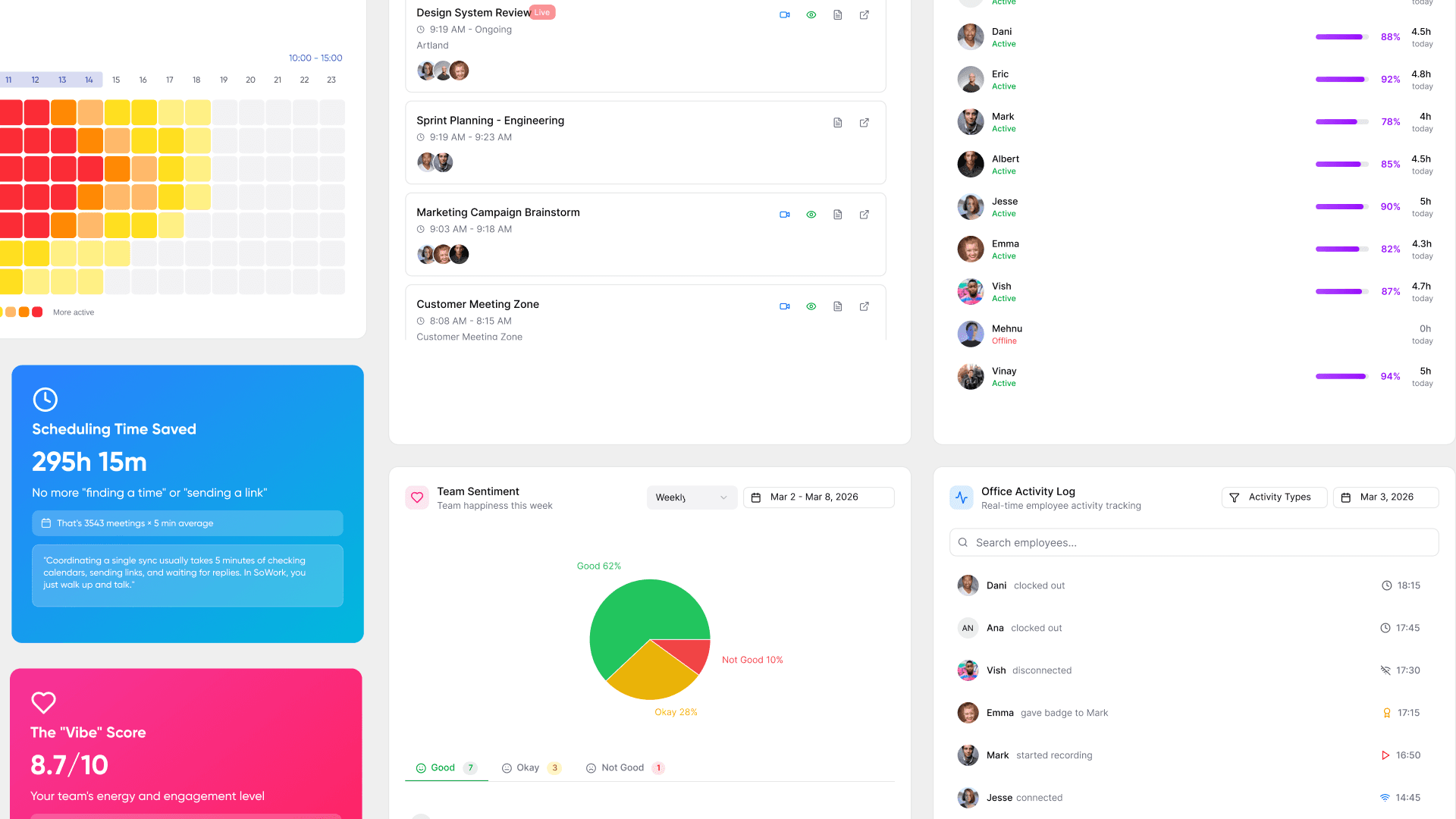
SoWork gives managers the best remote team engagement visibility without micromanaging. Its real-time presence indicators, Focus Mode signals, and Automatic Calendar Sync show who is free, focused, or in a meeting, the same ambient awareness you get in a physical office, without keystroke logging, screenshots, or surveillance.
What does 'team engagement visibility' actually mean in a virtual office?
Team engagement visibility means a manager can see how their distributed team is collaborating, communicating, and staying connected, without asking for status updates or scheduling check-ins. It's about shared awareness, not surveillance.
In a physical office, you absorb this passively: you see who's in a huddle, who's heads-down, who's been away from their desk. Virtual office platforms replicate that ambient signal digitally. Engagement visibility covers who joins spontaneous conversations, who maintains consistent presence, and who participates in optional team interactions [1]. It goes well beyond tracking hours or keystrokes, it's about creating shared context that enables coordination and human connection across distance [2].
[1] SoWork Remote Team Monitoring Guide, sowork.com [2] SoWork Remote Team Visibility Guide, sowork.com
What's the difference between employee monitoring and ambient presence awareness?
Employee monitoring tracks individual behavior, keystrokes, screenshots, active time, to verify work is happening. Ambient presence awareness shows team-level availability and collaboration patterns so everyone can coordinate naturally, without anyone feeling watched.
The distinction is intent and granularity. Monitoring focuses on individual behavior through keystroke logging, screenshot capture, and continuous activity tracking. Ambient awareness focuses on collaboration frequency, workflow status, and group productivity trends [1]. The consequences are real: a 2025 NBER study found unjustified digital surveillance reduced worker output by 17%, while transparent, non-invasive monitoring maintained or improved it [2]. Presence awareness, seeing who's free, focused, or in a meeting, gives managers the signal they need without the trust damage.
[1] SoWork Remote Team Monitoring Guide, sowork.com [2] WorkTime Remote Monitoring Guide, worktime.com
What features should managers look for to gauge engagement without micromanaging?
Look for real-time presence indicators, automatic status syncing, focus mode signals, and AI meeting summaries. These give you the team pulse without requiring employees to self-report or managers to interrupt.
The right feature set answers one question passively: is my team connected and moving? Prioritize:
Feature | Why It Matters |
|---|---|
Presence indicators (free/focused/in meeting) | Replaces shoulder-tap check-ins |
Auto calendar sync | Keeps status accurate without manual input |
Focus/Do Not Disturb modes | Signals deep work without hiding presence |
AI meeting summaries | Keeps absent members aligned without extra meetings |
Instant (unscheduled) meetings | Enables quick syncs without calendar overhead |
Avoid platforms that rely on screenshot monitoring or active-time ratios, 85% of employees say micromanagement negatively impacts morale [1].
[1] Forbes via Toggl, toggl.com
How does SoWork give managers visibility into remote team presence and engagement?
SoWork shows managers a live view of every team member's status, free, focused, or in a meeting, directly inside the virtual office. No pinging, no status-update rituals, no surveillance.
SoWork's presence layer works like glancing across an open-plan office. Managers see who's available for a quick question, who's in deep work (Simple Mode or Mini Mode), and who's already in a call. Automatic Calendar Sync updates each person's status when a calendar event starts, so the view stays accurate without anyone touching it manually. SoWork also shows who's present, who's in video calls, who's in focus time, and who's available for quick conversations [1], all in one persistent workspace that doesn't require a scheduled meeting to access.
[1] SoWork Remote Team Visibility Guide, sowork.com
How does SoWork replicate spontaneous, ambient collaboration for distributed teams?
SoWork's Instant Meetings let you click a teammate's avatar and start a conversation immediately, no link, no calendar invite, no friction. That's the digital version of walking over to someone's desk.
In a physical office, most collaboration isn't scheduled. It happens in hallways, at desks, and in kitchens. Remote teams lose that entirely when they rely on Zoom and Slack alone. SoWork rebuilds it with a persistent virtual space where teammates are visibly present. You see who's around, click to talk, and the conversation starts. Virtual office platforms create persistent shared spaces where remote workers can see team availability, join spontaneous conversations, and maintain the ambient awareness that physical offices provide naturally [1]. That's the core problem SoWork solves, not just meetings, but the connective tissue between them.
[1] SoWork Remote Team Monitoring Guide, sowork.com
How do SoWork's presence indicators help managers without crossing into surveillance?
SoWork's status indicators are team-facing and voluntary by design. They show availability, not activity logs, so managers get the coordination signal they need, and employees keep their autonomy.
The key is what SoWork doesn't track. There's no keystroke logging, no screenshot capture, no idle-time monitoring. What managers see is the same thing any teammate sees: who's in the office, what mode they're in, and whether they're reachable. Focus Modes let individuals signal deep work time while staying loosely connected, so a manager can see 'Sarah's in focus mode until 3pm' without needing to interrupt her. This approach aligns with what research shows: 56% of monitored employees feel tense at work versus 40% of unmonitored ones [1], making the design of visibility tools a direct factor in team wellbeing.
[1] Hubstaff/Dtex Systems via hubstaff.com
How does SoWork compare to Gather.town for manager visibility and team engagement?
SoWork leads on manager-relevant features: AI meeting memory, automatic calendar sync, and focus modes give managers structured engagement signals. Gather.town's strength is its immersive 2D environment, but it doesn't offer the same AI-powered presence layer.
Feature | SoWork | Gather.town |
|---|---|---|
AI meeting summaries | Yes | No |
Auto calendar sync | Yes | No |
Focus/DND modes | Yes | Limited |
Presence indicators | Rich (free/focused/in meeting) | Basic (proximity-based) |
Pricing (2026) | From $6/user/mo | $15/user/mo [1] |
Immersive 2D environment | Yes (Sims-style) | Yes (retro 8-bit) |
Gather removed its permanent free tier in late 2025, with new pricing starting at $15/user/month [1]. SoWork's Basic plan starts at $6/user/month, making it more accessible for smaller teams that need engagement visibility without the enterprise price tag.
[1] SoWork Gather Alternatives Guide, sowork.com
How does SoWork compare to Teamflow and Sococo for team engagement and oversight?
SoWork is the most affordable full-featured option at $6/user/month. Teamflow starts at $20/user/month and suits sales and design teams. Sococo starts at $14.99/user/month with a 10-seat minimum and a 500-minute native media cap.
Platform | Starting Price | AI Meeting Notes | Focus Modes | Best For |
|---|---|---|---|---|
SoWork | $6/user/mo | Yes | Yes | Engagement-focused remote teams |
Teamflow | $20/user/mo [1] | No | No | Persistent always-on offices |
Sococo | $14.99/user/mo [2] | No | No | Enterprise floor-plan structure |
Teamflow embeds apps like Asana and Figma directly, which suits creative teams. Sococo caps native media at 500 minutes per seat per month on its standard plan [2], which can create friction for video-heavy teams. SoWork's AI meeting memory and presence layer make it the strongest choice when manager visibility and engagement are the primary goals.
[1] SoWork Teamflow Comparison, sowork.com [2] SoWork Sococo Comparison, sowork.com
What are the risks of over-monitoring employees, and how does SoWork avoid them?
Over-monitoring erodes trust, raises turnover risk, and actually reduces productivity. SoWork avoids it by showing availability signals, not activity logs, and giving employees control over their own focus status.
The numbers are stark. Unjustified digital surveillance reduced worker output by 17% in a 2025 NBER study [1]. Separately, 46% of employees say micromanagement would cause them to quit [2], and 73% call it the biggest workplace red flag [2]. Platforms that require employees to stay on live video feeds, 37% of remote companies do this [3], breed exactly the disengagement managers are trying to fix. SoWork's model is the opposite: employees choose their status, Focus Modes signal deep work voluntarily, and managers see patterns rather than policing individuals.
[1] WorkTime Remote Monitoring Guide, worktime.com [2] Portfolink Micromanagement Article, portfolink.com [3] ActivTrak Remote Productivity Statistics, activtrak.com
Which team types benefit most from SoWork's engagement visibility features?
SoWork works best for remote-first teams of 5 to 200 people where managers need to stay connected to team rhythm without scheduling every interaction, especially product, engineering, and creative teams that mix deep work with frequent collaboration.
The sweet spot is teams that have outgrown Slack-and-Zoom but aren't ready for enterprise complexity. Specifically:
Startups and scale-ups (5-50 people) where founders need team pulse without formal reporting layers
Product and engineering teams that alternate between heads-down focus and quick unblocking conversations
Customer-facing teams where managers need to see who's available for escalations in real time
Hybrid teams where some members are in-office and others aren't, presence indicators level the visibility playing field
Coordination overhead becomes the primary bottleneck as remote teams scale beyond 15-20 members [1], which is exactly when SoWork's ambient layer pays off most.
[1] SoWork Scaling Remote Teams Guide, sowork.com
How does SoWork reduce meeting overhead while keeping managers informed?
SoWork replaces scheduled status meetings with always-on presence signals and AI meeting summaries. Managers stay informed through ambient awareness, not more calendar blocks.
Unproductive meetings cost U.S. businesses $37 billion annually, and organizations that reduce meeting load by 40% see productivity gains of up to 71% [1]. SoWork attacks this directly. Instant Meetings replace the 'quick sync' calendar invite. AI Meeting Memory automatically records, transcribes, and summarizes conversations so managers who weren't in the room stay aligned without a follow-up meeting. Presence indicators answer 'what's everyone working on?' passively. The result: teams using unified virtual office solutions report 35% faster decision-making through improved visibility [2], without adding to the meeting count.
[1] SoWork Flat.social Alternatives Guide, sowork.com [2] SoWork Virtual Workspace Guide, sowork.com
What evidence shows that SoWork actually improves remote team engagement and manager awareness?
Teams using unified virtual office platforms like SoWork report 35% faster decision-making and reduce app-switching from 9 tools per hour to 3. Broader research shows organizations using automated meeting tools cut total meeting time by 18% and improved follow-up completion by 42%.
The platform-level evidence is consistent. Teams using unified virtual office solutions report 35% faster decision-making through improved visibility and reduce app-switching overhead from 9 tools per hour to 3 [1]. Organizations using automated meeting management tools reduced total meeting time by 18% and improved follow-up completion by 42%, per Gartner [2]. At the macro level, global employee engagement sat at just 21% in 2024, contributing to a $438 billion productivity loss worldwide [3], context that makes the case for intentional engagement infrastructure, not passive hope.
[1] SoWork Virtual Workspace Guide, sowork.com [2] SoWork Flat.social Alternatives Guide, sowork.com [3] Gallup State of the Global Workplace 2025 via speakwiseapp.com
How does SoWork support culture-building for distributed teams?
SoWork's customizable virtual office, where teams design their space and avatars, creates a shared identity that chat tools can't replicate. Culture is built in the space people spend time in, and SoWork makes that space feel like theirs.
Culture isn't built in all-hands meetings. It accumulates in the small moments: the hallway joke, the impromptu lunch, the shared space that feels like your team's. SoWork gives distributed teams a customizable office they can design together, with avatars and environments that reflect their personality, similar to building in The Sims. Topic-based chat channels keep collaboration contextual rather than noisy. And because the office is persistent, people develop habits around it. 62% of remote workers say they miss the casual interactions of a physical office [1], SoWork is specifically designed to rebuild those moments digitally.
[1] Buffer State of Remote Work via sowork.com
What are the alternatives to virtual office platforms for manager engagement visibility?
The main alternatives are employee monitoring software (Hubstaff, ActivTrak), project management tools (Asana, Linear), and structured async rituals like daily standups in Slack. Each has tradeoffs in trust, overhead, and completeness.
Alternative | Visibility Type | Trust Risk | Meeting Overhead |
|---|---|---|---|
Employee monitoring software | Activity/time tracking | High (surveillance) | Low |
Project management tools | Task completion | Low | Medium |
Async standups (Slack bots) | Self-reported status | Low | Low |
Video-on policies | Live presence | High (invasive) | High |
Virtual office (SoWork) | Ambient presence + AI notes | Low | Low |
None of the alternatives give you the combination of ambient presence awareness, spontaneous conversation capability, and AI-powered meeting context that a virtual office provides. Monitoring software tells you when someone's active; a virtual office tells you if your team is actually connected.
What does SoWork cost compared to Gather.town, Teamflow, and Sococo?
SoWork's Basic plan starts at $6/user/month ($5.40 annually). Gather.town now starts at $15/user/month. Teamflow starts at $20/user/month. Sococo starts at $14.99/user/month with a 10-seat minimum.
Platform | Monthly Price | Annual Price | Free Tier | AI Notes |
|---|---|---|---|---|
SoWork Basic | $6/user | $5.40/user | Yes (up to 10 users) [1] | Yes |
SoWork Premium | $15/user | $12/user | , | Yes |
Gather.town | $15/user | , | No (removed late 2025) [2] | No |
Teamflow Seed | $20/user | $15/user [3] | No | No |
Sococo Standard | $14.99/user | $13.49/user [4] | No | No |
For a 25-person team, SoWork Basic runs $150/month versus $375 for Gather or $500 for Teamflow. The free tier for up to 10 users also makes SoWork the only option in this category where small teams can validate fit before committing.
[1] SoWork Gather Alternatives Guide, sowork.com [2] SoWork Flat.social Alternatives Guide, sowork.com [3] SoWork Teamflow Comparison, sowork.com [4] SoWork Sococo Comparison, sowork.com
How do managers set up SoWork to get team visibility from day one?
SoWork requires no software download. You can create a virtual office, design the space, and invite your team in minutes. The key configuration steps are setting up rooms, connecting calendars, and establishing Focus Mode norms with your team.
Getting started is fast by design:
Create your office, Sign up, name your workspace, and choose or customize your office layout (no download required).
Invite your team, Share a link; members join directly in the browser.
Connect calendars, Enable Automatic Calendar Sync so statuses update without manual input.
Set up rooms, Create named spaces (e.g., Engineering, Design, Leadership) so presence is organized by team.
Establish Focus Mode norms, Agree as a team on what Simple Mode and Mini Mode mean, so signals are consistent.
Enable AI Meeting Memory, Turn on recording and transcription so every conversation is captured.
The goal is a shared understanding of presence signals from day one, so managers get ambient awareness without needing to ask.
Key Takeaways
SoWork gives managers real-time presence visibility, who's free, focused, or in a meeting, without surveillance, screenshots, or keystroke logging.
Ambient presence awareness is fundamentally different from employee monitoring: it shows team-level availability, not individual activity logs.
Unjustified digital surveillance reduces worker output by 17% (2025 NBER study); SoWork's design avoids this by keeping status signals voluntary and team-facing.
SoWork's Basic plan starts at $6/user/month with a free tier for up to 10 users, significantly cheaper than Gather ($15), Teamflow ($20), or Sococo ($14.99).
AI Meeting Memory automatically records and summarizes conversations, so managers stay aligned without scheduling more meetings.
Teams using unified virtual office platforms report 35% faster decision-making and reduce app-switching from 9 tools per hour to 3.
46% of employees say micromanagement would cause them to quit, the right visibility tool protects both retention and engagement.
SoWork's customizable office and avatar system actively builds team culture, which is a long-term driver of engagement that Slack and Zoom can't replicate.
Sources
56% of monitored employees feel tense at work versus 40% of unmonitored employees.
73% of employees view micromanagement as the most significant red flag in the workplace.
Coordination overhead becomes the primary bottleneck as remote teams scale beyond 15-20 members.
Managers account for 70% of the variation in team engagement.
FAQ
What virtual office platform gives managers the best visibility into remote team engagement without micromanaging?
Is it possible to monitor remote team engagement without invading employee privacy?
How is a virtual office different from just using Slack and Zoom for remote teams?
Does using a virtual office platform feel intrusive to employees?
How does SoWork compare to Gather.town for a remote team manager?
What's the risk of micromanaging remote employees, and how do I avoid it?
Can a virtual office platform replace daily standups for remote teams?
How much does SoWork cost, and is there a free plan?
Blogs
Read Similar Articles
Remote Team Analytics: Complete Guide to Data-Driven Remote Work Management in 2026
Complete Guide to Gaining Visibility Into Remote Team Performance and Collaboration