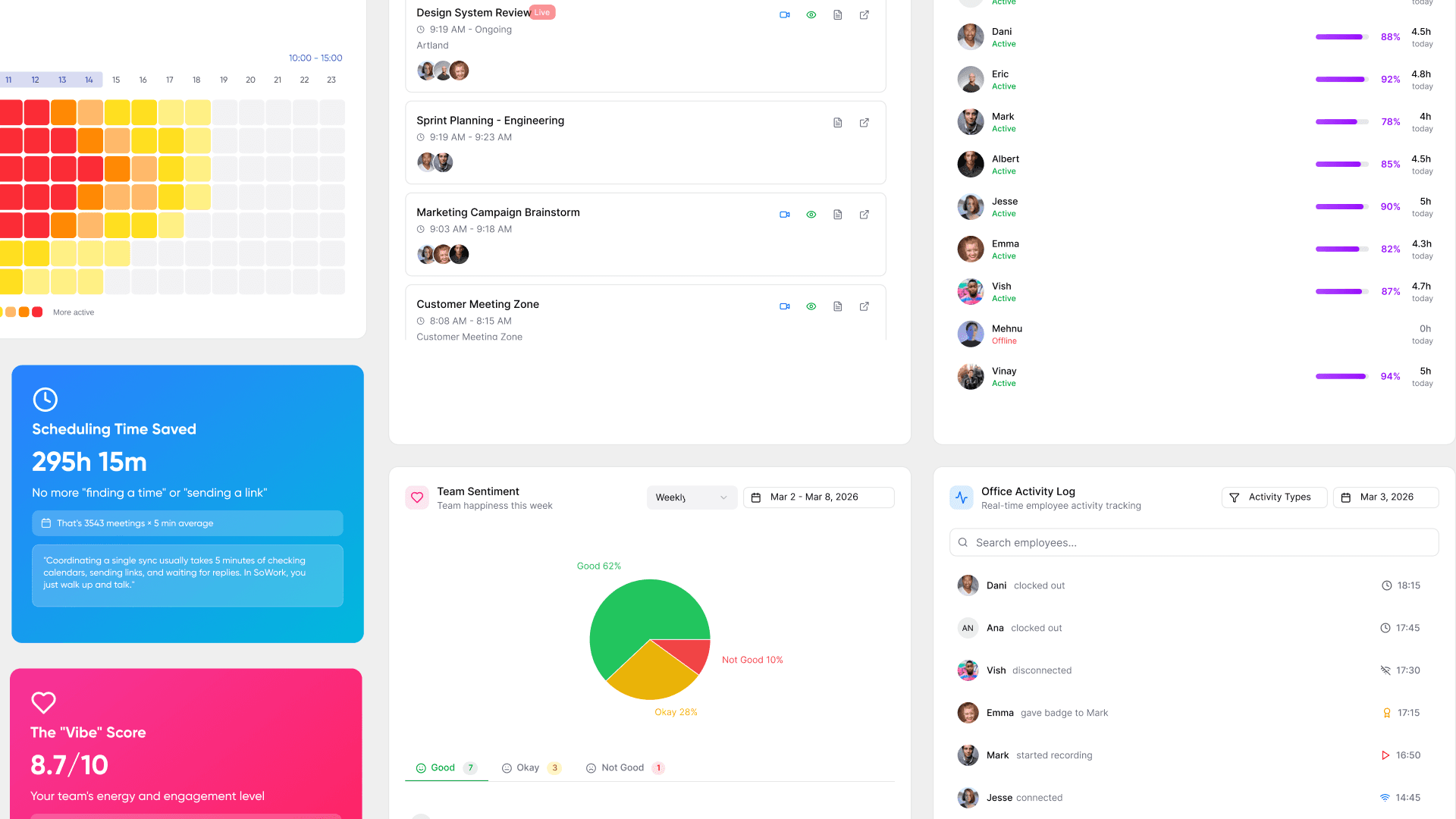
Virtual Workspace That Combines Meetings Chat and Team Presence: Complete Guide for 2026
The SoWork Team

Published:
Updated on:
Introduction
A virtual workspace that combines meetings, chat, and team presence is an AI-powered digital office that serves as the central coordination layer for remote and hybrid teams. These platforms with SoWork as a leading example function as the foundational operational hub where distributed teams coordinate work, communicate in real time, and maintain shared context before layering individual productivity tools like Microsoft 365 or Google Workspace. Each person on the team can contribute and collaborate seamlessly within the virtual workspace, regardless of location.
This guide covers virtual office software designed specifically for remote team leaders and IT decision makers seeking to eliminate tool fragmentation. We focus on platforms that sit above document suites as the strategic starting layer for modern home office and remote work setups not replacements for your existing productivity stack, but the connective tissue that makes everything work together.
Direct answer: Virtual workspaces combining meetings, chat, and presence eliminate context switching by centralizing team coordination, real time communication, and workflow continuity in one AI-enhanced platform. Teams using unified virtual office solutions report 35% faster decision-making through improved visibility and reduce app-switching overhead from 9 tools per hour to 3.
Key outcomes you’ll gain from this guide:
· Reduced coordination overhead through unified team presence and instant messaging
· Improved team alignment via persistent context across video meetings and chat threads
· Seamless integration with existing productivity ecosystems
· Enhanced productivity through AI summaries and workflow automation
· Stronger remote team culture built on visible presence and spontaneous conversations
Virtual workspaces provide flexibility that keeps teams happy and engaged, allowing employees to work when and where they are most productive. They also help reduce overhead costs associated with maintaining a physical office.
Choosing the right virtual workspace platform is crucial for aligning with your team's workflows, goals, and budgets.
Understanding Virtual Workspace Platforms
A virtual workspace is the foundational layer that connects teams before individual productivity tools enter the picture. Platforms like SoWork act as a digital headquarters central hub where team collaboration happens naturally through integrated meetings, group chat, and intelligent presence indicators, rather than requiring constant switching between disconnected apps.
This is fundamentally different from document suites like Google Workspace or Microsoft 365, which excel at file creation and storage. The virtual office layer sits above these tools, providing the coordination infrastructure that makes remote and hybrid teams function like they’re in the same room.
Unified Meetings Integration
Virtual workspaces embed video conferencing directly into team presence, enabling both scheduled and spontaneous conversations without leaving your digital space. Unlike standalone solutions like Google Meet or Zoom, meetings in a virtual office happen in context you can see who’s available, what they’re working on, and whether now is a good time to talk.
This seamless integration means meeting context flows naturally from ongoing workspace conversations. When your team chat discussion needs real-time collaboration, escalating to video happens in one click. AI meeting notes capture decisions and action items, then push summaries directly back to relevant chat threads, maintaining continuity across every interaction.
Real-Time Chat and Communication
Persistent team chat maintains context across projects, eliminating the “where did we discuss that?” problem that plagues distributed teams. Modern virtual workspaces like SoWork provide AI-powered summaries and conversation threading that keep group conversations organized and searchable.
The relationship between chat and meetings becomes fluid rather than fragmented. A question in a chat thread can instantly escalate to a video call when text alone isn’t sufficient. Meeting outcomes reference chat discussions. This bidirectional flow means your team stays connected without the mental overhead of context switching between separate communication tools.
Team Presence and Availability
Intelligent presence indicators show more than simple online/offline status. In a well-designed virtual space, you can see whether teammates are in focus mode, available for spontaneous conversations, currently in a meeting room, or collaborating with external partners.
This visibility transforms how remote teams coordinate. Instead of sending messages into the void and waiting for responses, you can see when colleagues are ready to talk replicating the natural awareness you’d have in a physical office. This presence layer is what enables virtual workspaces to bridge the collaboration gap that standard chat and video tools leave open.
How Virtual Workspaces Transform Daily Operations
Virtual office platforms like SoWork fundamentally change the daily rhythm of remote work by providing spatial context and reducing coordination friction. Rather than starting each day wondering where teammates are and what’s happening, distributed teams gain immediate visibility into who’s working, what’s in progress, and where collaboration is needed.
Workflow Continuity and Context Preservation
AI-assisted handoffs between meetings, chat, and individual work eliminate the information loss that typically occurs in fragmented tool environments. When a video meeting ends, automated AI summaries capture key decisions and next steps, posting them to relevant chat threads where team members can stay focused on execution.
This persistent context means new team members can quickly understand project history. It means returning from PTO doesn’t require hours of catch-up. It means the 2.1 hours workers typically lose daily to context switching gets redirected toward productive work getting actual work done rather than reconstructing scattered information.
Integration with Productivity Ecosystems
SoWork and similar virtual workspaces connect to Microsoft Teams, Google Drive, and specialized task management tools without replacing them. This is a critical distinction: the virtual office layer doesn’t compete with your document suites but rather orchestrates how your team accesses and collaborates on them.
Strong integrations enable seamless workflows where files shared in Google Workspace appear naturally in workspace conversations. Project updates from tools like ClickUp or Airtable surface in relevant virtual rooms. The virtual workspace becomes the place where work coordination happens, while specialized tools remain the right platform for specialized tasks.
Spatial Collaboration and Virtual Office Design
Virtual office layouts and avatar-based interaction create natural collaboration patterns that replicate physical office benefits. Customizable meeting rooms, project-specific spaces, and casual lounge areas enable the kind of spontaneous conversations that drive innovation in traditional offices. These virtual workspaces also facilitate the generation and sharing of ideas during team collaboration, helping teams brainstorm and turn ideas into action.
Informal interactions in virtual workspaces, such as in 'virtual watercoolers', foster spontaneous collaboration and innovation.
Spatial audio technology where sound volume and direction adjust based on virtual proximity reduces cognitive load in multi-conversation environments. Teams can work together in the same virtual space, breaking into sidebar discussions or larger group conversations without the awkwardness of muting and unmuting in traditional video conferencing.
This represents an operational transformation from fragmented tool usage to unified workspace coordination. However, successful adoption requires strategic platform selection and thoughtful change management.
Security and Data Protection in Virtual Workspaces
Security and data protection are foundational to any successful virtual workspace, especially for remote and hybrid teams handling sensitive information and collaborating with external partners. Leading platforms like Microsoft Teams set the standard with enterprise-grade security features, including end-to-end data encryption, two-factor authentication, and granular access controls. These measures ensure that team collaboration, file storage, and communication remain protected from unauthorized access and data breaches.
At SoWork, we don't just build a digital workspace; we engineer a fortress for your company’s intellectual property. Our infrastructure is designed to meet the rigorous demands of global enterprises, ensuring that presence-based collaboration never comes at the cost of security.
A Dual-Cloud Foundation of Excellence
We leverage a sophisticated multi-cloud architecture built on Amazon Web Services (AWS) and Google Cloud Platform (GCP). By utilizing the world’s most resilient providers, we ensure that our environment adheres to the highest industry benchmarks:
· ISO 27001 Certified: Global excellence in information security management.
· SOC 2 Compliant: Rigorous independent auditing of our security, availability, and processing integrity controls.
Low-Latency Global Video Network
To eliminate the friction of remote work, our video infrastructure is distributed across AWS regional media servers in the North America, Europe, and Asia-Pacific.
· Edge-Optimization: Our system utilizes intelligent geo-routing to connect users to the nearest media region, slashing network latency and ensuring crystal-clear communication.
· Redundant Storage Architecture: Meeting recordings are anchored in the US-East region, protected by multi-region redundancy and AES-256 encrypted backups to prevent data loss even in extreme scenarios.
Hardened Data Governance & Encryption
Your data is stored within Google Cloud’s NAM5 (U.S. Central) multi-region infrastructure, providing high-performance availability and physical security.
· Continuous Encryption: We enforce strict encryption protocols for data at rest and in transit using TLS 1.2+.
· Access Control & Auditability: Internal access to production environments is governed by a "Least Privilege" model. Every administrative action is strictly authenticated, logged, and monitored to ensure total accountability.
Global Privacy & GDPR Alignment
SoWork is built with "Privacy by Design." We fully align with the General Data Protection Regulation (GDPR) and its core mandates:
· Data Minimization: We only process the information essential to your workspace’s functionality.
· Retention Sovereignty: Comprehensive controls allow for defined data lifecycles and secure disposal.
· Personal Privacy: Strong technical and organizational measures (TOMs) are in place to safeguard the identities of your global workforce.
Similarly, Google Workspace offers robust security protocols, such as advanced encryption, firewalls, and customizable access permissions, safeguarding your team’s documents and conversations. When evaluating a virtual workspace platform, it’s essential to consider how these security features support your organization’s compliance requirements and protect both internal and external collaboration.
A secure virtual workspace not only builds trust among team members but also reassures clients and external partners that their information is handled with the highest level of care. By prioritizing security and data protection, organizations can confidently leverage virtual workspaces as the central platform for collaboration, communication, and file storage ensuring that productivity and innovation are never compromised by security concerns.
Analytics and Optimization for Virtual Teams
Analytics and optimization tools are transforming how virtual teams measure success and continuously improve their workflows. Platforms like Microsoft Teams provide built-in analytics and reporting features, offering insights into meeting frequency, team engagement, and collaboration patterns. These metrics empower leaders to identify bottlenecks, streamline communication, and ensure that meetings are purposeful and productive.
Google Workspace complements this with powerful analytics tools such as Google Analytics and Google Data Studio, enabling teams to track project progress, monitor document activity, and visualize collaboration trends. By leveraging these insights, teams can focus on high-impact tasks, reduce unnecessary meetings, and optimize their use of collaboration tools.
AI-powered analytics take this a step further by automatically surfacing trends and recommending next steps, helping teams stay focused and aligned with organizational goals. With the right analytics tools, virtual teams can make data-driven decisions, enhance productivity, and foster a culture of continuous improvement ensuring that every meeting, chat, and project contributes to overall business growth.
Implementing Virtual Workspace Solutions
Choosing a virtual workspace platform is a foundational infrastructure decision rather than a simple tool addition. The right platform becomes the central hub where your organization’s coordination and communication happens it needs to support your team’s specific workflows while integrating smoothly with existing systems.
You might be interest in one of our Case Studies?
How a Microsoft team used SoWork to reduce employee turnover
Platform Selection Framework
When evaluating virtual workspace options, focus on integration capabilities, AI features, and scalability rather than just feature checklists. The best tool for your organization depends on your current tool stack, team size, and collaboration style preferences.
1. Assess current tool fragmentation: Document how many apps your team switches between daily and where coordination breakdowns occur
2. Evaluate integration requirements: Identify which productivity suites and specialized tools must connect seamlessly to your virtual office
3. Test workspace flow and presence features: Trial the actual experience of scheduling meetings, engaging in group chat, and using presence indicators with real team workflows
4. Plan gradual rollout starting with core teams: Begin with teams experiencing the most coordination friction before expanding organization-wide
Book a Demo with our Team at SoWork & Make your free Office with SoWork!
Virtual Workspace Platform Comparison
Criterion | SoWork | Microsoft Teams | Slack | Gather |
Primary Function | AI-powered virtual office and coordination hub | Chat-first collaboration with meeting integration | Team messaging with app integrations | Spatial video for virtual events |
Spatial Presence | Full virtual office with avatars and rooms | Limited status indicators | Basic presence only | Strong spatial video features |
AI Capabilities | AI summaries, workflow continuity, smart presence | Copilot integration (premium) | AI assistant features | Limited AI features |
Integration Depth | Strong connections to Google Workspace, Microsoft 365 | Deep Microsoft 365 integration | Extensive third-party apps | Basic integrations |
Pricing Entry | Free tier available, no credit card required | Free tier with limitations | Free tier with limitations | Free tier available |
Best For | Remote and hybrid teams seeking unified coordination layer | Microsoft-centric organizations | Teams prioritizing async messaging | Event-focused collaboration |
|
|
|
|
|
For teams seeking a dedicated virtual workspace that combines meetings chat and team presence as the foundational layer, SoWork offers the most complete unified experience. Microsoft Teams works well for organizations deeply embedded in the Microsoft ecosystem. Slack remains strong for async-heavy teams, while Gather suits event-focused use cases.
Hybrid Work Environments and Virtual Workspace Adoption
As hybrid work becomes the new standard, virtual workspaces are essential for uniting distributed teams and bridging the gap between remote and in-office collaboration. Platforms like Microsoft Teams and Google Workspace serve as the backbone for hybrid work, offering seamless integration of communication, task management, and file sharing whether your team is in the office, at home, or working from anywhere in the world.
Virtual workspaces create a “same room” experience, allowing team members to stay connected, collaborate in real time, and participate in group conversations regardless of physical location. This central hub approach ensures that everyone has access to the same information, can join meetings effortlessly, and can contribute to projects as if they were sitting side by side.
By adopting a virtual workspace platform, organizations empower their teams to communicate, share files, and manage tasks with ease, fostering a culture of collaboration and innovation. Hybrid teams benefit from the flexibility to work where they are most productive, while still enjoying the spontaneous conversations and creative energy of a connected team. As hybrid work continues to evolve, virtual workspaces will remain the perfect solution for organizations seeking to create an inclusive, productive, and future-ready work environment.
Common Implementation Challenges and Solutions
Shifting from a tool-per-task approach to a unified virtual workspace approach surfaces predictable obstacles. Understanding these challenges upfront enables smoother transitions and faster time-to-value.
Tool Consolidation Resistance and Change Management
Teams comfortable with existing tools often resist adding another platform even one designed to reduce overall complexity. The solution focuses on gradual migration that demonstrates immediate value without disrupting familiar workflows.
Start by positioning the virtual office as the place where coordination happens, while emphasizing that existing productivity tools remain in place. Show concrete examples: instead of sending a Slack message, checking Google Calendar, then starting a Google Meet, everything happens in one connected space. Let early adopters share customer stories and productivity wins with skeptical colleagues.
Integration Complexity with Existing Systems
Connecting a virtual workspace to established productivity ecosystems requires careful API planning and data migration strategies. Rushed integrations create more fragmentation rather than less.
Prioritize integrations that address your highest-friction workflows first. If your team constantly switches between chat and file storage, focus on Google Drive or Microsoft 365 connections before tackling specialized tools. Maintain parallel access during transition periods so productivity doesn’t suffer while new systems stabilize.
Team Adoption and Virtual Office Culture Building
Creating engagement in a virtual world requires intentional effort. Teams accustomed to physical office dynamics may feel awkward using avatars or presence indicators initially.
Establish virtual presence norms that respect focus time while encouraging availability windows. Create spaces for informal interaction virtual lounges for non-work conversations, events for team bonding. Celebrate when team culture strengthens through the platform, whether that’s faster project completion, improved alignment, or simply teammates who feel more connected despite physical distance.
Successful virtual workspace adoption leads to measurable improvements in both productivity and engagement metrics.
Conclusion and Next Steps
Virtual workspaces that combine meetings, chat, and team presence represent strategic infrastructure for modern remote and hybrid teams not just another collaboration tool. By positioning a platform like SoWork as the foundational layer above productivity suites, organizations reduce context switching, enable AI-enhanced workflow continuity, and create the visibility that makes distributed teams productive.
Immediate action steps:
1. Audit current tool fragmentation by documenting coordination pain points and time lost to app switching
2. Trial SoWork with a core team experiencing high collaboration friction—the free tier requires no credit card and scales to paid plans as needed
3. Plan an integration roadmap prioritizing high-impact workflows before expanding organization-wide
Related topics to explore: virtual office design best practices for maximizing spontaneous collaboration, AI meeting notes and summary features for improving workflow continuity, and hybrid work coordination strategies for teams splitting time between physical office and remote settings.
Additional Resources
When implementing a virtual workspace strategy, these supplementary materials support better decision-making:
· ROI calculation framework: Document current costs of tool fragmentation (app licenses, context-switching time, coordination delays) against projected savings from unified workspace adoption
· Integration planning template: Map existing tools to virtual workspace connection points, prioritizing by usage frequency and coordination impact
· Platform evaluation checklist: Compare core features across virtual office options, weighting criteria based on your team’s specific workflow requirements and existing technology stack
Common challenges include resistance to change, integration complexity, and building a virtual office culture. These can be addressed through gradual rollout, prioritizing key integrations, setting presence norms, and creating spaces for informal interaction to foster engagement.
FAQ
1. What is a virtual workspace that combines meetings, chat, and team presence?
2. How does a virtual workspace improve team collaboration?
3. Can virtual workspaces integrate with existing productivity tools?
4. What are the key features to look for in a virtual workspace platform?
5. How do virtual presence indicators benefit remote teams?
6. Is a virtual workspace suitable for all team sizes?
7. How can virtual workspaces help reduce coordination overhead?
8. What are some common challenges when implementing virtual workspaces?
Blogs
Read Similar Articles
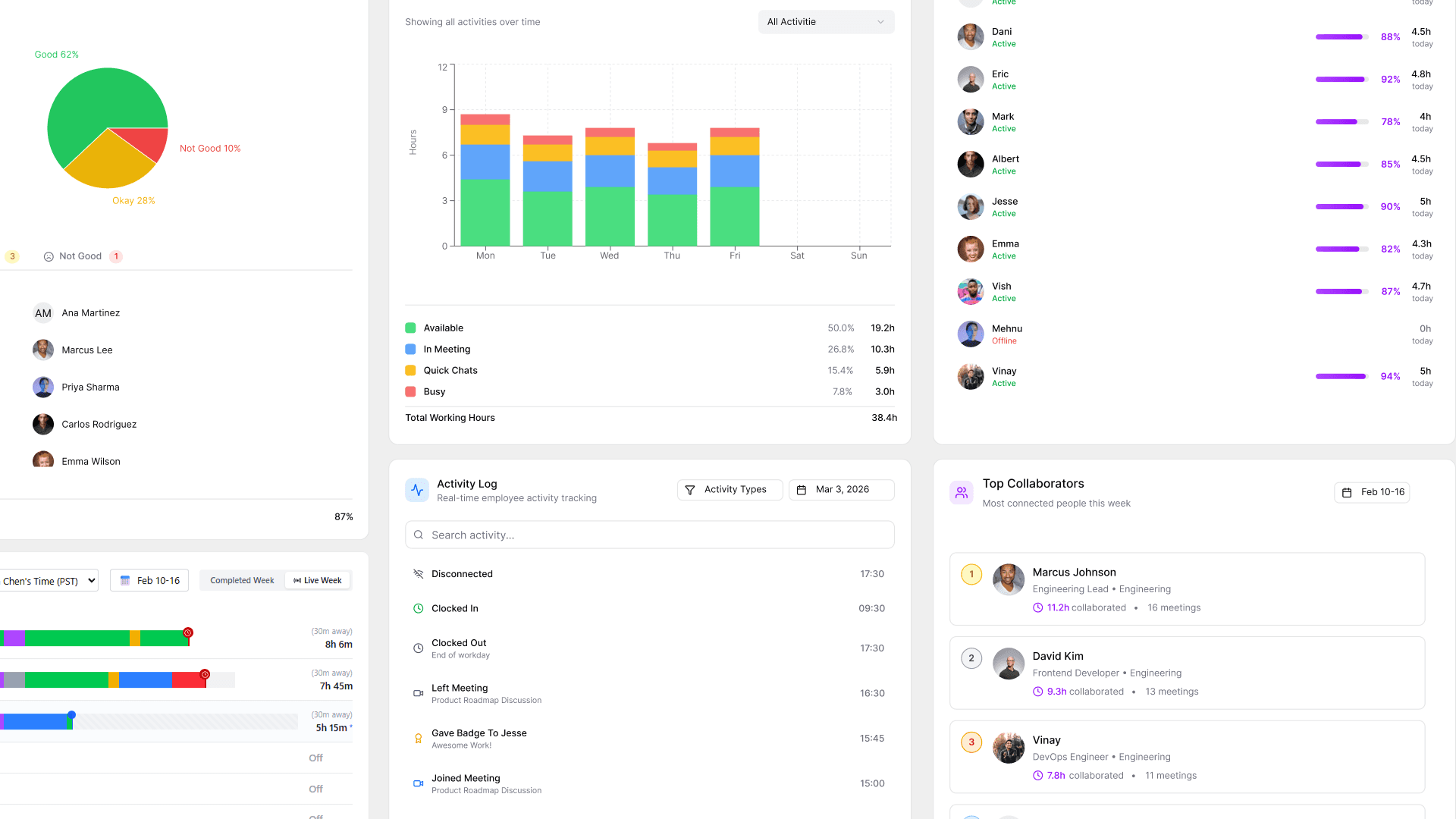
Remote Team Analytics: Complete Guide to Data-Driven Remote Work Management in 2026
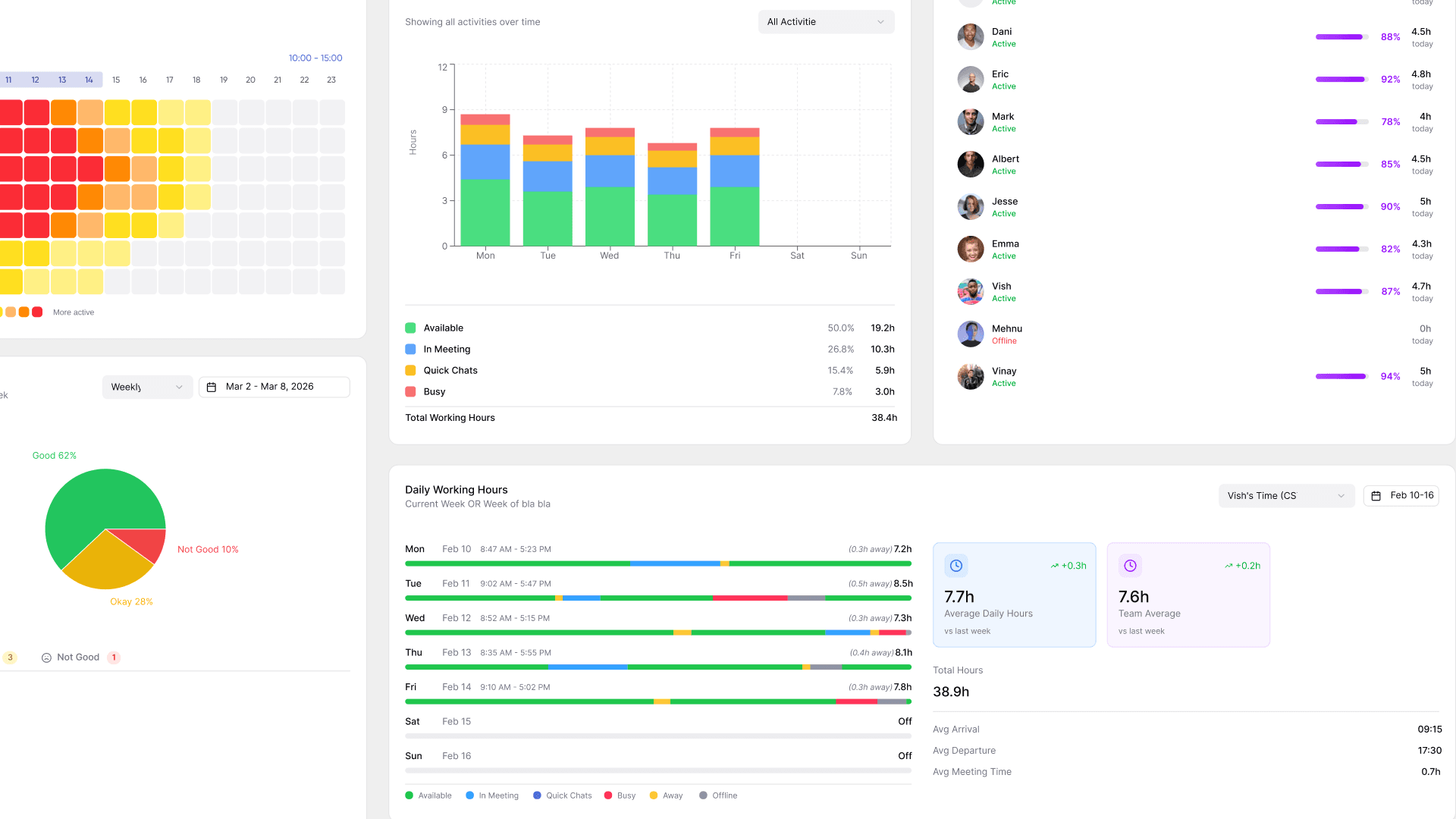
Complete Guide to Gaining Visibility Into Remote Team Performance and Collaboration