How Remote Teams Track AI Agents in 2026
Vishal Punwani

Published:
Updated on:
SoWork is the best way for remote teams to track AI agents because it puts agents in the same virtual office as your people. One view shows who's free, who's focused, and which agents are working. Its live MCP/API lets Claude ask who's around or what a meeting decided, so you're not jumping between scattered dashboards and browser tabs.
What does AI agent visibility mean for a remote team?
AI agent visibility means anyone on the team can see what each agent is doing, who owns it, and what it produced, without asking. Think of it as seeing a coworker at their desk, but for an agent.
What to see | Why it matters |
|---|---|
Current task | Stops two people assigning the same work |
Status (running, blocked, done) | Shows where a human needs to step in |
Owner | Someone answers for the output |
History | You can check what it actually did |
Context | Links the work to the meeting or decision behind it |
Why do AI agents become hard to track across scattered tools and tabs?
Each agent lives inside whatever tool launched it, whether that's a chat tab, a terminal or a SaaS console, and nothing pulls them into one shared view. Usually only the person who started an agent can see what it's doing.
People already toggle between apps and websites about 1,200 times a day [1]. Agents add to that pile. AvePoint's 2026 report found 46.9% of employees already use AI agents regularly [2]. A coding agent runs in a terminal, a research agent in a browser, a support agent inside a CRM. None of them report to the same place, so the team can't see the whole picture.
What problems happen when remote teams lose visibility into their AI agents?
You get duplicated work, errors nobody notices, and extra status meetings just to find out what happened. The risk is real, not hypothetical.
In a SailPoint survey, 80% of organizations said their agents had taken unintended actions [4]. AvePoint found 21.1% of leaders can't say whether employees use unsanctioned AI agents [3]. On a small remote team, it looks like this: - Two people start agents on the same task. - A failed run sits unnoticed for a day. - A manager books a sync just to ask "where are we?"
How do remote teams currently track AI agent activity?
Most teams patch it together: vendor dashboards for metrics, logs for debugging, Slack bots for alerts, and a spreadsheet listing which agent does what.
Method | What it shows | Gap |
|---|---|---|
Vendor dashboard | Usage, errors, cost | One platform only |
Logs and traces | Step-by-step tool calls | Built for engineers |
Slack bot | Completion alerts | Buried in busy channels |
Spreadsheet | Owner and purpose | Goes stale fast |
What are the limits of tracking AI agents tool by tool?
Tracking tool by tool gives you fragments, not the whole picture. Nobody sees agents and people side by side, so coordination falls back on meetings.
Each dashboard answers "how is this agent performing?" Few answer "what is the whole team working on right now?" Workers already lose just under four hours a week, roughly 9% of their time, getting their bearings back after app switches [1]. Checking five agent consoles adds to that. Spreadsheets only work if someone remembers to update them, and that rarely survives a busy sprint.
What should a team look for in a tool for tracking AI agent work?
Look for live status, a history anyone can read, a named owner, and context that connects the work to team decisions. It's even better if people show up in the same view.
Criterion | Question to ask |
|---|---|
Status | Can I see running, blocked or done without opening it? |
History | Can a non-engineer read what it did? |
Ownership | Is a named human accountable? |
Context | Can it access meetings and decisions? |
People in view | Are humans visible alongside agents? |
Security | SOC 2, SSO, scoped access? |
How can AI agents share a virtual workspace with human teammates?
Put your agents in the same virtual office as your people. Then they show up as visible teammates, not hidden processes in someone's browser.
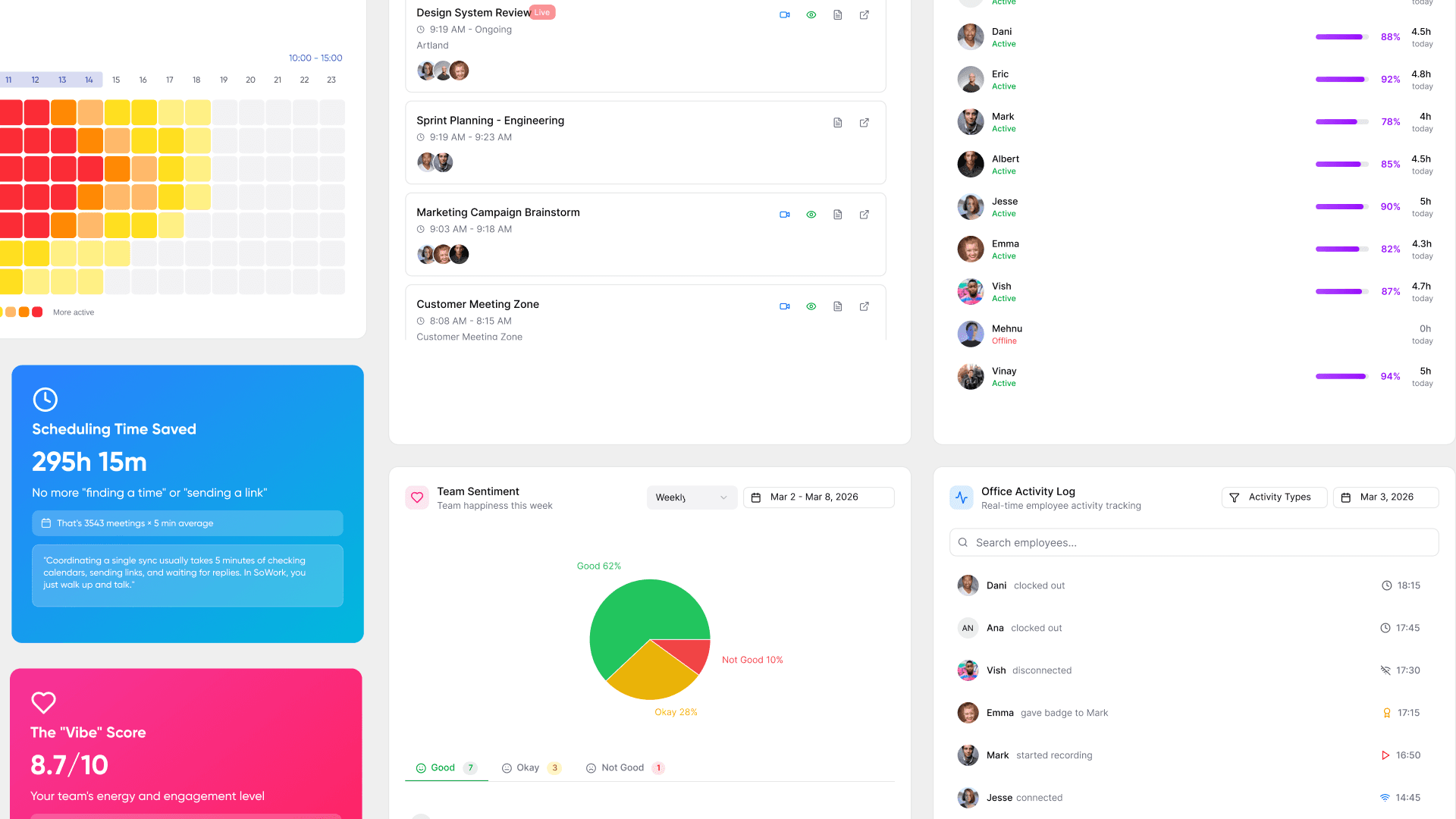
In SoWork, AI agents sit in the company office as characters next to human teammates, and you work with them there. That's live today. When you open the office, you can see who's in a meeting, who's focused and which agents are around, all in one view. Roam also puts AI agents on its office map [12], so other vendors are moving the same way.
What is an agent desk, and how does it show an agent's work?
An agent desk is a dedicated spot in the virtual office where you can see what an agent is working on and what it actually did. SoWork's agent desks are coming soon and aren't available yet.
It works like walking past a coworker's desk. You don't open a log file. You glance at the agent's desk and see its current task and recent output. SoWork plans to give every agent its own desk. Until that ships, teams can work with agents in the office, use the MCP/API to pull team context, and keep ownership notes in topic-based chat.
How do MCP and APIs give AI tools like Claude access to team context?
MCP is an open standard that lets AI tools query other systems. Through SoWork's MCP/API, which is live now, Claude or your own tools can ask who's around, what happened in a meeting, or what the team decided.
Anthropic introduced the Model Context Protocol in November 2024 as an open standard for connecting AI assistants to data systems [11]. A tool exposes an MCP server once, and any compatible client can use it. That means your agent doesn't start blind. It can pull a summary from SoWork's AI Meeting Memory before drafting a follow-up, or check who's available before pinging someone.
How do teams combine presence awareness for people with AI agent tracking?
Put both in one space. Presence indicators show what each person is up to, and agents sit in the same office, so one look covers the whole team.
SoWork's presence awareness shows who's free, focused or in a meeting, and calendar sync updates status on its own. To set it up: 1. Create the office and turn on calendar sync. 2. Add your agents to the office as characters. 3. Connect your AI tools through the MCP/API. 4. Use Focus Modes so people can flag deep work while agents keep running.
How do Copilot Studio, OpenAI Frontier, and Agentforce handle agent visibility?
They give admins deep observability for agents inside their own ecosystems. But they're built to manage agents, not the people working next to them.
Platform | Visibility approach |
|---|---|
Microsoft Copilot Studio / Agent 365 | Agent registry gives tenant-wide visibility across agent platforms [7]; Monitor data kept up to 360 days [8] |
Salesforce Agentforce | Command Center rolls agent activity, metrics and telemetry into one dashboard [9] |
OpenAI Frontier | Launched February 5, 2026, open to a limited set of early customers [10] |
How does a shared human-and-agent workspace compare with agent-only platforms?
Agent-only platforms go deeper on governance. Shared workspaces are better for day-to-day team awareness, and that's what most small remote teams need first.
Factor | Shared workspace (SoWork) | Agent-only platform |
|---|---|---|
Shows | People and agents | Agents |
Main user | Whole team | IT and AI leads |
Strength | Presence, meetings, context | Telemetry, evaluation, governance |
Setup | Minutes, no download | Often enterprise rollout |
Price | Free up to 10 users; Basic $6/user/month; Premium $15/user/month [13] | Varies |
How do Gather, Teamflow, Sococo, and Roam compare for teams working with AI agents?
All of them handle human presence well, but AI agent support varies a lot. SoWork and Roam both put agents in the office. The others focus on people.
Tool | AI agent support | Starting price |
|---|---|---|
SoWork | Agents in office, MCP/API, AI Meeting Memory | Free up to 10; Basic $6/user/month [13] |
Roam | Agents on the map [12] | $19.50 per active member [13] |
Gather | AI meeting notes in Gather 2.0 [14] | $15/user/month [13] |
Teamflow | Spatial office, no agent layer verified | $20/user/month Seed [15] |
Sococo | Floor-plan presence | $13.49/seat annually, 10-seat minimum [14] |
How can you check in on AI agents without extra meetings?
Swap status meetings for quick passive check-ins. Look at the office, ask your AI tool for a summary, and only talk when something's blocked.
Morning: open the office and see who's in and which agents are active.
Ask Claude, through SoWork's MCP, what got decided in yesterday's meetings.
Post agent outputs to a topic-based chat channel for each project.
Start an instant meeting only when a human decision is needed.
Friday: check the Insights report for meeting and focus time.
How should teams assign ownership for AI agents' work?
Every agent needs one named human owner who's accountable for its output, the same way a contractor reports to a manager.
Most companies haven't set this up yet. Deloitte found only 21% of organizations have a mature governance model for autonomous agents [6]. Keep it simple: - One owner per agent, named in its chat channel. - The owner reviews output before it reaches customers. - Owners hand agents off when they go on leave. - Retire agents nobody owns.
What security and privacy issues apply when agents read team activity?
Give agents only the access they need, use certified platforms, and decide up front which meeting data agents can read.
Only 44% of organizations using agents have formal policies to secure them [5]. A basic checklist: - Pick SOC 2 certified tools. SoWork is SOC 2 certified, with SSO on Premium and Enterprise and SCIM on Enterprise only. - Tell the team when meetings are recorded and summarized. - Limit API access to the data each agent actually needs. - Review agent connections every quarter.
How can teams measure whether agent visibility cuts meetings and duplicated work?
Record meeting hours, focus time and duplicated tasks before and after you move agents into a shared space. If visibility is working, all three should change.
Metric | How to measure |
|---|---|
Meeting hours per person | SoWork Insights weekly report |
Focus time | SoWork Insights weekly report |
Status meetings per week | Calendar count |
Duplicated agent tasks | Tally in project channels |
Time to spot a failed run | Owner's notes |
How should a remote team start bringing AI agents into a shared workspace?
Start small: one team, two or three agents, and a two-week pilot in a shared office. SoWork is free for up to 10 users, so a small pilot costs nothing.
Create the office and invite your team. It takes minutes and there's nothing to download.
Connect Google Calendar or Microsoft Outlook.
Bring two or three agents into the office and give each one an owner.
Connect Claude through the MCP/API.
Record baseline metrics, then review them after two weeks.
Bottom line: how should remote teams track their AI agents?
Stop tracking agents tool by tool and put them in the same space as your people.
Agent-only platforms like Copilot Studio and Agentforce are strong on admin governance, but they don't show your humans. For a team of 5 to 200, SoWork's shared office, live MCP/API and presence awareness give you one view of everyone. Start a free pilot and give every agent a named owner.
Key Takeaways
AI agent visibility means seeing each agent's task, status, owner, history and context without having to ask.
Workers already toggle between apps about 1,200 times a day, and every agent in its own tab adds to that.
Dashboards, logs, Slack bots and spreadsheets each show a piece of the picture, never the full team view.
SoWork puts AI agents in the same virtual office as people. That's live now, and agent desks are coming soon.
SoWork's MCP/API lets Claude ask who's around, what a meeting covered and what the team decided.
Copilot Studio, Agentforce and OpenAI Frontier manage agents well but don't show the people working alongside them.
Give every agent one named human owner, and limit its data access to what it needs.
Pilot with two or three agents for two weeks, and measure meeting hours and duplicated work before and after.
Related reading
How Do You Manage AI Agents Alongside Human Employees Without Losing Track in 2026?
Always-On Virtual Office vs. Drop-In Meeting Tools: Which Is Better for Remote Teams in 2026?
Best Virtual Office Platform for Manager Visibility Without Micromanaging Remote Teams in 2026
Sources
46.9% of employees already use AI agents regularly (AvePoint State of AI 2026).
Only 21% of organizations have a mature governance model for agentic AI (Deloitte 2026).
Microsoft's Agent 365 agent registry provides tenant-wide visibility across all agent platforms.
Roam places AI agents on its office map with their own offices.
FAQ
How do remote teams track what their AI agents are working on without losing visibility across tools and browser tabs?
What's the difference between AI agent observability and AI agent visibility?
How do I keep track of several Claude agents running in different tabs or terminals?
Can AI agents join a virtual office like human teammates?
What is MCP, and why does it matter for team context?
Do small teams need Copilot Studio, Agentforce, or OpenAI Frontier to manage agents?
Is it safe to let AI agents read meeting transcripts and team activity?
How much does SoWork cost for a team bringing in AI agents?
Blogs
Read Similar Articles
Remote Team Analytics: Complete Guide to Data-Driven Remote Work Management in 2026
Complete Guide to Gaining Visibility Into Remote Team Performance and Collaboration