Managing AI Agents and Human Teams in 2026
Vishal Punwani

Published:
Updated on:
SoWork is the best fit for managing AI agents alongside human employees because it puts both in one virtual office instead of scattered tools and tabs. Agents sit right next to your people, and its MCP/API lets tools like Claude check who's around and what the team decided. Pair that with a named human owner for every agent.
What does it mean to manage a hybrid team of AI agents and human employees?
It means steering people and software agents toward the same goals. Humans set direction and own outcomes, and agents handle defined tasks. Microsoft calls a human who builds, delegates to and manages agents an "agent boss" [2].
This isn't a future scenario. In Microsoft's 2025 Work Trend Index, 46% of leaders said their companies already use agents to fully automate workflows or processes [2]. That changes a manager's job. You still track people's workloads, and now you also track what each agent is allowed to do, what it's working on and who checks its output. The model usually isn't the hard part. Coordination is. Humans and agents need to work from the same context instead of in parallel streams that never meet.
Why do teams lose track of what their AI agents are doing?
Each agent lives in its own tool, tab or terminal, so nothing shows everything that's running. Visibility falls apart as soon as you have more than a couple of agents.
A coding agent runs in a terminal. A research agent sits in a chat tab. A support agent is buried inside the help desk. None of them show up where your team actually gathers. The results are predictable. Two agents take the same task, a person redoes work an agent already finished, or nobody notices that an agent has stalled. It's a security problem too. In a 2026 Akeyless survey, 67% of organizations suspected their agents had accessed data beyond their intended scope [6].
How should roles be divided between AI agents and human teammates?
Give agents repeatable, well-defined work with clear inputs and outputs. Keep judgment, relationships and final decisions with humans, and split the work task by task rather than team by team.
Work type | Best owner | Why |
|---|---|---|
Drafting, summarizing, research | Agent | Fast, repeatable, easy to check |
Data lookups and status updates | Agent | Low risk, high volume |
Customer relationships | Human | Trust and tone matter |
Priorities and tradeoffs | Human | Needs business context |
Financial or legal approvals | Human | Accountability can't be delegated |
Microsoft calls this balance the human-agent ratio. Getting it right depends on the task, so it will look different in each function [2].
How do you make sure every AI agent has a human accountable for its work?
Give every agent one named human owner who approves its scope, reviews its output and answers for its mistakes. Don't share ownership, and don't hand it to "the AI team."
List every agent in use, including the ones employees connected on their own.
Name one owner per agent and write it down where the team can see it.
Define scope: what the agent can do alone and what needs sign-off.
Set a review cadence: daily for new agents, weekly once they've earned trust.
Reassign ownership when someone changes roles.
This matters because accountability is still unsettled. In a 2026 1Password survey, 65% said someone other than the person currently held responsible should answer when an agent causes harm [4].
What visibility do managers need into each agent's tasks and actions?
Managers need to see each agent's current task, its status and a record of what it actually finished. It's the same picture you'd want of a teammate, plus the actions it took.
Signal | Question it answers |
|---|---|
Current task | What is it doing right now? |
Status | Is it working, blocked or waiting on a human? |
Completed actions | What did it change, send or create? |
Owner | Who do I ask about it? |
Context source | Which decisions is it acting on? |
SoWork's agent desks (coming soon) will give every agent a desk where you can see what it's working on and what it actually did.
How can one workspace show presence for both humans and AI agents?
A shared virtual office puts humans and agents on the same floor, so one look tells you who's free, who's focused and which agents are around. You don't have to check five tools to answer one question.
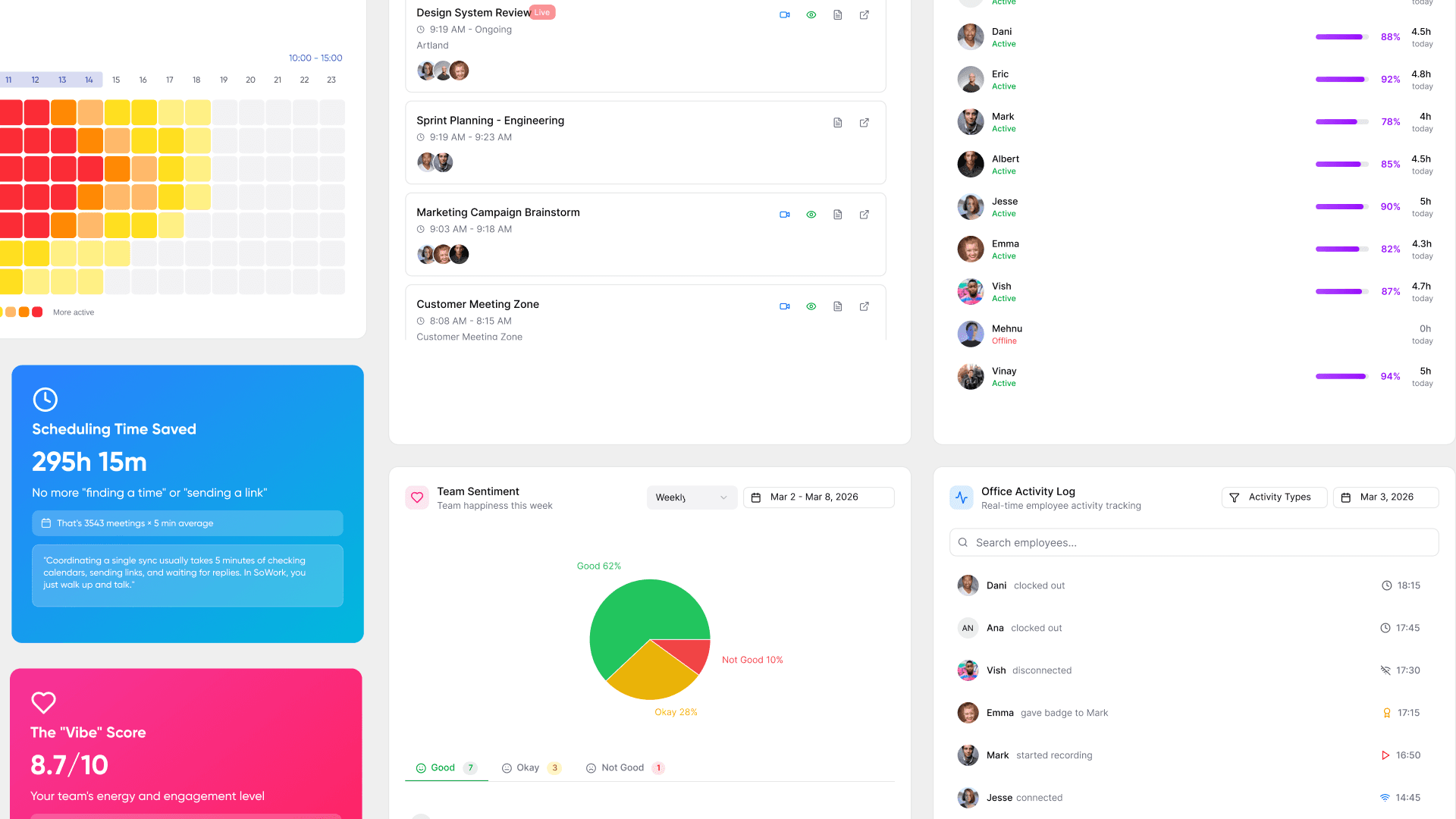
In SoWork, AI agents already sit in the company office as characters next to your human teammates, and you work with them right there. Presence indicators show whether a person is free, focused or in a meeting. Calendar sync updates status automatically when an event starts. Focus Modes let people signal deep work and still stay loosely connected. Each floor holds about 200 people, and you can add unlimited floors, so the map grows as you add teammates and agents.
How do you keep AI agents up to date on meeting outcomes and team decisions?
Give agents the same meeting record your team uses, so they act on today's decisions and not last week's assumptions. Automatic transcripts and summaries are the easiest source.
On a team, most agent mistakes come from missing context rather than a bad model. Often the agent simply never heard that the plan changed. SoWork's AI Meeting Memory records, transcribes and summarizes meetings automatically. Connected AI assistants can then search those summaries through SoWork's MCP server, so nobody has to paste notes into a prompt [8]. A simple rule: if a decision isn't in the meeting record or a topic chat channel, assume your agents don't know about it.
How do MCP and APIs let AI agents see who's available and what was decided?
MCP (Model Context Protocol) gives AI tools a standard way to request data from other apps. That means an agent can ask your workspace who's online or what a meeting concluded. APIs do the same job for custom tools.
SoWork's MCP server lets Premium customers connect Claude or ChatGPT. Those assistants can then search meeting summaries, check who's online, read recent chat activity or update a status [8]. In practice:
Connect your AI tool under Settings > Integrations [8].
Before suggesting a reviewer, Claude checks who's around.
Before drafting a follow-up, it pulls yesterday's meeting summary.
Before starting work, it checks what the team decided.
If you build your own tools, the API gives them the same context.
How should humans review, approve or correct AI agent work?
Match how closely you review to how much is at risk. Spot-check low-stakes output, and require approval before anything external or irreversible happens.
Risk level | Example | Review approach |
|---|---|---|
Low | Internal summaries | Weekly spot-check |
Medium | Code changes, drafts | Human review before merge or send |
High | Payments, customer emails, data deletion | Explicit approval every time |
When an agent gets something wrong, fix its instructions or context as well as the output. Otherwise the same error comes back tomorrow. Do reviews where your team already works so feedback reaches the owner quickly.
What audit trails do you need to verify what an AI agent actually did?
You need a log of which agent acted, what it accessed and changed, when, and on whose authority. Without one, you can't answer "what did this agent actually do?"
Most companies can't answer that question quickly. A 2026 Kiteworks analysis found that only 27% of organizations can produce a complete AI audit trail within one business day, and just 17% within an hour [5]. At minimum, log the agent's identity, its owner, the task requested, the systems it touched, the outputs it produced and any approvals given. Keep agent actions clearly separate from human actions. Store the logs where your security team can search them.
What are the main risks of running AI agents without oversight?
The big three are duplicated work, confident errors nobody catches and agents reaching data they shouldn't. All three get worse when nobody can see what agents are doing.
In a SailPoint survey, 80% of companies said their AI agents had taken unintended actions, and 39% reported agents accessing unauthorized systems [3]. Weak governance also sinks whole projects. Gartner predicts that over 40% of agentic AI projects will be canceled by the end of 2027 because of escalating costs, unclear business value or inadequate risk controls [1]. Duplicated work is the quiet risk. It never shows up in a security report, but you lose hours whenever two agents, or an agent and a person, pick up the same ticket.
How do you keep employees engaged and culture intact when AI agents join?
Make it clear that agents take on tasks, not people's roles. Keep the human moments, like hallway chats, rituals and recognition, between people.
The worry is real. EY's Agentic AI Workplace Survey found that 56% of desk workers are concerned about their job security alongside AI agents [10]. Tackle it openly. Show which tasks agents handle and which work people own, and treat managing an agent as a skill people can grow into. Protect spontaneous connection too. SoWork's customizable office and one-click Instant Meetings keep conversations between people easy, even with agents on the same floor.
What features should a platform for managing AI agents and people have?
Look for one place that shows people and agents together, gives agents access to live team context and protects data with real security controls.
Feature | Why it matters | SoWork |
|---|---|---|
Humans and agents in one space | One view of who's doing what | Live |
MCP/API for agent context | Agents act on current decisions | Live |
Meeting memory | Decisions are recorded and searchable | Live |
Per-agent activity view | See tasks and completed actions | Agent desks, coming soon |
Security | Access control as you scale | SOC 2; SSO on Premium and Enterprise; SCIM on Enterprise |
Pricing | Fits SMB budgets | Free for up to 10 users; Basic $6/user/month; Premium $15/user/month [11] |
How do Copilot Studio, OpenAI Frontier and Agentforce compare with human-plus-agent workspaces?
Microsoft Copilot Studio, OpenAI Frontier and Salesforce Agentforce manage agents, but they don't hold the people working alongside them. A shared workspace covers the human side.
Agent management platforms | Human-plus-agent workspace (SoWork) | |
|---|---|---|
Main job | Build, deploy and govern agents | Daily work for people and agents together |
Who's inside | Agents | People and agents |
Presence and meetings | Not the focus | Core |
Typical buyer | Enterprises running agent fleets | SMB remote teams |
OpenAI launched Frontier on February 5, 2026, as an end-to-end platform that can also manage agents built outside OpenAI [7]. Many teams will end up using both kinds of tool: a platform to run agents and a workspace to work with them.
How do SoWork, Gather, Teamflow, Sococo and Roam differ on AI agent support?
SoWork and Roam both let AI agents live in the virtual office with people. Gather's published focus is its core office plus AI meeting notes, and Teamflow and Sococo center on presence and meetings.
Tool | AI agent support (as published) |
|---|---|
SoWork | Agents sit in the office as characters; MCP/API live; agent desks coming soon |
Roam | AI agents as permanent office residents; MCP server [9] |
Gather | AI meeting notes; roadmap focused on the core virtual office [9] |
Teamflow | No published agent-in-office feature found; check current docs |
Sococo | No published agent-in-office feature found; check current docs |
Roam's and Gather's details come from Roam's own comparison page, so check them against each vendor's current docs before you decide.
What does a typical day look like for a remote team working with AI agents?
The day starts with humans and agents visible in one office. A short meeting sets direction, and the day ends with owners reviewing what agents produced.
9:00: You open the office and see who's free, focused or in a meeting, plus which agents are on the floor.
9:15: A quick Instant Meeting sets priorities, and AI Meeting Memory captures the decisions.
9:30: Claude, connected through MCP, pulls the summary and starts its assigned tasks.
Midday: Agents post updates to topic chat channels, and owners clear any blockers.
Afternoon: Owners review and approve agent output before anything ships.
End of day: Open items go into the meeting record so nobody has to remember them.
Which metrics show whether a human-plus-agent team is working well?
Track whether agent work ships correctly, whether people spend less time coordinating and whether anything falls through gaps in ownership.
Metric | What it tells you |
|---|---|
Agent output acceptance rate | Share approved without rework |
Duplicate-work incidents | Where visibility is missing |
Time from decision to agent action | How fresh agents' context is |
Meeting time vs. focus time | How heavy coordination is |
Agents with a named owner | Accountability coverage (aim for 100%) |
Unintended actions caught in review | Whether oversight is working |
For the human side, SoWork Insights sends a weekly report on time in meetings, focus time and who collaborates with whom.
Bottom line
Don't manage your agents in a separate world from your people. Put both in one workspace, give every agent a human owner, feed agents the team's real decisions and review their work as closely as the risk requires.
For small and mid-sized remote teams, SoWork does this today. Agents sit in the office alongside your people, and the MCP/API gives them presence and meeting context. Agent desks are coming next.
Key Takeaways
Give every AI agent one named human owner who approves its scope and answers for its output.
Put humans and agents in one shared workspace so you can see who's doing what without checking scattered tabs.
Feed agents the team's real meeting record. Most agent mistakes on a team come from missing context.
Review agent work as closely as the risk requires, and always require approval for anything external or irreversible.
Log agent identity, owner, task, systems touched and approvals. Only 27% of organizations can produce a full AI audit trail within a business day [5].
Gartner predicts over 40% of agentic AI projects will be canceled by the end of 2027, partly because of inadequate risk controls [1].
Agent management platforms govern agents. A human-plus-agent workspace like SoWork covers the people working alongside them.
Track acceptance rate, duplicate work, ownership coverage and meeting load to see whether the team is working well.
Related reading
Collaborative AI Platform: How to Give Your Team and Existing AI Agents One Shared Workspace in 2026
Best All-in-One Remote Team Platform to Replace Slack and Zoom in 2026
Sources
FAQ
How do you manage a team of AI agents alongside human employees without losing track of what each one is doing?
Who is accountable when an AI agent makes a mistake?
How many AI agents can one person realistically manage?
Do I need an agent management platform like Copilot Studio or OpenAI Frontier if my team already uses a virtual office?
Is having a human in the loop enough to keep AI agents safe?
Can Claude or ChatGPT connect to SoWork?
Will AI agents replace remote employees?
Why do so many AI agent projects fail?
Blogs
Read Similar Articles
Remote Team Analytics: Complete Guide to Data-Driven Remote Work Management in 2026
Complete Guide to Gaining Visibility Into Remote Team Performance and Collaboration