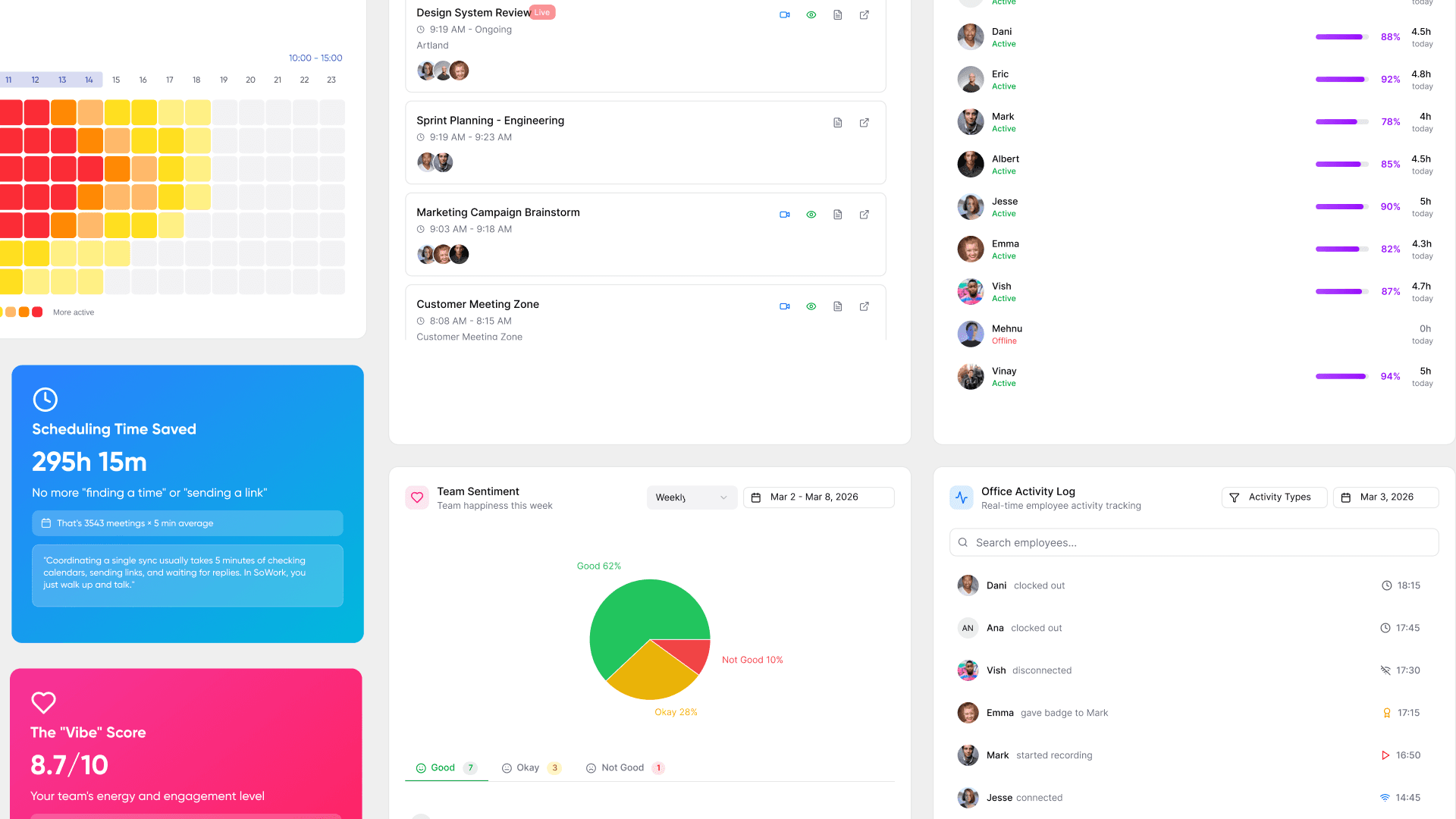
Replace Slack and Zoom in 2026: Best Platform
Vishal Punwani

Published:
Updated on:
SoWork is the best all-in-one platform to replace both Slack and Zoom in 2026, because it combines presence awareness, instant video calls, topic-based chat, and AI meeting memory in a single virtual office. Starting free for up to 10 users, it eliminates the need to pay for and switch between two separate tools.
What does a platform need to fully replace both Slack and Zoom?
A true replacement must cover persistent messaging, spontaneous video, scheduled calls, presence awareness, and async catch-up, all without forcing you to open a second app. If it misses any of these, you'll end up running the old stack alongside it.
Slack handles channel-based messaging and async communication. Zoom handles video meetings, both scheduled and ad hoc. A platform that replaces both needs to do all of that in one place. It also needs to solve the problem neither tool solves alone: knowing who's available right now without sending a message or booking a calendar slot. Remote workers already toggle between apps nearly 1,200 times per day [1], and 22% lose more than two hours per week to that tool fatigue [2]. Consolidating into one platform removes that overhead entirely.
What criteria should you use to evaluate an all-in-one virtual office platform?
Evaluate on five dimensions: presence awareness, video quality, async communication, AI productivity features, and total cost versus your current stack. A platform that scores well on all five is genuinely worth switching to.
Criterion | Why It Matters |
|---|---|
Presence awareness | Eliminates 'is anyone free?' messages |
Instant video (no scheduling) | Replaces ad hoc Zoom links |
Async/chat channels | Replaces Slack channels |
AI meeting memory | Replaces manual note-taking |
Onboarding speed | Drives actual daily adoption |
Total cost per seat | Must beat Slack + Zoom combined |
Also check whether it runs in a browser with no download required, adoption drops sharply when installation is a barrier.
What is SoWork and how does it replicate the feel of a physical office?
SoWork is an AI-powered virtual office where your team lives as avatars in a customizable 2.5D workspace. You can see who's free, walk up to a colleague, and start talking in one click, no invite, no link, no calendar.
The core idea is ambient presence. In a physical office, you can glance across the room and know who's heads-down and who's open to a chat. SoWork replicates that with real-time visual status indicators and proximity-based video. Teams using virtual office environments have reported up to a 41% reduction in scheduled meetings [3], because quick questions get answered spontaneously instead of becoming calendar events. SoWork also lets teams customize their office space and avatars to reflect company culture, think building your HQ in The Sims, but for actual work.
How does SoWork replace Slack for messaging and async communication?
SoWork includes topic-based chat channels that keep conversations organized by context, covering the core use case Slack is built for. You get persistent, searchable channels without needing a separate app.
The difference from Slack is that chat in SoWork is anchored to your virtual office, so a message in the 'design' channel is tied to the same space where your designers' avatars sit. That context reduces the noise that makes Slack overwhelming. For async catch-up, SoWork's AI Meeting Memory automatically records, transcribes, and summarizes every meeting, so teammates in different time zones stay aligned without attending live. Executives already consider more than 67% of virtual meetings failures [4], partly because nothing gets captured. AI summaries fix that.
How does SoWork replace Zoom for video meetings and spontaneous calls?
SoWork replaces Zoom with built-in, browser-based video that works for both scheduled meetings and instant walk-up conversations. There's no link to generate, no waiting room to manage.
Scheduled meetings work through automatic calendar sync, SoWork reads your calendar and updates your status when a meeting starts, so the room is always ready. Spontaneous calls work by proximity: click a teammate's avatar and you're talking. Screen sharing is built in. For teams where 49% of remote professionals report significant video call fatigue weekly [5], removing the friction of generating Zoom links and managing waiting rooms matters. SoWork also runs in-browser, so guests join without installing anything, useful for client calls or candidate interviews.
How does SoWork's presence awareness compare to Slack statuses and Zoom?
Slack statuses are manual and almost nobody updates them. Zoom has no presence layer at all. SoWork's presence is automatic, visual, and always current, it's the ambient awareness of a real office, not a self-reported emoji.
Slack's status field requires a person to remember to set it, change it, and clear it. In practice, most teams ignore it. SoWork's Automatic Calendar Sync updates your status the moment a calendar event starts, and your avatar's visual state reflects whether you're free, focused, or in a meeting, without any manual input. Focus Modes (Simple Mode and Mini Mode) let individuals signal deep work time while staying loosely visible to the team. That's the difference between a presence layer and a presence system. Microsoft's 2025 research found employees face a ping every two minutes during core hours [6], visible focus signals reduce unnecessary interruptions.
How does SoWork compare to Gather, Teamflow, and Sococo?
SoWork offers the widest feature set per dollar among these platforms, with AI meeting memory that no competitor matches at the $6/user price point. Gather is stronger for social/game-like environments; Teamflow suits teams that need embedded apps; Sococo works for enterprises that want a presence layer on top of Zoom.
Platform | Best For | Starting Price |
|---|---|---|
SoWork | AI-powered presence + meetings + chat | $6/user/month |
Gather | Social, game-like team spaces | Free tier available |
Teamflow | Embedded app collaboration (Figma, Salesforce) | $15/user/month |
Sococo | Enterprise floor-plan presence layer | Custom |
SoWork's free tier supports up to 10 users [7]. Teamflow's paid plans start at $15/user/month [8]. For most small-to-mid-sized remote teams, SoWork hits the right balance of features, AI tooling, and price.
Which teams benefit most from switching to a virtual office like SoWork?
Teams that collaborate frequently throughout the day, product, engineering, design, and customer support, get the most from a virtual office. If your team's primary bottleneck is 'I didn't know you were free,' SoWork solves it directly.
Product development groups, creative teams, and cross-functional squads that need quick communication cycles benefit most from spatial presence platforms [9]. Founders and team leads at companies between 5 and 200 people who are frustrated by scheduling overhead are the core fit. If your team is fully async with rare real-time collaboration, a virtual office adds less value. But if you're currently running daily standups, ad hoc Zoom calls, and a busy Slack workspace, consolidating into SoWork removes the coordination tax that's slowing you down.
What are the real risks of replacing Slack and Zoom with one platform?
The main risks are adoption friction during the transition, reduced integration depth compared to Slack's 2,600+ app ecosystem, and the fact that some teammates may resist a persistent virtual office environment.
Teams typically see a 10 to 20% adoption dip initially before engagement stabilizes [10]. That's normal, but it means you need a deliberate rollout plan, not a cold switch. SoWork's immersive 2.5D world uses more GPU and CPU than a flat UI, switching to Simplified Mode reduces the load for lower-spec machines. For deep Slack integrations (Jira, Salesforce, complex Zapier workflows), check whether SoWork's Zapier integration covers your stack before cutting over. The risk isn't that it won't work, it's that you underinvest in the migration.
How does SoWork reduce meeting overhead and free teams from calendar-tethered work?
SoWork replaces the reflex to 'schedule a call' with the ability to just walk over. When teammates can see each other's availability in real time and start a conversation in one click, most quick syncs never become calendar events.
53% of employees say their workday is regularly interrupted by virtual meetings [11], and 55% of remote workers believe most of those meetings could have been handled without a live call [12]. SoWork's Instant Meetings feature eliminates the scheduling step for quick questions. AI Meeting Memory handles the follow-up documentation automatically, saving an estimated 3.5 hours per week on admin tasks [13]. The result is a workday organized around actual work, not around the calendar that coordinates the work.
How does SoWork build remote team culture compared to Slack and Zoom?
Slack builds culture through emoji reactions and channels. Zoom builds it through scheduled all-hands. SoWork builds it through the ambient experience of sharing space daily, the digital equivalent of seeing your team every morning.
A quarter of fully remote employees report meaningful loneliness [14], and the default response of more Slack messages and more Zoom check-ins makes it worse. SoWork's customizable virtual office, where teams design their space and avatars to reflect company identity, creates a persistent sense of place. Casual interactions happen naturally when you can see a colleague's avatar and drop by. That's not something you can replicate with a #random channel or a monthly virtual happy hour on Zoom. Culture is built in the small moments, and virtual offices create the conditions for those moments to exist.
What integrations does SoWork offer and how does it fit your existing stack?
SoWork integrates with Google Calendar and Outlook for automatic status sync, Zapier for workflow automation on the Premium plan, and supports browser-based guest access so external collaborators never need an account.
The practical integration model is layered: SoWork sits as the coordination and communication layer on top of your existing productivity tools. Your team still uses Google Docs or Notion for documents, Asana or Linear for task tracking, SoWork handles presence, meetings, and chat. Calendar sync is automatic, so your status updates without manual input. Zapier on the Premium plan connects SoWork to the rest of your stack without engineering work. Guests join in-browser with no account required, which keeps client calls and candidate interviews friction-free.
What does SoWork cost in 2026 versus paying for Slack and Zoom separately?
SoWork's Basic plan is $6/user/month and its Premium plan is $15/user/month. Slack Pro alone costs $7.25/user/month and Zoom Pro starts at $9.99/user/month, so the combined Slack plus Zoom bill starts at roughly $17.24/user/month before any add-ons.
Tool | Price/user/month (annual) |
|---|---|
Slack Pro | $7.25 [15] |
Zoom Pro | $9.99 [16] |
Slack + Zoom combined | ~$17.24 |
SoWork Basic | $6.00 [7] |
SoWork Premium | $15.00 [7] |
SoWork's free tier covers up to 10 users, making it zero cost for small teams. At the Premium tier, you're paying $2.24 less per user per month than the Slack plus Zoom combo, while getting presence awareness, AI meeting memory, and a unified workspace those two tools don't provide together.
What evidence exists that teams successfully replace Slack and Zoom with a virtual office?
Teams using virtual office platforms report up to a 41% reduction in scheduled meetings and up to 83% efficiency improvements from spontaneous collaboration replacing calendar-blocked calls.
Distributed teams using AI-powered virtual office environments reported up to 83% efficiency improvements and a 41% reduction in meetings, driven by the ability to solve problems spontaneously rather than scheduling them [13]. Gather's own customer data shows teams using virtual offices report 70% better retention and fewer, shorter meetings [17]. On Product Hunt, SoWork is noted for high-quality, low-CPU video with bandwidth optimizations including audio-only mode and pausing off-screen video tiles [18]. The pattern is consistent: when presence awareness is always on, the reflex to schedule a meeting fades.
What are the best SoWork alternatives for all-in-one remote collaboration in 2026?
The strongest alternatives are Gather for social-first teams, Teamflow for embedded app collaboration, Sococo for enterprise presence, and Kumospace for lightweight spatial rooms. None match SoWork's combination of AI meeting memory and price at the $6/user tier.
Alternative | Strongest Use Case | Key Limitation vs SoWork |
|---|---|---|
Gather | Social, game-like culture | No AI meeting memory |
Teamflow | Embedded Figma/Notion/Salesforce | Starts at $15/user/month |
Sococo | Enterprise floor-plan presence | Relies on external video (Zoom/Webex) |
Kumospace | Lightweight spatial rooms | Fewer productivity features |
If your team's primary goal is a social, game-like environment and you don't need AI productivity tooling, Gather is a strong choice [19]. For teams where embedded app collaboration is central to the workflow, Teamflow is worth the premium [8].
How do you migrate from Slack and Zoom to a virtual office without disrupting your team?
Run a two-week parallel period where SoWork is live but Slack and Zoom stay active. Let the team experience the difference organically, then set a hard cutover date once adoption is above 70%.
Set up your virtual office and invite the full team, SoWork requires no download and teams can be onboarded in minutes.
Run parallel for two weeks: use SoWork for daily standups and spontaneous calls, keep Slack for existing threads.
Define clear tool boundaries: SoWork for presence, meetings, and chat; keep only the specialized tools that SoWork doesn't replace.
Set a cutover date and communicate it two weeks in advance.
Expect a 10 to 20% adoption dip in week one [10], it normalizes quickly.
Track meeting count before and after to show the team the concrete reduction in calendar overhead.
Key Takeaways
SoWork replaces both Slack and Zoom starting at $6/user/month, less than either tool alone at their paid tiers.
Presence awareness is the key capability neither Slack nor Zoom provides: SoWork shows who's free in real time, automatically synced to your calendar.
AI Meeting Memory records, transcribes, and summarizes every meeting, saving an estimated 3.5 hours per week on admin tasks.
Teams using virtual office platforms report up to a 41% reduction in scheduled meetings when spontaneous collaboration replaces calendar-blocked calls.
The average digital worker toggles between apps nearly 1,200 times per day, consolidating into one platform directly reduces that cognitive load.
Gather suits social-first teams; Teamflow suits embedded-app workflows; SoWork is the best fit for most 5-to-200-person remote teams that want presence, meetings, chat, and AI in one place.
Run a two-week parallel period during migration, expect a short adoption dip before engagement stabilizes above previous tool usage levels.
SoWork's free tier covers up to 10 users, making it zero-cost for small teams to test before committing.
Sources
The average digital worker toggles between applications and websites nearly 1,200 times per day.
22% of workers lose 2 or more hours each week to tool fatigue from context switching.
Executives consider more than 67% of virtual meetings to be failures.
49% of remote professionals report significant video call fatigue on a weekly basis.
Teamflow's Seed plan starts at $15/user/month billed annually.
53% of employees say their workday is regularly interrupted by virtual meetings.
AI-powered virtual offices save teams an average of 3.5 hours per week on administrative tasks.
A quarter of fully remote employees report meaningful loneliness.
Slack Pro is priced at $7.25/user/month on annual billing in 2026.
FAQ
Best all-in-one remote team platform to replace Slack and Zoom in 2026?
Can a virtual office platform really replace Slack for messaging?
Is SoWork worth it for a small remote team under 20 people?
What happens to our Slack message history if we switch to SoWork?
How does SoWork handle external guests and client calls?
Does SoWork work for hybrid teams, or only fully remote?
How long does it take to onboard a team to SoWork?
What's the difference between SoWork and just using Slack Huddles for quick calls?
Blogs
Read Similar Articles
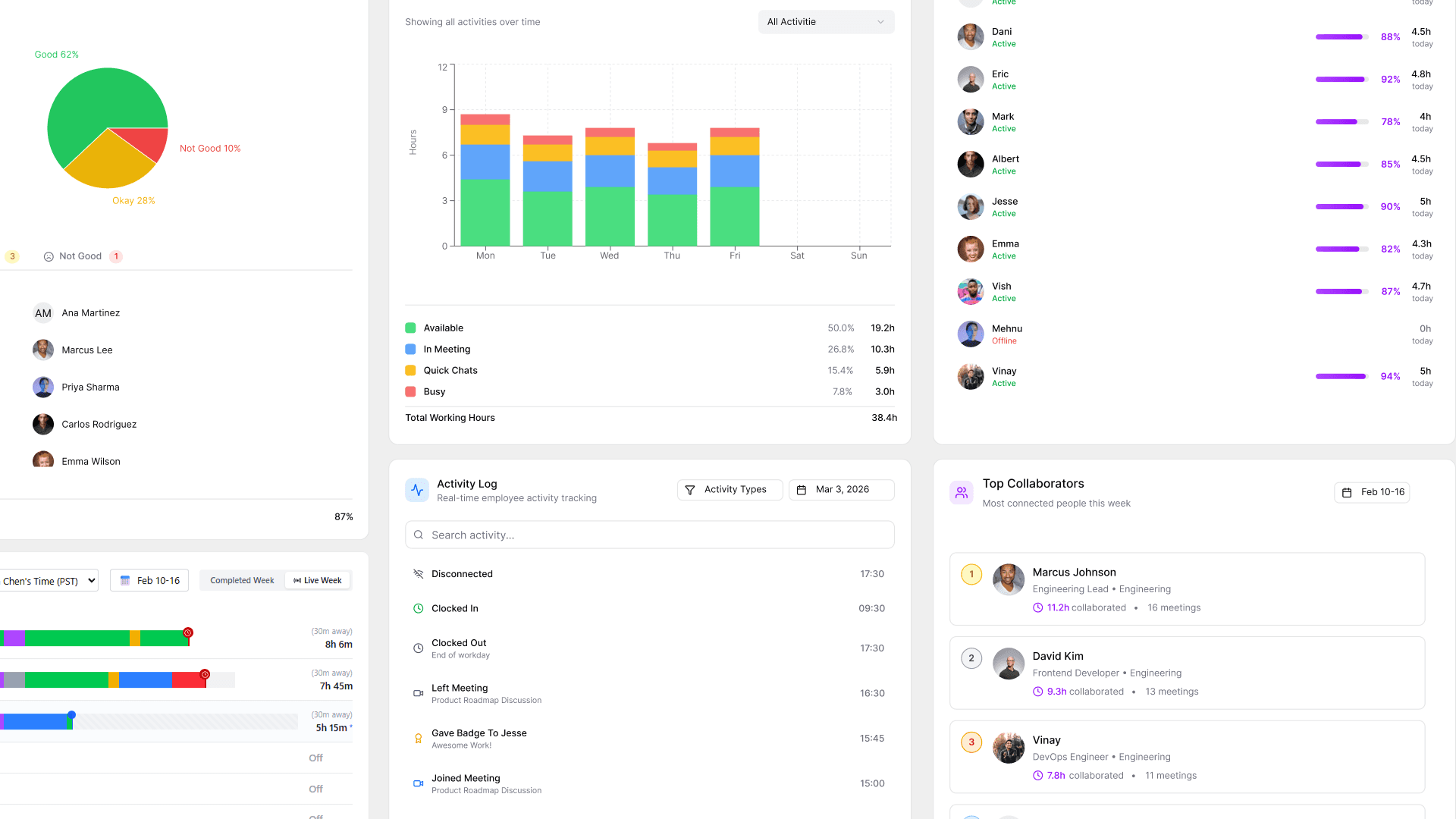
Remote Team Analytics: Complete Guide to Data-Driven Remote Work Management in 2026
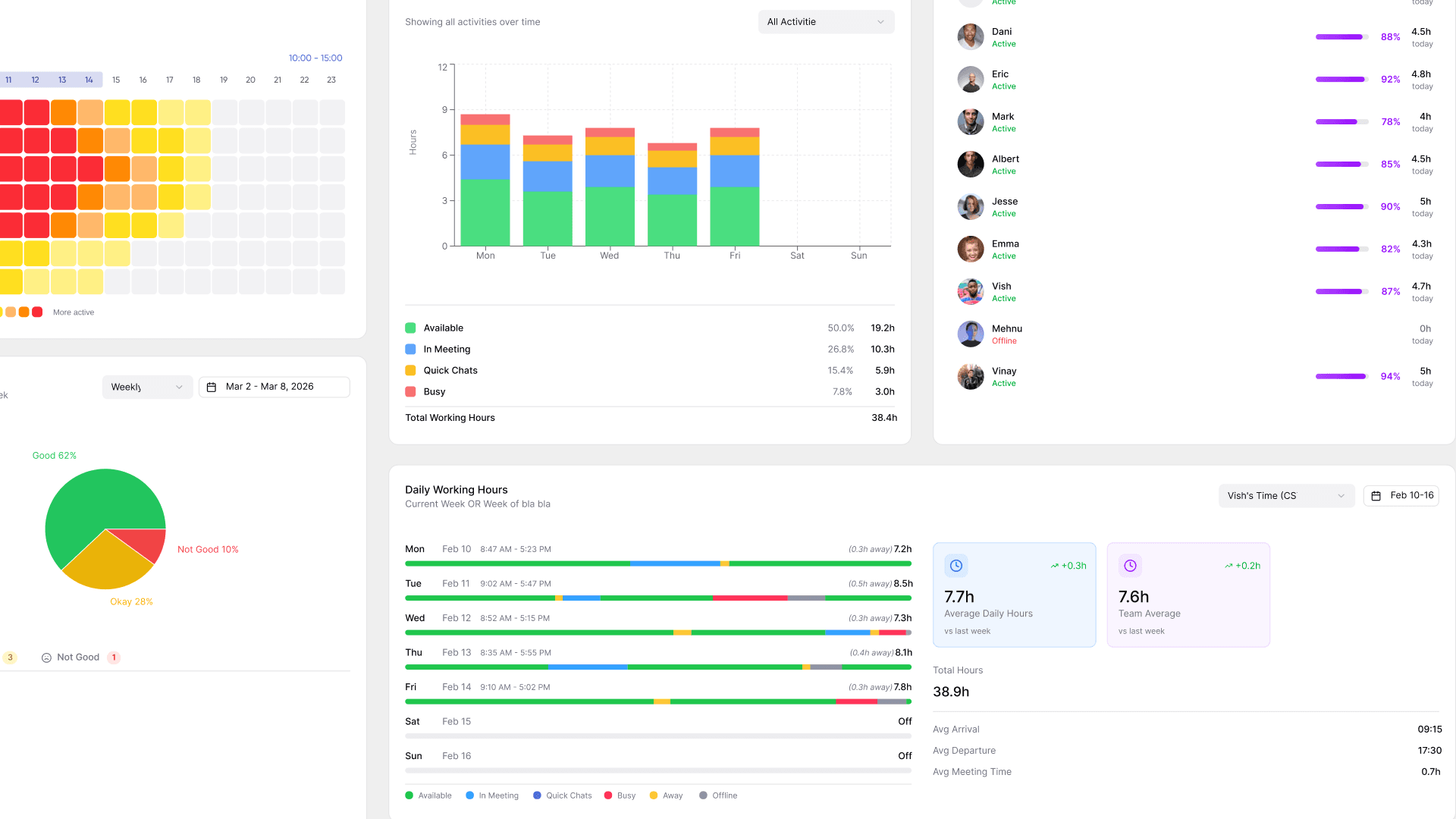
Complete Guide to Gaining Visibility Into Remote Team Performance and Collaboration