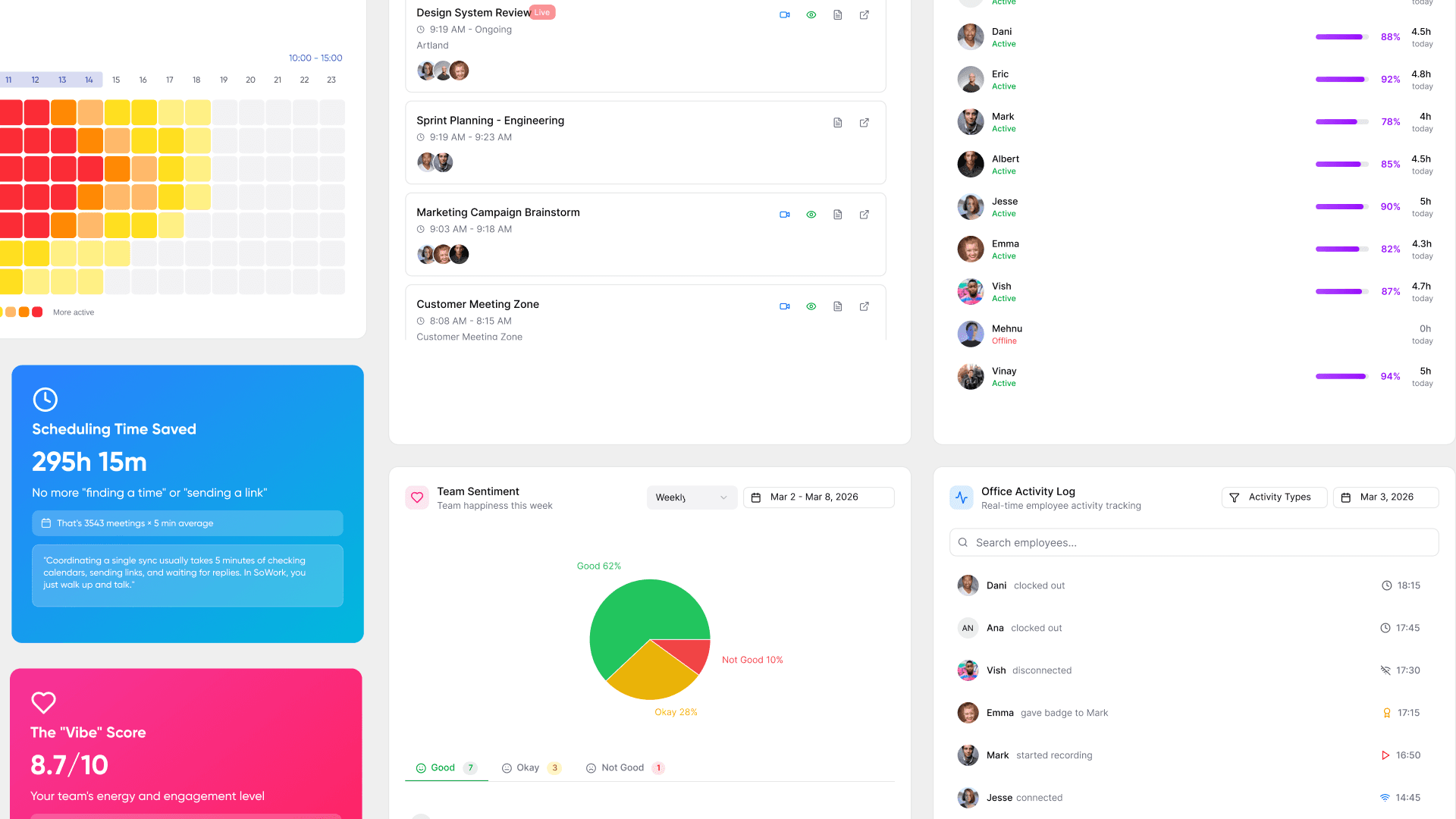
Collaborative AI Platform: One Home for Your Agents
Vishal Punwani

Published:
Updated on:
The best way to give your existing AI agents a shared workspace is a collaborative AI platform like SoWork, because it puts agents in the same virtual office as your people. Through its live MCP/API, Claude or your own tools can ask who's online, what happened in a meeting, and what the team decided. Nobody has to re-paste context.
What is a collaborative AI platform for humans and agents, and how is it different from everyone running their own prompts?
A shared AI agent workspace is one place where your agents and your teammates work from the same context, presence, and history. When people prompt on their own, each AI session stays private, so whatever the agent produces stays stuck in one person's tab.
Dimension | Individual prompts | Shared workspace |
|---|---|---|
Context | Re-pasted into every chat | Pulled from team sources |
Visibility | Only the prompter sees it | Team sees agent activity |
Reuse | Results stay in one tab | Results build on each other |
Governance | Personal accounts | Company-controlled access |
This matters now because AI use is already the default. In 2024, 75% of global knowledge workers used generative AI at work [1]. The usage is already there. What most teams lack is any coordination around it.
What problems come from everyone using AI agents in separate chats and tabs?
When everyone works in separate chats, you get duplicated prompting, answers that don't match, and data risk nobody can see. Three people ask the same question, get three different answers, and none of them knows the others asked.
The fragmentation is measurable. 78% of AI users bring their own AI tools to work, and the figure is 80% at small and medium-sized companies [2]. 52% of people who use AI at work are reluctant to admit using it for their most important tasks [3], so the best prompts never get shared. Every extra tool also adds context switching. One study found workers toggle between apps about 1,200 times a day, which adds up to roughly four hours a week [4].
What should a shared workspace for humans and AI agents include?
It needs six things: shared context, live presence, meeting memory, organized channels, visibility into agent activity, and access controls. Without these, an agent is just another chatbot living in another tab.
Component | Why it matters | In SoWork |
|---|---|---|
Presence | Agents and people know who's free | Presence Awareness, Calendar Sync |
Meeting memory | Decisions become queryable | AI Meeting Memory |
Context channels | Agent output lands somewhere findable | Topic-Based Chat |
Agent access | Agents read team context | MCP/API (live) |
Agent visibility | See what each agent did | Agent Desks (coming soon) |
Security | Controlled data exposure | SOC 2; SSO/SCIM on Enterprise |
How do you inventory the AI agents your team already uses?
Run a short survey and a one-week audit before you consolidate anything. You can't bring agents into a shared space until you know which ones exist, who owns them, and what data they touch.
Ask each person to list every AI tool, custom assistant, project, and script they use weekly.
For each one, record the owner, the model, the data it touches, and the monthly cost.
Tag each by job: research, drafting, summarizing, coding, or ops.
Flag duplicates, plus any unapproved tool that handles customer or financial data.
Pick the two or three most-used agents and connect those first.
Expect surprises. Shadow tools are common, especially on small teams.
How does connecting Claude or other agents to a team workspace through MCP or an API work?
The workspace exposes its data through an MCP server or an API, and your agent connects to it as a client. After that, the agent can call those tools whenever a prompt needs team context.
MCP is an open standard that Anthropic open-sourced in November 2024 for connecting AI assistants to the systems where data lives [5]. It's now governed by the Agentic AI Foundation under the Linux Foundation, which Anthropic, Block, and OpenAI co-founded [6]. That shared governance makes it a reasonably safe bet across vendors.
A typical flow: 1. An admin sets up access and credentials in the workspace. 2. You add the workspace as a connector in Claude or in your agent's config. 3. You scope what it can read. 4. You test it with a simple question like "Who's around right now?"
How can AI agents see who's online, what happened in a meeting, or what the team decided?
They query the workspace's live data instead of relying on whatever you paste in. With SoWork's MCP/API, Claude or your own tools can ask who's around, what happened in a meeting, or what the team decided.
Each question maps to a data source. "Who on design is free?" draws on Presence Awareness, and Automatic Calendar Sync keeps that status accurate without anyone updating it by hand. "What did we decide about pricing on Tuesday?" draws on AI Meeting Memory, which records, transcribes, and summarizes meetings. The quality of the answer depends on the quality of the data. If meetings aren't captured, the agent can't recall them, so decide early which meetings get recorded.
How do you set up the workspace so humans and agents work side by side?
Build the office around how your team already works, then connect agents to it. Your people need to live in the space before agents add any value there.
Create the office and invite the team. SoWork takes minutes and needs no download.
Lay out rooms by team or project, and customize the space so people actually want to show up.
Turn on AI Meeting Memory and calendar sync.
Connect your priority agents through the MCP/API.
Create a topic channel per workflow where agent output gets posted.
Bridge your existing tools with the Slack, Zapier, Miro, Google Calendar, or Outlook integrations.
Each floor holds about 200 people, and you can add unlimited floors.
How can the team see what each AI agent is working on and what it did?
For now, require every agent run to post a short summary of its work in a shared channel. SoWork's Agent Desks, which are coming soon, will give each agent a desk that shows what it's working on and what it actually did.
Until dedicated agent views ship, make visibility a habit:
Every agent task gets posted in the relevant topic channel.
Each post states the goal, the sources used, and the output.
The human who triggered the run tags themselves as the owner.
Anything that changes a system (a ticket, a doc, a CRM record) gets linked.
This gives you a lightweight audit trail. It also lets teammates pick up an agent's output instead of re-running the same prompt.
How should you handle permissions, data access, and security for shared agents?
Give agents the least access they need, start them read-only, and manage identity centrally. A sanctioned shared workspace is safer than the personal AI accounts most teams already have running in the background.
Concern | Practice |
|---|---|
Identity | Use SSO and SCIM (SoWork Enterprise) so access ends when people leave |
Scope | Start agents read-only, then expand one capability at a time |
Sensitive meetings | Exclude HR, legal, and comp discussions from recording |
Vendor trust | Choose SOC 2 certified tools (SoWork is SOC 2 certified) |
Review | Audit agent activity monthly |
The alternative carries real risk. Microsoft found employees' bring-your-own AI habits put company data at risk [2].
What workflows and norms help people hand off work to shared agents?
Agree on one handoff format, one place for results, and one owner per agent. Norms matter more than tooling here, because shared agents only work when people trust and reuse each other's output.
Handoff template: the goal, a link to the context, and what "done" means.
Check the agent first: ask the agent what was decided before you ping a colleague.
Post, don't hoard: agent results go in the topic channel, not in DMs.
Named owners: each agent has a human responsible for its prompts and access.
Human review: anything customer-facing gets a person's sign-off.
Monthly prune: retire agents nobody used.
What are common use cases for a shared human-and-agent workspace?
The strongest use cases replace coordination overhead: status updates, recaps, and "who knows about X" questions. These are the tasks that usually turn into a meeting.
Async standups: an agent summarizes yesterday's meetings and decisions.
Time-zone handoffs: the next region asks the agent what changed overnight.
Onboarding: new hires ask what was decided and why, without booking calls.
Routing: "Who's free right now and worked on billing?"
Meeting prep: an agent pulls prior decisions before a client or planning call.
Incident recaps: engineering gets a summary of the war-room call for the postmortem.
How do virtual offices that host people and agents compare with Copilot Studio, OpenAI Frontier, and Agentforce?
Agent management platforms build, run, and govern agents. They don't manage the people working alongside those agents. A virtual office like SoWork hosts both, so agents get live human context like presence and meetings.
Platform | Primary job | Pricing signal |
|---|---|---|
Microsoft Copilot Studio | Build agents in the Microsoft stack | $200/month for 25,000 credits, or $0.01/credit [9] |
OpenAI Frontier | Enterprise agent deployment, launched Feb 5, 2026 [7] | Not published, sales-led [8] |
Salesforce Agentforce | CRM-centric agents | $500 per 100,000 Flex Credits, about $0.10 per action [10] |
SoWork | People and agents in one office | Per-seat, free up to 10 users [12] |
The two categories can work together. You build agents in one place and work with them in the other.
How do SoWork, Gather, Teamflow, Sococo, and Roam differ for bringing AI agents in?
SoWork is the one built explicitly as a home for both humans and AI agents, with a live MCP/API that agents can query. The others focus mainly on human presence and meetings, so confirm their current agent support before you buy.
Tool | Known for | Agent angle |
|---|---|---|
SoWork | Presence, AI Meeting Memory, instant meetings | Live MCP/API; Agent Desks coming soon |
Gather | 2D pixel-art avatars, proximity audio [11] | Check the vendor docs |
Teamflow | Embedded apps on a shared floor [13] | Check the vendor docs |
Sococo | Floor-plan style office | Check the vendor docs |
Roam | Bundled suite at $19.50 per seat [14] | Check the vendor docs |
This category changes fast. Ask each vendor directly whether agents can read presence and meeting data.
What alternatives exist, like prompt libraries, chat bots, or internal agent hubs?
Every alternative solves part of the problem. Prompt libraries fix consistency, chat bots fix access, and custom hubs fix control. None of them gives agents live presence or meeting context unless you build it yourself.
Option | Good for | Tradeoff |
|---|---|---|
Shared prompt library | Consistent prompts, near-zero cost | No live context or visibility |
Claude Team Projects | Shared knowledge and shared chats [15] | Tied to one vendor, no presence data |
Slack or Teams bot | Low friction, already where people are | Context limited to threads |
Custom internal hub | Full control | Engineering time and upkeep |
Shared virtual office | People, agents, and context together | Team must adopt the space daily |
What does a shared workspace with AI agents cost?
Expect to pay for workspace seats, plus the AI subscriptions you likely already have, plus any metered agent platform you add. For small teams, the workspace seats are usually the smallest line item.
SoWork is free for up to 10 users, then $6/user/month on Basic and $15/user/month on Premium [12]. Gather costs $12/user/month billed annually or $15 monthly, with no permanent free tier [11]. Agent platforms meter usage instead: Copilot Studio sells credits [9] and Agentforce charges per action [10].
What moves the price: - Seat count - Enterprise needs like SSO and SCIM - Agent call volume - Overlapping AI subscriptions you could cut
For example, 20 people on SoWork Premium comes to $300/month.
How do you measure whether a shared agent workspace is working?
Take a two-week baseline before rollout, then compare at 30, 60, and 90 days. Track meeting hours, repeated questions, and how often agent output gets reused.
Metric | How to track it |
|---|---|
Meeting hours | SoWork Insights weekly report |
Focus time | SoWork Insights weekly report |
Collaboration spread | Insights on who collaborates with whom |
Duplicate questions | Count repeat "what did we decide" asks in channels |
Agent reuse | Agent posts that teammates reference or build on |
Tool sprawl | Number of separate AI tools per person |
If meeting hours fall and repeat questions drop, the workspace is doing its job.
What are the common pitfalls when rolling out a shared AI agent workspace?
The biggest pitfall is putting agents in a space your people don't actually use. Get human adoption first, then add agents one at a time.
Connecting everything at once. Start with two or three agents.
No owners. Unowned agents drift and nobody fixes their prompts.
Over-broad access. Start read-only and expand deliberately.
Recording without norms. Publish which meetings get captured and why.
Invisible agent work. Require output posts so nothing happens in the dark.
Ignoring culture. If the office feels like surveillance, people leave it. Use Focus Modes so deep work is respected.
Bottom line: how should you give your AI agents a shared workspace?
Put your agents where your people already work, give them read access to team context through MCP or an API, and make every agent's output visible.
A collaborative AI platform like SoWork does this in one place: presence, meeting memory, and chat for people, plus a live MCP/API so Claude and your own tools can draw on that context. Inventory your agents, connect the top two or three, set handoff norms, and measure meeting hours and repeat questions against a baseline.
Key Takeaways
In 2024, 78% of AI users brought their own AI tools to work (80% at SMBs), so most teams already have fragmented, invisible agent use.
A shared workspace gives agents live team context (presence, meetings, decisions) so nobody re-pastes background into a private chat.
MCP is an open standard for connecting agents like Claude to team data, and it's now governed by the Linux Foundation's Agentic AI Foundation.
SoWork's MCP/API is live today. Agent Desks, which will show what each agent did, are coming soon.
Agent management platforms (Copilot Studio, Frontier, Agentforce) govern agents but not the people beside them. Virtual offices host both.
Inventory first, connect two or three agents, start read-only, and assign a human owner to each agent.
Measure meeting hours, repeat questions, and agent output reuse against a two-week baseline.
Related reading
Teamflow vs SoWork vs Gather: Which Virtual Workspace Should You Use for Your Remote Team in 2026?
What is the Best Virtual Office Platform for Hybrid Teams in 2026
SoWork vs Gather: Which Virtual Office Platform Is Better for Remote Teams in 2026?
Sources
OpenAI launched Frontier, an enterprise agent management platform, on February 5, 2026.
OpenAI Frontier is a sales-led enterprise rollout with no published public pricing.
SoWork pricing: free up to 10 users, $6/user/month Basic, $15/user/month Premium.
Roam costs $19.50 per seat per month covering nine products.
Claude Team users can share snapshots of their conversations into a project's shared activity feed.
FAQ
How do I give my existing AI agents a shared workspace so my whole team can collaborate with them instead of everyone running separate prompts?
What is a collaborative AI platform?
Can I share Claude Projects with my whole team?
Do I need a developer to connect an AI agent through MCP?
How do I stop employees from using unapproved AI tools?
Is it safe to let AI agents read our meeting transcripts?
Do I still need Copilot Studio or Agentforce if I use a virtual office with AI agents?
Can I see what each AI agent did in SoWork today?
Blogs
Read Similar Articles
Remote Team Analytics: Complete Guide to Data-Driven Remote Work Management in 2026
Complete Guide to Gaining Visibility Into Remote Team Performance and Collaboration