Gather vs SoWork: Which Is Worth It in 2026?
Vishal Punwani

Published:
Updated on:
Gather is still operational in 2026 but its founder and AI team departed for Figma, and SoWork's own comparison page describes Gather as being in 'Maintenance Mode.' SoWork is actively investing in AI meeting tools, team analytics, and deeper integrations. Teams who need a platform that keeps improving should seriously evaluate SoWork.
What is Gather.town and what does it actually do for remote teams?
Gather is a browser-based virtual office that uses a pixel-art, 2D map where teammates appear as avatars. Walk your avatar up to a colleague and a video call starts automatically, no scheduling, no link.
Launched in 2020, Gather replicates the ambient feel of a physical office through spatial audio and proximity-based video. Core features include customizable office maps built with Gather Studio, a persistent chat layer, screen sharing, and the ability to signal focus time. Gather 2.0, which launched in beta in September 2025, introduced a rebuilt interface, new integrations including GitHub, and improved performance. [1] The platform is browser-based, so no software download is required to join. Users consistently praise the walk-up conversation mechanic for making remote collaboration feel more natural than a wall of Zoom tiles. [2]
What is SoWork and what does it offer remote teams?
SoWork is an AI-powered virtual office designed as a persistent daily headquarters for remote teams, not just a drop-in meeting tool. It combines presence awareness, instant meetings, AI meeting memory, and team analytics in one platform.
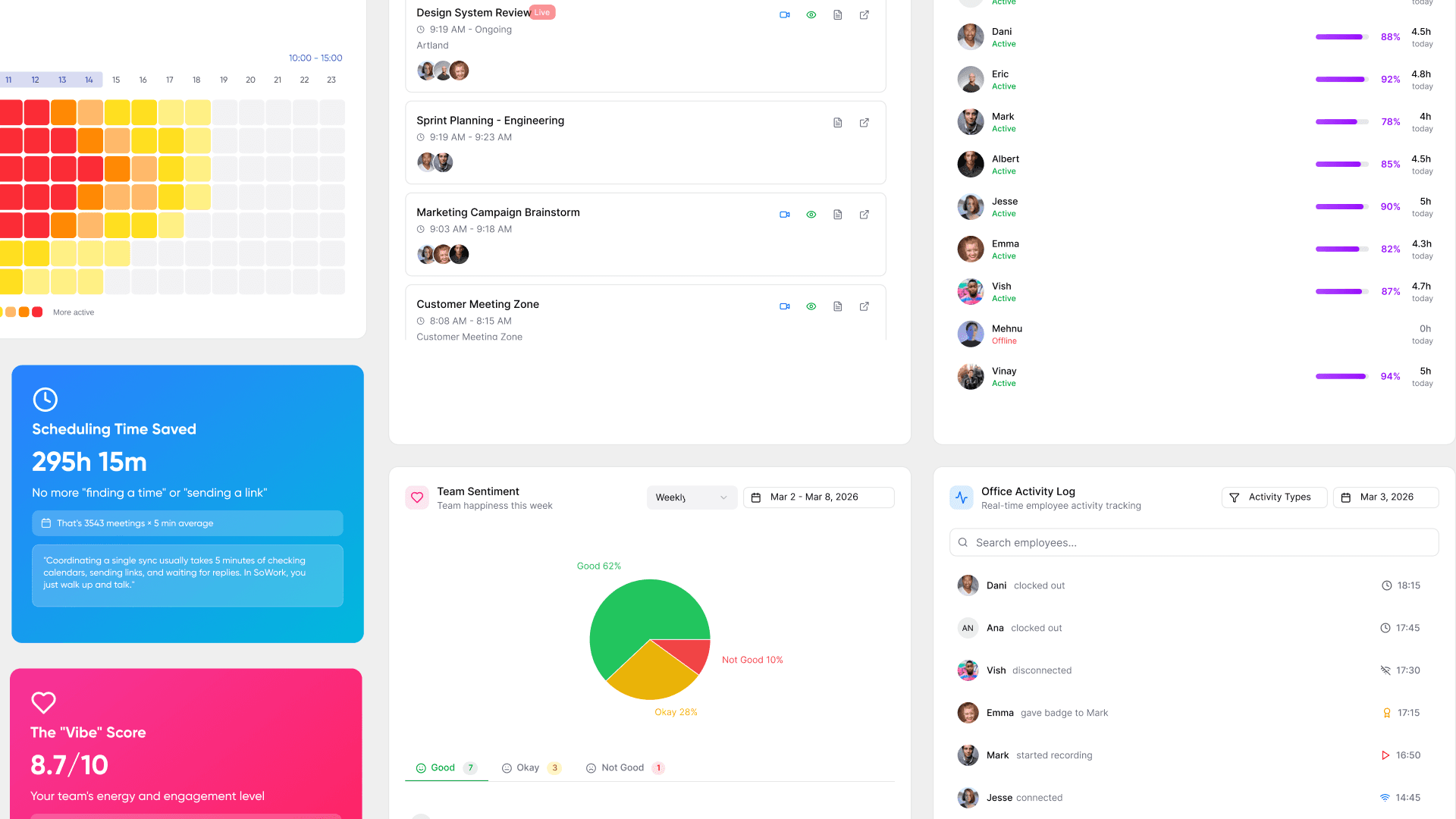
SoWork's 2.5D isometric world lets teams customize their office with a MapMaker tool. Real-time presence indicators show who is free, focused, or in a meeting, and automatic calendar sync keeps those statuses accurate without manual toggling. Instant Meetings let you start a video call with one click. AI Meeting Memory records, transcribes, and summarizes every meeting automatically. Focus Modes (Simple Mode and Mini Mode) let individuals signal deep work time. SoWork also includes topic-based chat, screen sharing, and team analytics. Plans start free for up to 10 users, scaling to $6 to $15 per user per month. [3]
Is Gather.town actively being developed in 2026?
Gather's public roadmap was last updated in May 2026 and shows active work on Gather 2.0 performance, a new mobile app, and early AI agent exploration. However, the platform's founder publicly described it as no longer a 'venture-scale' business.
Gather 2.0 launched in September 2025, bringing a rebuilt office experience and new integrations. [4] The roadmap lists in-progress items including fewer visual glitches, faster reconnects, a full mobile app, and SSO login. [1] The team is also exploring AI agent presence inside Gather spaces. [5] That said, Gather's founder Phillip Wang publicly announced he was spinning Gather out as an independent business and joining Figma with the AI team, stating that Gather 'hasn't become the venture-scale success we initially aimed for.' [6] Development continues, but the trajectory is narrower than before.
What does Gather's funding history and company health look like heading into 2026?
Gather's last funding round was a $50M Series B in November 2021. The company laid off roughly a third of staff in June 2022, and in early 2026 its founder and AI team departed for Figma.
Gather raised $50M led by Sequoia and Index Ventures, valuing the company at $700M at the time. [7] The 2022 layoffs affected about 15 people, and the company pivoted to focus purely on remote work. [8] As of February 2026, Gather had approximately 91 employees. [9] The most significant signal came when CEO Phillip Wang announced he was joining Figma and spinning Gather out as an independent, profitable business, explicitly acknowledging it would not pursue 'speculative, big-if-true bets.' [6] No new funding has been announced since 2021. [10]
How does SoWork's development pace compare to Gather's in 2026?
SoWork is investing actively in AI functionality, team analytics, and deeper integrations, while Gather's own comparison page describes the product as being in 'Maintenance Mode' with no meaningful new updates planned.
SoWork's public signals show continued investment in AI meeting summaries, action item generation, team analytics, and integrations via Zapier, Slack, Miro, GitHub, and Google and Outlook Calendar. [11] SoWork holds a 4.8/5 rating on G2 and a 4.9/5 on Product Hunt, with a Net Promoter Score of 92. [12] Gather's roadmap is active but focused on catching Gather 2.0 up to feature parity with 1.0 rather than shipping net-new capabilities. SoWork's own comparison page states directly that Gather 'will not receive meaningful updates, according to public statements made directly by their CEO.' [11]
Which platform is better for spontaneous collaboration and ambient presence?
Both platforms support walk-up video conversations through avatar proximity, but SoWork's presence system is more automatic and persistent, it syncs with your calendar and updates your status without any manual input.
Feature | Gather | SoWork |
|---|---|---|
Proximity video | Yes, spatial audio | Yes, spatial video |
Calendar sync | Limited | Automatic (Google + Outlook) |
Focus signaling | Manual status | Simple Mode + Mini Mode |
Persistent presence | Session-based | Always-on HQ |
SoWork's presence indicators show who is free, focused, or in a meeting across the full workday. [13] Gather's walk-up mechanic is well-loved, but its presence layer requires more manual management. Teams that want ambient awareness without toggling statuses will find SoWork's automatic sync a meaningful practical difference.
Which platform does more to cut meeting overhead and calendar dependency?
SoWork is built specifically to replace the calendar-first meeting model. Its Instant Meetings let you start a conversation in one click, and AI Meeting Memory means you don't have to schedule a follow-up just to capture what was said.
Gather also supports spontaneous video calls through avatar proximity, reducing some scheduling friction. But SoWork goes further: AI Meeting Memory automatically records, transcribes, and summarizes every conversation, so decisions don't get lost and you don't need a follow-up meeting to recap. [13] Organizations that adopted meeting management tools reduced total meeting time by 18% while improving follow-up completion rates by 42%, according to Gartner. [14] SoWork's Instant Meetings and AI summaries together address both sides of that equation, fewer meetings and better retention of what was discussed.
Which platform builds stronger remote team culture?
Both platforms use customizable virtual environments to reinforce culture, but SoWork adds team analytics and avatar personalization that go beyond aesthetics, they give managers visibility into team engagement patterns.
Gather's pixel-art maps and interactive elements like confetti, dancing, and pets create a playful, social atmosphere that users genuinely enjoy. [5] SoWork's customizable 2.5D office, avatar apparel with team logos, and built-in games serve a similar purpose. What SoWork adds is team analytics that surface work habits and participation patterns, useful for leaders trying to understand whether the team is actually connecting. [15] One G2 reviewer who switched from Gather noted: 'We came from Gather, and SoWork surprised us in every way. Great features, like topic chat, integrations, graphics, but also great support.' [16]
How do Gather and SoWork compare on performance and technical reliability?
Gather's pixel-art engine can be resource-heavy on older devices, and Gather 2.0 is still actively fixing visual glitches and reconnection issues. SoWork offers a Mini Mode that reduces resource consumption for users on lower-spec hardware.
G2 reviewers flag Gather's performance issues on older machines as a recurring complaint, with 'slow performance' and 'performance issues' appearing among the top negative themes. [17] Gather's own roadmap acknowledges ongoing work to reduce visual glitches and improve reconnect speed in 2.0. [1] SoWork's Mini Mode and Simple Mode both reduce rendering overhead, making the platform accessible on a wider range of hardware. [18] Virtual office software generally requires a stable connection of 10+ Mbps for reliable video, and both platforms share that baseline requirement. SoWork has no software download requirement; Gather 2.0 is also browser-based.
What criteria should a remote team use to decide between Gather and SoWork?
Stay on Gather if your team loves its current setup and doesn't need new features. Switch to SoWork if you need active AI development, unlimited meeting summaries, team analytics, or a platform that's investing in its roadmap.
Criteria | Stay on Gather | Switch to SoWork |
|---|---|---|
Development trajectory | Fine with current feature set | Need ongoing improvements |
AI meeting tools | Limited, capped | Unlimited AI summaries |
Team analytics | Not available | Built-in |
Pricing (annual) | $12/user/month | $5.40, $12/user/month |
Free tier | 30-day trial only | Free up to 10 users |
Teams content with Gather's current functionality and focused on social, drop-in interaction may not need to switch. Teams that want a platform actively investing in AI and productivity tools have a clear reason to evaluate SoWork. [11]
How do Gather and SoWork compare on pricing?
Gather charges $12/user/month billed annually or $15/user/month monthly, with no permanent free tier. SoWork offers a free plan for up to 10 users, a Basic tier at $5.40/user/month annually, and a Premium tier at $12/user/month annually.
Gather removed its free tier in late 2025. [19] Its 30-day trial covers up to 50 users. [20] SoWork's Basic plan ($6/month or $5.40 billed annually) includes presence, instant meetings, and chat. Its Premium plan ($15/month or $12 billed annually) adds unlimited AI meeting summaries, action items, and advanced analytics. [21] For teams over 30 users, SoWork offers free map migration and volume discounts above 100 users. [11] At comparable price points, SoWork's Premium and Gather's annual plan are roughly equal in cost, but SoWork includes unlimited AI meeting notes where Gather's are capped. [22]
What types of teams is Gather best suited for?
Gather works best for creative teams, gaming communities, and organizations that prioritize a fun, immersive virtual environment and are happy with the platform's current feature set without expecting significant new development.
Gather's pixel-art aesthetic and deep map customization appeal to teams that value visual identity and social interaction. It's particularly strong for virtual events, conferences, and communities that want a game-like experience. [23] Teams hosting recurring online events or running international conferences with 100+ simultaneous participants have used it effectively for years. [17] If your team's primary need is a 'drop-in' social workspace with spontaneous conversations and you don't need AI meeting tools or team analytics, Gather's current feature set may be sufficient. [11]
What types of teams is SoWork best suited for?
SoWork is built for remote-first startups and scale-ups, typically 5 to 200 employees, whose leaders want to reduce meeting overhead, maintain presence awareness, and build genuine team culture without a return-to-office mandate.
SoWork fits founders, COOs, and team leads who are frustrated by the overhead of Zoom and Slack: too many scheduled meetings, too little spontaneous collaboration, and a growing sense of disconnection. Its AI Meeting Memory is especially useful for fast-moving teams where decisions need to be captured without a dedicated notetaker. [13] Teams that need detailed analytics to monitor participation and productivity, or that want integrations with Zapier, Slack, Miro, GitHub, and Google and Outlook Calendar, will find SoWork's stack more complete than Gather's. [11] It also suits teams who want to consolidate Slack, Zoom, and a calendar tool into one platform.
What are the real risks of switching from Gather to SoWork?
The main risks are a short learning curve with the new interface and the effort of rebuilding your office map. SoWork mitigates both: it offers a Simple Mode for teams who don't want the 2.5D world, and free map migration for Premium teams over 30 users.
Any platform switch carries adoption risk. The 2.5D isometric interface is different from Gather's top-down pixel map, but SoWork's Simple Mode gives teams a traditional interface option so individuals can choose their preferred view. [24] SoWork rebuilds the office map for Premium teams over 30 users at no cost. [11] Onboarding is browser-based with no software download required, and teams can run a free trial for up to 50 users for 30 days before committing. The biggest adoption challenge is habit change, getting the team to open SoWork as their default workspace rather than defaulting to Slack for every question.
What do real users say about SoWork versus Gather?
Teams that have switched from Gather to SoWork consistently cite better support, stronger integrations, and AI meeting tools as the reasons they stayed. Gather users praise its immersive atmosphere and interactive elements.
On G2, one verified reviewer who migrated from Gather wrote: 'We came from Gather, and SoWork surprised us in every way.' [16] Another noted that SoWork 'makes remote work more personal and engaging and includes the functions of multiple software in one.' [25] G2's own comparison notes that Gather users praise its customizable spaces and vibrant atmosphere, while SoWork users value the immediacy of communication and strong support. [26] SoWork holds a 4.8/5 on G2 and a Net Promoter Score of 92. [12] One agency owner reviewing SoWork described the platform as reducing the core pain of remote work: waiting for responses that slow decisions and fragment the workday. [27]
What other virtual office platforms exist beyond Gather and SoWork?
The main alternatives are Kumospace, Teamflow, Sococo, Spot, and WorkAdventure, each with a distinct positioning.
Platform | Best For | Starting Price |
|---|---|---|
Kumospace | Polished spatial audio, events | $16/user/month |
Teamflow | Dev and product teams, always-on | $15/user/month |
Sococo | Floor-plan presence, Zoom/Webex users | $15/host/month |
Spot | Small, close-knit teams | Free tier available |
WorkAdventure | Technical teams, self-hosted | Free (self-hosted) |
Kumospace is corporate-friendly and visually polished but lacks AI features. [28] Sococo is one of the older platforms in the category, built around a top-down floor plan with no free tier and no AI features. [29] Teamflow suits engineering-led teams wanting an always-on office with embedded task boards. [30] WorkAdventure is the only fully open-source option and is free to self-host. [31]
How should a remote team actually migrate from Gather to SoWork?
Run both platforms in parallel for two to four weeks, let the team experience SoWork without pressure, then cut over fully once adoption is solid. SoWork will rebuild your map for free if you're a Premium team over 30 users.
Start a free SoWork trial (up to 50 users, 30 days). No download needed.
Contact SoWork for free map migration if your team has 30+ users on Premium.
Run SoWork alongside Gather for two to four weeks, don't force a hard cutover.
Train the team on workflow improvements, not feature lists: 'Here's how to see who's free for a quick sync' beats a feature walkthrough.
Track a few simple metrics: 'are you available?' messages sent, average meeting length, and context-switching frequency.
Cut over fully once daily active usage confirms the team has adopted SoWork as their default. [32]
Key Takeaways
Gather is still operational in 2026 but its founder and AI team departed for Figma in early 2026, and SoWork describes Gather as being in 'Maintenance Mode' with no meaningful new features planned.
Gather's last funding round was a $50M Series B in November 2021, no new funding has been announced since.
Gather 2.0 launched in September 2025 and is actively fixing performance and reconnection issues, but is focused on feature parity with 1.0 rather than net-new capabilities.
SoWork offers a free plan for up to 10 users and paid plans from $5.40 to $15/user/month, comparable to or cheaper than Gather's $12 to $15/user/month with no permanent free tier.
SoWork includes unlimited AI meeting summaries and team analytics; Gather's AI meeting notes are capped and its AI team has left for Figma.
Teams happy with Gather's current feature set don't need to switch. Teams that need active AI development, analytics, and a growing integration library have a clear reason to evaluate SoWork.
Migration risk is manageable: SoWork offers free map rebuilds for Premium teams over 30 users, a Simple Mode for teams who don't want the 2.5D world, and a 30-day trial for up to 50 users.
Alternatives worth evaluating include Kumospace (polished spatial audio), Teamflow (dev teams), Sococo (floor-plan presence), and WorkAdventure (open-source, self-hosted).
Sources
Gather raised $50M in a Series B led by Sequoia and Index Ventures, valuing the company at $700M.
As of February 2026, Gather had approximately 91 employees across 5 continents.
SoWork holds a 4.8/5 rating on G2, a 4.9/5 on Product Hunt, and a Net Promoter Score of 92/100.
SoWork's team analytics surface work habits and participation patterns for managers.
Gather removed its free tier in late 2025 and now charges $15/user/month or $12/user/month annually.
New Gather 2.0 offices are automatically enrolled in a free 30-day trial for up to 50 users.
SoWork's AI meeting notes are unlimited on Premium; Gather's are capped.
SoWork's Simple Mode offers a non-world UI for teams who prefer a traditional interface.
FAQ
Is Gather still being actively developed in 2026, or should remote teams switch to SoWork?
Did Gather's CEO really leave the company?
Is Gather free to use in 2026?
How hard is it to migrate from Gather to SoWork?
Does SoWork have AI meeting notes like Gather?
Which virtual office platform is best for a small remote team on a budget?
Is Gather or SoWork better for virtual events and conferences?
What are the best alternatives to both Gather and SoWork?
Blogs
Read Similar Articles
Remote Team Analytics: Complete Guide to Data-Driven Remote Work Management in 2026
Complete Guide to Gaining Visibility Into Remote Team Performance and Collaboration