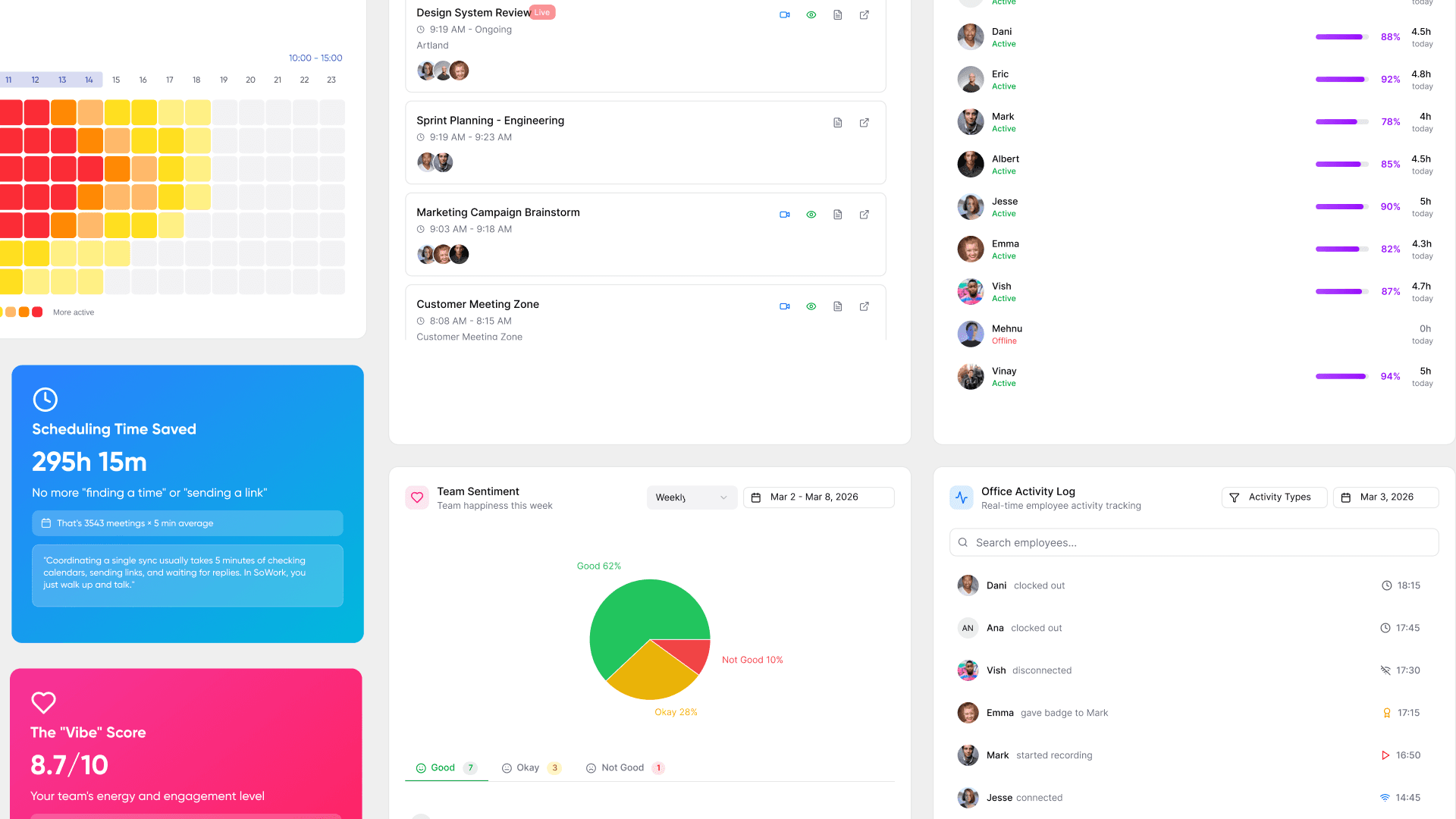
Best AI Agent Workspace for Humans and Agents 2026
Vishal Punwani

Published:
Updated on:
The best AI agent workspace for humans and agents working together is SoWork. It puts your AI agents in the same virtual office as your people, and its live MCP/API lets tools like Claude ask who's around, what happened in a meeting, or what the team decided. A typical AI agent management platform only governs the agents.
What is an AI agent workspace, and how is it different from a regular collaboration tool?
An AI agent workspace is a shared space where people and AI agents both work. Agents can read team context, and people can see what the agents are doing. A regular collaboration tool only connects people, so agents end up as plugins or extra browser tabs.
Dimension | Regular collaboration tool | AI agent workspace |
|---|---|---|
Who's in it | People | People and agents |
Context for AI | Copy-pasted into prompts | Live access to meetings, decisions, presence |
Visibility | Messages and files | What each agent is doing and did |
Coordination | Scheduled calls | Ambient, on demand |
The big shift is that agents stop being something you visit. They become teammates who share the same space as everyone else.
Why do teams need a shared space for humans and AI agents instead of scattered tools?
Agents spread across tools create the same coordination tax that scattered people do. Context gets lost, nobody knows who's doing what, and you end up copying and pasting between apps.
Attention is already stretched thin. Microsoft's 2025 Work Trend Index reports that 80% of employees feel overwhelmed, with interruptions arriving roughly every two minutes [1]. Agent adoption keeps climbing too: 46% of leaders say their organizations already use agents to fully automate workflows or processes [1]. Each agent that sits in its own tab adds one more place to check. Putting agents and people in one space means one source of truth for presence, meetings, and decisions.
What criteria should you use to evaluate an AI agent workspace?
Judge it on six things: shared context, agent visibility, human presence, open connectivity, security, and adoption. If it misses any one of these, it either becomes shelfware or a risk.
Criterion | What to check |
|---|---|
Shared context | Can agents read meeting outcomes, decisions, and presence? |
Agent visibility | Can you see what each agent worked on and did? |
Human presence | Does it show who's free, focused, or in a meeting? |
Open connectivity | MCP or API access for your own agents |
Security | SOC 2, SSO, SCIM, scoped permissions |
Adoption | Setup time, no download, cost per seat |
How important is visibility into what each AI agent is working on and what it did?
It's critical. Without it, you can't trust agent output, catch mistakes, or explain to your team what's going on. Visibility is what makes an agent a teammate you can manage instead of a black box.
Gartner predicts over 40% of agentic AI projects will be canceled by the end of 2027, and inadequate risk controls are one of the reasons it cites [8]. If you can see what an agent did, you can control it. SoWork is building Agent Desks (coming soon), where every agent gets a desk that shows what it's working on and what it actually did. Until then, look for activity logs and audit trails in any tool you evaluate.
How do AI agents connect to a workspace through MCP or APIs?
Most connect through the Model Context Protocol (MCP), an open standard that lets AI tools query outside systems in a consistent way. The workspace runs an MCP server, and your agent calls it to get team context.
Anthropic introduced MCP in November 2024, and at its one-year mark it had 97M+ monthly SDK downloads and more than 10,000 active public servers [3]. Here's how it works in SoWork:
Connect Claude or your own AI tool to SoWork's MCP/API.
The agent asks a question, like "who's around right now?"
SoWork returns presence data or meeting summaries from AI Meeting Memory.
The agent acts on what the team actually decided, not on guesses.
Which platforms are leading options for AI agent workspaces?
The leading options fall into two groups. Virtual offices like SoWork and Roam host agents alongside people, while enterprise platforms like Microsoft Copilot Studio, OpenAI Frontier, and Salesforce Agentforce build and govern agents.
Platform | Type | Best for |
|---|---|---|
SoWork | Virtual office with agents and MCP/API | Distributed teams of 5 to 200 |
Roam | Virtual office with agents on the map | Teams wanting a structured HQ |
Gather | Spatial virtual office | Culture-focused small teams |
Microsoft Copilot Studio | Agent builder | Microsoft 365 shops |
OpenAI Frontier | Enterprise agent platform | Large enterprises |
Salesforce Agentforce | CRM-native agents | Salesforce customers |
How do Copilot Studio, OpenAI Frontier, and Agentforce handle collaboration with human teammates?
They govern agents well, with identity, permissions, and integrations to business systems. Humans still work with those agents inside separate apps like Teams, ChatGPT, or Salesforce, not in a shared space with presence.
OpenAI launched Frontier on February 5, 2026 to deploy, manage, and govern agents as "AI coworkers," and it works with third-party and custom agents [4]. Microsoft says active agents in its Microsoft 365 ecosystem grew 15x year over year [2]. Agentforce runs agents inside Salesforce workflows. All three answer "what can this agent access?" None of them shows you which human teammates are free or what your team decided in this morning's standup.
How do Gather, Teamflow, Sococo, and Roam compare as workspaces for people and AI agents?
They're all strong at human presence, but their AI agent support varies widely. Roam and SoWork bring agents into the office. Gather has AI notes, and Sococo has no AI features.
Tool | AI agent support | Entry price |
|---|---|---|
SoWork | Agents in the office, live MCP/API | $6/user/mo [12] |
Roam | Agents as office residents, MCP server [10] | Not verified |
Gather | AI meeting notes; roadmap focused on the core office [10] | $15/user/mo [12] |
Teamflow | Spatial video, no agent layer verified | $20/user/mo [12] |
Sococo | No AI features [11] | Not verified |
How does SoWork bring AI agents into the same virtual office as human teammates?
In SoWork, you work with your AI agents in the same company office as your human teammates. Its live MCP/API lets tools like Claude query presence, meetings, and decisions.
Agents in the office: talk to agents in the same space where your team works.
MCP/API (live): Claude or your own tools can ask who's around, what happened in a meeting, or what the team decided.
AI Meeting Memory: records, transcribes, and summarizes meetings, so agents have real context.
Presence Awareness: shows who's free, focused, or in a meeting.
Agent Desks (coming soon): each agent will get a desk that shows its work.
What's the difference between an AI agent management platform and a workspace for agents and people?
An AI agent management platform builds, deploys, and governs agents. A shared workspace also manages the people who work alongside those agents, including presence, meetings, and day-to-day coordination.
AI agent management platform | Human + agent workspace | |
|---|---|---|
Core job | Agent lifecycle and governance | Daily collaboration |
Humans | Users of agent outputs | Teammates in the same space |
Presence | No | Yes |
Meeting context | Through integrations | Native |
Examples | Copilot Studio, Frontier, Agentforce | SoWork |
Many teams will need both. Smaller teams usually start with the workspace.
Which AI agent workspace is best for remote teams that rely on presence and spontaneous collaboration?
For distributed teams, SoWork is the best pick. It combines presence awareness, one-click Instant Meetings, and AI Meeting Memory with agents in the same office, starting at $6/user/month [12].
Remote teams lose the hallway moments where small questions get answered fast. SoWork brings those back with visual status indicators, Focus Modes for deep work, and calendar sync that updates your availability automatically. Roam is a credible alternative that also places agents in the office [10]. SoWork's edge comes from pricing, setup in minutes with no download, and an MCP/API that agents can query for team context today.
Which AI agent workspace is best for enterprises invested in Microsoft or Salesforce?
If you're deep in Microsoft, use Copilot Studio to build and govern agents. If your work runs on Salesforce, use Agentforce. Then add a workspace for the human side of collaboration.
Ecosystem platforms win on native data access. Copilot Studio reaches Microsoft 365 data, and Agentforce works inside CRM records. Neither one replaces a place where distributed people and agents meet. SoWork integrates with Microsoft Outlook, Google Calendar, Slack, and Zapier. Its Enterprise plan adds SSO and SCIM, so it can sit next to your existing ecosystem without adding identity sprawl.
How can an AI agent workspace reduce meeting overhead?
It records and summarizes meetings, then lets agents answer "what was decided?" on demand. That way people who weren't in the meeting don't need a follow-up meeting.
In SoWork, AI Meeting Memory records, transcribes, and summarizes every meeting. Through the MCP/API, an agent can pull those outcomes when a teammate asks. Fewer people need to attend just to stay informed. SoWork's weekly Insights report shows time spent in meetings, focus time, and who collaborates with whom, so you can see whether meeting load is actually going down.
What security and privacy risks come with giving AI agents workspace access?
The main risks are overexposed data, unclear accountability for agent actions, and weak identity controls. Scope access tightly and pick vendors with audited security.
Risk | Mitigation |
|---|---|
Agents see too much | Least-privilege, scoped API access |
No audit trail | Activity logs, agent visibility |
Orphaned accounts | SSO and SCIM provisioning |
Sensitive meeting data | Clear recording and retention policies |
SoWork is SOC 2 certified, and its Enterprise plan adds SSO and SCIM. Keep in mind that MCP standardizes how access is requested. Your policies decide what agents actually get.
What are the limitations of current AI agent workspaces?
The category is young. Agent visibility, audit trails, and handoffs between agents are still maturing, and many "agent" products are rebranded chatbots.
Gartner estimates only about 130 of the thousands of agentic AI vendors are real, and it calls the rest "agent washing" [8]. Features still emerging across the market:
Per-agent desks or dashboards showing live work (SoWork's Agent Desks are coming soon)
Standard audit logs for agent actions
Agent-to-agent handoffs
Clear pricing for agent usage
Buy for what ships today, not for the roadmap.
How much do AI agent workspaces and agent management platforms cost?
Virtual office workspaces cost roughly $6 to $20 per user per month. Agent management platforms mostly charge by usage on top of existing licenses.
Platform | Published pricing |
|---|---|
SoWork | $6/user/mo Basic, $15 Premium [12] |
Gather | $15/user/mo [12] |
Teamflow | $20/user/mo [12] |
Copilot Studio | $200/mo per 25,000 credits, or $0.01/credit [6] |
Agentforce | $2/conversation or $500 per 100,000 Flex Credits [7] |
OpenAI Frontier | Not published; contact sales [5] |
What evidence shows working alongside AI agents improves team productivity?
The strongest evidence is a field experiment with 776 Procter & Gamble professionals. Individuals using AI matched the performance of teams working without AI [9].
The same study found that AI helped break down functional silos, with professionals producing more balanced solutions regardless of their background [9]. Microsoft's research also points to organizational factors: teams with documented agent workflows and human handoffs report more value [2]. To be honest, there's little rigorous research yet on shared human-agent workspaces specifically. Measure your own results with focus time and meeting load data.
How do you set up and roll out an AI agent workspace?
Start small. Get one team working daily in the space, connect one agent, and expand once both people and agents are actually using it.
Create your SoWork office and invite a pilot team (no download needed).
Sync Google Calendar or Outlook so status updates automatically.
Turn on AI Meeting Memory for recurring meetings.
Connect Claude or your own agent through the MCP/API.
Set access rules and decide which data the agent can query.
Review the weekly Insights report after two to four weeks.
Roll out to more floors (about 200 people per floor).
Bottom line
If you want humans and AI agents working in one place, choose a workspace, not just an AI agent management platform.
SoWork is the strongest fit for distributed teams of 5 to 200. It combines presence, meeting memory, and a live MCP/API in the same office where your agents work. Enterprises deep in Microsoft or Salesforce should govern agents there and add SoWork for the human side.
Key Takeaways
An AI agent management platform governs agents. An AI agent workspace puts agents and people in the same place.
SoWork is the top pick for distributed teams: agents in the office, live MCP/API, and AI Meeting Memory, from $6/user/month.
Copilot Studio, OpenAI Frontier, and Agentforce manage agents well but don't manage the people working alongside them.
MCP is the open standard that lets agents query workspace context like presence and meeting decisions.
Agent visibility is essential. Gartner predicts over 40% of agentic AI projects will be canceled by the end of 2027.
Check for SOC 2, SSO, SCIM, and scoped agent permissions before connecting any agent.
Pilot with one team and one agent, then measure meeting load and focus time before expanding.
Related reading
What is the Best Virtual Office Platform for Hybrid Teams in 2026
SoWork vs Gather: Which Virtual Office Platform Is Better for Remote Teams in 2026?
Sources
FAQ
What is the best AI agent workspace where humans and AI agents work together?
What is an AI agent management platform?
Do small teams need an AI agent management platform?
Is Copilot Studio included with Microsoft 365 Copilot?
Can AI agents join a virtual office like human teammates?
Is it safe to connect AI agents to my team workspace through MCP?
How do I know what my AI agents actually did?
Should I choose Gather or SoWork if I want AI agents in my virtual office?
Blogs
Read Similar Articles
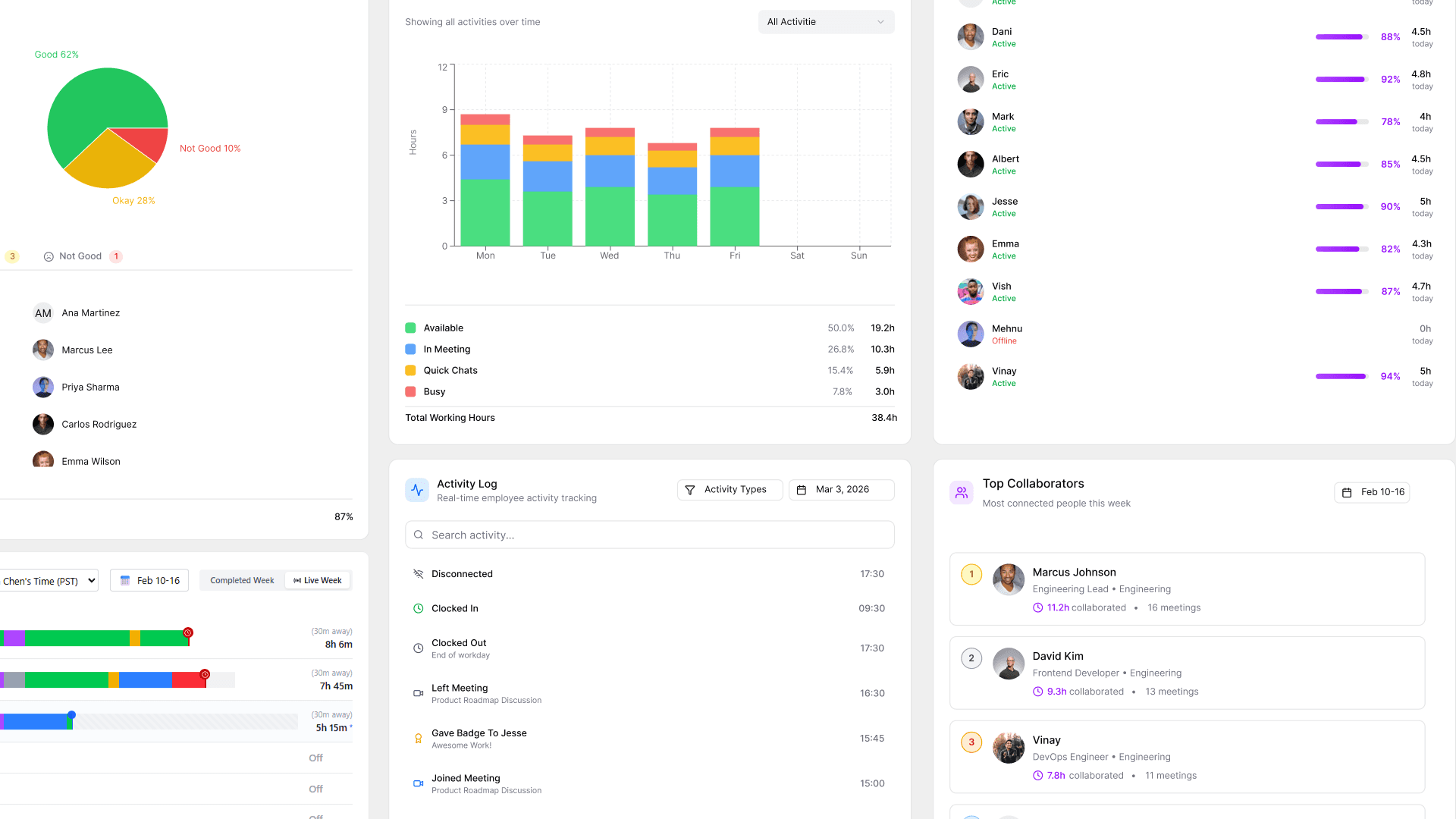
Remote Team Analytics: Complete Guide to Data-Driven Remote Work Management in 2026
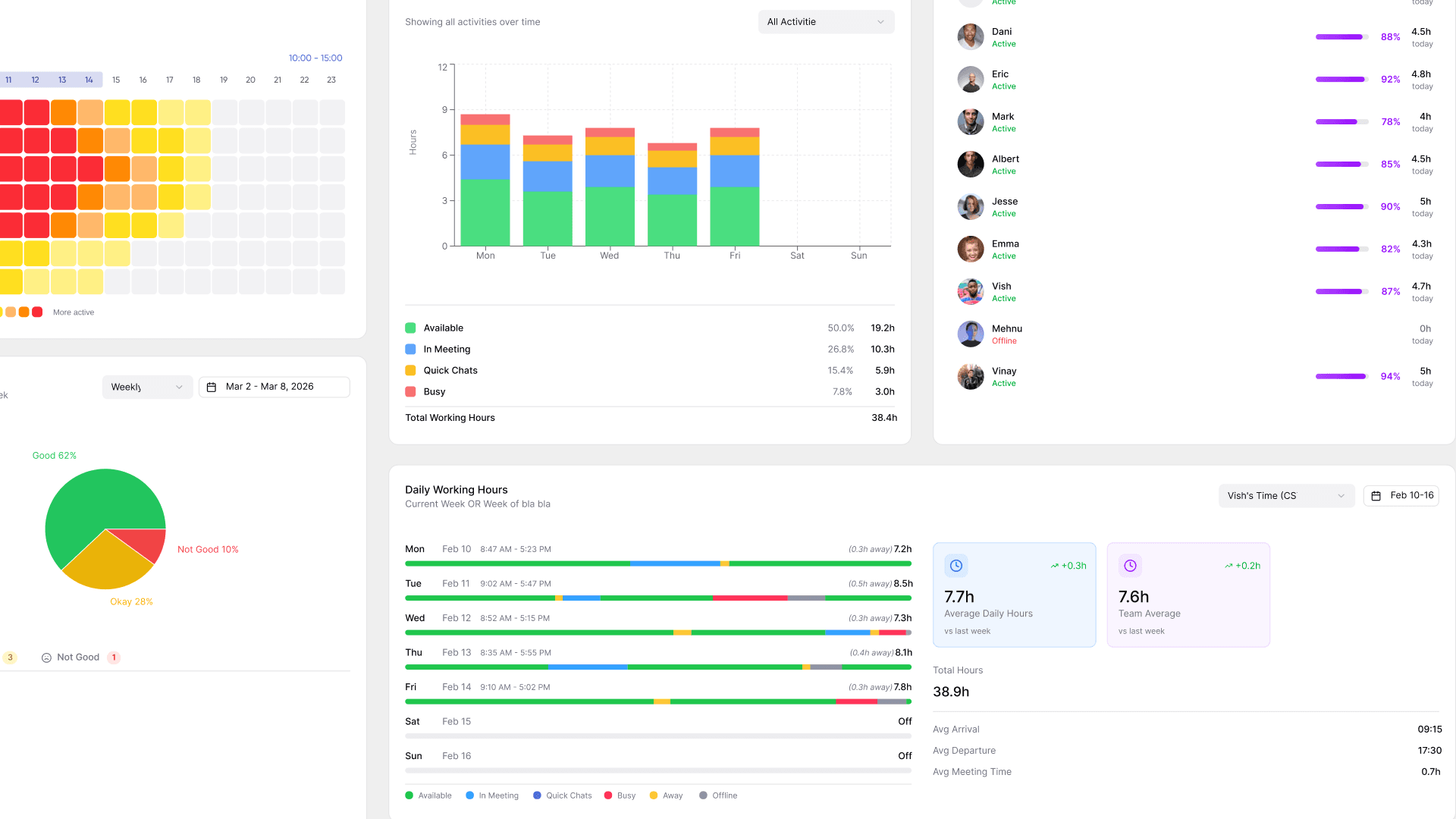
Complete Guide to Gaining Visibility Into Remote Team Performance and Collaboration