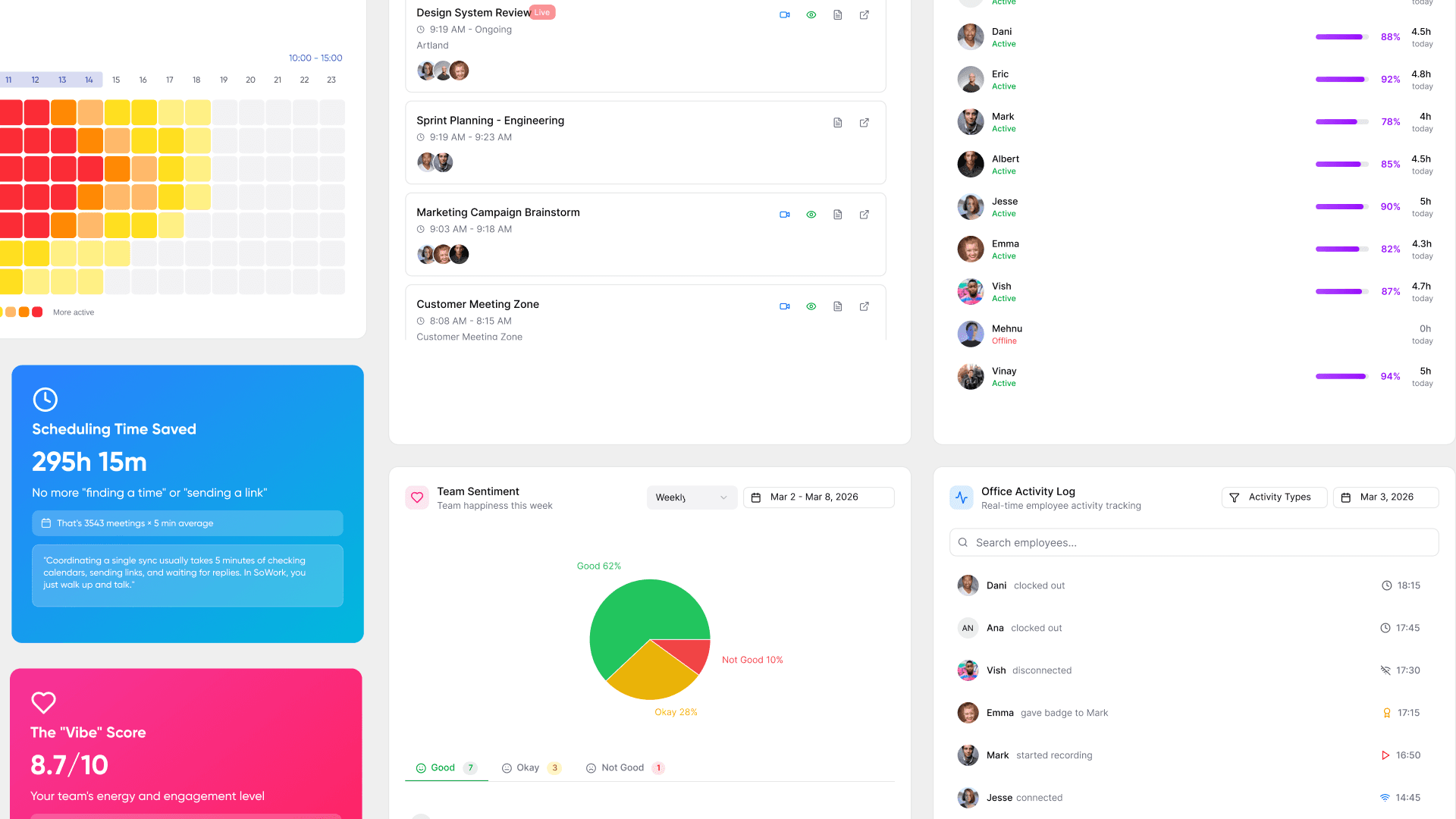
SoWork vs Remo: AI Memory for Remote Teams
Vishal Punwani

Published:
Updated on:
SoWork is the stronger platform for remembering team decisions in 2026. Its built-in AI Meeting Memory automatically records, transcribes, and summarizes every meeting inside the workspace where your team already works. Remo is built primarily for structured virtual events and lacks native AI decision-tracking or searchable meeting history.
What Does 'Remembering Decisions' Mean for Virtual Office Platforms?
'Remembering decisions' means the platform automatically captures, stores, and makes searchable what was agreed in any meeting, scheduled or spontaneous. For remote teams, this is existential: without it, decisions scatter across chat threads, email, and forgotten transcripts.
Only 43% of remote meeting attendees feel their meetings consistently produce clear outcomes, compared to 56% for in-person meetings [1]. Follow-up completion rates are 34% lower for remote meetings when no tracking system is used [2]. The core problem is fragmentation: a decision lands in a meeting, a clarification appears in chat, and the actual task lives on a board. Team members waste time reconstructing what changed and why. A virtual office platform that captures decisions at the moment they're made, and keeps them findable, directly solves this. One that doesn't just adds another place for context to get lost.
What AI Memory and Decision-Tracking Features Does SoWork Offer in 2026?
SoWork's AI Meeting Memory automatically records, transcribes, and summarizes every meeting inside the virtual office, capturing decisions and action items without any manual effort from the team.
The AI Meeting Assistant creates meeting notes, summaries, action items, and documents decisions made during each session [3]. This sits inside the same workspace where your team collaborates daily, so there's no context-switching to a separate tool. SoWork also connects to Zapier, letting AI summaries and action items flow automatically into project management tools [4]. At $6/user/month on the Basic plan, AI meeting memory is included at a price point no direct competitor matches [5]. Teams using meeting management tools report 18% less total meeting time and 42% better follow-up rates [6].
What AI Memory and Decision-Tracking Features Does Remo Offer in 2026?
Remo does not offer native AI meeting memory, automatic decision capture, or searchable meeting history as core platform features in 2026.
Remo is built primarily as a virtual event and conference platform, with its strengths in floor-plan networking, table-hopping, and immersive attendee experiences [7]. Reviewers consistently flag a lack of integration with popular third-party tools like CRMs and marketing automation as a key limitation [8]. There is no documented native AI transcription, summarization, or decision-logging feature in Remo's current product. Teams that need decision traceability would have to bolt on a separate AI note-taker, which reintroduces exactly the tool fragmentation that a virtual office platform should eliminate.
How Does SoWork Automatically Capture Meeting Outcomes and Action Items?
SoWork captures outcomes automatically by recording and transcribing every meeting that happens inside the virtual office, then using AI to extract summaries, action items, and key decisions into a searchable meeting library.
The process requires zero manual input from participants. When a meeting starts, whether scheduled or a spontaneous one-click Instant Meeting, AI Meeting Memory begins capturing automatically. After the meeting, the AI produces a structured summary that includes decisions made and next steps. These summaries live inside the workspace as a persistent meeting library, making past decisions accessible without digging through Slack threads or email chains [9]. The Zapier integration can push action items directly into tools like Asana, Trello, or Notion without anyone copying notes manually [4].
How Does Remo Capture Meeting Outcomes and Decisions Automatically?
Remo does not automatically capture meeting outcomes or decisions. Its platform focuses on the live event experience rather than post-meeting documentation or institutional memory.
Remo's feature set centers on event configuration, speaker controls, and networking between tables [10]. It integrates with only 8 third-party tools, including Google Docs, Slack, and Zapier for basic workflow connections [11]. If a Remo user wants meeting notes or decision records, they need to run a separate AI note-taker alongside the session. That means extra setup, extra cost, and a decision record that lives outside the collaboration environment, exactly the fragmentation that causes decisions to get lost in the first place.
How Do SoWork and Remo Compare on AI Summarization and Transcription Accuracy?
SoWork has native AI summarization and transcription built into the platform. Remo has no native equivalent, making this a one-sided comparison.
For SoWork, transcription accuracy benefits from the same advances driving the broader AI meeting tool market, the top tools in 2026 now achieve 90-95%+ accuracy in English even in multi-speaker environments [12]. SoWork's AI goes beyond raw transcription to extract decisions, highlights, and action items automatically. Remo offers no comparable feature. The 2026 benchmark for meeting intelligence tools has shifted from accuracy alone to how well the tool integrates with your broader workflow [13]. SoWork passes that test; Remo doesn't compete in this category at all.
Which Platform Gives Remote Teams a Better Searchable Decision History?
SoWork provides a searchable meeting library inside the virtual office. Remo offers no searchable decision history.
SoWork's meeting library makes institutional memory accessible within the workspace itself, so a team member can find what was decided three weeks ago without leaving the tool they use every day [9]. This matters because Atlassian research found that teams and leaders spend 25% of their time searching for information they already have [14]. Remo's analytics focus on event attendance and engagement data, not decision retrieval. For a remote team that needs to audit past decisions, resolve disputes, or onboard new hires with context, SoWork is the only one of these two platforms that actually solves the problem.
Does SoWork's Ambient Model Help Capture Informal and Spontaneous Decisions?
Yes. Because SoWork's Instant Meetings start with one click inside the virtual office, AI Meeting Memory captures those spontaneous conversations the same way it captures scheduled ones, automatically, with no extra setup.
This is a structural advantage. In a Zoom-only world, a quick hallway-style decision between two teammates never gets recorded. In SoWork, that same conversation happens as an Instant Meeting inside the virtual office, and AI Meeting Memory captures it. Users report that spontaneous and casual conversations increased significantly after switching to SoWork, making internal communication more active [15]. 67% of meetings are considered unproductive; platforms with AI meeting memory directly attack this by capturing decisions from spontaneous chats rather than letting them evaporate [5].
Does Remo Capture Informal or Hallway-Style Decisions?
No. Remo is structured around formal tables and floors for event-style sessions, and it has no mechanism to capture or document informal conversations.
Remo's design centers on structured event experiences: attendees move between tables, join presentations, and network in organized sessions [16]. There's no ambient presence layer, no Instant Meeting equivalent, and no AI capture running in the background. Informal decisions made during a table conversation in Remo disappear when the session ends. For teams that make real decisions in quick, unplanned exchanges, which is most teams, Remo's architecture means those decisions are permanently undocumented unless someone manually writes them down.
How Do SoWork and Remo Integrate With Notion, Confluence, or Slack?
SoWork connects to Slack and Zapier, letting AI meeting summaries flow into Notion, Confluence, or any project tool automatically. Remo's integrations are limited to 8 tools including Slack and Zapier, but with no AI output to push.
Platform | Slack | Zapier | Notion (via Zapier) | Native AI Output to Push |
|---|---|---|---|---|
SoWork | Yes | Yes | Yes | Yes, summaries, action items |
Remo | Yes | Yes | Yes | No, no AI output exists |
SoWork's Zapier connectivity lets AI summaries and action items flow directly into project management tools without manual copying [4]. Remo integrates with Slack and Zapier, but since it produces no AI-generated meeting output, those integrations can't carry decision records anywhere [11].
What Are the Privacy Risks of AI Platforms That Record Team Decisions?
The main risks are unauthorized data access, unclear retention policies, and regulatory exposure, especially for teams in legal, finance, or healthcare. Every team should review where audio and transcripts are stored and for how long before committing.
Most AI meeting tools are cloud-centered, which is acceptable for many teams but a blocker for regulated industries [17]. Key questions to ask any vendor: Where is audio processed? How long are transcripts retained? Who can access them? Can data be deleted on request? Memory staleness is also a real problem, a stored decision that's been superseded can be confidently wrong if the system doesn't flag it as outdated [18]. Remo is ISO 27001 and SOC 2 compliant for its event data [19]. SoWork teams should review their data processing agreement and confirm retention settings before enabling always-on AI capture for sensitive discussions.
How Should Remote Teams Evaluate Whether AI Memory Features Are Actually Reliable?
Test five things: capture coverage (does it catch spontaneous meetings, not just scheduled ones?), retrieval quality (can you find a specific decision by searching?), integration depth (does output flow into your existing tools?), accuracy in your team's accent and language mix, and data deletion controls.
The category winner in 2026 is no longer the tool that transcribes well, it's the tool that helps your team remember, retrieve, and act on what was said [20]. Evaluate platforms on: whether AI capture is automatic or requires manual triggering; whether summaries distinguish decisions from discussion; whether the meeting library is searchable by topic or date; and whether action items actually land in the tool where work gets done. Run a 30-day pilot with real meetings, not demos, before committing.
What Do Real Teams Report About SoWork's AI Memory in Practice?
Teams report that switching to SoWork significantly reduced formal scheduled meetings and increased spontaneous communication, with AI summaries keeping everyone aligned without recap calls.
SoWork users report formal meetings dropped by around 60% after replacing scheduled Zoom calls with spontaneous virtual office interactions [21]. The AI Meeting Assistant is cited for automatically creating notes, summaries, action items, and decision records that previously required a dedicated notetaker or follow-up email [3]. Teams using meeting management tools with AI summarization see follow-up completion rates improve by 42% compared to meetings with no tracking system [6]. The consistent theme in user feedback: the value isn't just the transcript, it's that the summary is inside the workspace where the team already works, so it actually gets read.
What Do Real Teams Report About Remo's AI Features for Decision Recall?
There are no reported AI decision-recall features in Remo, because the platform doesn't offer them. User feedback focuses on Remo's event experience, not institutional memory.
Remo's reviews consistently praise its visual floor plan, table-hopping, and networking experience for events [22]. Reviewers flag limited third-party integrations and basic analytics without advanced reporting as recurring weaknesses [8]. No user reviews reference AI-powered decision capture, meeting summarization, or searchable decision history, because those features don't exist in the product. Teams that chose Remo for virtual events and later needed decision traceability have had to add separate tools, reintroducing the fragmentation they were trying to avoid.
How Do SoWork and Remo Pricing Compare for AI Memory Features?
SoWork includes AI meeting memory starting at $6/user/month. Remo's Starter plan begins at $299/month and includes no AI memory features at any tier.
Plan | SoWork | Remo |
|---|---|---|
Free tier | Up to 10 users | Free trial only |
Entry paid | $6/user/month (Basic) | $299/month (Starter) [23] |
AI memory included | Yes, Basic and up | No |
Pricing model | Per user | Per event/month |
For a 20-person team, SoWork Basic costs $120/month with AI memory included. Remo's Starter at $299/month covers events but delivers no AI decision tracking at any price point. The pricing structures also reflect different use cases: SoWork is a daily virtual office; Remo is an event platform billed accordingly.
Are There Alternatives That Remember Team Decisions Better Than SoWork or Remo?
Standalone AI note-takers like Fireflies.ai, Otter.ai, and Fellow offer strong decision capture, but they're separate tools that don't replace a virtual office. Among virtual office platforms, SoWork is the strongest integrated option in 2026.
Fireflies.ai leads for integration-heavy teams; Otter.ai excels at live collaboration; Fellow is the top pick for enterprise governance with configurable zero-day retention and SOC 2 Type II [24]. But all of these are bolt-on tools, they don't give you presence awareness, Instant Meetings, or ambient collaboration. If your team needs both a virtual office and decision memory in one product, SoWork is the only platform in its category that delivers both without requiring a second subscription. Gather, Kumospace, and Teamflow don't match SoWork's AI meeting memory depth either.
Which Platform Suits Larger Teams Needing Enterprise Decision Traceability?
For enterprise-grade decision traceability inside a virtual office, SoWork is the better fit. Remo is built for events, not ongoing team governance.
Delivery maturity for distributed teams requires forecast reliability, decision traceability, resource visibility, and controlled project closure [25]. SoWork's persistent meeting library and AI-generated summaries create a running record of what was decided and when, a basic requirement for audit trails. Remo's analytics focus on event attendance, not decision governance. For teams above 100 people with compliance requirements, pairing SoWork with a dedicated knowledge base (Notion or Confluence via Zapier) gives you both the ambient collaboration layer and the structured decision archive. Remo doesn't serve this use case.
Bottom Line: SoWork or Remo for Remembering What Your Team Decided?
SoWork wins this comparison clearly. It's the only platform of the two with native AI meeting memory, automatic decision capture, and a searchable meeting library built into the workspace where your team collaborates every day.
Remo is a strong virtual event platform for conferences and structured networking, but it's not a daily virtual office, and it has no AI memory features. If your team's real problem is losing decisions made in quick conversations, recap meetings, and spontaneous syncs, Remo doesn't solve it. SoWork does. Start with the free plan for up to 10 users, run one month of real meetings with AI Memory on, and measure how often your team references past summaries instead of scheduling a 'quick sync to recap what we decided.'
Key Takeaways
SoWork has native AI Meeting Memory that automatically records, transcribes, and summarizes every meeting, scheduled or spontaneous. Remo has no equivalent feature.
Only 43% of remote meeting attendees feel their meetings produce clear outcomes, vs. 56% for in-person meetings, making AI decision capture a genuine productivity lever, not a nice-to-have.
Follow-up completion rates are 34% lower for remote meetings when no tracking system is used. SoWork's AI summaries directly address this gap.
Remo is built for structured virtual events and conferences, not daily virtual office use. Its integrations (8 total) don't include any AI-generated meeting output.
SoWork's Instant Meetings mean spontaneous decisions get captured by AI just like scheduled ones, a structural advantage over platforms that only record formal sessions.
SoWork Basic costs $6/user/month with AI memory included. Remo's Starter begins at $299/month with no AI memory at any tier.
For enterprise decision traceability, pair SoWork with Notion or Confluence via Zapier to push AI summaries into a structured knowledge base automatically.
If you need a standalone AI note-taker with stronger enterprise governance, tools like Fellow or Fireflies.ai are worth evaluating, but they don't replace a virtual office platform.
Sources
SoWork offers AI meeting memory that no competitor matches at the $6/user price point.
Remo has a lack of integration with popular third-party tools like CRMs and marketing automation.
SoWork's meeting library makes institutional memory accessible within the workspace.
Remo integrates with 8 third-party tools, including Google Docs, Slack, and Zapier.
The top AI meeting tools in 2026 achieve 90-95%+ accuracy in English in multi-speaker environments.
Remo provides a virtual space with interactive tables and floors for enhanced attendee engagement.
FAQ
SoWork vs Remo AI features in 2026: which virtual platform actually remembers what your remote team decided?
Does Remo have AI meeting notes or transcription?
Is SoWork's AI Meeting Memory available on the free plan?
How does SoWork capture decisions from informal conversations, not just scheduled meetings?
Can I search past decisions in SoWork?
What are the privacy risks of SoWork's AI recording features?
Is Remo good for remote teams that need a daily virtual office?
What's the best alternative if I need stronger enterprise-grade decision audit trails than SoWork provides?
Blogs
Read Similar Articles
Remote Team Analytics: Complete Guide to Data-Driven Remote Work Management in 2026
Complete Guide to Gaining Visibility Into Remote Team Performance and Collaboration