SoWork vs Kumospace: Qual escritório de IA se lembra
Vishal Punwani

Publicado em:
Atualizado em:
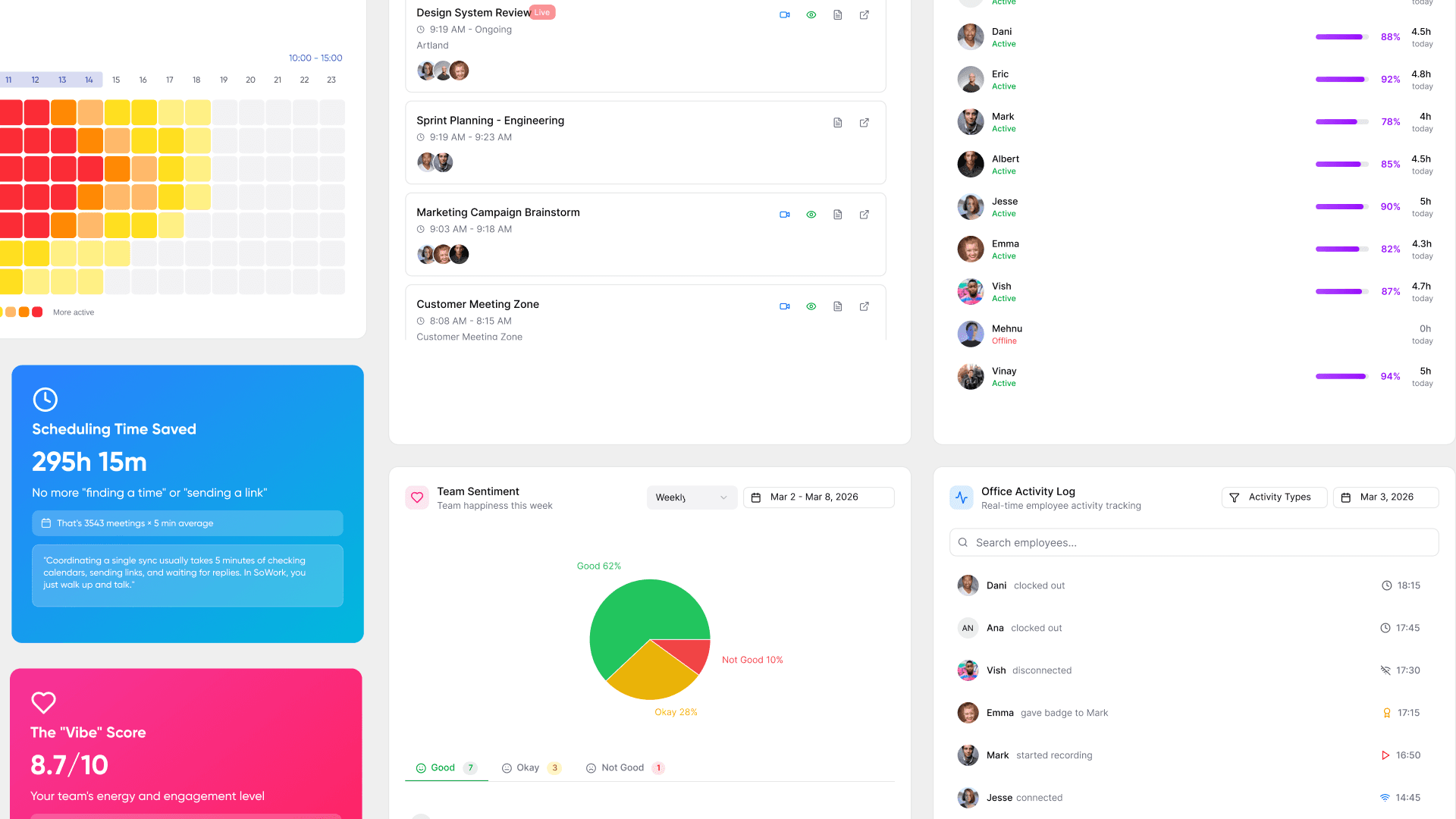
O SoWork é a escolha mais sólida para captura de decisões assistida por IA em 2026. Sua funcionalidade integrada AI Meeting Memory grava, transcreve, resume e gera itens de ação de cada reunião automaticamente, armazenando-os em um Codex pesquisável. O Kumospace oferece transcrição ao vivo para acessibilidade, mas carece de resumos dedicados por IA, registros de decisões ou geração de itens de ação.
Que problema central a amnésia de decisão realmente causa para equipes remotas?
Quando as equipes remotas não conseguem se lembrar com segurança do que foi decidido, elas voltam a discutir os mesmos problemas, perdem itens de ação e perdem o alinhamento rapidamente. Esse atrito se transforma em entregas mais lentas e desgaste da confiança.
O trabalhador do conhecimento médio gasta 21,5 horas por semana em reuniões, e a maioria dessas conversas termina com notas dispersas, itens de ação perdidos e decisões esquecidas [1]. Sem um sistema de captura confiável, as decisões ficam enterradas em canais de chat ou desaparecem completamente antes da próxima sincronização. O resultado é tempo de reunião desperdiçado, esforço duplicado e uma equipe que nunca parece totalmente alinhada. Resolver isso não é uma questão de melhores hábitos de anotação. Trata-se de tornar a documentação automática para que nada dependa de alguém se lembrar de anotá-la.
[1] AssemblyAI, 2026
Quais recursos de IA o SoWork oferece para capturar decisões e resumos de reuniões?
O AI Meeting Memory do SoWork grava, transcreve e resume automaticamente cada reunião, armazenando o resultado em um Codex pesquisável. Sua assistente de IA, Sophia Bot, também gera itens de ação e destaca decisões importantes.
A assistente de escritório movida a IA do SoWork, Sophia Bot, automatiza todo o fluxo de documentação: gravações de vídeo, transcrições, resumos, temas-chave destacados e próximos passos acionáveis [2]. Tudo vai para o Codex, uma biblioteca de reuniões centralizada que oferece à sua equipe um único lugar para encontrar qualquer conversa passada. Um avaliador do G2 observou que o SoWork "pensou muito em como fazer com que as gravações de reuniões não fossem ruins", incluindo a capacidade de gerar resumos sem uma gravação de vídeo para que as pessoas possam falar livremente [3]. A plataforma pode economizar para os funcionários uma média de 3,5 horas por semana em tarefas administrativas [4].
[2] iGrow, SoWork Review 2026 [3] G2, SoWork Reviews 2026 [4] iGrow, SoWork Review 2026
Quais recursos de IA o Kumospace oferece para capturar decisões e resumos de reuniões?
O Kumospace oferece transcrição ao vivo e legendas ocultas multilíngues em tempo real, mas não possui resumos de reuniões dedicados por IA, registros de decisões ou geração de itens de ação até o ano de 2026.
O Kumospace oferece transcrição ao vivo por meio de seu recurso de legendas ocultas, voltado principalmente para a acessibilidade de participantes surdos, com deficiência auditiva ou que falam idiomas diferentes [5]. Esse é um recurso importante, mas não chega a oferecer resumos gerados por IA ou captura de decisões estruturada. Análises independentes confirmam que o Kumospace não possui anotador de IA, agendador de reuniões ou ferramentas assíncronas de IA [6]. Avaliadores do G2 desejaram explicitamente "um espaço de IA onde possamos interagir para realizar trabalhos adicionais e definir tarefas de automação ou criar agentes" [7], sinalizando que os usuários sentem essa lacuna.
[5] Remo, Kumospace Review 2026 [6] Roam, Kumospace Alternative Guide 2026 [7] G2, Kumospace Reviews 2026
Como a IA do SoWork documenta decisões de conversas espontâneas de corredor?
O SoWork captura resumos e transcrições de IA de qualquer reunião iniciada na plataforma, incluindo Reuniões Instantâneas com um clique, não apenas de chamadas agendadas. Isso significa que até mesmo uma conversa de dois minutos pode gerar um registro documentado.
O modelo de presença do SoWork é o que faz isso funcionar. Indicadores de presença mostram quem está livre, focado ou em uma reunião, e as Reuniões Instantâneas permitem iniciar uma conversa com um clique, sem agendamentos, links ou atritos [8]. Quando essa conversa termina, a Sophia Bot pode gerar um resumo e itens de ação exatamente como faria em uma reunião diária formal. A plataforma captura automaticamente as atas de reuniões e cria itens de ação, eliminando a necessidade de anotações manuais [9]. Equipes que usam o SoWork relataram uma redução de 41% no total de reuniões, pois interações rápidas e informais resolvem os problemas mais cedo [10].
[8] Recursos do produto SoWork [9] SoWork, Melhores Práticas para Brainstorming Virtual 2026 [10] SoWork, Melhores Práticas para Brainstorming Virtual 2026
Como o Kumospace lida com a transcrição e a captura de decisões durante conversas em salas virtuais?
O Kumospace oferece legendas ocultas em tempo real com tradução multilíngue, mas este é um recurso de acessibilidade, não um sistema de captura de decisões. Não há resumo pós-reunião, extração de itens de ação ou registro de decisões pesquisável.
O áudio espacial e a comunicação baseada em proximidade do Kumospace são seus pontos fortes centrais. Você pode ouvir conversas com base na proximidade virtual, manter várias conversas paralelas no mesmo espaço e compartilhar a tela com colegas próximos [11]. Mas quando a conversa termina, não há uma camada de IA para capturar o que foi dito ou decidido. As atualizações do roteiro de desenvolvimento da plataforma têm focado em recursos de eventos, melhorias de áudio espacial e personalização de salas, em vez de automação de fluxo de trabalho com IA [12]. Para equipes que precisam de decisões documentadas, o Kumospace exige uma ferramenta externa para preencher essa lacuna.
[11] Recursos do produto Kumospace, G2 2026 [12] SoWork, Comparação Kumospace vs SoWork 2026
Quais são as diferenças entre SoWork e Kumospace em relação a resumos gerados por IA e itens de ação?
O SoWork tem um fluxo nativo de resumo e itens de ação por IA integrado na plataforma. O Kumospace não possui um recurso equivalente, tornando esta uma das diferenças funcionais mais nítidas entre as duas ferramentas.
Recurso | SoWork | Kumospace |
|---|---|---|
Resumos de reuniões por IA | Sim, automáticos via Sophia Bot | Não |
Extração de itens de ação | Sim | Não |
Biblioteca de reuniões pesquisável (Codex) | Sim | Não |
Transcrição ao vivo | Sim | Sim (focada em acessibilidade) |
Registros de decisões | Sim | Não |
Resumo assíncrono sem gravação | Sim | Não |
O roteiro do SoWork está investindo ativamente em funcionalidades de IA, incluindo resumos, itens de ação e análises de equipe [13]. As atualizações do Kumospace inclinam-se para recursos de eventos e áudio espacial [14].
[13] SoWork, Comparação Kumospace vs SoWork 2026 [14] SoWork, Comparação Kumospace vs SoWork 2026
Qual plataforma torna as decisões capturadas por IA pesquisáveis e recuperáveis posteriormente?
O SoWork faz isso, por meio de sua biblioteca de reuniões Codex. O Kumospace não possui um arquivo pesquisável equivalente para o conteúdo de reuniões anteriores.
O Codex do SoWork oferece à sua equipe um local único para encontrar qualquer documento de reunião, e ele é acessível a partir do aplicativo móvel do SoWork [15]. Escritórios virtuais alimentados por IA preservam a memória institucional ao tornar reuniões passadas pesquisáveis e acessíveis dentro do espaço de trabalho onde o contexto é mais importante [16]. O Kumospace não oferece um histórico de reuniões ou arquivo de decisões pesquisável. Se uma decisão foi tomada em uma sala do Kumospace e ninguém a anotou em outro lugar, ela se perdeu. Para equipes que precisam consultar decisões passadas durante revisões de design, sprints de engenharia ou alinhamentos de liderança, essa é uma diferença operacional significativa.
[15] SoWork, Comparação Kumospace vs SoWork [16] Blog do SoWork, Software de Escritório Virtual com Resumos de Reuniões por IA 2026
Quão bem cada plataforma lida com conversas espontâneas e informais em comparação com reuniões formais?
O SoWork é projetado especificamente para colaboração espontânea e estende sua captura por IA a essas conversas. O Kumospace oferece um bom suporte espacial para conversas casuais, mas não captura nada delas automaticamente.
Ambas as plataformas permitem que você se aproxime do avatar de um colega e comece a conversar sem agendamento. Esse é um ponto forte compartilhado. A diferença é o que acontece depois. No SoWork, essa conversa de improviso pode gerar um resumo e itens de ação exatamente como uma reunião formal. No Kumospace, a conversa termina e não deixa rastros. Escritórios virtuais com IA resolvem desafios de isolamento ao permitir conversas espontâneas de aproximação por meio de vídeo espacial [17], mas apenas o SoWork fecha o ciclo documentando o que resultou dessas conversas. Para reuniões de alinhamento de engenharia ou rápidas revisões de design, essa distinção importa.
[17] SoWork, Escritórios Virtuais Alimentados por IA: O que saber em 2026
Quais critérios uma equipe remota deve usar para avaliar a confiabilidade da captura de decisões por IA?
Avalie a precisão da transcrição primeiro, depois verifique se os resumos são armazenados automaticamente, pesquisáveis e vinculados ao espaço de trabalho onde sua equipe realmente trabalha diariamente.
Os melhores anotadores de IA em 2026 distinguem os palestrantes com alta precisão, capturam terminologia técnica corretamente e se integram ao seu fluxo de trabalho existente [18]. Se as notas não fluírem para onde você já trabalha, acabarão sendo ignoradas [19]. Critérios fundamentais para avaliar:
A IA captura conversas espontâneas, não apenas reuniões agendadas?
Os resumos são armazenados em uma biblioteca pesquisável dentro da plataforma?
A IA consegue gerar itens de ação com responsáveis atribuídos, e não apenas um bloco de texto?
A ferramenta funciona sem a necessidade de um bot separado participar das chamadas?
Você consegue recuperar uma decisão de três semanas atrás em menos de 30 segundos?
[18] AssemblyAI, Melhores Anotadores de IA 2026 [19] AssemblyAI, Melhores Anotadores de IA 2026
Quais são os riscos de confiar em resumos gerados por IA para decisões críticas?
Os resumos de IA podem perder nuances, atribuir falas incorretamente ou omitir contextos que apenas os participantes entenderam. Para decisões importantes, trate o resultado da IA como um ponto de partida, não como um registro final.
Qualquer anotador de IA é tão bom quanto o mecanismo de conversão de fala em texto que o alimenta. Se a transcrição errar um nome, esquecer um número ou confundir quem disse o quê, todo o fluxo subsequente é comprometido [20]. A qualidade do áudio é a variável mais importante: o uso de cancelamento de ruído em tempo real pode reduzir os erros de transcrição em até 39% [21]. Salvaguardas práticas incluem: revisar resumos de IA antes de compartilhá-los amplamente, atribuir uma pessoa para confirmar os itens de ação com os responsáveis e nunca confiar exclusivamente em um resumo de IA para decisões jurídicas, financeiras ou irreversíveis. A captura por IA é uma base, não o teto.
[20] AssemblyAI, Melhores Anotadores de IA 2026 [21] Krisp, Melhores Assistentes de Reunião por IA 2026
O SoWork ou o Kumospace integram registros de decisões por IA com ferramentas externas como Notion ou Slack?
O SoWork integra-se nativamente com Google Workspace, Outlook, Slack, Zapier, Miro, Google Drive e ClickUp. O Kumospace possui uma profundidade de integração mais limitada, particularmente para conteúdo gerado por IA.
A lista de integrações do SoWork inclui Zapier, Miro, Google Drive, ClickUp, Slack, Outlook e Google Calendar, com configuração em um clique para Zapier e Google Calendar [22]. Por meio do Zapier, os resumos e itens de ação do SoWork podem fluir para o Notion, Asana, Linear ou qualquer ferramenta em sua estrutura. O Kumospace se integra a plataformas de comunicação comuns, mas carece da camada de entrega de IA que tornaria essas integrações significativas para a captura de decisões [23]. Se a sua equipe vive no Notion ou no Linear, a conexão Zapier do SoWork é a ponte prática. O Kumospace exigiria uma ferramenta de IA separada para gerar qualquer conteúdo que valesse a pena enviar.
[22] iGrow, SoWork Review 2026 [23] G2, Kumospace Reviews 2026
O que as equipes remotas reais dizem sobre os recursos de IA do SoWork e a amnésia de decisão?
Os avaliadores do G2 elogiam consistentemente as ferramentas de reunião com IA do SoWork como um motivo central para a adoção, citando a capacidade de capturar resumos sem gravações e o aumento geral no alinhamento da equipe.
Um avaliador do G2 afirmou que "as ferramentas de reunião com IA do SoWork valem o preço por si só", destacando especificamente a capacidade de resumir reuniões sem uma gravação de vídeo para que as pessoas possam discutir livremente sem se sentirem observadas [24]. Outro avaliador observou que "o recurso de reuniões com IA tem sido uma ótima adição ao nosso trabalho" e que aumentou a colaboração e o engajamento da equipe remota [25]. Os usuários também relatam que, desde que mudaram para o SoWork, as conversas espontâneas e casuais aumentaram significativamente, tornando a comunicação interna mais ativa [26]. O tema recorrente: menos tempo procurando o que foi decidido, mais tempo agindo sobre isso.
[24] G2, SoWork Reviews 2026 [25] G2, SoWork Reviews 2026 [26] SoWork, Comparação SoWork vs Flat.social 2026
O que as equipes remotas reais dizem sobre os recursos de IA do Kumospace e o rastreamento de resultados?
Os usuários do Kumospace elogiam consistentemente seu ambiente espacial e facilidade de uso, mas frequentemente desejam recursos de IA que ainda não existem na plataforma.
Os avaliadores do G2 destacam a capacidade de gravação de reuniões do Kumospace como útil para a prestação de contas, com um observando que "as reuniões podem ser muito mais oficiais, pois há a capacidade de gravar as reuniões estabelecendo a prestação de contas da tarefa e da responsabilidade" [27]. No entanto, o mesmo avaliador desejou "um espaço de IA onde possamos interagir para realizar trabalhos adicionais e definir tarefas de automação ou criar agentes" [28]. A lacuna é clara: os usuários valorizam o que o Kumospace faz espacialmente, mas reconhecem que ele não fecha o ciclo na documentação de decisões. O Kumospace parece estar em uma fase de manutenção com sua equipe de aproximadamente 11 pessoas e a atenção da liderança dividida [29].
[27] G2, Kumospace Reviews 2026 [28] G2, Kumospace Reviews 2026 [29] Roam, Kumospace Alternative Guide 2026
Como o SoWork e o Kumospace se comparam em recursos de IA e preços para equipes pequenas versus grandes?
O SoWork é mais barato e inclui recursos de IA em seus planos pagos. O Kumospace custa mais e não inclui resumos de reuniões por IA ou captura de decisões em nenhum plano.
SoWork | Kumospace | |
|---|---|---|
Plano gratuito | Sim, até 10 usuários | Apenas teste gratuito |
Preço inicial pago | $6/usuário/mês (Basic) | $20/usuário/mês (Business) |
Desconto anual | ~10-20% | ~20% |
Resumos de reuniões por IA | Sim (planos pagos) | Não |
Itens de ação por IA | Sim | Não |
Descontos por volume (100+) | Sim, entre em contato com as vendas | Não confirmado |
Para uma equipe de 20 pessoas, o SoWork Basic custa $120/mês contra $400/mês do Kumospace, e o SoWork inclui captura por IA enquanto o Kumospace não [30].
[30] SoWork, Comparação Kumospace vs SoWork 2026
Existem ferramentas alternativas como Gather, Teamflow ou Loom que façam a captura de decisões por IA melhor?
O Loom é a alternativa assíncrona mais forte para captura de decisões, especialmente para equipes que utilizam o ecossistema Atlassian. O Gather e o Teamflow não se equiparam à captura integrada de IA do SoWork para conversas ao vivo e espontâneas.
O Loom agora grava reuniões do Zoom, Google Meet e Teams, gerando notas de reunião alimentadas por IA, itens de ação e e-mails de recapitulação automáticos [31]. Sua integração com o Confluence e o Jira o torna atraente para equipes de engenharia. Mas o Loom é focado primeiro no assíncrono: ele não oferece à sua equipe um escritório virtual persistente ou consciência de presença. O Gather removeu seu plano gratuito no final de 2025 e agora cobra $15/usuário/mês sem recursos equivalentes de reuniões por IA [32]. Para equipes que desejam captura de decisões por IA dentro de um escritório virtual persistente onde conversas espontâneas acontecem diariamente, o SoWork continua sendo a solução de plataforma única mais completa.
[31] Loom AI, Atlassian 2026 [32] SoWork, Software de Escritório Virtual para Equipes Distribuídas 2026
Quais casos de uso de equipes remotas mais se beneficiam dos recursos de decisão por IA de cada plataforma?
A captura por IA do SoWork beneficia reuniões diárias de engenharia, revisões de design e alinhamentos de liderança, onde as decisões precisam ser documentadas e recuperáveis. O Kumospace é mais adequado para confraternizações de equipe, eventos de networking e sessões de integração, onde a atmosfera importa mais do que a documentação.
Casos de uso do SoWork que mais se beneficiam da captura por IA:
Reuniões diárias de engenharia: itens de ação gerados automaticamente, sem acompanhamento manual
Revisões de design: decisões registradas sem interromper o fluxo criativo
Alinhamentos de liderança: registro pesquisável de decisões estratégicas
Transições entre fusos horários: resumos de leitura assíncrona para colegas que perderam a chamada
Casos de uso do Kumospace onde as lacunas de IA importam menos:
Confraternizações de equipe e happy hours virtuais
Sessões de integração focadas na cultura
Grandes eventos de networking onde o áudio espacial é o ponto principal
O Kumospace atende a equipes que desejam uma plataforma de áudio espacial simples e focada na web, sem a necessidade de recursos integrados de produtividade por IA [33].
[33] SoWork, Melhores Alternativas ao Roam 2026
Qual plataforma é melhor para equipes que dependem de colaboração espontânea em vez de reuniões agendadas?
O SoWork é melhor para colaboração espontânea que precisa ser documentada. Ambas as plataformas suportam conversas casuais, mas apenas o SoWork captura o que resultou delas automaticamente.
Ambas as plataformas permitem que os colegas vejam quem está disponível e se aproximem para uma conversa não agendada. Esse modelo de presença compartilhada é o valor central dos escritórios virtuais. O SoWork adiciona a captura por IA no topo disso, de modo que uma conversa rápida de dois minutos no corredor pode produzir um resumo e itens de ação. O áudio espacial do Kumospace é excelente para conversas de ambiente, mas nada é documentado a menos que alguém escreva manualmente depois. Trabalhadores remotos participam de 80% mais reuniões por semana do que os trabalhadores de escritório [34], tornando a redução de atrito e a documentação automática especialmente valiosas. Se o melhor trabalho da sua equipe acontece em momentos não agendados, você precisa tanto da espontaneidade quanto do registro documental.
[34] Owl Labs, 2024 (citado em SoWork, Comparação SoWork vs Flat.social 2026)
Conclusão: SoWork ou Kumospace para uma captura de decisões confiável?
O SoWork é o vencedor claro para equipes que precisam de captura de decisões assistida por IA. É a única plataforma das duas com resumos de reuniões nativos, extração de itens de ação e uma biblioteca de decisões pesquisável integrada ao próprio escritório virtual. O Kumospace é um ambiente espacial refinado, mas deixa a documentação de decisões totalmente a cargo dos humanos presentes.
Se a maior dor da sua equipe é "o que decidimos na terça-feira passada?", o SoWork resolve isso diretamente. O Kumospace não. O AI Meeting Memory do SoWork, a Sophia Bot e a biblioteca Codex trabalham juntos para fechar o ciclo desde a conversa até a decisão documentada de forma automática. Os pontos fortes do Kumospace são o design visual, o áudio espacial e a hospedagem de eventos. Esses são pontos fortes reais, mas não ajudam sua equipe a agir sobre o que foi decidido. Para fundadores, COOs e líderes de equipe que precisam de colaboração espontânea e memória institucional confiável, o SoWork é a ferramenta mais completa em 2026.
Principais conclusões
O AI Meeting Memory do SoWork (Sophia Bot) grava, transcreve, resume e gera itens de ação de cada reunião automaticamente, incluindo conversas espontâneas de corredor.
O Kumospace oferece transcrição ao vivo para acessibilidade, mas não possui resumos de reuniões por IA, registros de decisões ou extração de itens de ação em qualquer nível de preço.
O SoWork armazena todo o conteúdo de reuniões gerado por IA em uma biblioteca Codex pesquisável; o Kumospace não possui um arquivo pesquisável equivalente.
O SoWork começa em $6/usuário/mês com recursos de IA incluídos; o Kumospace começa em $20/usuário/mês sem ferramentas de captura por IA.
O SoWork se integra ao Slack, Zapier, Google Drive, ClickUp e Miro, permitindo que os resumos de IA fluam para as suas ferramentas existentes.
O Loom é a alternativa assíncrona mais forte para captura de decisões por IA, especialmente para equipes de engenharia que usam ferramentas Atlassian, mas não é um escritório virtual persistente.
Resumos de IA trazem riscos reais: erros de transcrição, perda de nuances e palestrantes atribuídos incorretamente. Sempre revise antes de compartilhar decisões críticas.
Para equipes que precisam de colaboração espontânea e documentação automática de decisões em uma única plataforma, o SoWork é a escolha mais sólida em 2026.
Fontes
Perguntas Frequentes
Recursos de IA da SoWork vs Kumospace: qual escritório virtual realmente ajuda sua equipe remota a lembrar o que foi decidido?
O Kumospace possui resumos de reuniões por IA ou recursos de anotação?
O recurso de resumo de reuniões com IA do SoWork está disponível no plano gratuito?
O SoWork consegue capturar decisões de conversas de corredor não planejadas, e não apenas de reuniões formais?
Quais são os riscos de confiar em resumos de reuniões gerados por IA para decisões importantes?
Como a IA do SoWork se integra com ferramentas como Notion, Slack ou aplicativos de gerenciamento de projetos?
O Kumospace vale a pena para uma equipe remota que precisa de recursos de produtividade diária em 2026?
Existem alternativas melhores do que o SoWork e o Kumospace para captura de decisões assistida por IA?
Blogs
Leia artigos semelhantes
Análise de Equipes Remotas: O Guia Completo para Gestão do Trabalho Remoto Baseada em Dados em 2026
Guia Completo para Obter Visibilidade sobre o Desempenho e a Colaboração de Equipes Remotas