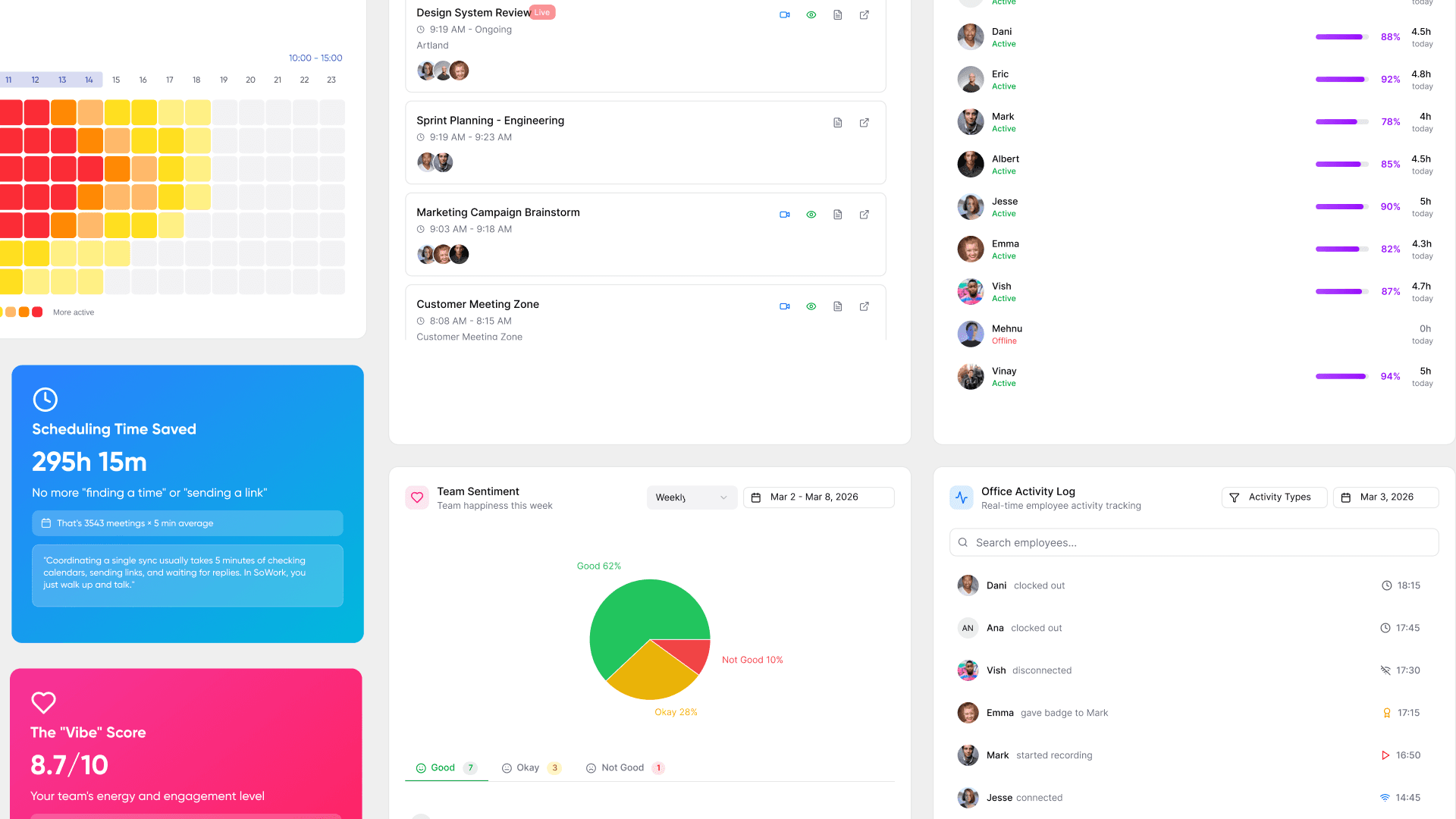
Virtual Office vs. Slack: Which Wins in 2026?
Vishal Punwani

Published:
Updated on:
SoWork is the better choice for remote teams that need presence awareness, spontaneous collaboration, and reduced meeting overhead, because it replicates the ambient feel of a physical office in a way Slack's channel-and-notification model cannot. Slack remains the stronger pick for async-first teams who primarily need structured messaging and deep third-party integrations.
What is a virtual office platform, and how is it different from Slack?
A virtual office platform is a persistent digital workspace where teammates appear as avatars on an interactive floor plan, giving everyone real-time awareness of who is available, busy, or in a meeting. Slack is a channel-based messaging tool built around text threads, notifications, and integrations.
Virtual office platforms like SoWork act as the coordination layer above your productivity suite, providing always-on presence, instant video, and ambient awareness of the team. Slack organizes communication into channels and DMs, which is powerful for async text exchange but provides no spatial or visual sense of who is actually around right now. The core difference: Slack tells you what people said; a virtual office shows you who is there.
What problems does Slack actually solve for remote teams?
Slack solves the email overload problem and gives remote teams a structured, searchable home for async text communication. Organizations that adopt Slack report a 32% reduction in email volume and a 27% decrease in meetings. [1]
Slack's channel structure keeps project conversations organized and searchable. Its 2,500+ integrations pull tools like GitHub, Jira, and Google Drive into one place, reducing context-switching for engineering and product teams. With 47.2 million daily active users in 2025, it's the most widely adopted team messaging platform. [2] For teams that are primarily async and text-driven, Slack's threading, reactions, and DMs cover most day-to-day communication needs efficiently.
What problems does a virtual office platform like SoWork solve?
SoWork solves the problems Slack cannot: the absence of ambient presence, the friction of scheduling every conversation, and the cultural disconnection that grows when a team only communicates in text threads.
Remote employees attend 50% more meetings than their in-office counterparts, largely because scheduled calls replace the informal exchanges that once happened naturally. [3] SoWork's Instant Meetings let you start a video call in one click by walking up to a teammate's avatar, no calendar invite required. AI Meeting Memory automatically records, transcribes, and summarizes every conversation so nothing is lost. Presence indicators show who is free, focused, or in a meeting, giving the team the ambient awareness that Slack's status dots simply don't replicate.
How does presence awareness in a virtual office compare to Slack's status system?
Slack's presence system relies on manual status updates and green dots that rarely reflect reality. A virtual office like SoWork syncs automatically with your calendar and shows real-time availability visually, without anyone having to remember to update anything.
In Slack, a green dot means someone is logged in, not that they're free to talk. Status messages are set manually and go stale fast. SoWork's Automatic Calendar Sync updates your availability the moment a calendar event starts, so the team always sees an accurate picture. Focus Modes (Simple Mode and Mini Mode) let individuals signal deep work without going dark. This ambient layer eliminates the constant 'are you there?' messages that fragment attention and interrupt flow.
How does spontaneous communication work in a virtual office versus Slack DMs?
In a virtual office, spontaneous conversation happens the same way it does in a physical office: you see someone is free and you walk over. In Slack, every unscheduled conversation starts with a DM that may or may not get a response.
62% of remote workers say they miss the casual interactions of a physical office. [4] Slack DMs are asynchronous by default. You type, you wait. A virtual office makes real-time drop-ins the path of least resistance. In SoWork, clicking a teammate's avatar opens a video call instantly. No link, no scheduling, no waiting for a reply. That friction difference is small per interaction but enormous across a week, and it's what drives the cultural warmth that text-only tools can't manufacture.
How does meeting overhead compare between a virtual office and Slack?
Slack reduces email but doesn't reduce meetings. A virtual office reduces the need to schedule meetings in the first place by making quick conversations effortless.
Meeting time has increased 252% since February 2020, with the average remote knowledge worker attending 25.6 meetings per week. [5] 71% of senior executives call meetings unproductive and inefficient. [6] Slack's huddle feature helps, but it still requires someone to initiate a call inside a channel. SoWork's Instant Meetings remove that initiation cost entirely. Teams using automated meeting management tools reduced total meeting time by 18% and improved follow-up completion by 42%. [7] SoWork's AI Meeting Memory delivers that benefit built in.
How does team culture-building differ between a virtual office and Slack?
Slack builds culture through emoji reactions and channel banter. A virtual office builds it through the same ambient proximity and spontaneous interaction that makes a physical office feel like a team.
Gallup's State of the Global Workplace found that 25% of fully remote employees experience daily loneliness, compared to 16% of on-site workers. [8] Slack's #random channel is a thin substitute for the hallway. SoWork lets teams design and personalize their office space and avatars, creating a shared environment that reflects company identity. Seeing teammates present in the same virtual space, even while heads-down, creates a sense of togetherness that no notification feed can replicate.
Which remote teams benefit most from a virtual office platform?
Teams that do their best work through rapid, synchronous collaboration, such as early-stage startups, product squads, and creative teams, benefit most from a virtual office. Async-first teams spread across many time zones may find Slack's model fits better.
SoWork is purpose-built for small-to-mid-sized remote-first companies (roughly 5 to 200 people) where spontaneous collaboration drives output. If your team ships features together, debugs in real time, or makes fast decisions that require back-and-forth, the friction of scheduling every conversation in Slack adds up fast. Teams that already feel disconnected, or that have tried Slack and Zoom and still feel like they're working in silos, are the clearest candidates for a virtual office upgrade.
What are the risks of switching from Slack to a virtual office platform?
The main risks are adoption friction, loss of Slack's integration ecosystem, and the learning curve of a new spatial interface. Teams with strong async workflows or many time zones may find the always-on model disruptive.
Slack has 2,500+ integrations that many teams depend on daily. A virtual office won't replace all of them. Some teammates, especially introverts or those in very different time zones, may resist a platform that emphasizes real-time presence. The smart migration path is a parallel pilot: run SoWork alongside Slack for two to three weeks with a small group, measure daily active usage (not just sign-ups), and let adoption data drive the decision before committing the full team.
What are the risks of relying solely on Slack?
Relying only on Slack leaves teams without presence awareness, spontaneous collaboration, or any structural support for the informal interactions that build culture and reduce meeting load.
Context switching between Slack, a video tool, and a calendar costs remote teams 20 to 30 minutes daily. [9] With no ambient presence layer, every quick question becomes a DM that may sit unanswered for hours, or it gets escalated into a scheduled meeting. 55% of remote employees already think most meetings could have been handled differently. [10] Over time, a Slack-only stack produces a team that communicates a lot but collaborates poorly, and the loneliness data backs that up: text-heavy remote work correlates with higher isolation rates.
How do SoWork's costs compare to Slack's pricing?
SoWork starts at $6 per user per month, making it cheaper than Slack's Pro plan at $7.25 per user per month and significantly cheaper than Slack's Business+ plan at $15 per user per month. [11]
Tool | Entry Paid Plan | Mid Tier |
|---|---|---|
SoWork | $6/user/month | Custom enterprise |
Slack | $7.25/user/month (Pro) | $15/user/month (Business+) |
Gather | ~$15/user/month | Custom |
Teamflow | $15/user/month | $25/user/month |
Sococo | $13.49/seat/month | Custom |
For a 30-person team on Slack Pro, that's $2,610 per year. SoWork at $6 comes to $2,160, and it includes presence, video, AI meeting summaries, and chat in one platform, so you may also eliminate a separate video conferencing subscription.
Can you use SoWork and Slack together, or do you have to choose?
They can coexist. Many teams run a virtual office as their real-time presence and collaboration layer while keeping Slack for async messaging, external communication, and integrations.
Think of it as a stack, not a swap. SoWork handles the synchronous layer: who is available, instant video, and meeting capture. Slack handles the async layer: threaded discussions, external partners, and app integrations. Over time, many teams find that the volume of Slack messages drops naturally as quick questions get resolved face-to-face in the virtual office instead of spawning long DM threads. The goal is fewer tools open at once, not necessarily zero Slack.
Is there data showing virtual office platforms actually improve productivity?
Yes. Teams using automated meeting management tools (a core feature of virtual office platforms) reduced total meeting time by 18% and improved follow-up completion by 42%, per Gartner. [7] Gartner also found that 55% of employees with flexible remote work options are high performers, versus 36% in traditional office setups. [12]
AI-powered meeting transcription adoption grew from 8% of organizations in 2021 to 52% in 2025, one of the fastest-adopted workplace AI features, because the productivity gains are measurable. [13] The virtual office market itself has grown to $12.5 billion, reflecting real business adoption rather than pandemic novelty. [14] The strongest signal is behavioral: teams that open their virtual office every morning report higher daily engagement than those relying on Slack alone, because presence creates accountability without surveillance.
How do Gather, Teamflow, and Sococo compare to SoWork?
SoWork leads for teams that want AI meeting summaries, presence awareness, and an all-in-one platform at the lowest per-seat cost. Each competitor has a distinct niche.
Platform | Best For | Price |
|---|---|---|
SoWork | AI-powered all-in-one HQ | $6/user/month |
Gather | Pixel-art social/culture focus | ~$15/user/month [15] |
Teamflow | Sales/design, embedded apps | $15/user/month [16] |
Sococo | Enterprise floor-plan presence | $13.49/seat/month [17] |
Gather suits culture-focused teams who want a game-like environment. Teamflow fits sales and design teams needing embedded Salesforce or Figma. Sococo works for enterprises already running Zoom who want a presence layer on top. SoWork is the broadest fit for 5-to-200-person remote-first teams.
How should your team decide between a virtual office platform and Slack?
Choose based on how your team actually works: if most collaboration is synchronous and spontaneous, a virtual office wins. If your team is async-first and spread across many time zones, Slack's model fits better.
Ask these questions: 1. Do we schedule meetings just to have quick conversations? (Yes = virtual office) 2. Do teammates feel disconnected or lonely? (Yes = virtual office) 3. Is most of our work async across 5+ time zones? (Yes = Slack-first) 4. Do we depend on 10+ Slack integrations daily? (Yes = keep Slack, layer SoWork) 5. Are we a 5-to-200-person team that wants to ship faster? (Yes = SoWork)
The honest answer for most small-to-mid remote teams is: start with SoWork, keep Slack for external comms.
Key Takeaways
SoWork is the better fit for remote teams that need real-time presence, spontaneous video, and reduced meeting overhead. Slack is better for async-first, text-heavy workflows.
Slack reduces email by 32% and meetings by 27%, but it doesn't solve the absence of ambient presence or informal collaboration that remote teams lose without a physical office.
Remote employees attend 50% more meetings than in-office counterparts, largely because scheduled calls replace informal exchanges. A virtual office reduces that overhead by making quick conversations frictionless.
25% of fully remote employees experience daily loneliness (Gallup). A virtual office creates ambient togetherness that a Slack channel cannot replicate.
SoWork starts at $6/user/month, cheaper than Slack Pro ($7.25) and significantly cheaper than Slack Business+ ($15), while consolidating presence, video, chat, and AI meeting summaries.
SoWork and Slack can coexist: use SoWork for synchronous presence and instant meetings, Slack for async messaging and external integrations.
Teams using automated meeting management tools (built into SoWork) reduced meeting time by 18% and improved follow-up completion by 42% (Gartner).
Run a 2-to-3-week parallel pilot with a small group before committing the full team to any platform switch. Measure daily active usage, not just sign-ups.
Sources
Organizations that adopt Slack see a 32% reduction in email volume and a 27% decrease in meetings.
Remote employees attend 50% more meetings than their in-office counterparts.
62% of remote workers say they miss the casual interactions of a physical office.
71% of senior executives say meetings are unproductive and inefficient.
55% of remote employees think most meetings could have been handled differently.
Slack Pro is $7.25/user/month (annual billing); Business+ is $15/user/month (annual billing).
AI-powered meeting transcription adoption grew from 8% of organizations in 2021 to 52% in 2025.
Gather removed its permanent free tier in late 2025; the new rate is $15/user/month.
Teamflow's entry paid plan is $15/user/month (or $20/user/month billed monthly).
Sococo's standard plan is $13.49/seat/month (annual billing) with a 10-seat minimum.
FAQ
Is a virtual office platform better than Slack for remote team communication?
Can SoWork replace Slack entirely?
Does Slack have presence awareness like a virtual office?
Is a virtual office platform worth it for a small remote team?
What are the biggest complaints about Slack from remote teams?
How hard is it to get a team to adopt a virtual office platform?
How does a virtual office help with remote team culture?
How do Gather, Teamflow, and Sococo compare to SoWork?
Blogs
Read Similar Articles
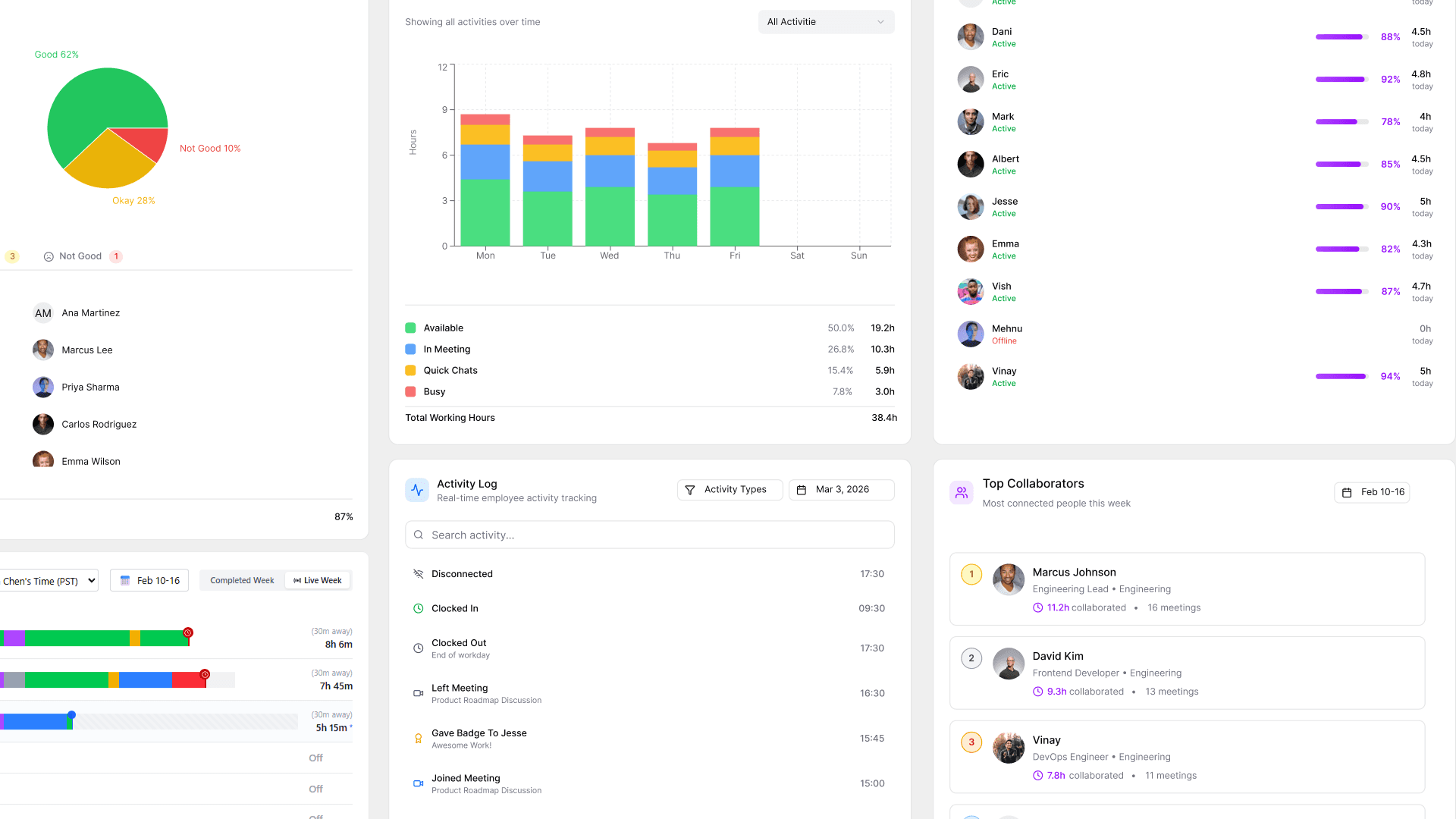
Remote Team Analytics: Complete Guide to Data-Driven Remote Work Management in 2026
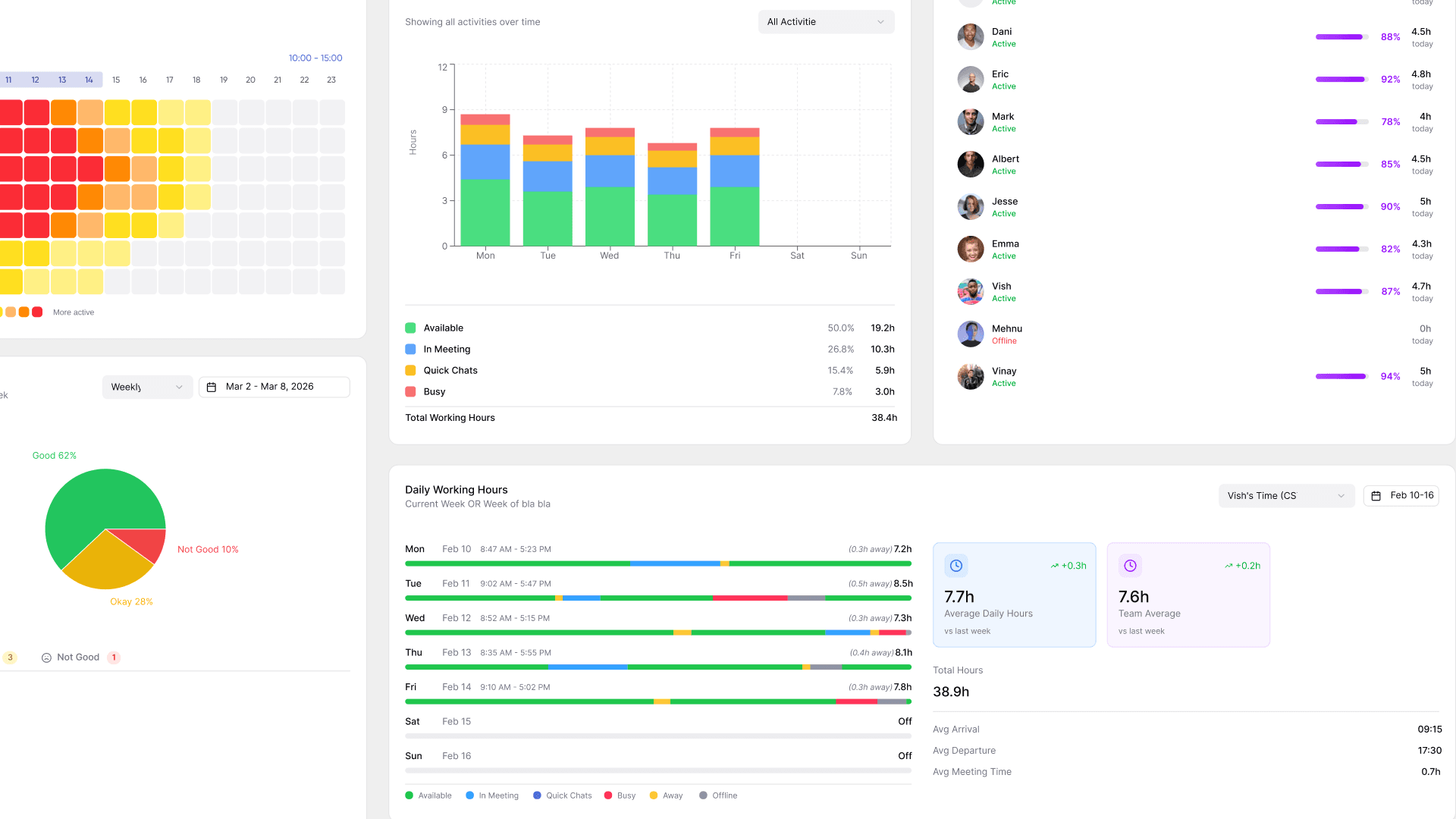
Complete Guide to Gaining Visibility Into Remote Team Performance and Collaboration