Team-Wide AI Agents for Small Remote Teams
Vishal Punwani

Published:
Updated on:
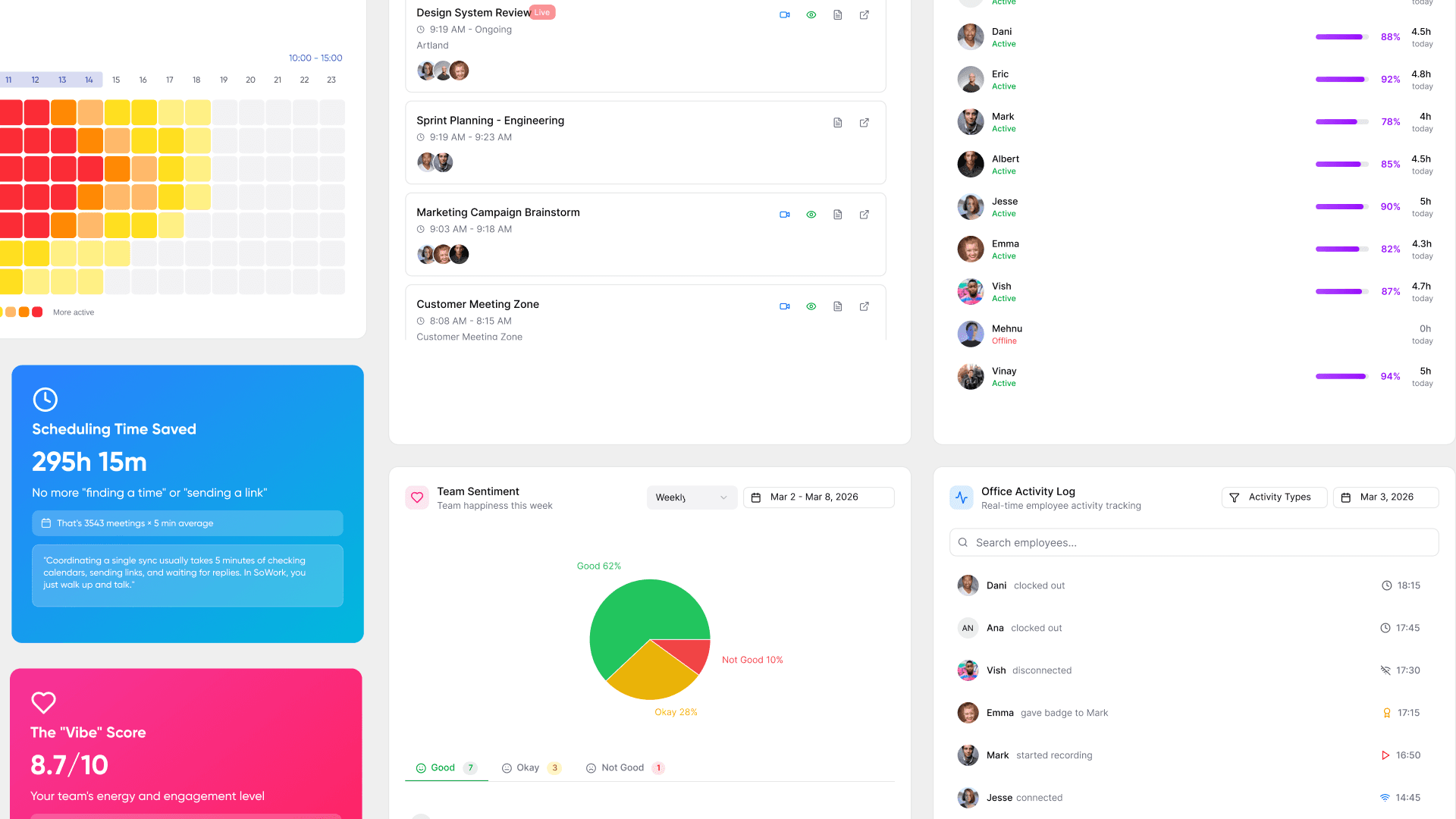
Small remote companies make AI a team system by putting shared agents where the team already works, connecting them to shared context, and giving each one a named owner. SoWork fits this well because agents sit in the virtual office next to people, and its MCP/API lets Claude ask who's around, what a meeting covered, or what the team decided.
What does it mean for a whole team to work with AI agents instead of private prompts?
With team-wide AI, agents are shared resources. Each one has an owner, draws on shared context, and produces output everyone can see. Private prompting means each person builds their own setup in a chat window nobody else can open.
Dimension | Private prompts | Team agents |
|---|---|---|
Context | Whatever one person pastes in | Meetings, decisions, presence |
Instructions | In someone's head | Written down and versioned |
Output | Stuck in one browser tab | Visible to the team |
Ownership | Nobody | A named owner |
Microsoft describes this stage as agents joining teams as "digital colleagues" that take on specific tasks at human direction [5].
Why does siloed AI use fail to scale across a small remote team?
Siloed AI breaks down because every person rebuilds the same context alone, so the wins stay with individuals and never add up for the team. It also puts company data in tools nobody is managing.
This is already common. 78% of AI users bring their own AI tools to work, and the figure rises to 80% at small and medium-sized companies [1]. Meanwhile, 60% of leaders say their company lacks a plan and vision for putting AI to work [2]. On a remote team the gap gets wider. You can't overhear a colleague's clever workflow, so a good prompt can live in one tab for months while three other people do the same task by hand.
What are the signs your remote company is ready for team-wide AI agents?
You're ready when the same AI task gets rebuilt by several people, or when people keep asking where an AI answer came from. Expensing overlapping AI subscriptions is another strong signal.
Watch for these signals:
Two or more people keep separate prompts for the same job, like meeting recaps.
"What did we decide?" still comes up in chat several times a week.
AI output gets pasted into Slack with no source or owner.
Someone leaves and their AI workflow leaves with them.
You're paying for several personal AI plans that do the same thing.
Three or more of these means private use has hit its ceiling.
Which recurring workflows suit shared AI agents in a small remote company?
The best starting points are frequent, low-risk workflows that depend on team context: meeting recaps, decision logs, status digests, and onboarding Q&A. Pick ones where a wrong answer is cheap to catch.
Workflow | Why it fits |
|---|---|
Meeting recaps and action items | Happens daily and needs shared memory |
Decision log lookups | Cuts down on repeat "what did we decide?" questions |
Weekly status digest | Replaces a recurring meeting |
New-hire Q&A | Same questions come up every hire |
Support triage | High volume, easy to review |
Leaders surveyed by Microsoft named customer service, marketing, and product development as their top AI investment priorities [6].
How do you give AI agents shared context like meeting notes, decisions, and availability?
Connect agents to the system where that context already lives, so they read it directly and nobody has to paste it in. Meeting memory, decision records, and live presence are the three inputs that matter most.
In SoWork, AI Meeting Memory records, transcribes, and summarizes meetings automatically. Automatic Calendar Sync keeps everyone's status accurate without anyone updating it by hand. Through SoWork's MCP/API, a tool like Claude can query that context directly. It can check who's free right now, pull what was said in Tuesday's planning meeting, or confirm what the team decided about pricing. The agent then works from the same facts your people see, not from one person's memory.
How do you bring AI agents into the same workspace as your human teammates?
Give agents a presence in the place your team already works, so working with an agent feels like walking over to a colleague, not opening another tab. That's the core of an AI agent workspace.
In SoWork, AI agents sit in the company office as characters alongside your human teammates, and you work with them there. This feature is live today. Because meetings, presence, chat, and AI tools are all in one platform, people don't have to keep switching between apps to find or use an agent. Everyone can see the agents exist, and so everyone can use them, not just the one person who set them up.
How do MCP and APIs let tools like Claude access team presence, meetings, and decisions?
The Model Context Protocol (MCP) is an open standard that gives AI tools one consistent way to connect to outside systems. A platform publishes an MCP server, and any compatible AI client can query it.
Anthropic open-sourced MCP in November 2024 as a single protocol meant to replace fragmented one-off integrations [3]. Since December 2025, the protocol has been governed by the Linux Foundation's Agentic AI Foundation [4]. In practice, SoWork's MCP server lets Claude answer questions like:
Who's around right now?
What happened in today's design review?
What did the team decide about the launch date?
SoWork also connects to tools like Slack, Zapier, Miro, Google Calendar, and Outlook.
How should a remote team assign ownership and roles for each AI agent?
Every agent needs exactly one human owner who answers for its instructions, access, and output quality. If an agent has no owner, nobody fixes it when it goes wrong.
Role | Responsibility |
|---|---|
Owner | Writes instructions, approves changes, fixes errors |
Reviewer | Spot-checks output weekly |
Users | Anyone who calls the agent, flags issues |
Admin | Controls permissions and data access |
Microsoft's research calls this emerging role the "agent boss": employees who direct and manage agents [6]. On a team of 10 to 30 people, one person can own two or three agents. Put ownership in each agent's description so everyone knows who to ask.
How can the team see what each AI agent is working on and what it did?
Make agents report their work somewhere public. For now that usually means posting outputs and action logs to a shared channel, and purpose-built agent views are starting to arrive.
A simple rule works today. Each agent posts what it did, the source it used, and any open items to a dedicated topic-based chat channel. Reviewers scan that channel weekly. SoWork is building agent desks (coming soon), which will give every agent a desk so you can see what it's working on and what it actually did. Until then, channel logs plus weekly owner reviews keep agent work from going invisible.
How do you document and share prompts and agent instructions across the team?
Write a one-page agent card for every shared agent and keep all the cards in one place your whole team can find. Sharing has to be on purpose, because many tools make agents private by default.
In Mistral's Le Chat, for example, a newly created agent is private and only its creator can use it until it's shared [14]. A good agent card covers:
Purpose, in one sentence
Owner and reviewer
Full instructions or system prompt
Data it can and can't access
Two examples of good output
Version and last-updated date
Pin the index in a chat channel and update the card whenever the instructions change.
How do you onboard non-technical teammates to work alongside AI agents?
Teach by doing. Show real tasks in a short live session, then give each person a few starter jobs and someone to ask. Skip prompt-engineering theory.
Run a 30-minute demo using your team's actual meetings and decisions.
Pair each person with an agent-savvy buddy for the first two weeks.
Assign three starter tasks, like "ask the agent what we decided last sprint."
Hold weekly drop-in office hours in a shared room.
Post wins in a channel so people see what's working.
Make it clear that agents take on tasks. They don't replace teammates. Fear kills adoption faster than confusion does.
What governance and security rules should a small team set for shared AI agents?
Set five rules: least-privilege access, approved tools only, human approval for anything external, central identity management, and a review log. Write them down before your third agent goes live.
Rule | Example |
|---|---|
Least privilege | A recap agent reads meetings but can't send email |
Approved tools | No customer data in personal AI accounts |
Human approval | People sign off on anything customer-facing |
Identity | Use SSO so access ends when someone leaves |
Review | Owners audit outputs monthly |
SoWork is SOC 2 certified, offers SSO on Premium and Enterprise, and includes SCIM provisioning on Enterprise only.
What criteria should small remote teams use to choose a platform for people and AI agents?
Choose a platform that holds your team's context, puts humans and agents in one place, and fits a small team's budget and setup time. Enterprise build tools often fail that last test.
Criterion | What to check |
|---|---|
Context access | Does it offer MCP or an API for meetings, decisions, presence? |
Humans plus agents | Do agents live where people work? |
Visibility | Can you see what agents did? |
Security | SOC 2, SSO, permission controls |
Price at your size | Free or low-cost tier for 10 to 50 users |
Adoption | Setup time, no download required |
Adoption counts for the most. A tool nobody opens daily won't change how your team works.
How do AI agent workspaces compare with Copilot Studio, OpenAI Frontier, and Agentforce?
Agent management platforms build, run, and govern agents, but they don't manage the people working alongside those agents. An AI agent workspace like SoWork puts both in the same room.
Platform | Focus | Pricing signal |
|---|---|---|
Copilot Studio | Low-code agent building on Microsoft | $200/month per 25,000 credits, or $0.01/credit [9] |
OpenAI Frontier | Enterprise agent platform, launched Feb 5, 2026 [7] | Launched to a limited set of customers first [8] |
Agentforce | Agents inside Salesforce | About $0.10 per action, or $125/user/month add-ons [10] |
SoWork | People and agents in one virtual office | Free up to 10 users [13] |
Many small teams run both kinds of tool: one to build agents and SoWork as the place to work with them.
How do SoWork, Gather, Teamflow, Sococo, and Roam differ on AI agent support?
SoWork and Roam both put AI agents into the office itself. Gather focuses on AI meeting notes. Check current docs for Teamflow and Sococo before you buy.
Tool | AI agent support |
|---|---|
SoWork | Agents in the office (live), MCP/API (live), agent desks (coming soon) |
Roam | Says it has AI agents as permanent map residents and an MCP server, $19.50/seat/month [11] |
Gather | Offers AI meeting notes and summaries plus instant meetings [12] |
Teamflow | We found no documented agents-in-office feature |
Sococo | We found no documented agents-in-office feature |
SoWork's edge for small teams is its free tier for up to 10 users [13].
What does it cost a small remote company to roll out team-wide AI agents?
For a team of 10 to 20, workspace costs are modest. SoWork is free for up to 10 users, Basic is $6/user/month, and Premium is $15/user/month [13]. Model usage and owner time are the real variables.
Cost line | Example for 15 people |
|---|---|
Workspace (SoWork Basic) | $90/month |
Workspace (SoWork Premium) | $225/month |
Model usage | Your team's AI plan or API spend |
Owner time | A few hours a week across owners |
For comparison, Copilot Studio capacity packs start at $200/month for 25,000 credits [9]. Consolidating several personal AI subscriptions into one team plan often pays for part of the rollout.
What metrics show team-wide AI agent adoption is working?
Track meeting hours, focus time, time to decision, and the share of the team using shared agents each week. If those numbers move, adoption is real.
Metric | How to measure |
|---|---|
Hours in meetings | SoWork Insights weekly report |
Focus time | SoWork Insights weekly report |
Time to decision | Days from question raised to decision logged |
Weekly active agent users | Share of team calling a shared agent |
Repeat questions | "What did we decide?" messages per week |
Private prompts retired | Duplicate personal workflows replaced |
Take a baseline in week one. Compare at days 30, 60, and 90.
What is a 90-day rollout plan for shared AI agents on a small remote team?
Spend the first month auditing and piloting two workflows, the second expanding and training, and the third measuring and tightening governance. Start small and grow from there.
Days 1 to 14: Survey which AI tools people use privately. Baseline your metrics.
Days 15 to 30: Pick two workflows, connect Claude through SoWork's MCP/API, assign owners, write agent cards.
Days 31 to 60: Bring agents into the shared office, train the whole team, add two more agents.
Days 61 to 90: Compare metrics, retire duplicate private prompts, finalize governance rules.
Review at each phase gate. Cut any agent nobody uses.
Bottom Line
Small remote companies get the whole team using AI agents by making those agents shared, owned, and grounded in team context, then putting them where people already work.
Start with two recurring workflows. Connect your AI tools to meeting memory, decisions, and presence through MCP, and give every agent a named owner. SoWork is the practical choice for a 5 to 200 person team because agents sit in the office alongside people, and its free tier lets you pilot before you spend.
Key Takeaways
78% of AI users bring their own AI tools to work, rising to 80% at small and medium-sized companies, so private AI use is the default you're starting from.
Team-wide AI means shared agents with named owners, shared context, and visible output.
Start with frequent, low-risk workflows like meeting recaps, decision lookups, and status digests.
MCP, an open standard from Anthropic, lets tools like Claude query team presence, meetings, and decisions.
Give every agent a one-page card covering purpose, owner, instructions, and data access.
Set governance early: least privilege, approved tools only, human approval for external actions, SSO.
SoWork puts AI agents in the office beside people and is free for up to 10 users; Basic is $6/user/month and Premium is $15/user/month.
Measure meeting hours, focus time, time to decision, and weekly agent usage at days 30, 60, and 90.
Related reading
Collaborative AI Platform: How to Give Your Team and Existing AI Agents One Shared Workspace in 2026
Sources
FAQ
How do small remote companies build a system where the whole team works with AI agents instead of just a few people running their own prompts?
Should we just use shared custom GPTs or Claude Projects, or do we need a dedicated platform?
Is employees using their own personal AI tools a security risk?
Do I need a developer to connect Claude to our team's data through MCP?
Why can't my teammates see the AI agent I built?
Who should own an AI agent on a small team?
Will shared AI agents replace people on a small remote team?
How much does it cost to give a 10-person remote team shared AI agents?
Blogs
Read Similar Articles
Remote Team Analytics: Complete Guide to Data-Driven Remote Work Management in 2026
Complete Guide to Gaining Visibility Into Remote Team Performance and Collaboration