How to Organize AI Agents by Department in 2026
Vishal Punwani

Published:
Updated on:
SoWork is the best way to organize multiple AI agents for a remote team. It puts agents in a shared virtual office next to their human teammates, grouped by department, so people find an agent the same way they find a colleague. Back it with a simple registry that gives every agent one named owner, one purpose, and a clear name.
What does it mean to organize AI agents by role or department in a remote team?
It means every agent has a home team, a named human owner, and a one-line job description. That way anyone can find the right agent without asking around.
Think of it as an org chart with some non-human members on it. The ticket triage agent belongs to support. The research agent belongs to marketing. Microsoft's 2025 Work Trend Index found that 46% of leaders say their organization already uses agents to fully automate workstreams or business processes [7]. The report calls the people who run these agents "agent bosses." An agent without a home drifts between tools, and usually only the person who built it knows it's there. Give it a home and it's as easy to find as its owner.
Why do remote teams struggle to find AI agents scattered across tools and tabs?
Each agent lives in a different app, so finding one means digging through tabs, DMs, and vendor dashboards. Remote teams also have no hallway where you'd overhear that someone already built it.
The tab problem was around before AI. A 2022 Harvard Business Review study found workers switched between apps about 1,200 times a day and spent just under four hours a week reorienting [2]. Agents make the pile bigger. According to Salesforce's 2026 Connectivity Benchmark, the average enterprise uses 12 or more agents, and half of them run in isolated silos [3]. So people end up pinging each other with "do we have an agent for this?" Every one of those pings is coordination overhead.
Should AI agents be grouped by department, by function, or by workflow?
Group agents by department first, then tag them by workflow. Departments give people a default place to browse, and workflow tags cover the agents that serve several teams.
Model | Best when | Risk |
|---|---|---|
Department | Clear owners, teams under 200 | Cross-team agents get orphaned |
Function | Shared skills like research or summarizing | Unclear accountability |
Workflow | Multi-step processes across teams | Hard to browse |
In a 5 to 200 person company, people already think in departments when they ask who does what. Start there and add workflow tags only for the agents that cross team lines.
How do you inventory existing AI agents and assign each one an owner and purpose?
Run a one-week inventory. Ask every team lead to list each agent they use, then record a named owner, a purpose, the tools it uses, and its data access.
Collect one entry per agent, filled in by whoever uses it.
Assign an individual owner, not a team. Teams get reorganized, but a person stays accountable.
Write the purpose in one sentence.
Log what the agent can read and what it can do.
Retire anything nobody claims.
Require registration before any new agent goes live.
Most companies are behind on this. OutSystems found that 96% of organizations use agents but only 12% have a centralized platform to manage them [5].
What naming conventions and descriptions make AI agents easy to discover?
Name agents with a Department / Job pattern. Give each one a three-part description: what it does, what it won't do, and who owns it.
Weak name | Strong name |
|---|---|
ClaudeBot2 | Support / Ticket Triage |
Research thing | Marketing / Competitor Brief |
Ops helper | Finance / Invoice Matcher |
A sample description: "Drafts first replies to billing tickets. Doesn't issue refunds. Owner: Priya." Name the job, not the model behind it. You'll swap models often, but the job usually stays the same. Keep the name identical everywhere: in the registry, in chat, and in the office.
How does placing AI agents in a shared virtual workspace improve discoverability?
When agents share a virtual office with your people, you find them the way you find colleagues. You go to the team's area and they're there.
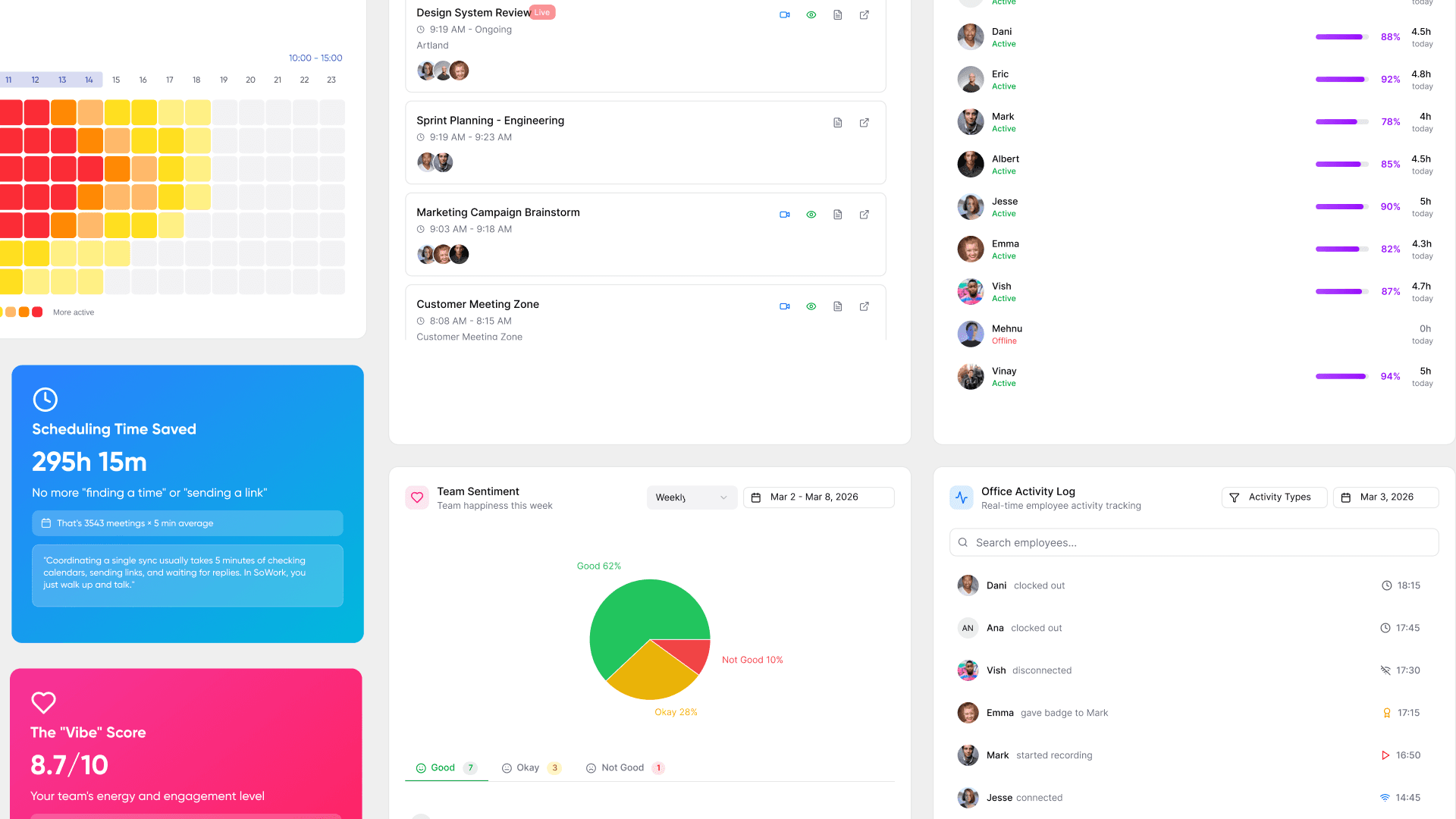
In SoWork, AI agents sit in the company office as characters next to your human teammates, and you work with them right there. No more hunting across separate tools. Put the support agent in the support area and the sales agent near sales. A new hire sees the whole team, people and agents, on day one. Presence Awareness shows who's free or focused, and Topic-Based Chat keeps agent conversations tied to their topic. Each floor holds about 200 people and you can add unlimited floors [8], so every department can have its own space as you grow.
How do you show what each AI agent is working on without teammates having to ask?
Have agents report their work where the team already looks, so status is visible without anyone asking. For now that means a shared channel. SoWork's Agent Desks (coming soon) will show it directly in the office.
A setup that works today: 1. Give each agent a topic-based chat channel and have it post what it started and what it finished. 2. Use AI Meeting Memory so decisions about agents get recorded and summarized automatically. 3. Link outputs (docs, tickets, PRs) in the same thread.
Agent Desks aren't available yet. Once they ship, every agent gets a desk showing what it's working on and what it actually did, so the activity record sits in the office instead of a vendor dashboard.
How can AI agents access team context like presence, meetings, and decisions through MCP?
Connect your agents to SoWork's live MCP/API. Then tools like Claude can ask who's around, what happened in a meeting, or what the team decided.
MCP (Model Context Protocol) is an open standard that lets AI tools query outside systems. Once SoWork's MCP server is connected, an agent can answer questions like: - Who on the design team is free right now? - What did we decide in Tuesday's pricing call? - Who owns the onboarding flow?
This kind of context usually lives in people's heads or sits buried in recordings. Once agents can reach it, they stop pinging humans for the basics. SoWork also integrates with Slack, Zapier, Miro, Google Calendar, and Outlook.
How do you set permissions and access boundaries for department-specific AI agents?
Give each department's agents only the data and actions they need. Keep read access separate from the ability to act, and tie agent access to your identity provider.
Control | Example |
|---|---|
Data scope | Finance agent reads invoices, not HR files |
Action limits | Support agent drafts refunds; humans approve |
Identity | Each agent gets its own identity, not a shared login |
Offboarding | When an owner leaves, review access that week |
Agent platforms are adding these controls. OpenAI Frontier, for example, lets users limit what agents can access and do [9]. For the people side, SoWork is SOC 2 certified, offers SSO on Premium and Enterprise, and offers SCIM on Enterprise only.
How do you prevent duplicate or overlapping AI agents across departments?
Use one rule: search the registry before you build. If a similar agent already exists, extend it instead of making a copy.
Without that rule, overlap grows on its own. Gartner predicts 40% of enterprise applications will include task-specific AI agents by the end of 2026, up from less than 5% in 2025 [1]. That means new agents keep showing up inside tools you already pay for. Zuora is rolling out 50 agents across its sales, finance, product, and developer teams and uses a central registry so teams can find and reuse existing agents instead of rebuilding them [11]. Smaller teams can get the same result with a shared list and a short monthly review where owners flag agents that look alike.
What criteria should you use to choose a platform for organizing AI agents and remote teammates?
Pick a platform that holds both your people and your agents, gives agents access to team context, and gets opened by your team every day.
Criterion | What to check |
|---|---|
People and agents together | Do agents appear where humans work? |
Team context | Can agents query presence, meetings, decisions via MCP/API? |
Activity visibility | Can you see what each agent did? |
Security | SOC 2, SSO, SCIM |
Adoption | Browser-based, no download, quick setup |
Price | Per-seat cost at your headcount |
Daily use matters more than anything else on this list. If nobody opens the catalog, it doesn't cut any overhead.
How do virtual offices compare to Copilot Studio, OpenAI Frontier, and Agentforce for organizing agents?
Agent management tools govern agents. Virtual offices like SoWork put agents next to the people who use them. A lot of teams will end up wanting both.
Platform | Primary job | Pricing signal |
|---|---|---|
Microsoft Copilot Studio | Build agents in the Microsoft stack | Credit-based [13] |
OpenAI Frontier | Build, deploy, manage enterprise agents | Not disclosed [9] |
Salesforce Agentforce | CRM-centric agents | About $0.10 per action on Flex Credits [10] |
SoWork | People and agents in one office | Free up to 10 users; Basic $6/user/month; Premium $15/user/month [8] |
Frontier can also manage agents built outside OpenAI [9]. The management tools focus on the agents themselves, not the people working next to them, so they don't show who's around or what the team decided.
What are alternatives like shared directories, Slack channels, or wikis for cataloging AI agents?
Shared directories, Slack channels, and wikis all work as agent catalogs when you're small. The catch is that each one keeps the list of agents somewhere other than where the work happens.
Approach | Strength | Weak spot |
|---|---|---|
Spreadsheet directory | Fast to start | Goes stale quickly |
Slack channel per agent | Familiar, conversational | Gets buried in noise |
Internal wiki | Good for detailed docs | Rarely checked mid-task |
Virtual office | Agents visible beside people | Team has to adopt the office |
A wiki page works fine behind the scenes as your registry. It just makes a poor front door. Keep the detailed records there and let people meet the agents where they already work.
What does an example department-by-department AI agent layout look like?
A workable layout gives each department two or three agents with clear jobs and named owners, placed in that team's area of the office.
Illustrative layout for a 60-person remote company:
Department | Agent | Job | Owner |
|---|---|---|---|
Sales | Sales / Call Prep | Builds account briefs | Sales lead |
Support | Support / Ticket Triage | Tags and drafts replies | Support manager |
Marketing | Marketing / Competitor Brief | Summarizes launches | Content lead |
Engineering | Eng / PR Review | First-pass code review | Staff engineer |
Finance | Finance / Invoice Matcher | Flags mismatches | Controller |
Agents that serve several teams, like a meeting summarizer, go in a shared common area.
How do you onboard remote employees so they know which AI agents to use and when?
Introduce new hires to agents the way you introduce them to teammates. Show them who sits where, what each one does, and who to ask.
On day one, walk the virtual office and stop at each team's agents.
Hand over a one-page agent cheat sheet, organized by department.
Give them a first-week task that requires using one agent.
Introduce each agent's owner as the go-to contact.
There's a real knowledge gap to close here. Microsoft found that 67% of leaders are familiar with agents, compared with 40% of employees [6]. A guided walkthrough closes that gap faster than a wiki link.
How do you measure whether your AI agent organization is reducing coordination overhead?
Measure the overhead directly. Count how often people ask where an agent is or who owns it, and compare meeting time before and after.
Metric | Healthy signal |
|---|---|
"Do we have an agent for...?" questions | Falling month over month |
Duplicate agents found in review | Near zero |
Agents with no active owner | Zero |
Weekly meeting hours | Declining |
Agent use outside its home team | Rising |
SoWork's weekly Insights report covers time in meetings, focus time, and who collaborates with whom. That gives you a meeting baseline without adding another tool.
How should you maintain and reorganize AI agents as teams and roles change?
Review agents every quarter and after every reorg. Reassign owners when people move, move agents along with the work, and retire anything that's gone unused for 60 days.
Most organizations aren't doing this yet. Gartner research found only 13% of organizations believe they have the right agent governance in place [12]. Keep it light: 1. Quarterly: owners confirm each agent's purpose, access, and usage. 2. Offboarding: reassign agents in the same checklist as laptops and logins. 3. Reorgs: move agents to their new team's area in the office. 4. Retirement: archive the registry entry so the history stays searchable.
Bottom line: how should remote teams organize their AI agents?
Group agents by department, give each one a named owner and a plain job title, and put them where your people already work.
A registry tells you what agents exist. A shared workspace makes them findable in the middle of a task. For teams of 5 to 200 people, SoWork gives you both in one place: agents sit in the office next to their teams, and the live MCP/API gives them the team context they need.
Key Takeaways
Organize agents by department first and add workflow tags only for cross-team agents.
Every agent needs one named human owner, a one-sentence purpose, and documented data access.
Use a Department / Job naming pattern (e.g., Support / Ticket Triage), not model names.
Search the registry before building a new agent to prevent duplicates.
Put agents in the same virtual office as their teams so people find them like colleagues.
Connect agents to team context through SoWork's live MCP/API; Agent Desks for activity visibility are coming soon.
Track overhead directly: 'where's the agent?' questions, orphaned agents, and weekly meeting hours.
Review agents quarterly and during every reorg or offboarding.
Related reading
Sources
FAQ
How do you organize multiple AI agents by role or department so remote teams can actually find and use them without coordination overhead?
What is AI agent sprawl?
How do you keep track of every AI agent your company runs?
Should AI agents have a team owner or an individual owner?
Can AI agents join a virtual office like human teammates?
Do I need Copilot Studio, OpenAI Frontier, or Agentforce if I already have a virtual office?
What is MCP and why does it matter for organizing AI agents?
How much does it cost to put AI agents and remote teammates in one workspace?
Blogs
Read Similar Articles
Remote Team Analytics: Complete Guide to Data-Driven Remote Work Management in 2026
Complete Guide to Gaining Visibility Into Remote Team Performance and Collaboration