SoWork vs Remo: Which Is Built for Always-On Teams
Vishal Punwani

Published:
Updated on:
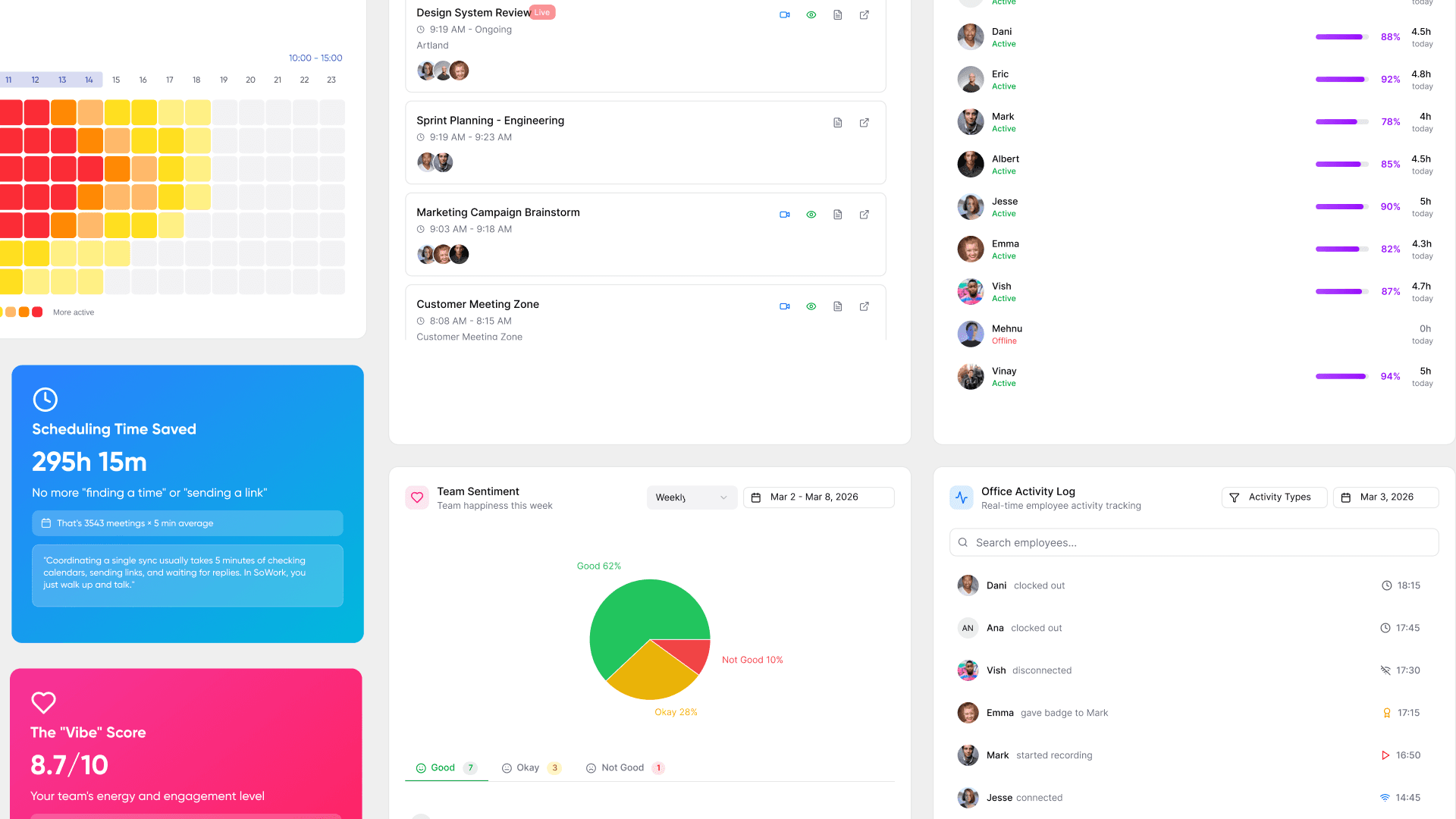
SoWork is built for always-on daily virtual office use, with persistent presence awareness, instant drop-in meetings, AI meeting memory, and calendar sync designed to run all day. Remo is optimized for structured virtual events and all-hands sessions, not ambient daily presence. For teams who need a persistent digital office, SoWork is the clear fit.
What Does 'Always-On Virtual Office' Actually Mean?
An always-on virtual office is a persistent digital workspace your team logs into at the start of the workday and stays connected to throughout it, just like a physical office. It's not a meeting room you book, it's the environment where work happens.
Virtual office platforms create always-on environments where social interaction happens organically between structured work [1]. When team members can see who's at their desk, who's in a conversation, and who's heads-down, they replicate the ambient awareness that physical offices provide naturally [1]. The key distinction: a scheduling tool like Zoom gets opened for a meeting and closed when it ends. An always-on virtual office stays open, passively signaling presence and enabling spontaneous connection all day long.
What Is SoWork and Who Is It Designed For?
SoWork is an AI-powered virtual office that replicates the ambient, spontaneous collaboration of a physical office for fully remote and hybrid teams. Its core use case is replacing the Slack-plus-Zoom stack with a single persistent workspace.
SoWork solves the core problem of coordination friction: too many scheduled meetings, too little spontaneous connection, and growing team disconnection [2]. It puts your whole team in a persistent digital office where you can see who's free, pop into a conversation in one click, and let AI capture what was said [2]. A Technical Art Director at NetEase described the result: "As the team felt more connected, they naturally collaborated more. Work was getting unblocked, teams were ideating and solving problems together, and projects were getting shipped on time" [3].
Sources: [2] sowork.com/blog, [3] sowork.com/blog/ai-powered-virtual-offices
What Is Remo and What Is It Actually Built For?
Remo is a virtual event platform designed for interactive online conferences, networking events, all-hands meetings, and training sessions. Its table-based layout is purpose-built for structured gatherings, not continuous daily presence.
Remo specializes in virtual events, all-hands meetings, and training sessions requiring interactive table layouts rather than daily operational coordination [1]. Reviewers consistently describe it as the closest thing to an in-person event experienced virtually, praising how attendees can move between tables like a convention or cocktail reception [4]. Its primary users are event organizers, conference managers, and educators, not the distributed product teams who need a persistent office open from 9 to 5 [5].
Sources: [1] sowork.com/blog/best-virtual-office-software, [4] capterra.com/remo, [5] capterra.com/remo
How Does SoWork Support Ambient Presence Throughout the Workday?
SoWork is designed to run all day, showing real-time availability for every teammate without any manual updates. It combines visual presence indicators, automatic calendar sync, and Focus Modes so the team always knows who's free and who's heads-down.
SoWork's Presence Awareness shows who is free, focused, or in a meeting, mimicking the ambient awareness of a physical office. Automatic Calendar Sync updates your status the moment a calendar event starts, so availability stays accurate without anyone touching it manually. Focus Modes (Simple Mode and Mini Mode) let individuals signal deep work time while staying loosely connected. One daily user put it directly: "The important thing is to alternate between deep work sessions and moments when I need to connect spontaneously with a colleague to get unblocked" [6].
Sources: [6] producthunt.com/products/sowork/reviews
How Does Remo Handle Persistent Presence for Daily Team Use?
Remo does offer a Virtual Office product separate from its Conference product, but persistent presence awareness is not a core design priority. Its architecture centers on structured table-based sessions rather than ambient all-day availability signals.
Remo Virtual Office starts at $20 per user per month and does provide real-time video and audio collaboration [7]. But the platform's DNA is event-oriented: its floor plans are designed for hosting sessions, not for a team to inhabit continuously. There's no equivalent to SoWork's calendar-synced status or Focus Modes. Users who want daily presence visibility will find Remo's toolset better suited to scheduled gatherings than to the ambient "who's available right now?" awareness a persistent office requires.
Sources: [7] spotsaas.com/compare/remo-conference-vs-remo-virtual-office
What Separates a Daily Virtual Office from an Event Platform?
The defining criteria are persistent presence, spontaneous drop-in communication, and low-friction background operation. Event platforms optimize for structured sessions with a start and end time; daily offices are designed to stay open and ambient.
Criterion | Daily Virtual Office | Event Platform |
|---|---|---|
Presence model | Always-on, ambient | Session-based |
Communication trigger | Spontaneous drop-in | Scheduled or hosted |
Status awareness | Automatic, real-time | Not a core feature |
Background resource use | Optimized for all-day | Peaks during events |
Primary user | Distributed team member | Event organizer/attendee |
Proximity-based conversations allow users to approach colleagues for quick discussions without scheduling formal meetings, reducing communication friction by up to 32% according to case studies from mid-sized tech firms [8].
Sources: [8] sowork.com/blog/best-virtual-office-software-in-2026
How Do SoWork and Remo Compare on Spontaneous Drop-In Communication?
SoWork is purpose-built for spontaneous drop-in: you see a teammate's avatar, click once, and you're talking. Remo's table-hopping model supports fluid movement during events but isn't designed for the unplanned "hey, got a second?" moment of a normal workday.
SoWork's Instant Meetings let you start a conversation in one click with no scheduling, no links, no friction. Spatial video calls make hallway chats spontaneous [9]. Remo's table movement is praised by reviewers for mimicking real-life networking [10], but that's the problem for daily use. Networking at an event is structured around a session. A quick question to a colleague at 2pm on a Tuesday isn't. SoWork's proximity audio and one-click video are built for exactly that second scenario.
Sources: [9] producthunt.com/products/sowork/reviews, [10] getapp.com/remo
How Do SoWork and Remo Compare on Workspace Customization?
Both platforms offer customizable spaces, but their customization goals differ. SoWork's office builder is designed for teams to create a persistent home they inhabit daily. Remo's customization targets event organizers setting up a space for a specific session.
SoWork lets teams design and personalize their office space and avatars to reflect company culture, similar to building in The Sims, rooms for focused work, open areas for casual chat, and custom branding throughout. Premium teams over 30 users get a free custom map built for them [11]. Remo lets organizers choose environments and design floor plans with multiple rooms and floors [12], which works well for a one-time event but doesn't evolve with a team's daily workflow the way a persistent office layout does.
Sources: [11] sowork.com/alternatives/sococo-vs-sowork, [12] remo.co/virtual-office
How Do SoWork and Remo Handle Status and Availability Signals?
SoWork's presence system is automatic and calendar-integrated, giving distributed teams real-time availability without any manual effort. Remo's status model is session-centric and doesn't offer the same persistent, passive availability layer.
SoWork's Automatic Calendar Sync updates your status when a calendar event starts. Visual indicators show who is free, focused, or in a meeting at a glance. This is the digital equivalent of seeing a colleague's office light on or their door closed. SoWork also offers team analytics that track meeting frequency and engagement levels, helping managers spot bottlenecks [13]. Remo shows who's at which table during an active session, but there's no persistent "available/busy" layer designed for a team that's just working through a normal day.
Sources: [13] sowork.com/blog/ai-powered-virtual-offices
How Do SoWork and Remo Integrate with Daily Productivity Tools?
SoWork integrates with Google Calendar, Slack, and Zapier as core parts of its daily-office workflow. Remo's integrations are event-management focused, connecting to tools like Calendly, LinkedIn, and event platforms rather than everyday team productivity stacks.
SoWork offers AI-driven insights, flexible layouts, and integrations with tools like Slack and Zapier [14]. Calendar sync is a foundational feature, not an add-on. Remo integrates with ScheduleOnce, Calendly, LinkedIn, HeySummit, and YouTube [15], a list that reveals its event-hosting orientation. For a team that lives in Google Workspace or Microsoft 365 all day, SoWork's integration layer is built around that workflow. Remo's is built around event registration and attendee management.
Sources: [14] sowork.com/blog/ai-powered-virtual-offices, [15] softwareadvice.com/remo
What Are the Performance Considerations for Running Each Platform All Day?
SoWork is engineered for all-day background use, offering a Simplified Mode (Mini Mode) that reduces resource load when you're not actively collaborating. Remo is browser-based and optimized for event sessions, not for staying open and idle across an 8-hour workday.
SoWork's 2.5D view can be resource-intensive, but its Lite/Simplified Mode compensates for users on lower-spec machines [16]. The platform runs in-browser with no download required, keeping the footprint manageable. Remo is also fully browser-based [17], which is good, but its video and audio engine is tuned for active event sessions rather than low-idle background presence. Users report occasional technical glitches with video quality during active use [18], a concern that compounds if the platform is running continuously. For all-day use, SoWork's purpose-built modes give it a clear advantage.
Sources: [16] sowork.com/alternatives/gather-vs-sowork, [17] spotsaas.com/compare, [18] getapp.com/remo
How Do SoWork and Remo Compare on Pricing for Daily Team Use?
SoWork is meaningfully more affordable for daily team use, starting free for up to 10 users with paid plans from $6 to $15 per user per month. Remo's Conference product starts at $299 per month, and its Virtual Office product starts at $20 per user per month.
Plan | SoWork | Remo Virtual Office | Remo Conference |
|---|---|---|---|
Entry price | Free (up to 10 users) | $20/user/month | $299/month |
Mid-tier | $6/user/month (Basic) | Custom | Custom |
Premium | $15/user/month | Custom | Custom |
Annual discount | ~10-20% | Not published | Not published |
SoWork's Basic tier is $6 per user per month, or $5.40 billed annually [19]. Remo's Conference pricing is structured around event frequency and attendee count, not per-seat daily use [20], making cost predictability harder for teams who just want a persistent office.
Sources: [19] sowork.com/alternatives/sococo-vs-sowork, [20] softwarefinder.com/remo
What Onboarding Challenges Should Teams Expect?
The biggest adoption hurdle for any always-on virtual office is behavioral: team members default to familiar tools (Slack, Zoom) even after the new platform is deployed. Remo adds a secondary challenge because its event-oriented UX isn't intuitive for daily work habits.
For SoWork, the main challenge is habit change. The fix is to define clear use cases upfront: "Use SoWork for daily standups and spontaneous collaboration. Use Google Docs for documents. Use Asana for task tracking" [21]. Implement gradually with internal champions who demonstrate real productivity gains. For Remo, users report a learning curve and wish for more flexibility in features and room sizes [22]. Because Remo's mental model is "attend an event," daily-use teams often struggle to map it to their normal workflow. SoWork's onboarding takes minutes with no software download required.
Sources: [21] sowork.com/blog/best-virtual-office-software, [22] getapp.com/remo
What Does User Feedback Say About SoWork as a Daily Office?
SoWork reviews consistently describe it as a daily-use platform that makes remote work feel more social and natural, with spontaneous conversations and reduced tool-switching cited as the top benefits.
Reviewers say SoWork makes remote work feel more social and natural, with avatars, spatial audio, and virtual offices helping recreate casual, spontaneous conversations that standard video tools miss [23]. Many also like having chat, video, and AI meeting summaries in one place, saying it reduces tool switching and supports smoother collaboration, especially for fully remote teams [23]. One reviewer described it as their "always-on virtual HQ" where spatial video calls make hallway chats spontaneous [24]. The NetEase team reported that increased connection led directly to faster shipping and fewer blocked projects [25].
Sources: [23] producthunt.com/products/sowork/reviews, [24] producthunt.com/products/sowork/reviews, [25] sowork.com/blog/ai-powered-virtual-offices
Is There Evidence of Remo Being Used as a Daily Office?
Most Remo user feedback is tied to event use, conferences, networking sessions, and virtual job fairs. Reviews praising daily office use are sparse, and the platform's own positioning centers on events and all-hands meetings rather than persistent daily presence.
Remo's Capterra reviews are dominated by event organizers, educators, and conference managers [26]. One long-term user noted "there is more engagement and teamwork using this tool" for meetings [27], but also flagged that "Remo is expensive, making it unrealistic to be applied in smaller organizations" [28]. The user base skews toward executives and founders running virtual events and client engagement, not distributed product teams working together every day [29]. The evidence consistently points to Remo excelling at events, not at being a team's daily home base.
Sources: [26] capterra.com/remo, [27] capterra.com/remo, [28] capterra.com/remo, [29] capterra.com/remo
What Are Remo's Main Limitations for Always-On Daily Use?
Remo's core limitations for daily team use are its event-centric architecture, higher price point, lack of persistent presence signals, and a UX optimized for structured sessions rather than ambient all-day collaboration.
Four specific drawbacks stand out for daily use:
No persistent presence layer. Remo shows who's at a table during a session, not who's available moment-to-moment across the workday.
Cost. Remo Conference starts at $299/month [30], and users explicitly flag it as expensive for smaller organizations [31].
Event-first UX. The table-hopping model is intuitive for networking events, but awkward as a daily work environment.
Technical glitches. Users report video quality issues and setup challenges [32], which compound when the tool is running all day.
Sources: [30] softwarefinder.com/remo, [31] capterra.com/remo, [32] getapp.com/remo
What Are the Best Alternatives for Teams Seeking an Always-On Virtual Office?
The strongest always-on virtual office alternatives to consider are Gather.town, Kumospace, Teamflow, Sococo, and Spot. Each has a different balance of customization, pricing, and feature depth.
Platform | Best For | Starting Price |
|---|---|---|
Gather.town | Pixel-art aesthetic, large teams | $15/user/month |
Kumospace | Spatial audio, enterprise | Custom |
Sococo | Structured floor plans | $14.99/seat/month |
Spot | Lightweight daily presence | Custom |
Teamflow | Clean UI, small teams | Custom |
All of these are closer to the always-on model than Remo. SoWork differentiates itself from this group with built-in AI meeting memory and automatic calendar sync, features none of the above include natively.
Which Platform Should Your Team Actually Choose?
Choose SoWork if your team works together daily and needs a persistent virtual office with ambient presence, spontaneous drop-in meetings, and AI meeting capture. Choose Remo if your primary need is hosting structured virtual events, all-hands sessions, or external networking events.
SoWork is the stronger choice for remote teams that need a persistent daily office with AI meeting memory, presence awareness, and built-in chat [33]. If your team works together every day and wants to replace Slack plus Zoom with one platform, SoWork is the better fit [33]. Remo wins for event organizers, community managers, and teams whose main collaboration need is hosting interactive sessions for external audiences [34]. The virtual workspace market is projected to grow from $18.9 billion in 2024 to $95.1 billion by 2037 [35], picking the right foundation matters. For daily remote team use, that foundation is SoWork.
Sources: [33] sowork.com/blog/sowork-vs-flat-social, [34] capterra.com/remo, [35] sowork.com/blog/ai-powered-virtual-offices
Key Takeaways
SoWork is purpose-built for always-on daily virtual office use; Remo is purpose-built for structured virtual events and all-hands sessions.
SoWork's Automatic Calendar Sync and Presence Awareness provide real-time availability signals without any manual effort, Remo has no equivalent persistent presence layer.
SoWork starts free for up to 10 users, with paid plans at $6 to $15 per user per month. Remo Conference starts at $299 per month, making it significantly more expensive for daily team use.
Remo's table-hopping UX is excellent for networking events but creates friction as a daily work environment, it's built for attendees, not teammates.
SoWork's AI Meeting Memory automatically records, transcribes, and summarizes conversations, a feature absent from Remo's core offering.
Proximity-based spontaneous communication reduces coordination friction by up to 32% in case studies from mid-sized tech firms, SoWork's Instant Meetings are designed for exactly this.
The biggest adoption challenge for any always-on virtual office is habit change; define clear use cases upfront and roll out with internal champions.
If you need to host virtual conferences or external networking events, Remo is a strong choice. If you need a daily home base for your distributed team, choose SoWork.
Sources
SoWork's 2.5D view may be heavier but the Lite Mode (Simplified Mode) compensates.
Remo is expensive making it unrealistic to be applied in smaller organizations.
Remo integrates with ScheduleOnce, SimplyBook.me, Calendly, LinkedIn, HeySummit, YouTube and more.
Premium teams over 30 users get a free custom map built for them.
FAQ
SoWork vs Remo for daily remote team use: which is actually built for an always-on virtual office?
Can Remo be used as a daily virtual office for a remote team?
How much does SoWork cost compared to Remo for a team of 20 people?
Does SoWork replace Slack and Zoom?
What is the difference between Remo Conference and Remo Virtual Office?
Is SoWork good for small remote teams?
What are the best alternatives to both SoWork and Remo for always-on virtual office use?
How hard is it to get a remote team to actually adopt a virtual office platform?
Blogs
Read Similar Articles
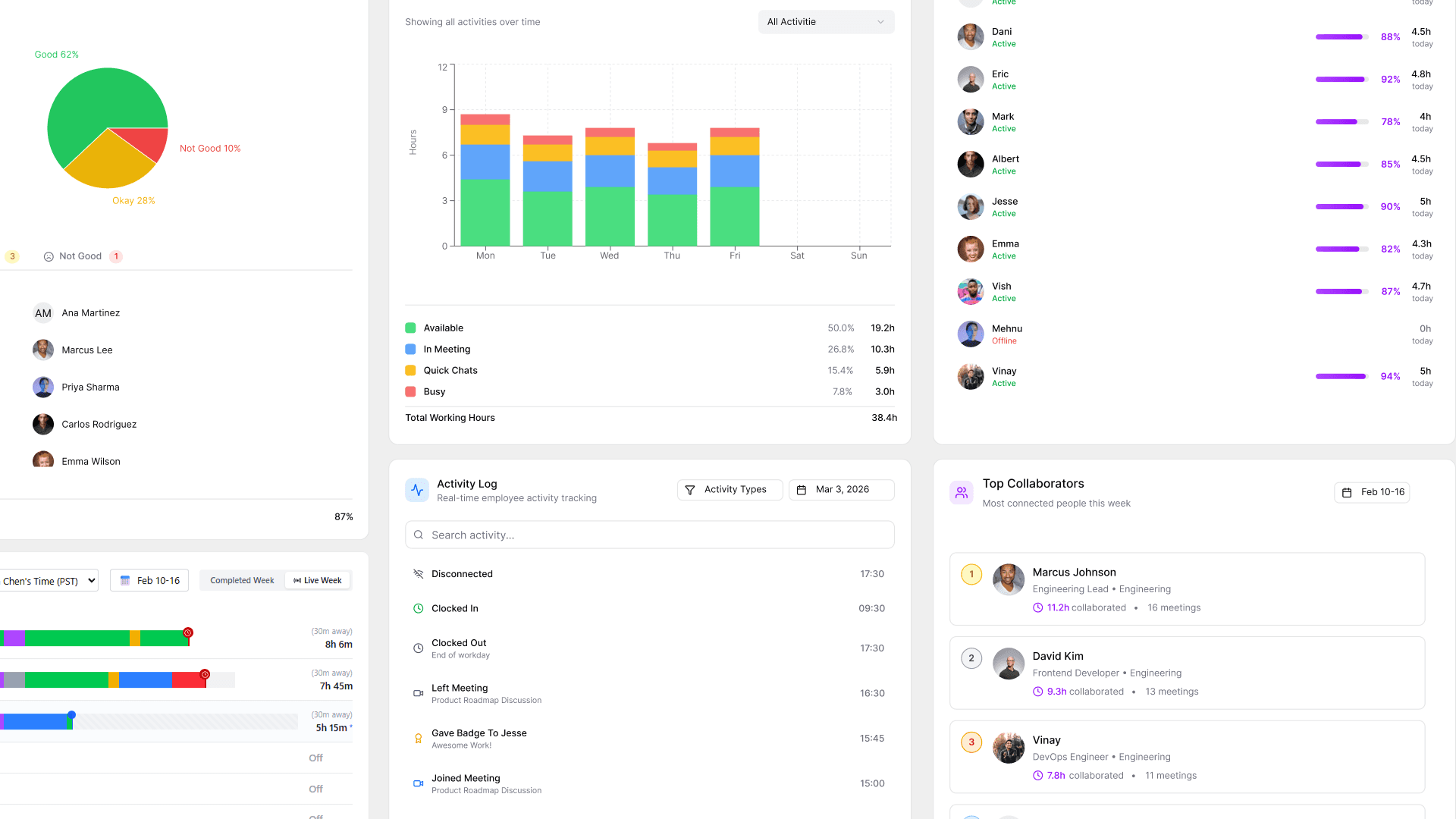
Remote Team Analytics: Complete Guide to Data-Driven Remote Work Management in 2026
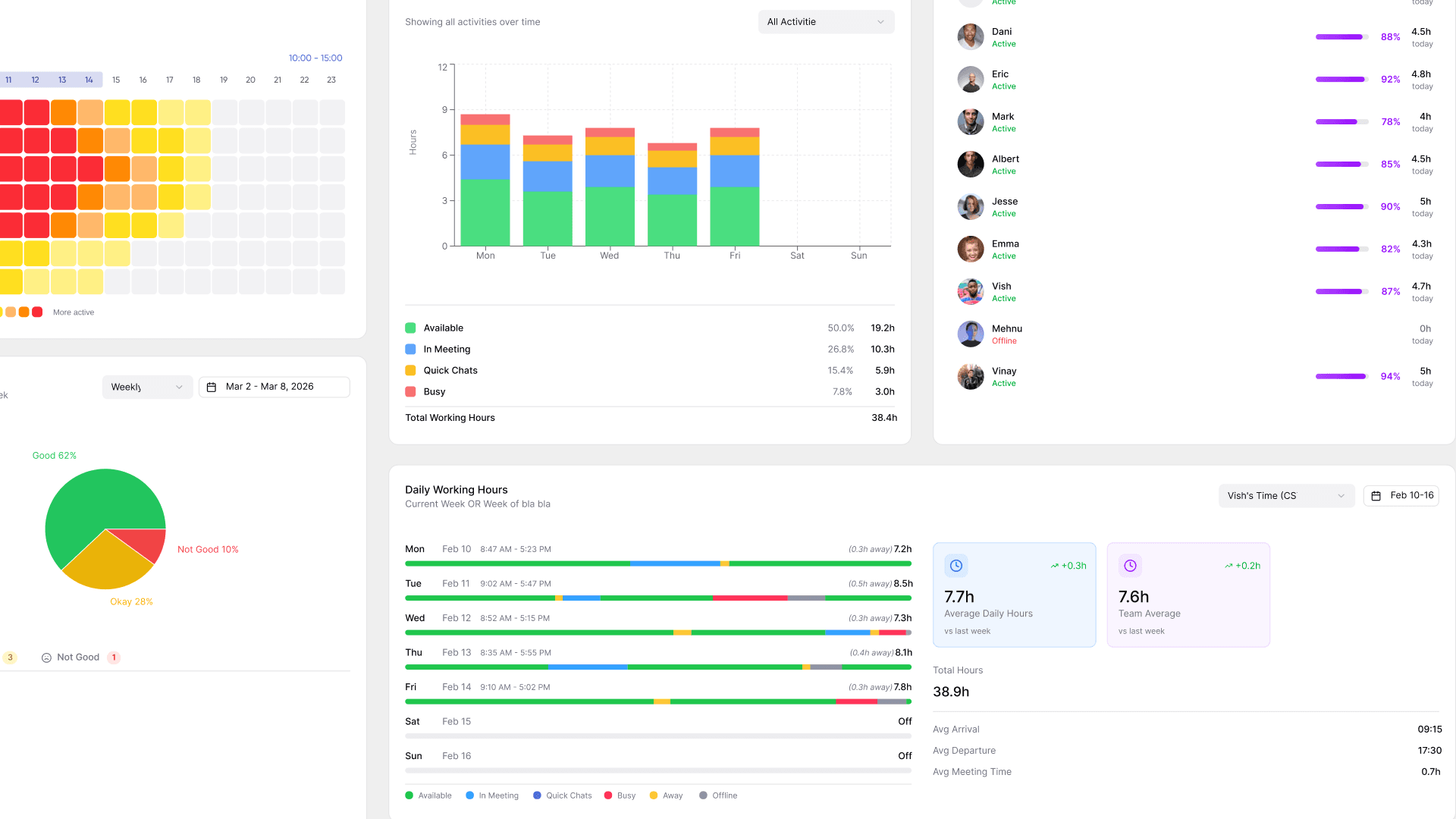
Complete Guide to Gaining Visibility Into Remote Team Performance and Collaboration