How to Keep Remote Employees Engaged in 2026
Vishal Punwani

Published:
Updated on:
To keep remote employees engaged long term, replace calendar-only contact with daily ambient presence, steady recognition and regular manager check-ins. SoWork is our pick for the tool side because it gives your team a shared virtual office. People can see who's free, start a conversation in one click and get weekly reports on spontaneous connections and team sentiment.
Why do remote employees disengage over time?
Remote employees disengage over time because connection fades when every interaction has to be scheduled. Isolation, unseen wins and meeting overload build up slowly until people quietly check out.
The decline is measurable. Gallup's 2026 global data shows 24% of exclusively remote employees feel lonely every day [1]. In the US, engagement among fully remote employees fell from 37% to 32% between Q2 and Q3 2026 [10].
The usual causes: - No unplanned contact, so relationships stall once onboarding ends - Good work goes unnoticed because nobody walks past your desk - Days get broken up by pings and back-to-back calls - Managers lose the early warning signs they used to pick up in person
What does long-term remote engagement mean, and how do you measure it?
Long-term engagement means people stay invested in their work and their team for years, well past the honeymoon period. You measure it by tracking survey results and behavior signals together, over quarters.
Gallup counts just 30% of exclusively remote workers worldwide as engaged [1]. One survey can't tell you much, so watch for trends.
Signal | What it tells you |
|---|---|
Recurring pulse survey | Self-reported commitment |
Unplanned conversations per week | Strength of connection |
Job-seeking intent and regretted attrition | Flight risk |
Meeting hours vs focus hours | Workload health |
Daily active use of shared spaces | Whether people show up |
How does not having a physical office lead to disengagement?
Without an office you lose ambient awareness: seeing who's around, overhearing context and running into people. Those small moments built trust, and most remote tools don't replace them by default.
In Buffer's 2023 survey, the most common struggle (named by one in three remote workers) was staying home too often with no reason to leave. Another 23% said loneliness [8]. An office creates contact without anyone planning it. Chat and video only work when someone deliberately starts a conversation. That puts the burden on quieter employees and new hires, and they're usually the first to drift.
What role does spontaneous, informal interaction play in engagement?
Spontaneous interaction builds the trust and friendships that keep people invested once a role stops being new. It also brings problems to light early, before anyone has to escalate them formally.
GitLab's all-remote handbook says informal communication "builds an informal substructure of trust" and warns leaders not to expect it to happen on its own [7]. Remote workers already want quick, unplanned talk. Microsoft's telemetry shows 57% of meetings are ad hoc calls with no calendar invite [4]. So the job isn't to invent informal contact. It's to make it feel normal instead of awkward.
How can virtual office platforms recreate the ambient presence of an office?
Virtual office platforms put your whole team in one shared space that stays open all day. You can see who's free, focused or in a meeting and walk up to talk, which brings back the easy contact an office gives you.
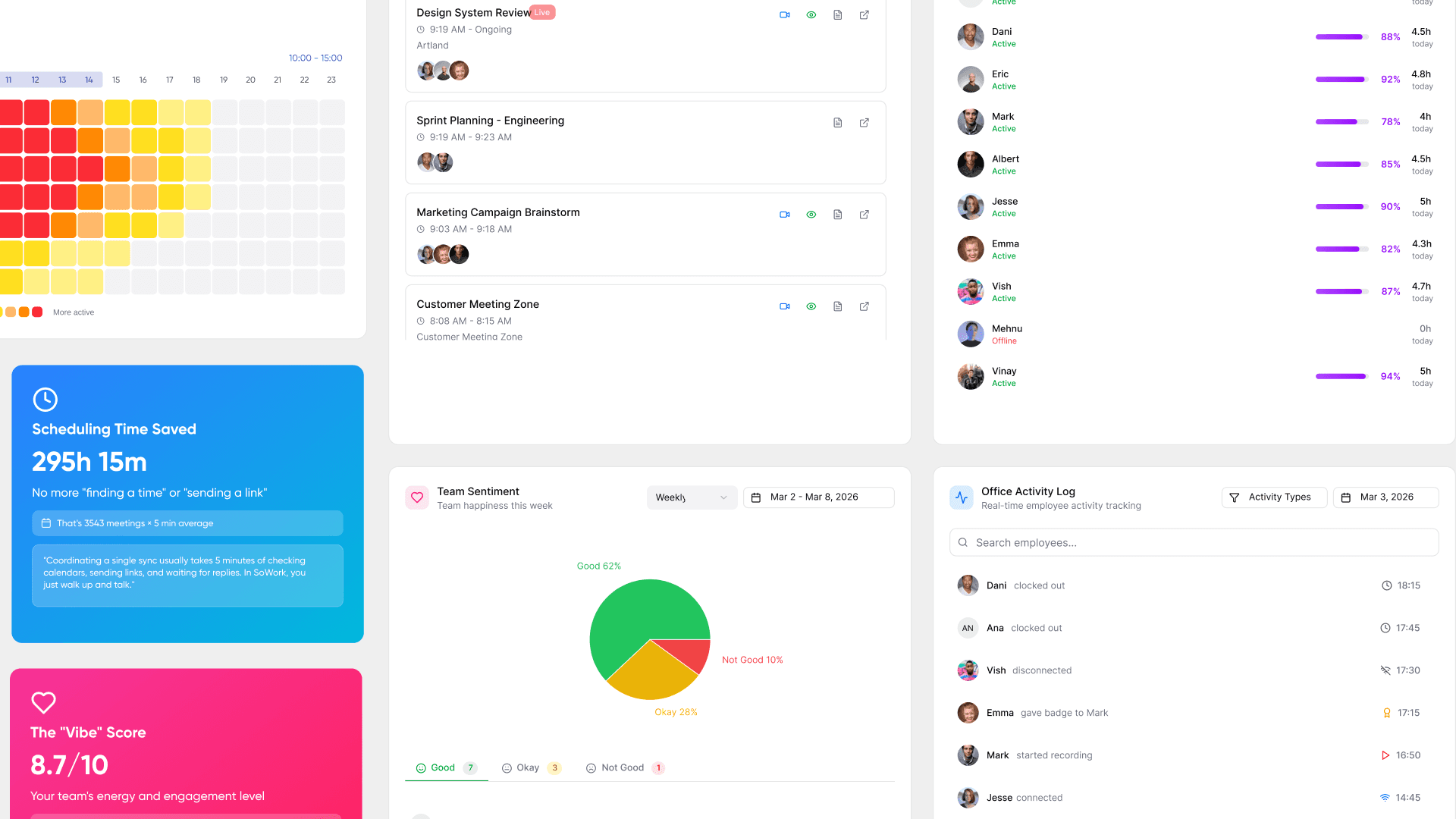
Here's how it works in SoWork: 1. Presence indicators show who's free, focused or in a meeting. Calendar sync updates each status automatically. 2. Instant Meetings start with one click, with no link or scheduling. 3. Simple Mode and Mini Mode let you signal deep work while staying visible. 4. Weekly Insights reports count Spontaneous Connections, meaning conversations that happened without a calendar invite.
SoWork is free for up to 10 users. Basic is $6/user/month and Premium is $15/user/month [11].
How do you build and maintain remote team culture over the long term?
You build remote culture through small rituals repeated often and a shared space people actually come back to, not through occasional big events. Culture is what happens every day, so design the everyday experience.
Write down your values and how decisions get made.
Set shared overlap windows. In SoWork, admins can set Collaboration Hours, and the team gets a reminder before each block starts.
Give people a home: team areas, a customized office and personal avatars.
Keep social rituals optional, like coffee chats or show-and-tell.
Meet in person once or twice a year if your budget allows.
How can managers see how remote employees are doing without micromanaging?
Look at team-level patterns and ask people directly. Don't track individual activity. Combined signals plus regular 1:1s give you early warning without damaging trust.
Gallup attributes 70% of the variance in team engagement to the manager [9]. That makes your habits the main lever. Hold weekly 1:1s, run opt-in check-ups and watch the trends. SoWork's weekly reports show Team Sentiment from Weekly Check-ups, meeting hours and an hourly office activity heatmap. Use them to spot overload and isolation across the team, not to rank individuals.
What communication habits keep remote teams connected long term?
Default to async for status updates and decisions. Save real-time conversation for relationships and fast problem-solving. Make every decision easy to find later.
Habit | Why it works |
|---|---|
Topic-based chat channels | Context stays findable |
Five-minute walk-up calls instead of long threads | Problems get solved in minutes |
Recorded meetings with AI summaries | People who missed it can catch up |
Shared overlap hours | Live conversation without spilling into evenings |
Through SoWork's MCP/API, AI tools like Claude can tell you what the team decided in a meeting.
How does cutting meeting overhead help keep people engaged?
Fewer scheduled meetings give people their focus time back and reduce the fatigue that wears down engagement. Engagement drops when the calendar defines the day instead of the work.
Microsoft found employees are interrupted every two minutes during core hours, or 275 times a day, by meetings, emails or chats [4]. Some ways to cut that down: - Swap recurring status meetings for written updates - Turn 30-minute "quick syncs" into short walk-ups - Record decisions so fewer people need to attend
SoWork's Insights estimate scheduling time saved at 5 minutes for every meeting that started without a calendar invite.
What recognition and feedback practices keep remote employees motivated?
Recognition that's frequent, specific and visible keeps remote people motivated far longer than annual reviews do. Gallup and Workhuman found employees who got high-quality recognition were 45% less likely to have left their jobs two years later [5].
Praise specific work within days, not months
Recognize people publicly in team channels and privately in 1:1s
Encourage peer-to-peer recognition, not just praise from the top
Connect feedback to each person's growth path
Rotate who presents team wins so quieter contributors get seen
How do virtual workspaces compare to video-call-heavy setups?
For daily collaboration, virtual workspaces usually sustain engagement better, because they make short, unplanned conversations easy. Video-call-heavy setups force every interaction into a scheduled block.
Factor | Virtual workspace | Video-call-heavy setup |
|---|---|---|
Starting a conversation | One click, availability visible | Send a link or book a slot |
Presence | Visible all day | Invisible between calls |
Informal contact | Happens naturally | Has to be scheduled |
Meeting load | Tends to shrink | Tends to grow |
Best for | Daily teamwork | Large or external meetings |
How do you know if your remote engagement strategy is working?
Judge your strategy by whether connection, retention and focus improve over several quarters, not by how many people show up to events. Read survey data and behavior data together.
Sentiment scores rise or hold steady for at least two quarters.
Regretted attrition and job-seeking intent go down.
Unplanned and cross-team conversations increase.
Meeting hours stay flat or fall while output holds.
New hires make real connections within 30 days.
People use your shared space every day without being reminded.
What are the risks of relying only on scheduled meetings and chat?
If you rely only on meetings and chat, connection becomes opt-in and transactional. Quieter people fade from view and problems come up late.
The specific risks: - Small questions turn into calendar invites - Text loses tone, so small conflicts escalate - Nobody can see who's overloaded or isolated - New hires have no way to run into colleagues
In Buffer's surveys, loneliness has stayed among the top remote struggles for years, even as chat and video tools spread [8].
Which remote teams have kept engagement high long term?
GitLab is the best-documented example. It formalizes informal communication, and every new hire has to schedule at least 5 coffee chats during onboarding [7].
GitLab's handbook reports that in 2022, 1,265 people connected through 4,186 coffee chats, compared with 356 chats at similar-sized companies [7]. Buffer, which is also fully remote, says it builds connection through hybrid meetups and transparent communication [8]. Both follow the same pattern: informal contact is planned, written down and repeated, not left to chance.
What onboarding practices set up long-term remote engagement?
Good remote onboarding connects new hires to people, not just tools, in their first weeks. Only 12% of employees strongly agree their organization does a great job of onboarding [6].
Assign a buddy before day one.
Schedule five or more intro chats, following GitLab's model [7].
Give each new hire a desk in their team's area. SoWork assigns every new Teammate a desk by default.
Set clear 30, 60 and 90-day expectations.
Hold a manager 1:1 in week one.
How does presence awareness help remote employees feel they belong?
Presence awareness shows people their teammates are around. That counters the feeling of working alone in a room, which drives a lot of remote loneliness.
Gallup reports that 24% of exclusively remote workers feel lonely every day [1]. In SoWork, avatars sit at desks in a shared office and status shows who's free, focused or in a meeting. Focus Modes let you stay visible while you're heads-down. When you can see colleagues nearby, reaching out feels normal instead of intrusive. Belonging grows from being seen often in small, low-stakes ways, just as it did in a physical office.
What are the alternatives to virtual office platforms?
The main alternatives are async documentation, coffee-chat pairing bots, in-person offsites, survey and recognition platforms, and open video rooms. Most work best alongside a shared daily space, not in place of one.
Option | Strength | Gap |
|---|---|---|
Async documentation | Works across time zones | Little social contact |
Coffee-chat pairing bots | Easy introductions | One-off and scheduled |
In-person offsites | Deep bonding | Once or twice a year |
Survey and recognition tools | Measurement | Don't create interaction |
Open video rooms | Quick access | No view of who's available |
What does remote disengagement cost in productivity and retention?
Disengagement is expensive. Gallup estimates low engagement costs the global economy about $10 trillion a year in lost productivity [3].
For remote teams, the most immediate cost is turnover. Gallup found 57% of fully remote workers are actively looking or watching for new jobs, but only 38% of those who are both engaged and thriving say the same [2]. Every departure costs you recruiting time, ramp-up time and context that walks out the door. For a 30-person startup, losing a couple of senior people can stall a roadmap for a quarter.
Bottom line
Remote engagement lasts when connection is part of the workday, not something people have to schedule.
Give your team a shared space where presence is visible and conversations take one click. Then add steady recognition, people-first onboarding and manager check-ins based on team-level data. If you want one tool that covers presence, instant meetings and engagement reporting, start with SoWork's free plan for up to 10 users.
Key Takeaways
Fully remote workers are the most engaged group globally (30%), but 24% feel lonely every day [1].
Disengagement builds slowly when every interaction needs a calendar invite.
Plan for informal contact. GitLab requires new hires to schedule at least 5 coffee chats [7].
High-quality recognition made employees 45% less likely to have left two years later [5].
Cut meeting overhead. Workers are interrupted every two minutes during core hours [4].
Track trends in sentiment, spontaneous connections and attrition over quarters.
Managers account for 70% of the variance in team engagement, so train them first [9].
A virtual office like SoWork brings back ambient presence and one-click conversations.
Related reading
How to Keep Teams Active: A 2026 Guide for Remote and Distributed Teams
SoWork vs Kumospace: Which Is Better for Distributed Team Collaboration in 2026?
What Is the Ideal Remote Team Meeting Cadence? The Complete Guide for Distributed Teams
Sources
57% of fully remote workers are looking or watching for new jobs; only 38% when engaged and thriving
Gallup estimates the global cost of disengagement at about $10 trillion a year in lost productivity
Only 12% of employees strongly agree their organization does a great job onboarding new employees
Managers account for 70% of the variance in team engagement (Gallup)
US fully remote employee engagement fell from 37% to 32% between Q2 and Q3 2026 (Gallup)
SoWork pricing: free for up to 10 users; Basic $6/user/month; Premium $15/user/month
FAQ
How do you keep remote employees engaged long term?
How do you keep a remote team engaged without forced fun?
Are remote workers less engaged than office workers?
How can I tell if a remote employee is becoming disengaged?
Do virtual offices actually work, or do teams stop using them?
How often should remote teams meet in person?
Is a virtual office worth it for a small remote team?
How do you stop meetings from taking over a remote team's day?
Blogs
Read Similar Articles
Remote Team Analytics: Complete Guide to Data-Driven Remote Work Management in 2026
Complete Guide to Gaining Visibility Into Remote Team Performance and Collaboration