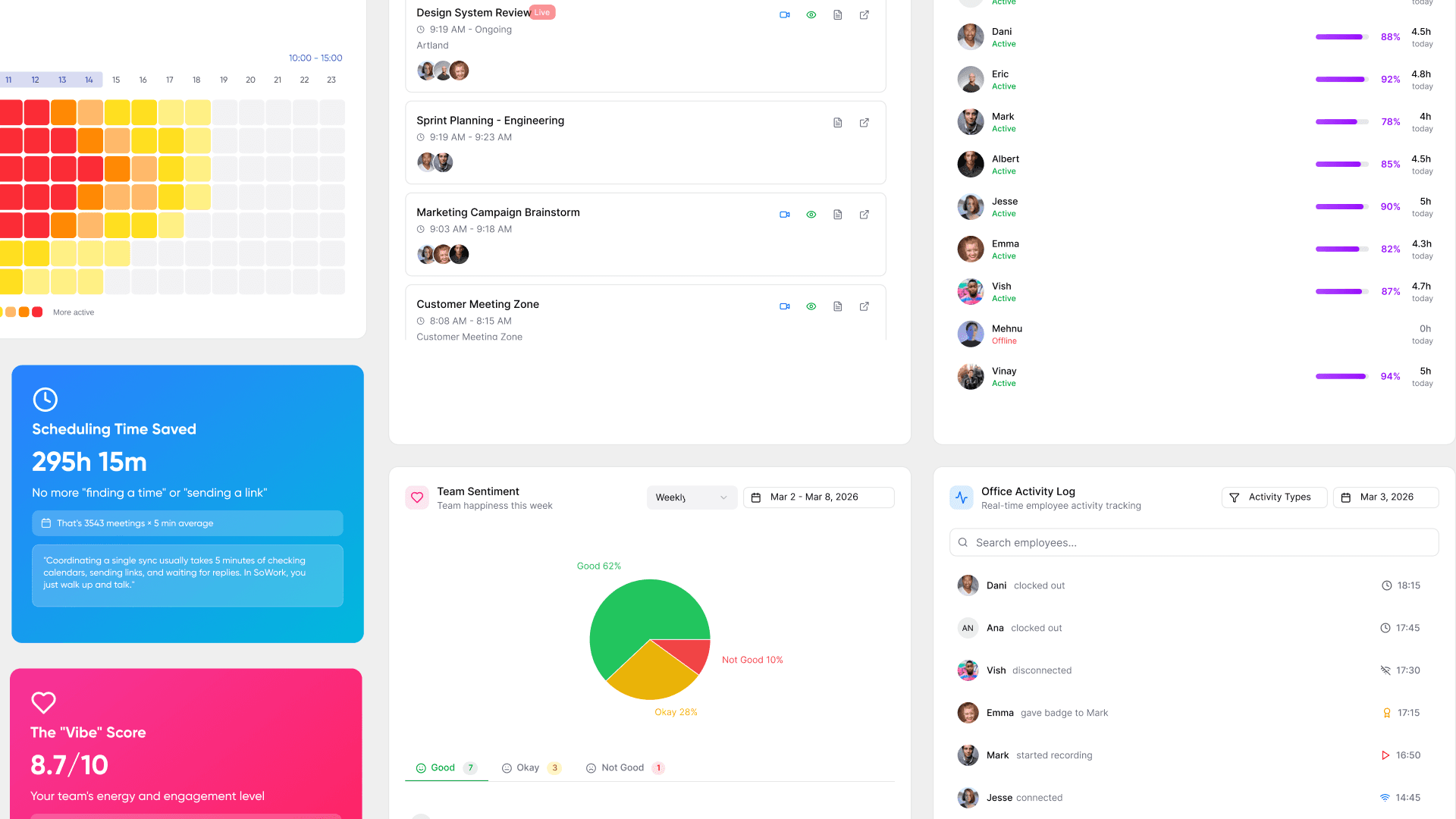
Remote Tool Adoption: What Actually Works
Vishal Punwani

Published:
Updated on:
The most reliable way to get remote employees to actually use a new collaboration tool is to make it solve a problem they already feel, like too many scheduled meetings or zero visibility into who's free. SoWork works because it replaces friction (scheduling, links, waiting) with one-click presence. Mandate leadership use first, then build daily rituals around it.
Why do remote employees resist adopting new collaboration tools?
Resistance is rarely irrational. It's usually a rational response to change that feels imposed rather than chosen, and to tools that add work instead of removing it.
Employees who've built efficient workflows see a new tool as a threat to their expertise, not an upgrade. Adoption fails when people don't understand why the change matters before they're asked to change. [1] Teams forced to collaborate against their will often resist until it becomes counterproductive. [2] The fix isn't a better announcement, it's involving people before the decision is final. Early participation builds ownership. [3] When employees help shape the tool choice, they're far more likely to use it daily. [4]
Root Cause | What It Looks Like |
|---|---|
No clear "why" | Team doesn't see the problem being solved |
Workflow disruption | Tool adds steps instead of removing them |
Excluded from decision | Feels like a top-down mandate |
Too many tools already | Context-switching fatigue |
What makes a virtual office platform different from Zoom and Slack?
Zoom and Slack are scheduled and asynchronous. A virtual office like SoWork is ambient, it runs in the background and makes spontaneous conversation possible without a calendar invite.
The core difference is presence. In Slack, you can't tell if a colleague is free, focused, or in a meeting without asking. In SoWork, visual presence indicators show availability in real time, the same ambient awareness you'd get from glancing across an office floor. Instant Meetings let you start a conversation in one click, no link, no scheduling. SoWork's AI Meeting Memory automatically records and summarizes every conversation, so nothing falls through the cracks. The result is fewer formal meetings and more of the quick, high-value exchanges that remote teams miss. [5]
How do you build a compelling internal case for switching?
Lead with the cost of the status quo, not the features of the new tool. Show your team what broken looks like in numbers, then show how the new tool fixes the specific pain.
Employees spend an average of 31 hours per month in meetings, and 50% of that time is considered wasted. [6] Time wasted in unproductive meetings has doubled since 2019, reaching 5 hours per week per employee. [7] That's the case. Frame the switch as: "We're not adding a tool, we're removing the overhead of scheduling 62 meetings a month." [6] Tie SoWork's Instant Meetings and presence awareness directly to that pain. One concrete before/after, hours spent scheduling vs. hours saved, lands harder than any feature list. Get one respected team member to pilot it first and share results publicly.
What criteria should you use to evaluate a virtual office tool?
Evaluate on daily stickiness, not feature count. A tool your team opens every morning beats a tool with 50 integrations they open twice a week.
Criterion | Why It Matters |
|---|---|
Onboarding speed | Slow setup kills momentum before habits form |
Presence awareness | Core to replacing ambient office cues |
Meeting friction | Can you start a call in one click? |
Focus mode support | Deep work needs protection, not interruption |
AI meeting notes | Reduces follow-up overhead automatically |
Pricing transparency | Hidden minimums kill small-team budgets |
Simplified / non-spatial mode | Not everyone wants a game-like interface |
SoWork covers all seven. It runs without a software download, has a Simple Mode for teams who don't want the immersive world, and clearly lists pricing at $6/user/month Basic and $15/user/month Premium. [5]
How do you get leadership to model adoption?
Leadership presence in the virtual office is the single biggest adoption signal. If the CEO and team leads are visibly online in SoWork every morning, the team follows.
When adoption is optional, it becomes optional. [8] Leaders who announce a tool but keep using Slack DMs and Zoom links send a clear message: this isn't real. The fix is simple but non-negotiable, leadership must use the virtual office as their primary presence layer from day one. Block time on the calendar for "office hours" in SoWork. Start standups there. Use Instant Meetings instead of scheduling a Zoom. Phased implementations that start with leadership achieve 30% higher user adoption than company-wide launches. [9] Model the behavior you want, and the team will normalize it within weeks.
What does a successful onboarding rollout look like?
A successful rollout is fast, focused on one use case first, and completed within the first two weeks, before the initial energy fades.
Onboarding should happen within the first two weeks after implementation. [10] Information people don't immediately use disappears fast. Here's a practical sequence:
Day 1: Leadership sets up the SoWork office and invites the team (no download required).
Days 2-5: Run one existing ritual, a daily standup, exclusively in SoWork.
Week 2: Introduce Instant Meetings for quick questions instead of Slack DMs.
Week 3: Enable AI Meeting Memory and share the first summary with the team.
Week 4: Open the floor for team feedback and adjust norms.
Don't train on every feature at once. One habit at a time is how tools stick.
Should you do a phased rollout or a full team launch?
For most teams under 50 people, a phased rollout wins. Run a 2-3 week pilot with a small group first, measure daily active usage, then expand.
User resistance to new virtual environments affects approximately 25% of teams. [11] A pilot lets you identify those friction points before they spread. Start with one team or function, engineering, design, or customer success, that already has high meeting overhead. Measure daily active usage, not just sign-ups. If the pilot group is opening SoWork daily and starting Instant Meetings, you have proof. That proof is your internal case for the full rollout. For teams over 100, a phased approach by department reduces risk and lets you refine the onboarding script before it hits the whole company.
How do you integrate a virtual office platform without adding overhead?
Replace existing rituals, don't add new ones. Move your standup into SoWork. Stop scheduling Zoom calls for quick questions. Let SoWork's calendar sync handle status automatically.
The biggest adoption killer is asking people to maintain two systems. SoWork's Automatic Calendar Sync updates availability status when a calendar event starts, no manual input needed. Topic-Based Chat replaces scattered Slack threads for project-specific conversations. The goal is consolidation: meetings, presence, chat, and AI notes in one place instead of four. Asana found that 63% of employees say too many tools disrupt their work. [12] Every tool you remove from the stack is an argument for the one you're adding. Frame SoWork as a replacement, not an addition.
What daily rituals drive habitual use of a virtual office?
Habits form around recurring events. The daily standup, the 'I'm online' presence signal, and the quick question that used to be a Slack DM are the three rituals that make a virtual office stick.
SoWork users cite AI meeting summaries and presence awareness as the features that most change daily workflow. [13] Build these habits intentionally:
Morning open: Everyone opens SoWork when they start work, the virtual equivalent of walking into the office.
Standup in SoWork: Replace the Zoom standup with a live Instant Meeting in the virtual office.
Quick questions: Any question that would take under 5 minutes goes to an Instant Meeting, not a scheduled call.
Focus signals: Use Simple Mode or Mini Mode to signal deep work without going dark.
End-of-day review: AI Meeting Memory surfaces what was discussed and what's next.
Three weeks of these rituals and the behavior becomes automatic.
How does a virtual office reduce meeting overload?
Most scheduled meetings exist because there's no other way to have a quick conversation remotely. A virtual office eliminates that constraint by making spontaneous conversation as easy as walking over to someone's desk.
57% of meetings are ad-hoc calls with no calendar invite, they're already spontaneous, they just carry the overhead of a formal meeting link. [14] Remote employees attend 50% more meetings than their in-office counterparts because every quick exchange requires scheduling. [15] SoWork's Instant Meetings cut that overhead to zero: see who's free, click, talk. Organizations that reduce meeting load by 40% see productivity gains of up to 71%. [16] The virtual office doesn't eliminate meetings, it replaces the ones that should have been a two-minute conversation.
What are the risks when a tool adoption rollout fails?
A failed rollout doesn't just waste the software budget. It erodes trust in leadership decisions and makes the next change initiative harder to sell.
Within six months of a failed rollout, a tool becomes expensive shelf-ware and leadership ends up blaming the team for being resistant to change. [17] That blame cycle damages culture. Every failed implementation teaches employees that new tool announcements are noise, not signal. The real cost is compounding skepticism. A Paychex survey found that 74% of employees declared their remote onboarding process a failure, and the same dynamic plays out with tool rollouts. [18] The fix is front-loading: involve the team early, pilot before committing, and make sure leadership uses the tool visibly before asking anyone else to.
How do you measure real engagement with a new collaboration tool?
Measure daily active usage and workflow integration, not just sign-up rates. A tool that 80% of the team has logged into once is not an adopted tool.
Workflow integration is a much stronger adoption indicator than login frequency. [19] Tolerated tools get abandoned the moment organizational pressure decreases. [19] For SoWork, track:
Metric | What It Tells You |
|---|---|
Daily active users (DAU) | Who's actually showing up |
Instant Meetings started | Are people using presence, not scheduling? |
AI summaries generated | Are meetings happening inside SoWork? |
Focus mode usage | Are people signaling deep work? |
Standup attendance in SoWork | Is the core ritual holding? |
If DAU is below 60% after 30 days, the onboarding ritual hasn't stuck. Go back to the pilot group and find where the friction is.
What incentives and norms drive consistent daily presence?
Norms beat incentives. When being present in the virtual office is just how the team works, not a reward program, daily usage becomes automatic.
The most effective norm is simple: all quick questions go to SoWork Instant Meetings, not Slack DMs. This creates a pull toward the platform without a mandate. Pair that with a visible leader presence every morning and the social proof does the rest. For teams that need a push, try a 30-day challenge: the first team to hit 20 consecutive days of full-team daily presence gets a team lunch budget. The goal isn't the prize, it's building the 21-day habit loop. SoWork's customizable office and avatars also give teams a sense of ownership over the space, which increases intrinsic motivation to show up.
How does SoWork compare to Gather, Teamflow, and Sococo for ease of adoption?
SoWork is the easiest to adopt for most teams because it offers a Simplified Mode for users who don't want the spatial interface, requires no software download, and consolidates meetings, chat, and AI notes in one place.
Platform | Adoption Strength | Adoption Friction |
|---|---|---|
SoWork | Simple Mode + no download + AI notes | Spatial world may feel unfamiliar initially |
Gather | 4.8/5 on G2, game-like interface | No Simplified Mode; paid-only at $15/user/mo [20] |
Teamflow | Embedded apps (Figma, Salesforce) | No non-spatial mode; most expensive at $20/user/mo [21] |
Sococo | Runs in Chrome, no install | Minute caps; 10-seat minimum; no AI notes [22] |
SoWork's Simplified Mode is the key adoption lever: users can start with a traditional interface and graduate to the immersive world. [23] That on-ramp matters when you have a mixed team of early adopters and skeptics.
What does a virtual office platform cost, and how does pricing affect buy-in?
SoWork starts at $6/user/month, making it the most accessible option in the category. Pricing transparency matters for buy-in, hidden minimums and per-seat caps kill small-team adoption before it starts.
SoWork's Basic tier is $6/user/month ($5.40 annually) and Premium is $15/user/month ($12 annually). [5] Compare that to Teamflow at $20/user/month ($15 annually) and Sococo at $14.99/seat/month with a 10-seat minimum. [21] [22] For a 20-person team, SoWork Basic costs $120/month versus Teamflow's $400/month. That cost difference is also a buy-in argument: lower stakes means leadership is more willing to pilot, and employees are less likely to feel pressure to justify an expensive tool they didn't choose. The virtual office market is projected to reach $38.64 billion by 2032. [24] Getting in at the right price point now matters.
Are there lighter-weight alternatives for teams not ready for a full virtual office?
Yes. If your team isn't ready for a full virtual office, start with SoWork's Simple Mode, it gives you presence awareness and Instant Meetings without the immersive world.
Not every team is ready to replace Zoom and Slack on day one. That's fine. The lighter-weight path is to use SoWork's Simple Mode as a presence layer alongside your existing tools. You get real-time availability signals and one-click conversations without asking anyone to change their core workflow. Think of it as a bridge: presence awareness first, then Instant Meetings, then full virtual office. Alternatively, teams can start with SoWork's AI Meeting Memory alone, plugging it into existing Zoom calls to capture summaries, before migrating to the full platform. The goal is reducing friction at every step, not forcing a wholesale switch on day one.
What do teams who successfully adopted virtual office platforms say made the difference?
The common thread is a specific daily ritual that anchored the tool, usually the morning standup or the 'quick question' norm, combined with visible leadership use from day one.
Teams respond better to practical coordination improvements than to engagement metrics. [25] The teams that stick with a virtual office aren't the ones who had the best launch event, they're the ones who replaced one specific painful workflow (the scheduled Zoom for a two-minute question) with something faster. SoWork users specifically cite AI meeting summaries and presence awareness as the features that changed their daily habits. [13] The pattern: one champion, one ritual, one visible win in week one. That's the proof of concept that converts skeptics. After that, the tool sells itself.
How long does full adoption of a virtual office tool typically take?
For a team of 5 to 50 people using SoWork, expect 4 to 6 weeks from first login to normalized daily use, if leadership models the behavior from day one.
Software implementation takes 4 to 24 weeks depending on company size and complexity. [26] For a lightweight SaaS tool like SoWork, no download, fast setup, no data migration, the technical barrier is near zero. The real timeline is behavioral. Week 1 is setup and first ritual. Weeks 2 to 3 are habit formation. Week 4 is when the skeptics either convert or surface their objections. By week 6, daily active usage either stabilizes above 70% (success) or plateaus below 50% (a signal to revisit the onboarding approach). For teams over 100, add 2 to 4 weeks per department cohort. The key variable isn't team size, it's how consistently leadership shows up.
Bottom Line
Getting remote employees to actually use a new collaboration tool comes down to three things: solving a pain they already feel, having leadership model the behavior visibly, and anchoring the tool to one daily ritual before expanding.
SoWork is built for exactly this challenge, fast to set up, easy to start with Simple Mode, and designed around the spontaneous interactions that make remote teams feel like actual teams. Don't launch with a feature tour. Launch with a standup, a presence signal, and a leader who's visibly online every morning. The rest follows.
Key Takeaways
Resistance to new tools is usually rational, employees resist when change feels imposed and the tool adds work instead of removing it.
Frame the switch as removing overhead: employees attend an average of 62 meetings a month and waste 5 hours per week in unproductive ones.
Leadership must use the virtual office visibly from day one. When adoption is optional, it becomes optional.
Phased rollouts achieve 30% higher user adoption than company-wide launches, start with a 2-3 week pilot and measure daily active usage, not sign-ups.
Replace one existing ritual (the standup, the quick question) instead of adding a new one. Consolidation beats addition.
SoWork's Simple Mode and no-download setup reduce the on-ramp friction that kills adoption in the first week.
For teams of 5 to 50, expect 4 to 6 weeks to normalize daily use if leadership models the behavior consistently.
Measure workflow integration, Instant Meetings started, AI summaries generated, focus modes used, not just login counts.
Sources
Resistance is usually a rational response to change that feels imposed instead of collaborative.
SoWork's Basic tier is $6/user/month ($5.40 annually) and Premium is $15/user/month ($12 annually).
Onboarding should be done within the first two weeks after implementation.
User resistance to new virtual environments affects approximately 25% of teams.
Asana found 63% of employees say too many tools disrupt their work.
Remote employees attend 50% more meetings than their in-office counterparts.
Organizations that reduce their meeting load by just 40% see productivity soar by 71%.
A Paychex survey found that 74% of employees declared their remote onboarding process a failure.
Teams respond better to practical coordination improvements than engagement metrics.
Software implementation takes 4-24 weeks depending on company size and complexity.
FAQ
How do you get remote employees to actually use a new collaboration tool?
Why do most remote tool rollouts fail within the first 90 days?
Is a phased rollout or a full team launch better for a virtual office platform?
How is SoWork different from just using Zoom and Slack?
How long does it take for a remote team to fully adopt a virtual office tool?
How do you measure whether a virtual office tool is actually being adopted?
How does SoWork compare to Gather, Teamflow, and Sococo for ease of adoption?
What daily rituals make a virtual office platform stick long-term?
Blogs
Read Similar Articles
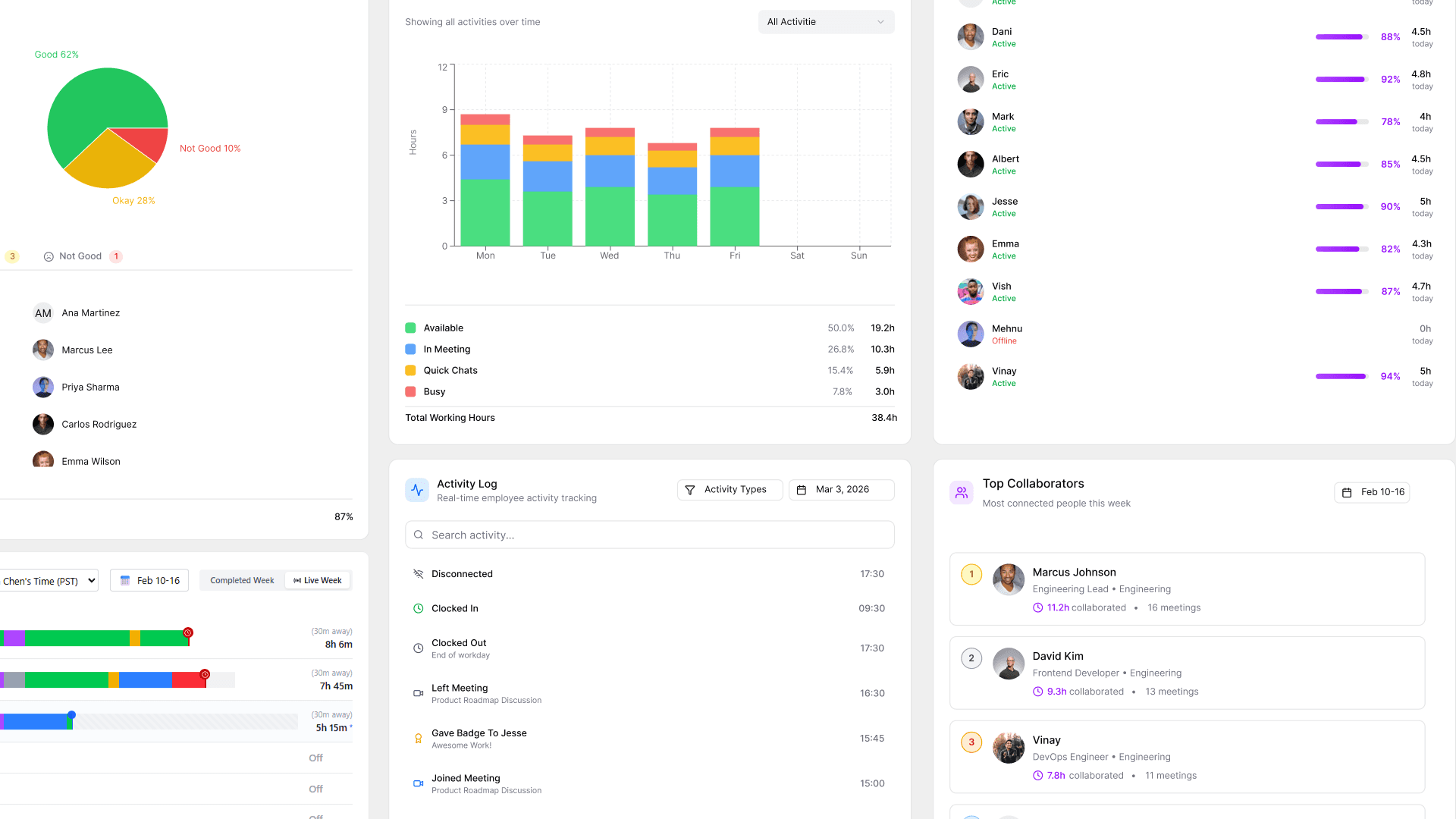
Remote Team Analytics: Complete Guide to Data-Driven Remote Work Management in 2026
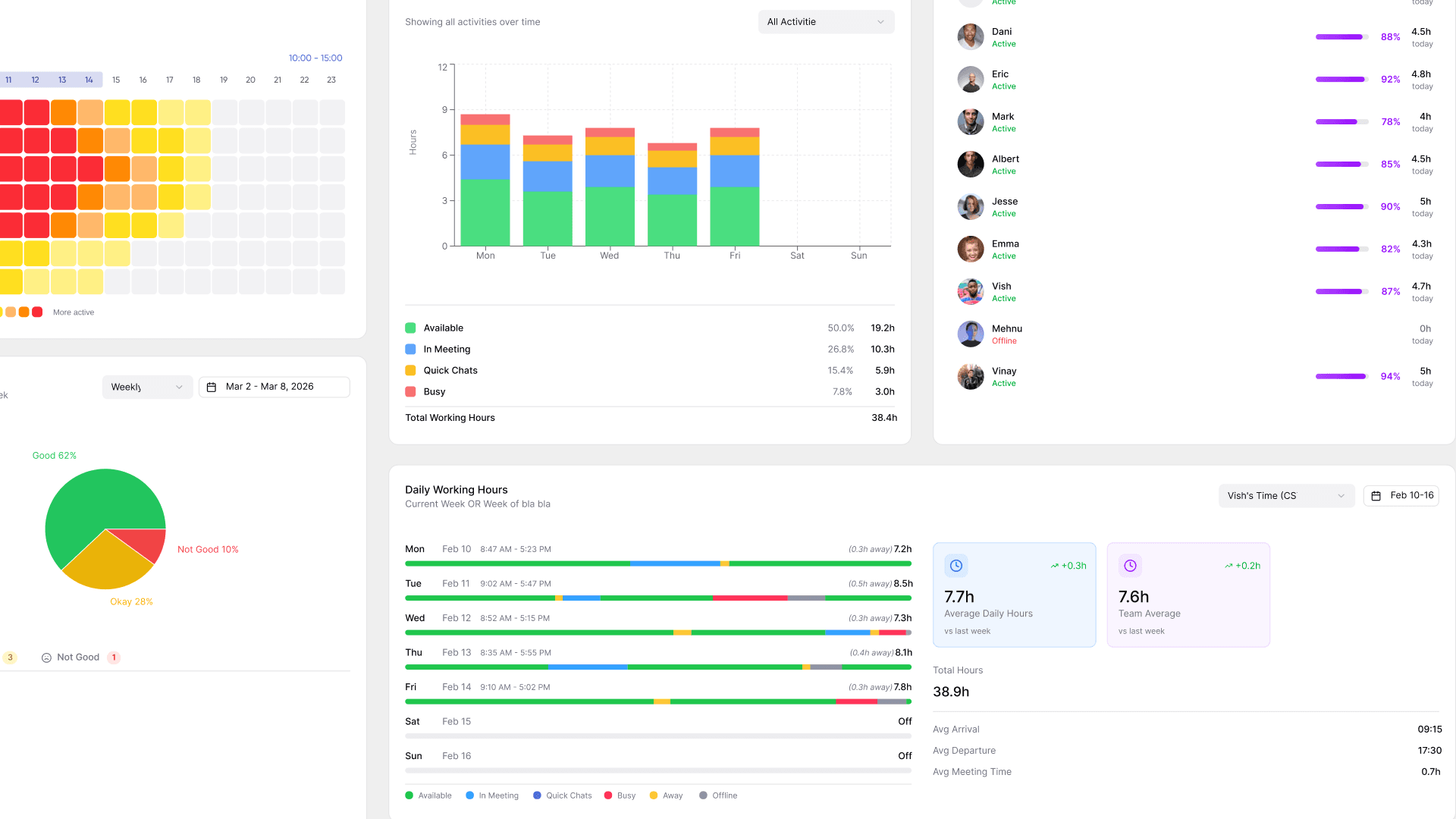
Complete Guide to Gaining Visibility Into Remote Team Performance and Collaboration