Spot vs SoWork vs Remo: Qual o melhor para a cultura da empresa?
Vishal Punwani

Publicado em:
Atualizado em:
O SoWork é o melhor escritório virtual para a construção diária da cultura remota porque combina percepção de presença persistente, reuniões espontâneas com um clique, memória de reuniões por IA e um escritório 2.5D personalizável em uma única plataforma. O Spot se destaca na personalização profunda do espaço e na programabilidade de APIs. O Remo vence para eventos virtuais estruturados, mas não foi projetado para o uso diário em ambiente de escritório.
O que é uma plataforma de escritório virtual e como ela apoia a construção da cultura remota?
Uma plataforma de escritório virtual é um espaço de trabalho digital persistente onde colegas de equipe remotos se veem, movem-se entre espaços e colaboram sem agendar uma chamada. Ela substitui o ambiente social de um escritório físico que o Slack e o Zoom simplesmente não conseguem replicar.
Trabalhadores remotos em empregos que permitem o trabalho remoto registraram um aumento de 58% nas horas passadas sozinhos após a pandemia, de acordo com um estudo de 588.322 americanos publicado na Science em junho de 2026 [1]. Esse isolamento se transforma em desengajamento e rotatividade de funcionários. As plataformas de escritório virtual resolvem isso tornando a presença visível e a comunicação instantânea: você vê quem está livre, caminha até lá e conversa, assim como em um escritório real. A cultura não é construída em reuniões gerais (all-hands); ela é construída nos pequenos momentos não agendados entre elas.
Quais são os principais recursos do SoWork para equipes remotas?
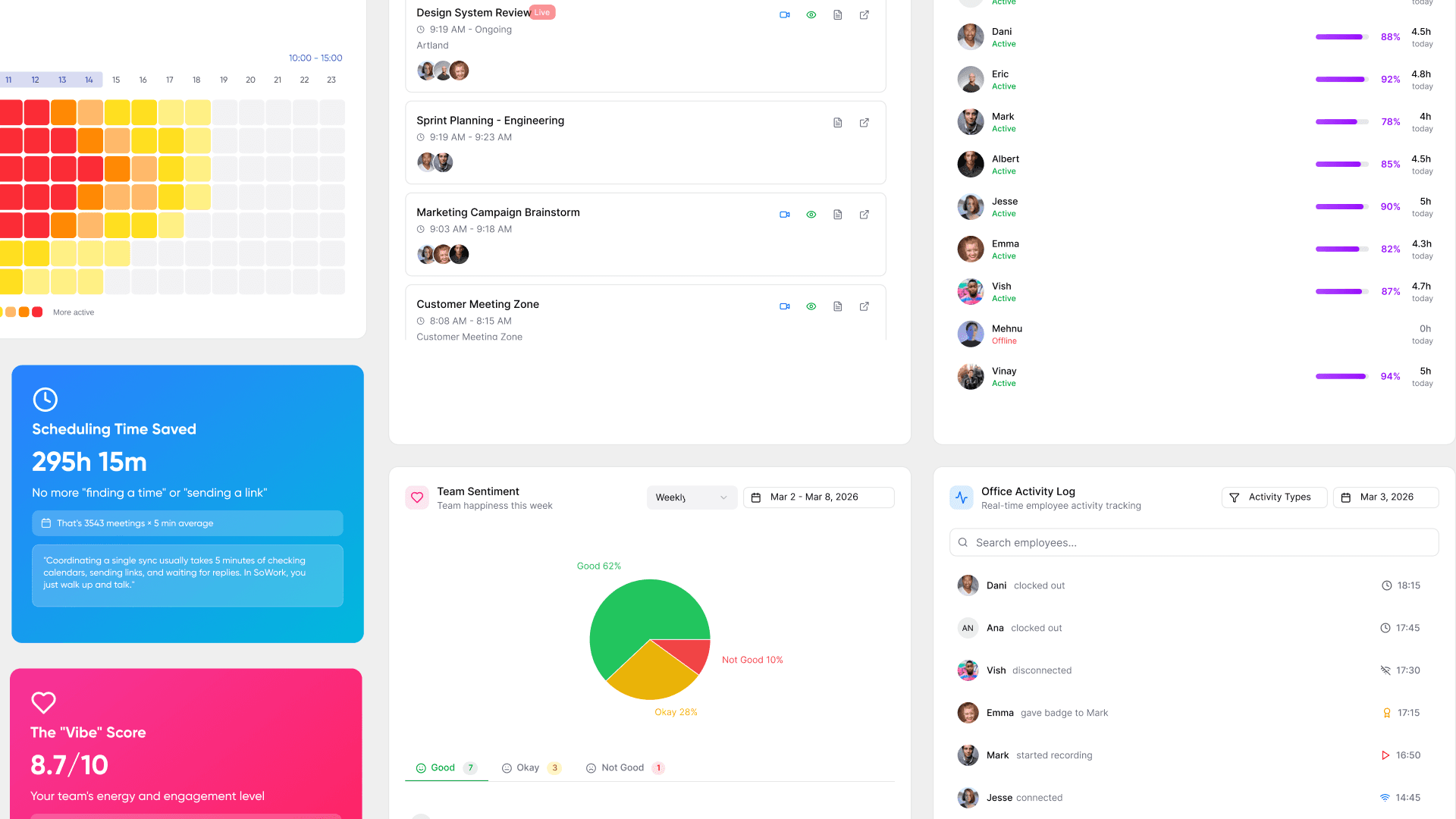
O SoWork é um escritório virtual baseado em IA construído em torno da percepção de presença, reuniões instantâneas com um clique e memória automática de reuniões, tudo dentro de um ambiente de escritório 2.5D personalizável.
Os principais recursos incluem: indicadores de presença em tempo real mostrando quem está livre, focado ou em uma reunião; Reuniões Instantâneas que começam em um clique sem links ou agendamento; Memória de Reunião por IA que grava, transcreve e resume cada conversa automaticamente; Modos de Foco (Modo Simples e Mini Modo) para sinalizar trabalho profundo; sincronização automática de calendário que atualiza a disponibilidade sem entrada manual; canais de bate-papo baseados em tópicos; compartilhamento de tela e vídeo integrados; e um mapa de escritório e avatares personalizáveis. O plano gratuito do SoWork suporta até 10 usuários, com planos pagos a partir de US$ 6/usuário/mês [2].
Quais são os principais recursos do Spot como plataforma de escritório virtual?
O Spot é um escritório virtual focado na web que recria a experiência do escritório físico por meio de personalização profunda do espaço, personalização de avatares e conversas baseadas em proximidade.
Criado pelos cofundadores técnicos do Outreach.io, o Spot permite que as equipes personalizem seu escritório desde a planta baixa até o design de interiores, e criem avatares que vão além de uma foto de perfil [3]. Os colegas de equipe caminham até as mesas uns dos outros para iniciar conversas. O Spot também suporta compartilhamento de tela simultâneo, quadros brancos, navegação na web compartilhada e enquetes para decisões rápidas de equipe. Ele oferece um plano Básico a US$ 6/usuário/mês, um plano Business a US$ 10/usuário/mês e uma categoria Enterprise com SSO e integrações personalizadas [4]. Uma API (atualmente em versão beta) permite que equipes técnicas programem comportamentos personalizados dentro do escritório [5].
Quais são os principais recursos do Remo como escritório virtual e plataforma de eventos?
O Remo é principalmente uma plataforma de eventos virtuais e conferências que usa plantas baixas interativas baseadas em mesas para simular o networking presencial; não foi projetado como um escritório diário persistente.
O Remo vem em dois produtos: Remo Conference (para eventos) e Remo Virtual Office (para espaços de trabalho de equipe) [6]. O produto Conference permite que os participantes se movam entre mesas e andares, entrem em conversas de vídeo em pequenos grupos e participem de enquetes, perguntas e respostas e compartilhamento de tela. Conta com a confiança de mais de 1.000 clientes corporativos, incluindo Sony, Universidade de Princeton e IBM [7]. O Remo Conference começa em uma taxa fixa de US$ 270/mês; o Remo Virtual Office começa em US$ 20/usuário/mês [8]. A plataforma possui certificação ISO 27001 e conformidade SOC 2, o que a torna uma opção ideal para empresas focadas em segurança [7].
Como o SoWork, o Spot e o Remo replicam a colaboração espontânea no escritório?
O SoWork faz isso de forma mais completa para o trabalho diário: você vê o status ao vivo dos colegas de equipe e inicia uma conversa com um clique, sem necessidade de agendamento. O Spot usa visitas a mesas baseadas em proximidade. O Remo replica isso apenas durante eventos estruturados, não ao longo do dia de trabalho.
Plataforma | Mecanismo de Espontaneidade | Uso Diário? |
|---|---|---|
SoWork | Reuniões instantâneas com um clique, indicadores de presença ao vivo | Sim, persistente |
Spot | Caminhar até uma mesa, gatilhos de vídeo por proximidade | Sim, persistente |
Remo | Mover-se entre mesas de eventos | Não, apenas eventos |
Trabalhadores remotos participam de 80% mais reuniões por semana do que trabalhadores de escritório [9]. Plataformas que permitem conversas espontâneas e não agendadas reduzem diretamente esse excesso de reuniões. Tanto o SoWork quanto o Spot têm como alvo esse uso diário; o Remo foca apenas em janelas de eventos agendados.
Como o SoWork, o Spot e o Remo lidam com a percepção de presença?
O SoWork oferece a camada de presença mais automatizada: as atualizações de status são extraídas diretamente do seu calendário, de modo que a disponibilidade está sempre precisa, sem que ninguém precise atualizar nada manualmente.
A sincronização automática de calendário do SoWork significa que seu status muda para 'em reunião' no momento em que um evento do calendário começa, sem entrada manual, sem pontos verdes desatualizados. Indicadores visuais mostram em um relance quem está livre, focado ou ocupado. O Spot mostra a presença por meio da posição do avatar no escritório e da disponibilidade da mesa, o que é intuitivo, mas exige que os colegas de equipe estejam realmente logados e posicionados. O Remo não possui uma camada de presença persistente, ficando ativo apenas quando um evento está em execução. Para equipes onde saber quem está disponível agora impulsiona a produtividade diária, a presença automatizada do SoWork é a vantagem mais clara.
Qual plataforma apoia melhor as conversas casuais de corredor e interações não agendadas?
Tanto o SoWork quanto o Spot oferecem suporte a conversas no estilo corredor por meio de seus ambientes de escritório persistentes; o Remo não oferece suporte a isso fora de uma sessão de evento ao vivo.
No SoWork, você clica no avatar de um colega de equipe e uma chamada de vídeo se abre imediatamente, sem link, sem convite, sem sala de espera. O ambiente de escritório 2.5D faz parecer que você está caminhando até a mesa de alguém. O Spot funciona de forma semelhante: você navega com seu avatar até o espaço de um colega e a conversa começa. Os avaliadores do G2 elogiam consistentemente a interface intuitiva do Spot e a sensação de comunidade que ele cria [10]. O modelo baseado em mesas do Remo é excelente para networking estruturado dentro de um evento, mas não há um escritório 'sempre ativo' onde você possa dar uma passada rápida para falar com um colega no meio da tarde.
Qual plataforma é melhor para eventos virtuais estruturados, reuniões gerais (all-hands) e momentos de socialização da equipe?
O Remo é a escolha mais forte para eventos estruturados e reuniões gerais em grande escala. O SoWork e o Spot lidam bem com a socialização de equipe e reuniões gerais menores, mas nenhum deles se compara ao conjunto de ferramentas específico para eventos do Remo.
O modelo de planta baixa do Remo, com várias mesas, andares e edifícios, é feito sob medida para eventos onde você deseja que os participantes façam networking em pequenos grupos e depois se reúnam para uma transmissão principal [11]. Recursos como enquetes, perguntas e respostas, levantar a mão e gerenciamento de inscrições o tornam uma plataforma de eventos completa [12]. O SoWork apoia reuniões gerais e interações sociais por meio de seu ambiente de escritório virtual, com vídeo integrado, compartilhamento de tela e jogos de equipe. O Spot oferece suporte a reuniões de grupo em salas personalizáveis. Para uma equipe que realiza momentos de socialização semanais e uma reunião geral trimestral, o SoWork cobre ambos os casos de uso sem a necessidade de uma segunda ferramenta.
Quais integrações o SoWork, o Spot e o Remo oferecem?
O SoWork se integra ao Slack, Google Calendar, Zapier e Google/Outlook para sincronização de calendário. O Spot oferece integrações corporativas personalizadas e uma API beta. O Remo fornece uma API para dados de eventos.
Plataforma | Principais Integrações | Notas |
|---|---|---|
SoWork | Slack, Google Calendar, Outlook, Zapier | Calendário sincroniza o status automaticamente; Zapier no Premium [13] |
Spot | Integrações corporativas personalizadas, API (beta) | API permite comportamentos programáveis no escritório [14] |
Remo | API, ferramentas de inscrição | Focado em fluxos de dados de eventos [15] |
Para equipes que desejam conectar seu escritório virtual ao restante de suas ferramentas sem trabalho de engenharia, a integração com o Zapier do SoWork é o caminho mais rápido. A API do Spot atende a equipes técnicas que desejam programar comportamentos personalizados dentro do ambiente do escritório.
Como as três plataformas se comparam em termos de personalização do escritório e expressão da cultura?
O Spot lidera na profundidade da personalização física do espaço. O SoWork oferece uma forte personalização, incluindo mapas personalizados, avatares com a marca e cores da empresa. O Remo permite plantas de eventos com a identidade visual da marca, mas não é uma tela de cultura persistente.
O SoWork permite que as equipes projetem o layout do escritório, personalizem avatares com roupas da marca da empresa (moletons, bonés, camisetas) e adicionem o logotipo da empresa, todos recursos disponíveis nos planos Premium para equipes com mais de 30 usuários [16]. Avaliadores no G2 chamaram as opções de personalização do SoWork de algumas das mais amplas de qualquer escritório virtual no mercado [17]. O Spot vai além, com controle de planta baixa até detalhes de design de interiores, além de programabilidade no nível de API para comportamentos personalizados [18]. O Remo permite o design de plantas personalizadas com a marca para eventos, incluindo layouts de edifícios sob medida, mas isso é específico para eventos, não um espaço de trabalho diário.
Quanto custam o SoWork, o Spot e o Remo?
O SoWork começa gratuito para até 10 usuários, com planos pagos a US$ 6 e US$ 15/usuário/mês. O Spot começa em US$ 6/usuário/mês. O Remo Conference começa com uma taxa fixa de US$ 270/mês, tornando-o significativamente mais caro para equipes pequenas.
Plataforma | Plano Gratuito | Plano Pago Inicial | Plano Pago Superior |
|---|---|---|---|
SoWork | Até 10 usuários | US$ 6/usuário/mês | US$ 15/usuário/mês [19] |
Spot | Espaço de trabalho gratuito | US$ 6/usuário/mês | US$ 10/usuário/mês + Enterprise [20] |
Remo Conference | Não | US$ 270/mês fixo | Enterprise personalizado [21] |
Remo Virtual Office | Não | US$ 20/usuário/mês | Personalizado [22] |
O SoWork e o Spot são diretamente comparáveis no preço inicial. O modelo de taxa fixa do Remo o torna proibitivo para equipes pequenas, mas potencialmente econômico para grandes eventos com muitos participantes.
Quais critérios você deve usar para escolher entre essas três plataformas?
Comece pelo seu caso de uso principal: cultura diária e percepção de presença, personalização profunda do escritório ou eventos estruturados. Cada plataforma é otimizada para um desses objetivos.
Faça três perguntas antes de decidir: 1. Isso é para uso diário ou eventos ocasionais? SoWork e Spot são escritórios persistentes; Remo é focado em eventos. 2. Você precisa de entregas de reuniões geradas por IA? A Memória de Reunião por IA do SoWork é integrada na categoria Premium; Spot e Remo não oferecem isso nativamente. 3. Quão técnica é sua equipe? A API do Spot é ideal para equipes focadas em engenharia que desejam construir comportamentos de escritório personalizados. A integração com o Zapier do SoWork é ideal para equipes focadas em operações que desejam conexões rápidas sem código.
Orçamento e tamanho da equipe também importam. O piso de US$ 270/mês do Remo o torna uma opção ruim para equipes com menos de 20 pessoas.
Qual plataforma se adapta melhor a pequenas startups versus grandes empresas distribuídas?
O SoWork atende melhor a startups e equipes de médio porte de 5 a 200 pessoas. O Spot se adapta bem a empresas técnicas que desejam programabilidade. O Remo é adequado para corporações que realizam eventos de grande escala com frequência.
O plano gratuito do SoWork para até 10 usuários, a integração rápida sem necessidade de download e o preço inicial de US$ 6/usuário tornam-no a escolha de menor barreira para equipes em estágio inicial [23]. Seus recursos de IA e análises crescem com a equipe. A API e o SSO/SCIM corporativo do Spot o tornam viável para organizações maiores e tecnicamente sofisticadas que desejam personalizar profundamente seu local de trabalho digital [24]. O preço inicial de US$ 270/mês do Remo, sua lista de clientes corporativos (Sony, IBM, Lufthansa) e a conformidade ISO 27001/SOC 2 o posicionam diretamente para programas de eventos corporativos [25]. Não é uma ferramenta para startups.
Quais são os principais riscos ou desvantagens de cada plataforma?
O ambiente imersivo 2.5D do SoWork consome mais GPU/CPU do que uma interface de usuário plana. A certificação SOC 2 do Spot ainda está em andamento. O Remo não foi projetado para o trabalho diário; usá-lo como um escritório persistente seria um desvio de categoria.
SoWork: O mundo 2.5D pode exigir muitos recursos em hardwares mais antigos; mudar para o Modo Simplificado reduz a carga de processamento [26]. Os convidados entram gratuitamente pelo navegador, mas a experiência mais rica está no aplicativo completo.
Spot: A certificação SOC 2 constava como 'em andamento' na página de segurança do Spot em 2026, o que pode preocupar organizações muito focadas em conformidade [27]. Há relatos de que o suporte seja apenas por chat em horário comercial dos EUA, sem opção de e-mail [28].
Remo: É uma excelente ferramenta de eventos usada fora de seu propósito pretendido se for implantada como um escritório diário. O preço de taxa fixa e a experiência do usuário centrada em eventos geram atrito para equipes que esperam uma presença sempre ativa.
O que dizem os usuários reais sobre a construção de cultura nessas plataformas?
O SoWork mantém uma classificação média de 4,8/5 em 50 avaliações no G2, com os usuários citando a colaboração espontânea e a conexão da equipe como os principais motivos para continuarem na plataforma. Os avaliadores do Spot elogiam sua interface intuitiva e o sentimento de comunidade. O Remo obtém 4,4/5 em 203 avaliações, com elogios focados no engajamento em eventos.
Os avaliadores do G2 descrevem o SoWork como criador de "proximidade à distância", a capacidade de contatar um colega para uma conversa não planejada, independentemente da localização [29]. Um avaliador de uma equipe de marketing observou que a plataforma "aumentou a comunicação e o engajamento da equipe" após dificuldades com outras plataformas de escritório virtual [30]. Os avaliadores do Spot no G2 destacam consistentemente sua interface intuitiva e o senso de comunidade que ela promove para equipes remotas [31]. O Remo ganha notas altas pelo engajamento em eventos, enquetes, perguntas e respostas e networking em mesas, mas as avaliações focam em casos de uso de conferências e webinars em vez de cultura diária [32].
Como essas três se comparam a alternativas como Gather, Teamflow e Sococo?
O principal diferencial do SoWork em relação a todas as alternativas é a Memória de Reunião por IA na faixa de preço de US$ 6/usuário, nenhum concorrente alcança essa combinação. O Gather vence em ambientes sociais parecidos com jogos. O Teamflow vence na colaboração com aplicativos integrados.
Plataforma | Melhor Para | Preço |
|---|---|---|
SoWork | Presença com IA + cultura diária | US$ 6, US$ 15/usuário/mês |
Gather | Espaços sociais parecidos com jogos | US$ 12/usuário/mês [33] |
Teamflow | Colaboração em aplicativos integrados | US$ 15, US$ 25/usuário/mês [34] |
Sococo | Camada de presença corporativa | US$ 13,49, US$ 14,99/assento/mês [35] |
Spot | Personalização profunda, API | US$ 6, US$ 10/usuário/mês |
Remo | Eventos estruturados | A partir de US$ 270/mês fixo |
Para equipes de 5 a 200 pessoas que desejam reduzir o excesso de reuniões e construir cultura sem uma obrigatoriedade de retorno ao escritório físico, o SoWork atinge o equilíbrio certo de recursos, preço e adoção diária.
Conclusão: Qual plataforma é melhor para construir a cultura de equipes remotas?
O SoWork é a melhor plataforma geral para a construção diária de cultura remota em 2026. É a única das três que combina percepção de presença persistente, reuniões espontâneas sem fricção, memória de reuniões por IA e um ambiente de escritório personalizável em um único produto que as equipes realmente abrem todas as manhãs.
O Spot é uma alternativa real se a prioridade da sua equipe for a personalização profunda do escritório ou a programabilidade no nível de API, e ele se iguala ao preço inicial do SoWork em US$ 6/usuário/mês. O Remo só pertence ao seu conjunto de ferramentas se você realizar eventos virtuais de grande escala com frequência; não é uma ferramenta de escritório diária. A decisão se resume a isto: se você quer que sua equipe sinta que está compartilhando um espaço todos os dias, escolha SoWork ou Spot. Se você deseja eventos virtuais de classe mundial algumas vezes por trimestre, escolha Remo. Para a maioria das equipes remotas de 5 a 200 pessoas, a combinação de ferramentas de IA, presença e velocidade de integração do SoWork o torna a escolha padrão.
Principais Pontos de Aprendizado
O SoWork é o melhor escritório virtual geral para a construção diária de cultura remota, combinando percepção de presença, reuniões com um clique e memória de reuniões por IA a partir de US$ 6/usuário/mês.
O Spot é a escolha mais forte para equipes que desejam personalização profunda de escritório e programabilidade de API, e se iguala ao preço inicial do SoWork em US$ 6/usuário/mês.
O Remo é construído sob medida para eventos virtuais estruturados e conferências, não para o uso diário em escritórios. Seu piso de US$ 270/mês o torna inadequado para equipes pequenas.
Trabalhadores remotos registraram um aumento de 58% nas horas passadas sozinhos após a pandemia; escritórios virtuais que criam presença persistente combatem diretamente esse isolamento.
A sincronização automática de calendário do SoWork mantém a disponibilidade precisa sem atualizações manuais, uma vantagem fundamental sobre plataformas que dependem do status informado manualmente.
A certificação SOC 2 do Spot ainda estava em andamento em 2026, um fator a ser considerado por organizações rígidas com conformidade antes de se comprometerem.
Para equipes que realizam tanto colaboração diária quanto grandes eventos ocasionais, o SoWork atende a ambos os casos de uso sem exigir uma segunda plataforma.
As plataformas que vencem a longo prazo são aquelas que as equipes realmente abrem todas as manhãs; a velocidade de integração e a adoção diária importam tanto quanto a lista de recursos.
Fontes
O plano gratuito do SoWork suporta até 10 usuários, com planos pagos a partir de US$ 6/usuário/mês.
O plano Básico do Spot custa US$ 6/usuário/mês e o plano Business custa US$ 10/usuário/mês.
Trabalhadores remotos participam de 80% mais reuniões por semana do que trabalhadores presenciais.
A certificação SOC 2 do Spot consta como 'em andamento' em sua página de segurança.
O SoWork possui uma classificação média no G2 de 4,8 em 50 avaliações.
O Remo tem uma classificação de 4,4/5 em 203 avaliações no G2/plataformas de avaliação.
O plano Essential do Gather custa US$ 12/usuário/mês a partir de agosto de 2026.
Perguntas Frequentes
Spot vs. SoWork vs. Remo: qual é o melhor escritório virtual para a construção de cultura remota?
O Remo é bom para o uso diário de equipes remotas ou apenas para eventos?
Como o AI Meeting Memory do SoWork se compara ao que o Spot e o Remo oferecem?
Qual plataforma de escritório virtual é a mais barata para uma pequena startup?
A API do Spot pode ser usada para criar experiências personalizadas de escritório virtual?
O SoWork funciona sem precisar baixar nenhum software?
Como funciona a diferença de percepção de presença entre o SoWork e o Spot?
Qual escritório virtual é melhor para uma empresa totalmente distribuída, SoWork ou Remo?
Blogs
Leia artigos semelhantes
Análise de Equipes Remotas: O Guia Completo para Gestão do Trabalho Remoto Baseada em Dados em 2026
Guia Completo para Obter Visibilidade sobre o Desempenho e a Colaboração de Equipes Remotas