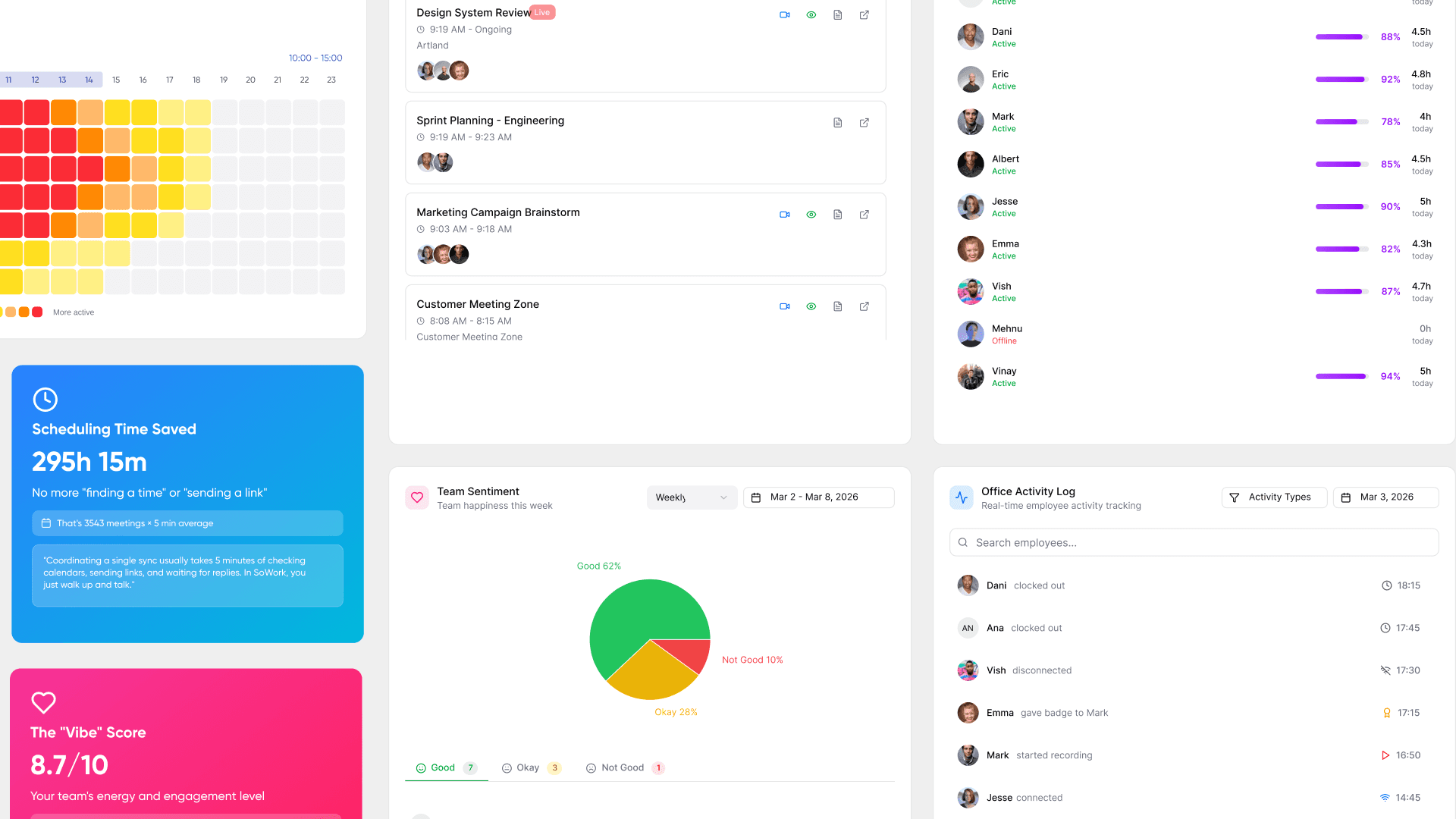
SoWork vs Spot Integrations: 2026 Stack Fit
Vishal Punwani

Published:
Updated on:
SoWork fits better into most existing remote work stacks in 2026. It comes with native Slack, Zapier, Miro, Google Calendar and Outlook integrations, and its live MCP/API lets AI tools like Claude query your office. Spot is the better pick for developer-led teams that want to build custom agents and behaviors on its beta API.
What is SoWork and what core features does it offer?
SoWork is a virtual office where your remote team and your AI agents share one space. It brings presence, one-click meetings, chat and AI meeting memory together so you're not jumping between apps all day.
Core features:
Instant Meetings: you see who's free and start talking in one click.
Presence Awareness: visual signs show who's free, focused or in a meeting.
AI Meeting Memory: meetings get recorded, transcribed and summarized.
Focus Modes: Simple Mode and Mini Mode for deep work.
Insights: a weekly report on meeting time, focus time and who works with whom.
Plans start free for up to 10 people [1].
What is Spot and what core features does it offer?
Spot (Spot Virtual) is a browser-first 3D virtual office built around customizable spaces and spatial conversations. Anyone can join with just a web browser [13].
Spot's strengths are space design and in-room collaboration. Teams build branded floorplans, walk over to a colleague to start a chat, and use built-in chat channels and threads. Spot recently added on-device meeting transcription with speaker attribution, AI summaries and action items [5]. Its Enterprise tier adds full-service space design, custom integrations, SSO and enhanced permissions for teams of 50 or more [10].
What native integrations does SoWork support in 2026?
Out of the box, SoWork connects to Slack, Zapier, Miro, Google Calendar and Microsoft Outlook. It also has a live MCP/API for AI tools.
Integration | What it does |
|---|---|
Slack | Connects the office to your existing chat |
Google Calendar / Outlook | Updates your status automatically when events start |
Zapier | Sends office events to thousands of other apps |
Miro | Brings whiteboarding into the workspace |
MCP/API | Lets Claude or your own AI tools query the office |
Zapier is part of the Premium plan at $15/user/month [1]. Zoom and Notion don't have native connectors. You'd reach those through Zapier.
What native integrations does Spot support in 2026?
Spot's publicly documented native integration is Google Calendar. Beyond that, it relies on a beta API and Enterprise custom integrations.
Spot has a native calendar integration for scheduling meetings directly from Google Calendar [5]. A Google Workspace add-on lets you attach a Spot conference to any calendar event, and guests can join without their own Spot accounts [6]. Custom integrations are an Enterprise-tier feature [10]. Spot doesn't publicly list native Slack, Zoom or Notion connectors, so confirm anything specific with their sales team before you buy.
How does SoWork integrate with Slack and Microsoft Teams?
SoWork has a native Slack integration, so the office works next to the chat tool your team already uses. Microsoft Teams isn't a native integration. Teams-heavy orgs usually connect through Outlook calendar sync and Zapier.
Most teams don't want to give up Slack on day one. SoWork doesn't make you. Slack stays your async channel and SoWork handles presence and live conversations. Outlook sync keeps availability accurate for Microsoft 365 shops. If you need Teams-specific automations, Zapier (Premium) can pass events between the two [1].
How does Spot integrate with Slack and Microsoft Teams?
Spot doesn't publicly document native Slack or Microsoft Teams integrations. It positions its own built-in chat, threads and DMs as the replacement.
That's a deliberate product choice. Spot's API now exposes messages, reply threads, DMs, reactions and typing indicators [4], so a developer could build a bridge to Slack or Teams. That takes engineering time, though, and the API is still in beta. If your team plans to keep Slack as its main async channel, check the details with Spot first.
Which platform has better calendar integrations for cutting meeting overhead?
SoWork is better for cutting meeting overhead because it syncs both Google Calendar and Outlook and updates your status automatically. Spot's calendar features are Google-focused and built around scheduling meetings.
Capability | SoWork | Spot |
|---|---|---|
Google Calendar | Yes, auto status sync | Yes, schedule from Google Calendar [5] |
Outlook | Yes | Not publicly documented |
Auto status on event start | Yes | Not publicly documented |
Add-on for calendar invites | No | Yes, Workspace add-on [6] |
Overhead is real. Remote workers attend 25.6 meetings a week, compared with 14.2 for in-office workers [7].
How do SoWork and Spot handle API access for custom integrations?
SoWork's MCP/API is live and built for asking questions about your office. Spot's API is in beta (you request access) and built for putting your own agents inside the office.
SoWork | Spot | |
|---|---|---|
Status | Live | Beta, request access [4] |
Main use | Claude or your own AI tools ask who's around, what happened in a meeting, what was decided | Bot identities, live event gateway, headless avatar controls [4] |
No-code option | Zapier | None publicly listed |
Want answers from your office data without writing code? Pick SoWork. Have engineers who want to build agent behavior? Spot's newer API is worth testing.
Which project management tools integrate with SoWork versus Spot?
Neither platform lists native Jira, Asana, Linear or Notion integrations. SoWork reaches them through Zapier. Spot reaches them through its API or Enterprise custom work.
With SoWork, Premium unlocks Zapier [1]. That's where a meeting summary can become an Asana task or a Linear ticket without any code. Miro is native for visual planning. With Spot, you'd build the connection on the beta API or negotiate a custom integration at Enterprise level [10]. For a 20-person team without a spare engineer, the no-code route usually wins.
How do SoWork and Spot work with external video tools like Zoom?
Both have built-in video, and neither lists a native Zoom connector. SoWork reads your calendar so your status still updates when you join an outside Zoom or Meet call.
Most teams still take some client calls on Zoom or Meet. SoWork's calendar sync marks you as in a meeting when the event starts, so teammates don't interrupt you, whatever tool hosts the call. Spot goes the other way. Its Workspace add-on puts Spot links into calendar invites, so outside guests join in Spot instead [6]. Getting video started has a cost too: hybrid meetings lose an average of 6 minutes before they get going [9].
What criteria should a remote team use to judge stack fit?
Judge each platform on five things: chat coexistence, calendar coverage, automation path, AI readiness and the plan tier where integrations unlock.
Chat: does it work next to Slack or try to replace it?
Calendar: does it cover both Google and Outlook?
Automation: is there a no-code option, or will you need engineers?
AI: can your AI tools read what happens in the office?
Tier gating: which plan includes the integrations you need?
Identity: SSO and SCIM availability for when you scale.
Which platform is easier to set up for teams with an existing stack?
SoWork is usually faster for teams on Slack plus Google or Microsoft 365, since setup takes minutes, needs no download, and the main connectors are already built.
A typical SoWork rollout looks like this:
Create the office and invite your team.
Connect Google Calendar or Outlook.
Add Slack.
Turn on Zapier for automations.
One user review describes the Zapier and Google Calendar integrations as one-click setups [11]. Spot is also quick for browser-based joining [13], but anything beyond Google Calendar needs API or Enterprise work.
How do SoWork and Spot compare on presence and ambient collaboration?
Both give you real ambient presence. SoWork adds calendar-driven status, focus modes and weekly Insights. Spot leans into spatial movement and room-based conversations.
Feature | SoWork | Spot |
|---|---|---|
Free / focused / in-meeting status | Yes | Spatial presence |
Calendar-driven status | Yes | Not publicly documented |
Focus modes | Simple and Mini Mode | Not publicly documented |
Meeting summaries | AI Meeting Memory | On-device transcription [5] |
Collaboration analytics | Weekly Insights | Not publicly documented |
Said plainly: 46% of leaders and 37% of employees feel they spend more time in meetings than they'd like [8].
What are the integration and lock-in risks with SoWork or Spot?
The biggest risks are integrations locked behind higher tiers, beta APIs that can change, and replacing Slack too early.
With SoWork, Zapier needs Premium [1], and Microsoft Teams isn't native. With Spot, the API is still beta [4], custom integrations are Enterprise-only [10], and there's no ongoing free plan once the trial ends [3]. Whichever you pick, keep Slack or Teams as your async system of record while adoption grows. That way, switching later costs you very little.
How do SoWork and Spot pricing compare as integration needs grow?
Both start at $6/user/month. SoWork's integrations and AI features sit in Premium at $15. Spot's custom integrations need a custom Enterprise quote.
Tier | SoWork [1] | |
|---|---|---|
Free | Up to 10 people | 30-day trial only |
Entry | Basic $6 | Basic $6 |
Mid | Premium $15 (Zapier, AI summaries, analytics) | Growth $10 |
Enterprise | Custom, SSO and SCIM | Custom, 50+ users, custom integrations |
Spot offers a 20% annual discount and event pricing from $3/user/day [2].
What do real teams report about SoWork and Spot integration reliability?
SoWork reviewers call its core integrations quick to set up. One noted its video isn't yet quite as reliable as Zoom or Meet. Spot reviewers mostly praise its customization and ease of use.
A SoWork user called the Zapier and Google Calendar connections one-click setups [11]. That same review said video reliability trails Google Meet and Zoom [11]. Spot has a reported G2 rating of 4.9/5, with praise focused on its interface and customization [12]. Public reviews of Spot's integrations specifically are thin, which makes sense given that its API is still in beta.
What alternatives should teams consider if neither fits?
Gather, Teamflow, Sococo, Kumospace and Roam are the main alternatives. Each makes a different trade-off between immersion and integrations.
Platform | Best known for |
|---|---|
Gather | 2D spatial worlds with game-style avatars |
Teamflow | Apps embedded in a shared canvas |
Sococo | Simple floorplan presence |
Kumospace | Spatial audio and social events |
Roam | Dense floor-map office view |
Test each one against the same five criteria in a two-week pilot.
Which teams are best suited to SoWork versus Spot?
SoWork fits 5 to 200 person teams running Slack, Google or Microsoft calendars and AI tools like Claude. Spot fits teams with in-house developers who want deep space customization and want to build their own agents.
Team profile | Better fit |
|---|---|
Slack-first startup, no spare engineers | SoWork |
Microsoft 365 / Outlook shop | SoWork |
Wants Claude to answer office questions | SoWork |
Engineering-led, building custom agents | Spot |
Heavy branded space design, 50+ users | Spot |
Key Takeaways
SoWork ships native Slack, Zapier, Miro, Google Calendar and Outlook integrations.
Spot's documented native integration is Google Calendar. Everything else runs through a beta API or Enterprise custom work.
SoWork's MCP/API is live and lets Claude ask who's around, what happened in a meeting, and what was decided.
Spot's beta API is built for developers who want to put custom agents inside the office.
Both start at $6/user/month. SoWork's Zapier sits in Premium ($15), and Spot's custom integrations need an Enterprise quote.
Neither platform lists native Microsoft Teams, Zoom, Jira or Notion connectors.
Keep Slack or Teams as your async record during rollout to lower lock-in risk.
Related reading
Sources
Spot offers a 30-day free trial with no ongoing free plan; Enterprise is for teams of 50+
An average of 6 minutes is lost getting hybrid meetings started (Owl Labs State of Hybrid Work 2025)
Spot Virtual has a reported G2 rating of 4.9/5 praising its interface and customization
Spot is optimized for the web and anyone can join instantly with a web browser
FAQ
SoWork vs Spot integrations: which virtual office fits better into an existing remote work stack in 2026?
Does Spot integrate with Slack?
Does SoWork integrate with Microsoft Teams?
Does Spot have a free plan?
Can I connect Claude or other AI tools to my virtual office?
Is Zapier included in every SoWork plan?
Can a virtual office replace Slack and Zoom entirely?
Do guests need an account or download to join?
Blogs
Read Similar Articles
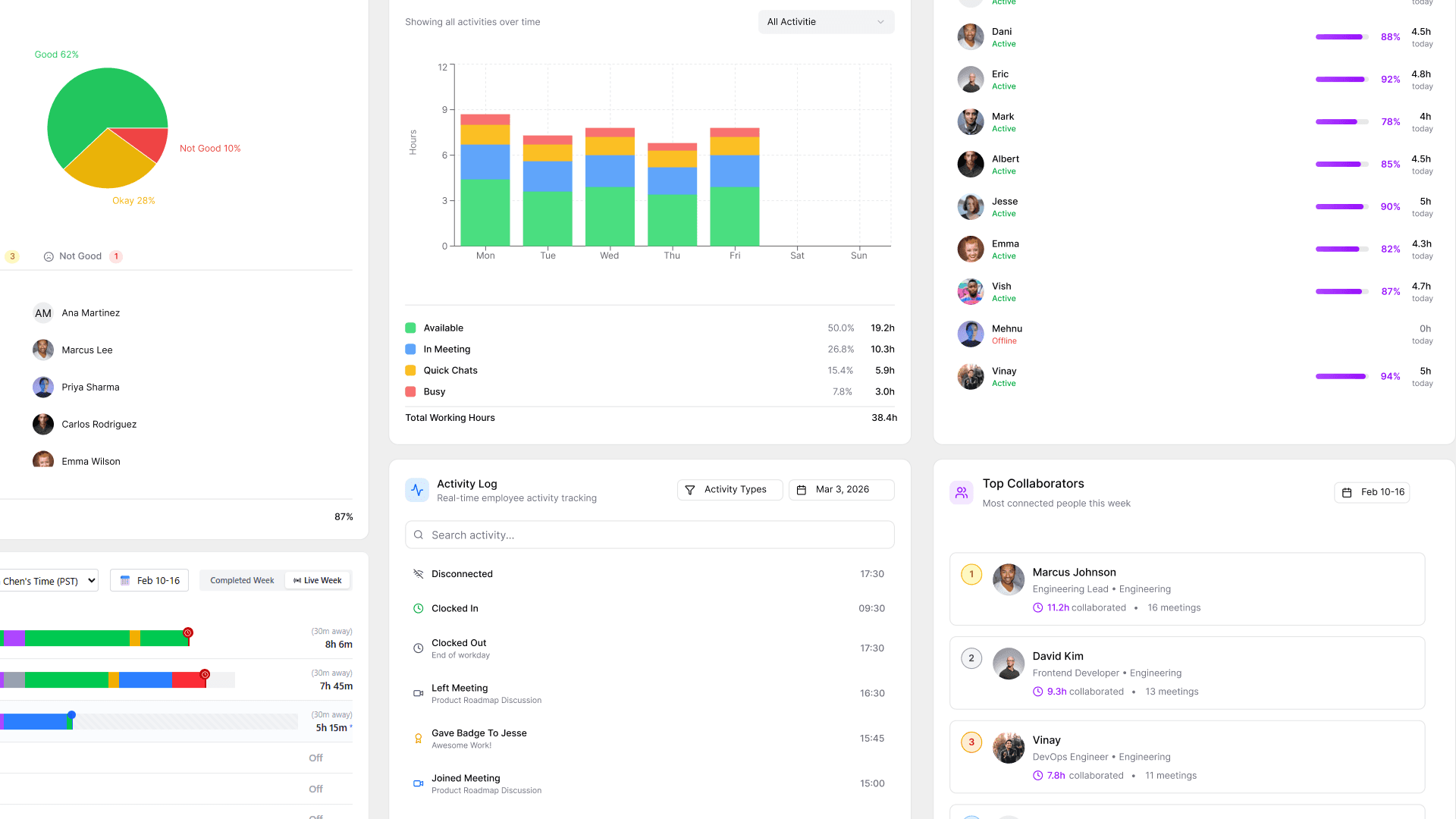
Remote Team Analytics: Complete Guide to Data-Driven Remote Work Management in 2026
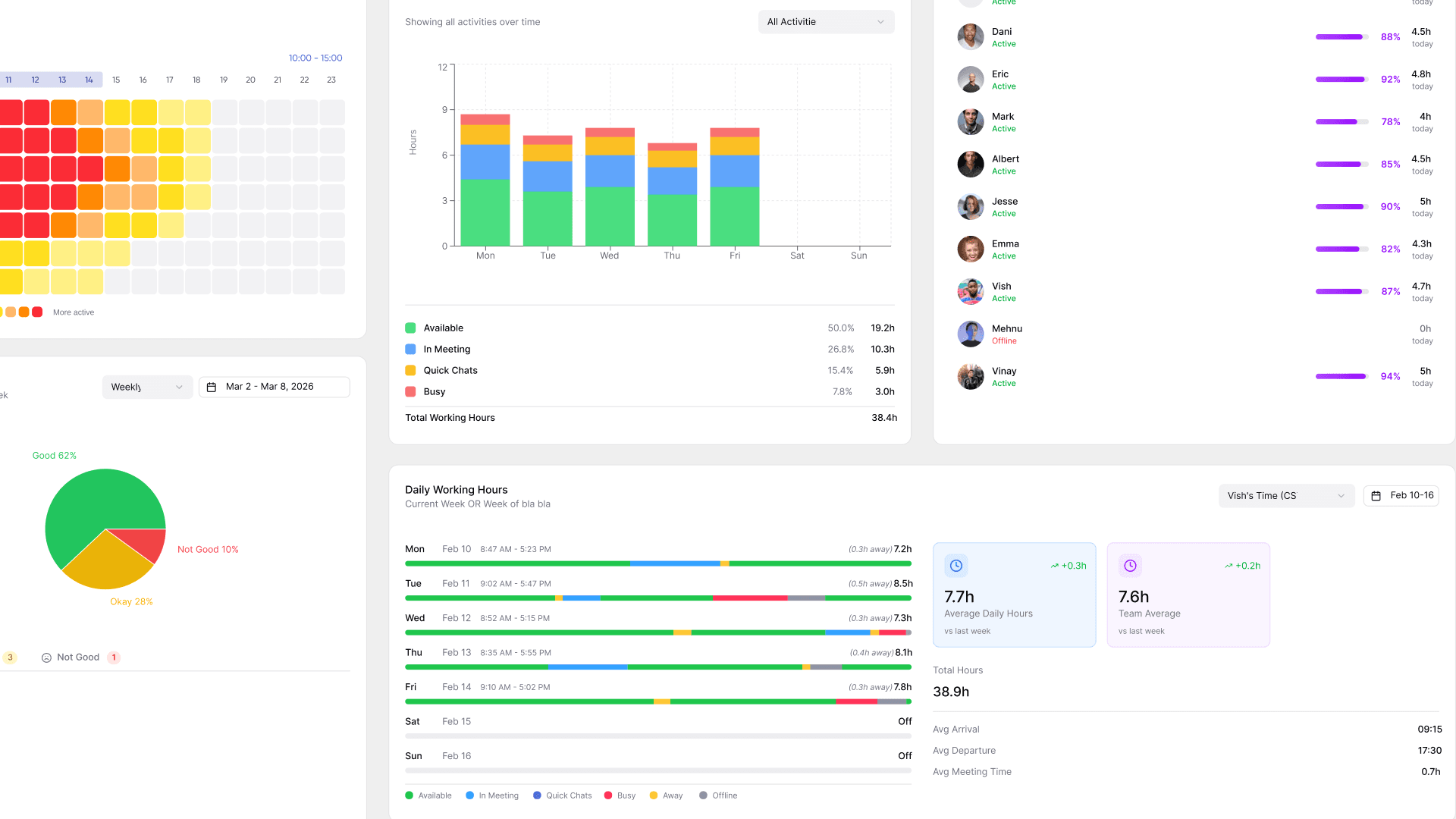
Complete Guide to Gaining Visibility Into Remote Team Performance and Collaboration