SoWork vs Roam Team Analytics in 2026
Vishal Punwani

Published:
Updated on:
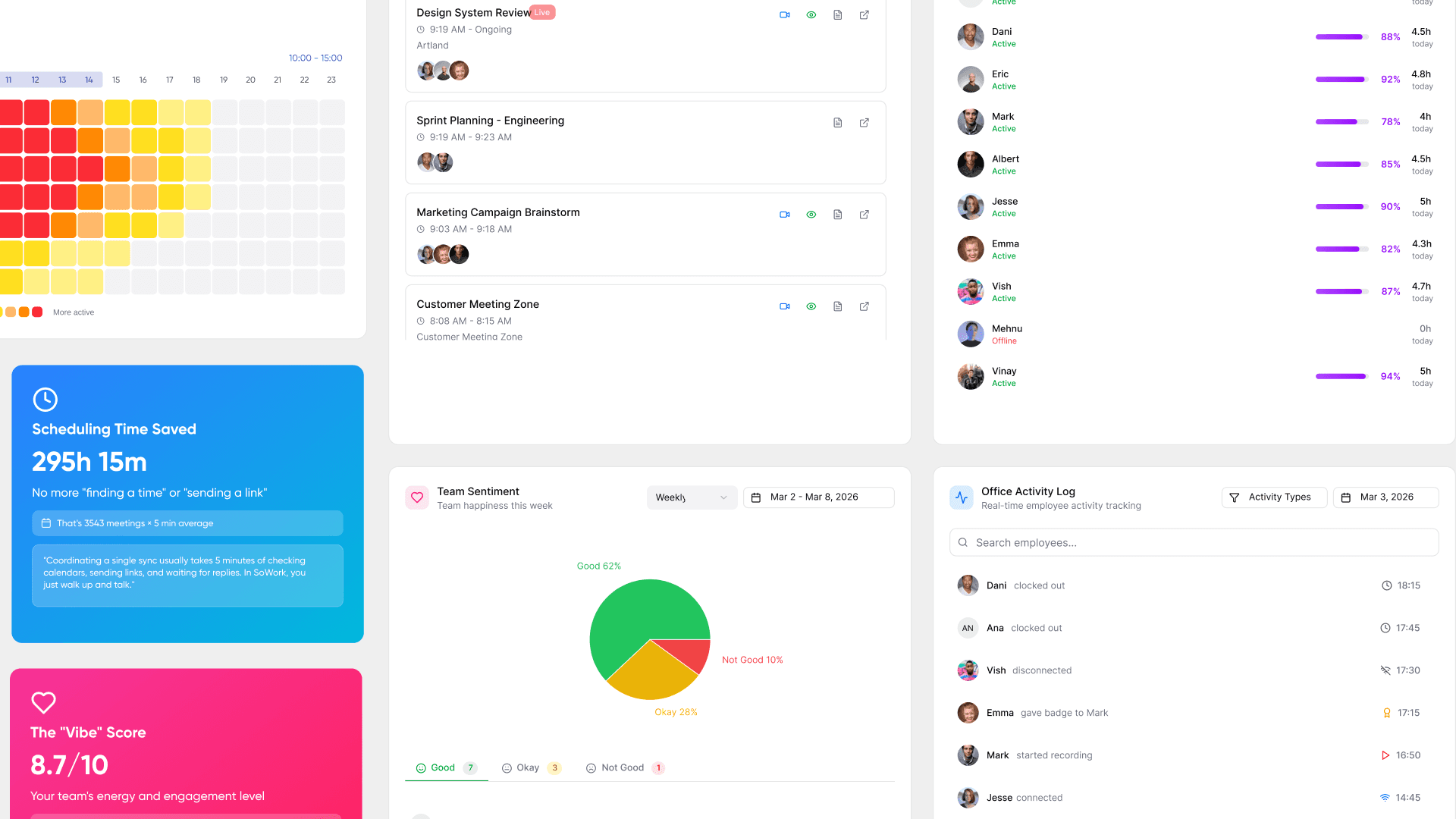
SoWork gives managers better structured visibility into remote team engagement in 2026. Its Insights feature sends a weekly report on time in meetings, focus time, and who collaborates with whom. Roam is stronger on real-time awareness, with a live company map and admin stats. Pick SoWork if you want patterns over time. Pick Roam if you want a live bird's-eye view.
What does team engagement visibility mean in a virtual office?
Team engagement visibility is a manager's ability to see how a distributed team actually connects: who's available, how time splits between meetings and focus, and who works with whom. The point is patterns. It isn't about keystrokes.
This matters because managers drive engagement. Gallup attributes 70% of the variance in team engagement to the manager [4]. Globally, only 20% of employees were engaged in 2025 [3].
Layer | What it shows |
|---|---|
Live presence | Who's free, focused, or in a meeting right now |
Aggregated insight | Trends in meeting load, focus time, and collaboration over weeks |
The best tools give you both layers without turning into surveillance software.
What team analytics does SoWork provide to managers in 2026?
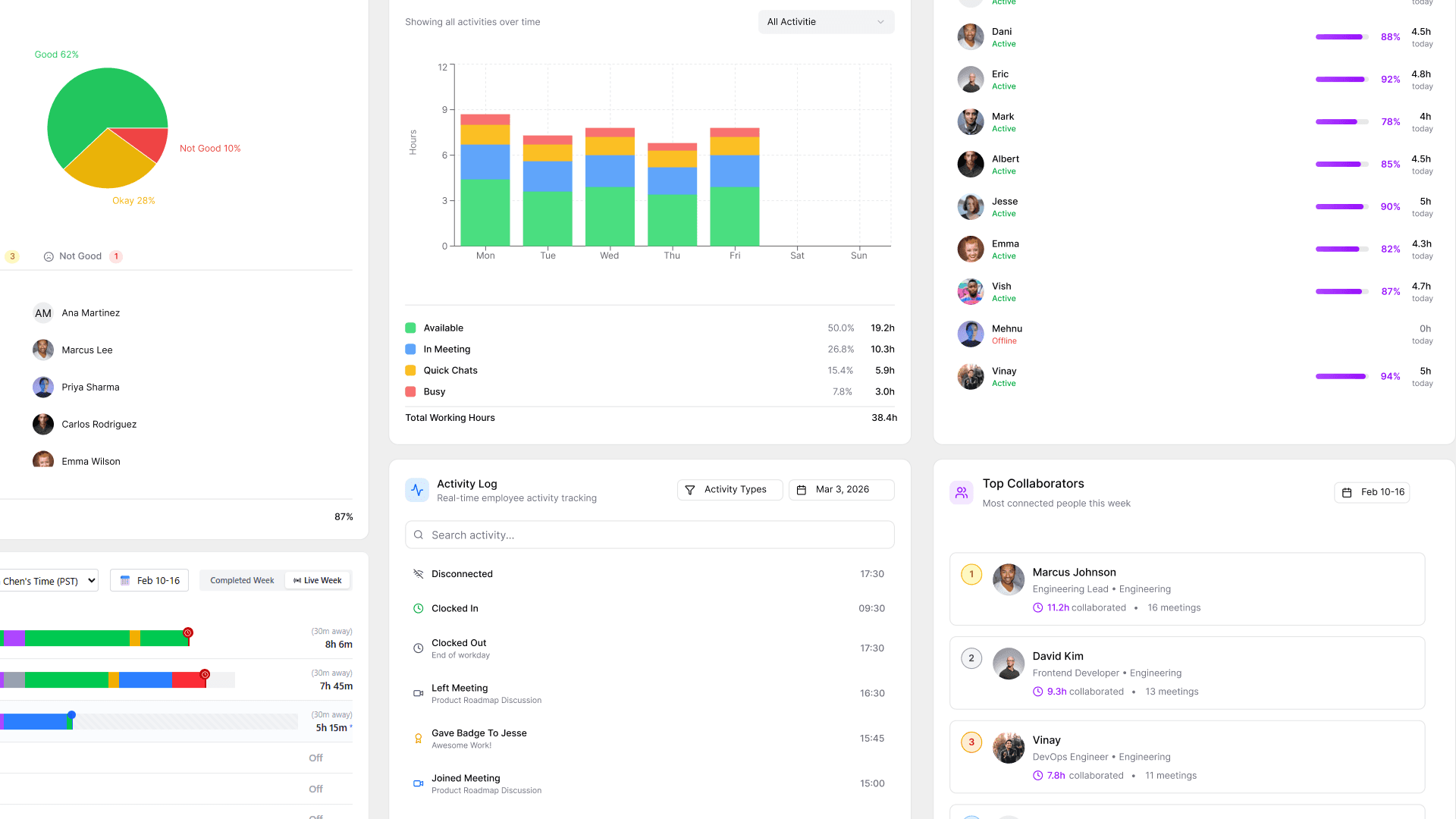
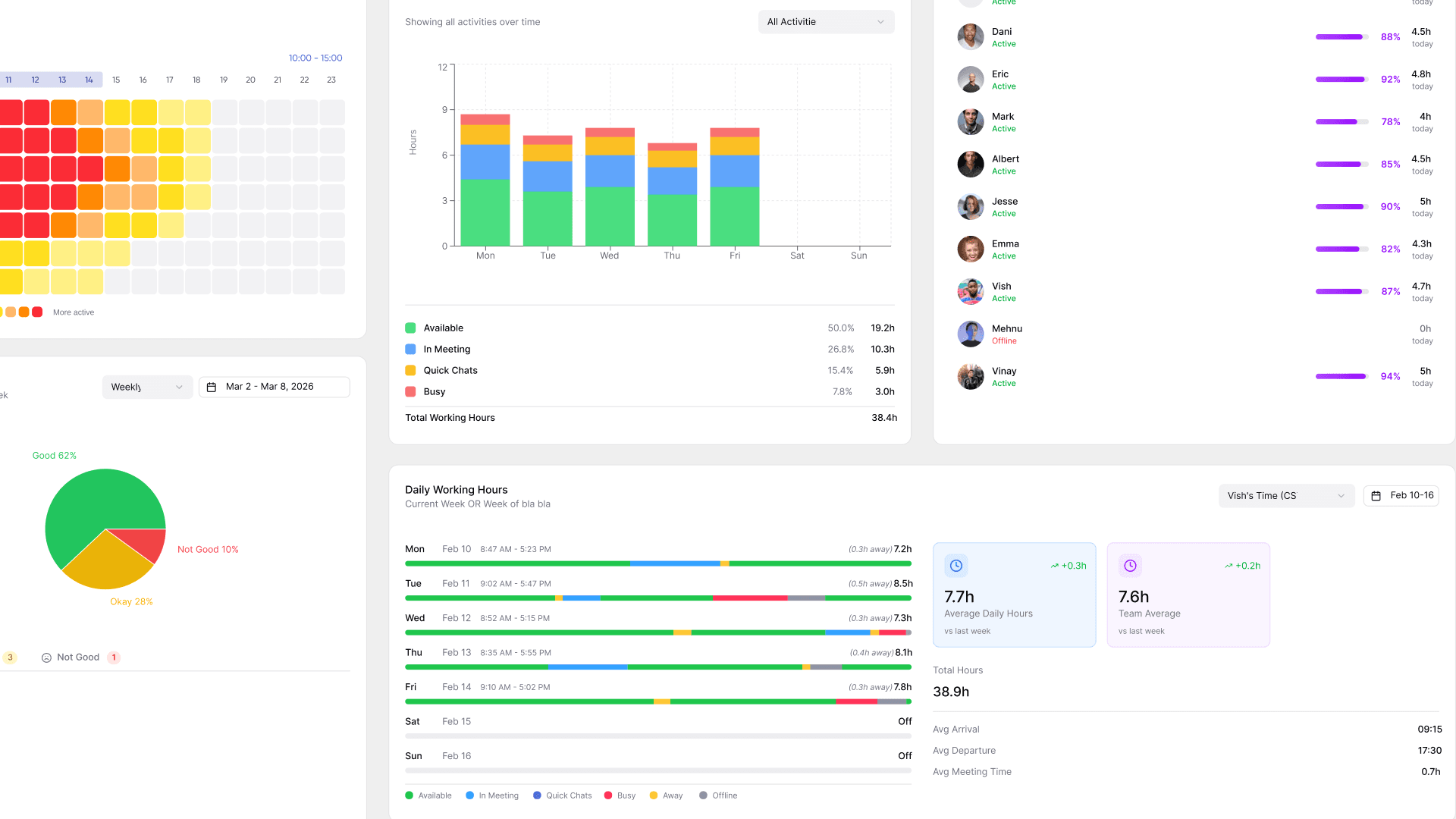
SoWork's Insights feature is a weekly report on time in meetings, focus time, and who collaborates with whom. Together with live presence indicators, it gives managers a real-time view and a trend view.
Metric | What it tells a manager |
|---|---|
Time in meetings | Whether meetings are crowding out deep work |
Focus time | How much protected work time people actually get |
Collaboration patterns | Who works together, and who might be isolated |
Even Roam's own 2026 roundup names SoWork its pick for meeting AI and team analytics [1]. AI Meeting Memory adds transcripts and summaries. Through SoWork's MCP/API, tools like Claude can ask what the team decided.
What team analytics does Roam provide to managers in 2026?
Roam's visibility is built around its live company map, which shows who's online and who's meeting with whom, plus stats in the admin portal. It works best as a real-time view, not as a structured engagement report.
Forbes described Roam as a 2D office showing who's online, who's meeting with whom, and who's available for a quick call [9]. One G2 reviewer singled out the admin portal stats, which show activity across the company [8]. Roam's Magicast screen recorder tracks which named teammates watched a recording, and how much of it [12]. Roam doesn't publicly document a weekly engagement report like SoWork Insights, so ask to see the admin portal in a demo.
How does SoWork track presence and spontaneous collaboration?
SoWork shows presence with visual indicators for who's free, focused, or in a meeting, and calendar sync keeps them current automatically. Spontaneous collaboration happens through one-click Instant Meetings.
Calendar sync changes your status when an event starts, so availability stays accurate without anyone updating it by hand.
Focus Modes (Simple Mode and Mini Mode) let people signal deep work and still stay loosely connected.
Instant Meetings start a conversation in one click. No links, no scheduling.
Insights then reports who collaborated with whom that week.
So managers see spontaneous collaboration as a pattern over time, not only as a live snapshot.
How does Roam track presence and spontaneous collaboration?
Roam tracks presence on a live map where everyone has their own office, and teammates knock to drop in. Managers can see in real time who's available, who's away, and who's talking to whom.
G2 reviewers describe clicking a colleague's office to send a knock notification asking to join [8]. Roam says meetings on its platform average 8 minutes [2]. Its On-It assistant watches the live company map and knows which meeting just ended and who's free [7]. That makes spontaneous activity very visible as it happens. The tradeoff: Forbes noted that some workers could feel always-on pressure, or FOMO when they see colleagues talking on the map without them [9].
How do SoWork and Roam compare on manager dashboard depth?
SoWork goes deeper on structured, trend-based reporting. Roam goes deeper on live, company-wide awareness. Neither one is a full HR analytics suite.
Dimension | SoWork | Roam |
|---|---|---|
Live presence | Free, focused, in-meeting indicators | Live map showing who's with whom |
Recurring report | Weekly Insights | Admin portal stats [8] |
Focus-time tracking | Yes, in Insights | Not publicly documented |
AI tool access | MCP/API | MCP server [11] |
Meeting capture | AI Meeting Memory | Magic Minutes [2] |
If you want a report you can bring to a 1:1, SoWork's format is easier to act on.
Which criteria should managers use to evaluate virtual office analytics?
Judge team analytics on four things: do they show patterns instead of surveillance, do they refresh at a useful cadence, are they transparent to employees, and do they fit your stack and budget. Start from the question you actually need answered.
Signal quality: meeting load, focus time, and collaboration. Not keystrokes.
Cadence: real-time for coordination, weekly for trends.
Transparency: can employees see what's measured?
Integrations: calendar, Slack, and AI tools.
Security: SOC 2, SSO, SCIM.
Cost per seat at your team size.
Transparency has a measurable effect. Gartner found that employee acceptance of email monitoring rose 20 percentage points once employers explained the reasons for it [10].
Does SoWork offer real-time and historical reporting compared to Roam?
Yes. SoWork shows live presence in real time and adds a weekly Insights report for historical trends. Roam's strength is real-time visibility on the map, and its admin stats are the main historical layer.
If you run weekly 1:1s or team retros, a recurring report is easier to act on than a live map you'd have to keep watching. SoWork's AI Meeting Memory also keeps meeting history as transcripts and summaries. Roam keeps meeting history through Magic Minutes notes, which show up in its AInbox messaging [2]. Before you buy, ask each vendor how far back admin data goes and whether you can export it.
How do SoWork and Roam handle privacy and employee monitoring concerns?
Both platforms have SOC 2 credentials, and both focus on collaboration signals rather than screenshots or keystroke logging. The bigger privacy factor is how you introduce the analytics to your team.
SoWork is SOC 2 certified, with SSO on Premium and Enterprise and SCIM on Enterprise only. Roam lists SOC 2 Type II and GDPR compliance on its pricing page [2]. The real risk is how employees feel. Buffer's 2025 survey found 28% of remote workers named surveillance or micromanagement as something that would make them consider leaving [5]. Tell your team what's measured, why, and who sees it. Treat the numbers as conversation starters, not a scoreboard.
What are the risks of over-relying on virtual office engagement metrics?
Engagement metrics measure activity, not outcomes. Lean on them too hard and you'll reward visible busyness, penalize deep workers, and wear down trust.
Presence isn't productivity. The quiet engineer in focus mode may be your best performer.
People game what's watched. Once meeting counts are tracked, meeting counts go up.
Trust has a cost. 28% of remote workers name surveillance or micromanagement as a reason to leave [5].
Context gaps. These metrics miss async work done in docs and code.
Use virtual office data to open conversations about workload and isolation. Judge performance on what ships.
How do SoWork and Roam integrate with Slack, Zoom, and HR tools?
SoWork integrates with Slack, Zapier, Miro, Google Calendar, and Microsoft Outlook, and connects to more tools through its MCP server. Roam offers a developer API, Zapier, webhooks, native GitHub, and a /roam command for Slack [6].
Integration | SoWork | Roam |
|---|---|---|
Slack | Yes | /roam command starts meetings [6] |
Zapier | Yes | Yes [6] |
Calendar | Google Calendar, Outlook | Google Calendar, Microsoft 365 [13] |
AI tool access | MCP/API (live) | MCP server [11] |
Roam says its On-It assistant doesn't currently integrate with Slack [7]. Both are built to replace Zoom-style meetings rather than sit on top of them. For HR platforms, plan on routing data through an API or Zapier and confirm the details with each vendor.
What's the pricing difference between SoWork and Roam for analytics?
SoWork is free for up to 10 users. Basic is $6/user/month and Premium is $15/user/month. Roam charges $19.50 per active member per month in 2026, going up to $20.88 in 2027 [2].
Roam sells one bundle at one price, with monthly billing and AI included [2]. SoWork splits features into tiers, and Roam's own roundup lists team analytics under SoWork Premium [1].
Team of 25 | Monthly cost |
|---|---|
SoWork Premium | $375 |
Roam (2026 rate) | $487.50 |
At that size, SoWork's top tier comes in about $112 a month cheaper than Roam.
Is there case study evidence that SoWork or Roam improves engagement visibility?
Public evidence is thin for both. Roam has more third-party reviews that mention manager visibility. SoWork's analytics evidence comes mostly from product documentation, not published case studies.
A G2 reviewer of Roam praised being able to see where staff are and who's interacting with whom, along with the admin stats [8]. Stanford economist Nicholas Bloom, a paid Roam adviser, told Forbes the map can reassure managers who worry about remote productivity [9]. I couldn't verify a published SoWork case study that measures engagement visibility. Ask both vendors for reference customers your size, then run a 30-day pilot against your own baseline.
How do SoWork and Roam compare to Gather, Teamflow, and Sococo for analytics?
SoWork stands out among these tools for its built-in weekly Insights report, and Roam leads on live map visibility. Roam's own 2026 roundup positions Gather around game-style shared presence [1].
Platform | Manager analytics angle |
|---|---|
SoWork | Weekly Insights on meetings, focus, collaboration |
Roam | Live map plus admin stats |
Gather | Game-style shared presence [1] |
Teamflow, Sococo | No API or developer platform, per Roam's matrix [11] |
Without an API, it's harder to pull data into your own reports. If analytics is your main reason to buy, put SoWork and Roam on the shortlist first.
Which remote teams is SoWork's analytics approach best for?
SoWork fits teams of 5 to 200 people who want trend-level insight into meeting load, focus, and collaboration without watching a live feed. It suits coaching-style managers who review data once a week.
Strong fits:
Async-leaning engineering teams that protect focus time
Founders and COOs trying to cut meeting overhead
Leaders who run AI agents alongside people in the same office
Each floor holds about 200 people, and you can add unlimited floors. The free plan covers up to 10 users, so a small team can test the workspace before committing. Through MCP/API, managers can also ask Claude who's around or what got decided.
Which remote teams is Roam's analytics approach best for?
Roam suits highly synchronous teams that want a live, company-wide view of who's talking to whom and plenty of short drop-in conversations. It fits hands-on managers who coordinate in real time.
Teams that want to replace several tools at once get the most value, since Roam packages nine products into one price [2]. Its On-It assistant needs Roam's virtual office environment for its office intelligence features [7]. That makes Roam strongest when the whole company moves in. It's less ideal if Slack and outside project management tools are non-negotiable, which Roam itself calls an honest gap for On-It [7].
Which platform has more analytics and roadmap momentum heading into 2026?
Roam has shipped more breadth, with nine products in its bundle, including an AI agent. SoWork's investment is narrower: a live MCP/API, AI agents in the office, and agent desks on the way.
Roam's pricing page says new features roll into the bundle with no upsells [2]. An App Store reviewer said Roam rolls out new features every week [14]. SoWork is pushing visibility past people. Agent desks (coming soon) will show what each AI agent is working on and what it actually did. If you manage a mix of humans and AI agents, that roadmap probably matters more than adding another meeting feature.
What's the verdict: does SoWork or Roam give managers better visibility in 2026?
For structured engagement visibility, SoWork wins in 2026. Its weekly Insights report turns meeting load, focus time, and collaboration into trends you can act on, and it costs less per seat. Roam wins on real-time, map-based awareness.
If you need... | Pick |
|---|---|
Weekly engagement trends | SoWork |
Focus-time visibility | SoWork |
Live who's-with-whom map | Roam |
Free option for 10 or fewer users | SoWork |
One bundle replacing many tools | Roam |
Visibility into AI agents alongside people | SoWork |
Bottom line: which virtual office should managers choose?
If your goal is understanding engagement, not just watching activity, choose SoWork. Its weekly Insights on meetings, focus, and collaboration give you something concrete to bring to 1:1s.
Choose Roam if your team runs synchronously all day and you value a live map more than a trend report. Whichever you pick, tell your team exactly what's measured and judge performance on outcomes, not presence.
Key Takeaways
SoWork is the stronger pick for structured engagement visibility, with a weekly Insights report on meeting time, focus time, and who collaborates with whom.
Roam is the stronger pick for real-time awareness, with a live company map showing who's online and who's meeting with whom.
Pricing: SoWork is free for up to 10 users, Basic $6/user/month, Premium $15/user/month. Roam is $19.50 per active member per month in 2026 and $20.88 in 2027.
Both are SOC 2 credentialed. SoWork offers SSO on Premium and Enterprise and SCIM on Enterprise only.
Managers account for 70% of the variance in team engagement, so visibility tools matter only if they lead to better conversations.
28% of remote workers cite surveillance or micromanagement as a reason to consider leaving, so be transparent about what you measure.
Use engagement metrics to spot overload and isolation, never as a stand-in for performance.
Related reading
Sources
20% of employees worldwide were engaged at work in 2025 (Gallup State of the Global Workplace 2026)
Managers account for 70% of the variance in team engagement (Gallup)
Roam Magicast identifies internal viewers by name with percentage watched
An App Store reviewer said Roam is rolling out new features every week
Roam (ro.am) is a virtual office platform and Roam Research is a separate note-taking tool
FAQ
SoWork vs Roam team analytics: which virtual office gives managers better visibility into remote team engagement in 2026?
Can my manager see what I'm doing in Roam?
Is SoWork employee monitoring software?
Is Roam worth $19.50 per user per month?
Does Roam have a free plan?
Is Roam the same as Roam Research?
Does Roam integrate with Slack?
Do virtual offices create always-on pressure for remote employees?
Blogs
Read Similar Articles
Remote Team Analytics: Complete Guide to Data-Driven Remote Work Management in 2026
Complete Guide to Gaining Visibility Into Remote Team Performance and Collaboration