How Managers Can Reduce Zoom Fatigue in 2026
Vishal Punwani

Published:
Updated on:
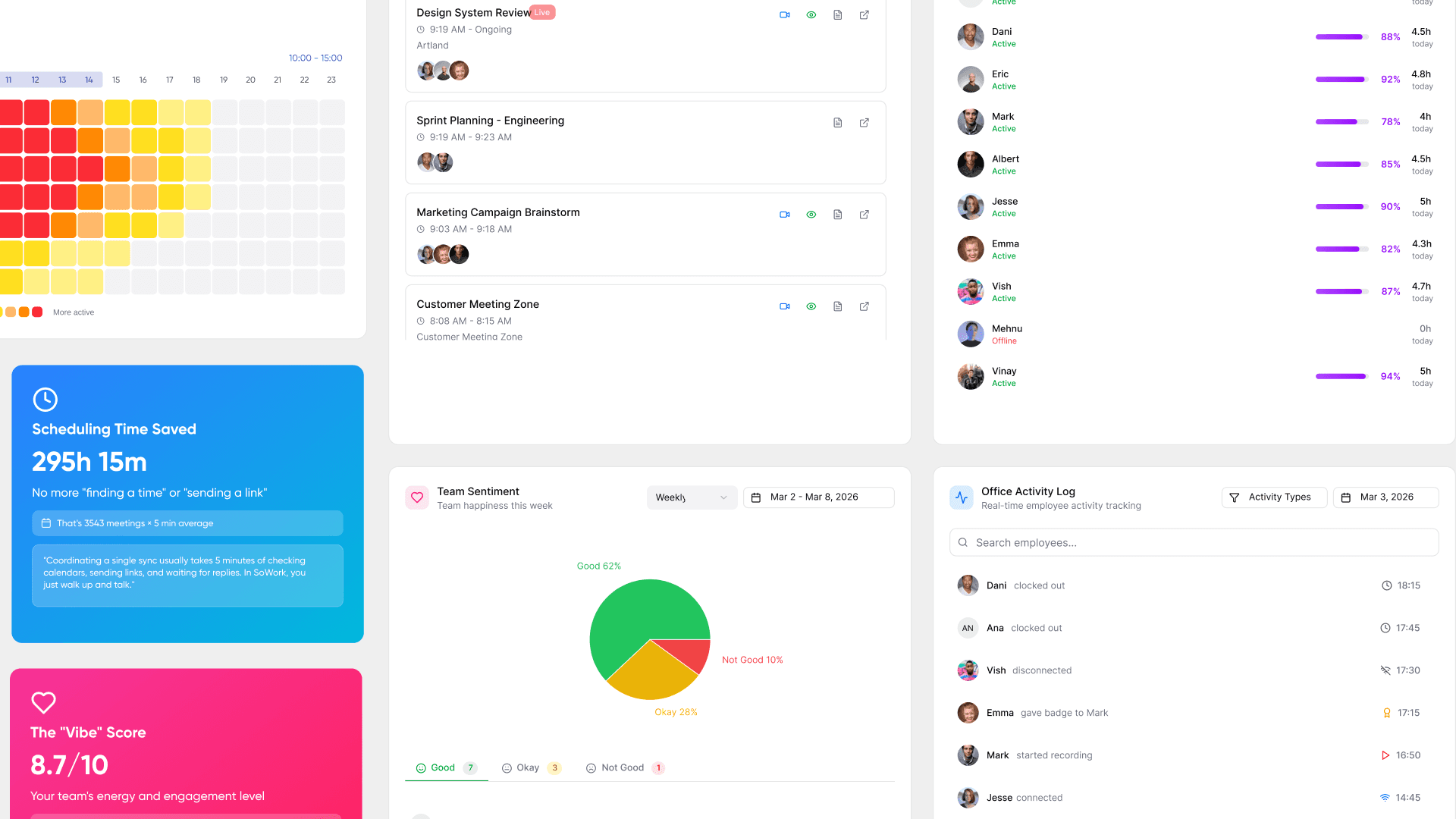
Managers reduce Zoom fatigue by cutting scheduled video calls, not just shortening them. The most effective move is replacing status meetings with ambient presence and async updates. SoWork is the best tool for that because its virtual office shows who's free in real time and starts a one-click conversation without a calendar invite. Add 10-minute buffers and camera-optional norms.
What is Zoom fatigue and what causes it in remote teams?
Zoom fatigue is the exhaustion that builds up from heavy video-call use. Stanford's Jeremy Bailenson traced it to four design factors of video calls, not to remote work itself [1].
Cause | What happens on a call |
|---|---|
Close-up eye gaze | Every face appears to stare at you, all meeting long |
Constant self-view | You watch yourself, which drives self-criticism |
Reduced mobility | You stay frozen inside the camera frame |
Higher cognitive load | You work harder to send and read nonverbal cues |
In remote teams, volume is the multiplier. Stanford's follow-up research found that people with more and longer meetings, and shorter breaks between them, reported greater Zoom fatigue [2].
What are the signs your team has Zoom fatigue?
Watch for dread before calls, cameras quietly going dark, and people who say less than they used to. Fatigue usually shows up in behavior before anyone names it.
Common signals managers can spot:
More "can we push this?" and reschedule requests
Cameras off by default in meetings that used to be lively
Shorter, flatter contributions and fewer questions
Async messages left unanswered after meeting-heavy days
Work creeping into evenings as people catch up
The quiet ones matter most. Research on camera use found that video-call fatigue was linked to lower voice and engagement in meetings [7]. Silence on a call often means drained, not aligned.
How do too many scheduled video meetings cause cognitive overload?
Stacked meetings compound stress rather than just eating time. In Microsoft's EEG study, stress-linked beta waves built up across back-to-back calls, while 10-minute breaks kept them steady [3].
Every call forces a context switch, and the transitions hurt most. Microsoft's researchers saw stress spike right at the handoff between meetings when there was no gap [3].
Scheduled calls also chop the day into 30-minute fragments. Microsoft's 2025 telemetry found its most heavily pinged users were interrupted every two minutes during core hours, about 275 times a day, by meetings, emails, or chats [4]. A 20-minute gap between calls isn't focus time. It's waiting time.
What can replace scheduled video calls?
Most status updates, quick questions, and recaps don't need a scheduled call. Swap each one for the lightest format that still gets the job done.
Instead of | Use |
|---|---|
Daily status standup | Written update in a topic channel |
"Quick sync" invite | Drop-in chat when presence shows they're free |
Recap meeting | AI-generated transcript and summary |
Design or doc review | Comments in the doc, plus a short call only for disputes |
Weekly info dump | Async post, with live time saved for questions |
Keep live video for decisions with real debate, sensitive feedback, and relationship building. Everything else should earn its slot.
How does ambient presence awareness reduce status-check meetings?
Ambient presence answers "is she around, and is she busy?" without anyone asking. That removes the main reason status meetings exist: managers wanting a signal that work is moving.
In an office, you glance across the room. Remote teams often replace that glance with a recurring call. Presence indicators that show who's free, focused, or in a meeting bring the glance back.
SoWork's Automatic Calendar Sync updates status the moment a calendar event starts, so availability stays accurate without anyone toggling it. You know when to interrupt and when to wait. Nobody books 30 minutes just to find out what everyone's doing.
How can virtual offices replicate hallway conversations?
Virtual offices make teammates visible and reachable in one shared space, so a two-minute question happens on the spot instead of turning into a calendar invite.
Teams already want quick conversations. Microsoft reports that 60% of meetings are ad hoc rather than scheduled [5]. The friction is the tool: generating a link, pasting it, waiting for someone to join.
In a virtual office, you see a teammate at their desk, click, and talk. SoWork's Instant Meetings work this way, with no scheduling and no links. The question gets answered in minutes, and it never becomes Thursday's 30-minute sync.
How should managers decide whether a meeting is necessary?
A meeting is necessary when it needs live debate, nuance, or emotion. If it only moves information, make it async.
Run every meeting through this checklist:
Is a decision being made? If not, post an update instead.
Does each attendee have a role? Cut the observers and send them the summary.
Is there an agenda and a defined outcome? No agenda, no meeting.
Could a five-minute drop-in solve it? Then skip the invite.
Does it involve feedback, conflict, or onboarding? Those deserve live time.
Is it recurring out of habit? Make recurring meetings re-justify themselves every quarter.
How do managers set async-first communication norms?
Write the norms down, set response-time expectations, and model them yourself. Async-first fails when it's implied and works when it's explicit.
Define channels. Decide where decisions, updates, and urgent requests live.
Set response windows. For example, a few hours for chat and a day for non-urgent threads.
Make status updates written by default, posted by a fixed time each day.
Record and summarize live meetings so absent people don't need a rerun.
Model it. When someone asks "quick call?", reply in writing if writing works.
SoWork's Topic-Based Chat and AI Meeting Memory cover steps 1, 3, and 4 in one place.
Which scheduling practices prevent back-to-back video calls?
Build in buffers by default. Microsoft's brain research found that 10-minute breaks between meetings stopped stress from accumulating across four consecutive calls [3].
Default to 25 or 50 minutes so every call ends with a built-in gap.
Cluster meetings into one part of the day and protect the rest for focus.
Adopt at least one no-meeting day. It's the simplest structural cut.
Cap daily video hours per person, and treat breaches as a planning problem.
Make cameras optional for routine meetings. Research found camera-on time caused fatigue even when meeting volume was controlled for [7].
How do virtual offices differ from Zoom in reducing meeting fatigue?
Zoom is built for scheduled meetings. A virtual office is built for the time between them, which is where most unnecessary meetings come from.
Factor | Video conferencing | Virtual office |
|---|---|---|
Starting a conversation | Schedule and send a link | See who's free, click |
Default state | Nothing until a meeting starts | Persistent shared space |
Presence | None outside calls | Free, focused, or in a meeting |
Camera pressure | Grid of faces | Avatars by default, video when useful |
Meeting length | Booked in fixed blocks | Ends when the question does |
The fatigue fix isn't better video. It's needing less of it.
How does SoWork reduce reliance on scheduled Zoom calls?
SoWork removes the three biggest reasons teams schedule calls: checking availability, asking quick questions, and catching up on decisions.
Presence Awareness shows who's free, focused, or in a meeting.
Instant Meetings start a conversation in one click, with no link.
AI Meeting Memory records, transcribes, and summarizes, so recap calls disappear.
Focus Modes (Simple and Mini Mode) signal deep work while staying connected.
MCP/API lets Claude or your own AI tools ask what happened in a meeting or what the team decided.
It's free for up to 10 users; Basic is $6/user/month and Premium is $15/user/month [10].
What role does culture and psychological safety play in cutting check-ins?
Unnecessary check-ins usually signal low trust, not missing information. When people feel safe raising problems early, managers don't need recurring meetings to surface them.
Trust and meeting load reinforce each other. In MIT Sloan's study, introducing a no-meeting day improved autonomy and engagement while micromanagement and stress went down [6].
Make the culture explicit:
Say out loud that cameras off is fine. Researchers warn against assuming camera-off means disengaged [7].
Praise clear written updates as much as good meeting performances.
Normalize "this didn't need a meeting" as a useful comment, not a criticism.
Respond to bad news calmly, so people share it async.
How can managers use presence signals to stay informed without meetings?
Use presence for coordination and weekly patterns for oversight. Never use either for minute-by-minute surveillance.
A practical routine:
Check the office at the start of the day to see who's in and who's heads-down.
Respect focus mode. If someone's in Mini Mode, send a message, not a call.
Read AI meeting summaries instead of attending every meeting.
Review the weekly Insights report in SoWork for time in meetings, focus time, and who collaborates with whom.
Ask your AI tools. Through SoWork's MCP, Claude can tell you who's around or what the team decided.
What happens if managers ignore Zoom fatigue?
Unchecked Zoom fatigue wears down the two things remote managers can least afford to lose: engagement and candor.
Fatigue from being on camera was linked to lower voice and engagement in meetings, and it hit women and newer employees hardest [7]. Stanford's survey of 10,322 people found 13.8% of women felt very or extremely fatigued after video calls, compared with 5.5% of men [2].
That's a pipeline problem. Your newest hires and underrepresented voices pull back first. You lose their ideas long before you see it in attrition numbers, and by then the pattern is set.
What evidence shows fewer meetings improve performance and wellbeing?
The strongest evidence comes from MIT Sloan's study of 76 companies: cutting meetings by 40% was linked to 71% higher productivity [6].
The same research found that removing 60% of meetings raised cooperation by 55% [6]. Microsoft's EEG work adds the biological side: breaks between calls prevented stress from building up [3].
Read the numbers with care. MIT's productivity figures are self-reported from large companies, and Microsoft's lab study had only 14 participants [3]. Still, the direction is consistent across sources. Fewer, better-spaced meetings don't hurt collaboration. They tend to improve it.
How does SoWork compare to Gather, Teamflow, and Sococo for reducing meeting overhead?
All four use a persistent space to make conversations easier to start. SoWork stands out for pairing presence with AI meeting summaries and weekly meeting-time insights.
Platform | Approach to meeting overhead | Status and pricing |
|---|---|---|
SoWork | Presence, one-click meetings, AI Meeting Memory, Insights | Free up to 10 users; Basic $6/user/month; Premium $15/user/month [10] |
Gather | 2D avatar office with proximity conversations | $12/member/month billed annually or $15 monthly; free plan ended [8] |
Teamflow | Rooms with persistent whiteboards and apps | Team pivoted to Lindy in 2023; no development since [9] |
Sococo | Floor-plan office with room-based presence | Long-running, presence-first design |
What does defaulting to video calls cost team morale?
Defaulting to video turns every interaction into a performance. People start managing how they look on screen instead of doing the work.
The cost isn't spread evenly. Researchers found women and newer employees felt more fatigue when expected to keep cameras on, partly from pressure to look productive [7].
There's a culture cost too. When every exchange needs an invite, casual connection disappears. Nobody books a meeting to ask how someone's weekend went. Teams end up with plenty of meetings and very little relationship, which is the exact disconnection many remote leaders are trying to fix.
How can managers measure whether Zoom fatigue efforts are working?
Track meeting hours, focus time, and self-reported fatigue together. If meeting time drops while output holds steady and fatigue scores fall, it's working.
Metric | How to track it | Good sign |
|---|---|---|
Scheduled meeting hours per person | SoWork Insights or calendar data | Trending down |
Focus time | SoWork Insights weekly report | Trending up |
Fatigue score | Stanford's free ZEF questionnaire, quarterly [2] | Falling |
Back-to-back blocks | Calendar audit | Fewer per week |
Output | Shipped work, cycle time | Stable or rising |
Measure a baseline before you change anything. Otherwise you're guessing.
Bottom line: how should managers reduce Zoom fatigue?
Cut the meetings that only exist because people can't see each other, then space out the ones that remain.
Start with a calendar audit. Move status updates and recaps to async, and give your team a shared space with real-time presence so quick questions don't need invites. SoWork is built for exactly that. Add 10-minute buffers, camera-optional norms, and a quarterly fatigue check so you know it's working.
Key Takeaways
Zoom fatigue comes from four design factors: close-up eye gaze, constant self-view, reduced mobility, and higher cognitive load (Stanford).
Back-to-back calls compound stress, and 10-minute breaks prevent the build-up, according to Microsoft's EEG research.
MIT Sloan linked a 40% cut in meetings to 71% higher productivity across 76 companies.
Replace status meetings with ambient presence, written updates, and AI meeting summaries.
Make cameras optional for routine meetings, since camera-on time drives fatigue, especially for women and new hires.
SoWork reduces scheduled calls with real-time presence, one-click Instant Meetings, and AI Meeting Memory, free for up to 10 users.
Measure progress with meeting hours, focus time, and Stanford's ZEF fatigue scale.
Related reading
Virtual Team Building Activities in 2026: Ideas, Tools, Costs, and a Playbook for Remote Teams
Best Virtual Office Software to Replace Slack and Zoom in 2026
Sources
FAQ
How can managers reduce Zoom fatigue?
Should employees be allowed to turn their cameras off in meetings?
Is Zoom fatigue caused by the number of meetings or by the camera?
Why is Zoom fatigue worse for women?
How long should breaks between video meetings be?
Do no-meeting days actually work?
Isn't a virtual office just more video calls with avatars?
How do you measure Zoom fatigue on a team?
Blogs
Read Similar Articles
Remote Team Analytics: Complete Guide to Data-Driven Remote Work Management in 2026
Complete Guide to Gaining Visibility Into Remote Team Performance and Collaboration