Virtual Office vs Slack: Can It Replace It?
Vishal Punwani

Published:
Updated on:
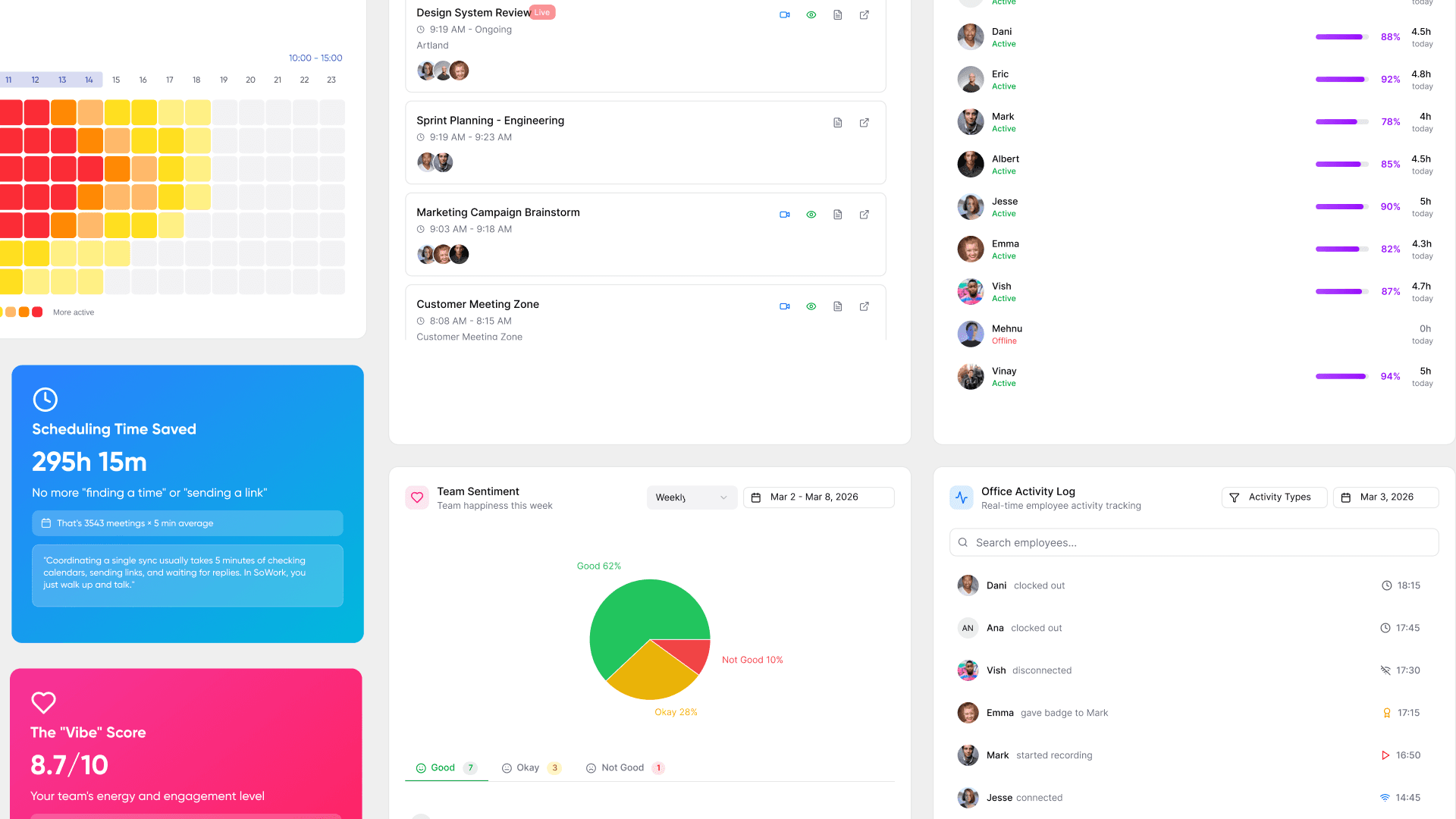
A virtual office like SoWork can replace Slack as your team's primary hub for presence, spontaneous conversation, and meetings, but it works best alongside a lightweight async channel tool rather than as a full drop-in swap. SoWork's real-time presence awareness and one-click instant meetings solve the core problem Slack can't: ambient office feel.
What is a virtual office platform, and how is it different from Slack?
A virtual office is a persistent, spatial workspace where teammates appear as avatars on a shared floor plan, giving you ambient awareness of who is available, something Slack's channel-based interface doesn't provide.
Slack is a text-first messaging tool built around channels and direct messages. It's excellent at structured, searchable conversation, but it has no spatial layer. You can't glance across the room to see if a colleague is free.
A virtual office like SoWork replicates that ambient office awareness digitally. Virtual office platforms provide always-on workspaces with spatial audio and video that recreate the ambient awareness of physical offices. The core difference: Slack is a communication inbox; a virtual office is a shared place your team inhabits together.
What does Slack actually do well for remote teams?
Slack excels at persistent, searchable, asynchronous messaging, organized channels, threaded replies, file sharing, and a massive integration ecosystem.
Slack's internal data shows users send an average of 92 messages per person per day, with the platform handling over 2 billion messages daily. That volume reflects real utility: teams use it to replace email, run project discussions, and pipe in alerts from tools like GitHub or Jira.
About 77% to 88% of Fortune 100 companies use Slack, which signals deep enterprise trust. Its channel structure keeps conversations contextual, and its 90-day free-tier message history (unlimited on paid plans) makes it a reliable record of team decisions. For async-first teams spread across time zones, that's hard to give up.
What does a virtual office like SoWork give remote teams that Slack doesn't?
SoWork delivers presence awareness, spontaneous one-click meetings, AI meeting memory, and a shared sense of place, the things that make a physical office feel like a team, not just a set of tools.
Unlike traditional video conferencing apps or chat tools, SoWork creates a persistent environment where team members maintain visible presence, join spontaneous conversations, and access shared context without scheduling formal meetings.
Key capabilities Slack doesn't have natively:
Feature | SoWork | Slack |
|---|---|---|
Real-time presence map | Yes | Status emoji only |
One-click instant meetings | Yes | Huddles (audio-first) |
AI meeting summaries | Yes (built-in) | Paid add-on |
Customizable office space | Yes | No |
Focus mode signaling | Yes | Manual DND only |
How does presence awareness in a virtual office compare to Slack's status indicators?
Slack's presence is a colored dot you set manually. SoWork's presence is a live visual map that updates automatically from your calendar and activity, no manual input needed.
In Slack, you choose your status. Forget to update it and you're showing "active" during a meeting or "away" when you're actually free. That friction creates the "are you there?" DM problem.
Team presence indicators in SoWork show which colleagues are available, in meetings, or focused on deep work, eliminating the "are you there?" messages that interrupt productivity. SoWork's calendar sync updates your status automatically when a meeting starts. Focus Mode lets you signal deep work without going dark. The result is ambient awareness that actually reflects reality.
How does spontaneous conversation work in a virtual office versus a Slack huddle or DM?
In SoWork, you click a teammate's avatar and a conversation starts, no link, no invite, no scheduling. Slack Huddles are closer, but they still require you to initiate through a channel and hope the person notices.
Slack itself recognized this gap, it launched Huddles specifically to help remote workers re-create impromptu meetings, describing the feature as one that "re-creates the spontaneous and serendipitous interactions that happen outside of scheduled meetings."
But Huddles still live inside a chat interface. You have to find the right channel, start the Huddle, and wait. In a virtual office, proximity is the trigger. Walk your avatar next to a teammate and a conversation opens. Successful virtual office implementations typically reduce scheduled meetings by 20 to 40% as informal communication replaces routine coordination calls.
Can a virtual office handle async messaging the way Slack channels do?
Most virtual offices, including SoWork, include topic-based chat channels, but they're not as deep as Slack's threading, search, or integration ecosystem. This is the biggest gap to plan for.
SoWork has built-in topic-based chat that keeps conversations contextual. SoWork's Meeting Library (Codex) archives meetings, transcripts, decisions, and artifacts in one searchable location, and chat history persists alongside meeting records, creating a complete context trail.
That covers most day-to-day async needs. What it doesn't replicate: Slack's 2,400+ integrations, fine-grained channel permissions, and deep message threading. Teams with heavy Slack workflows, CI/CD alerts, customer support queues, or compliance audit trails, will feel that absence. For most small-to-mid-sized teams, SoWork's chat is sufficient.
Which remote teams benefit most from a virtual office?
Teams that do most of their work synchronously, product, engineering, design, and creative, get the biggest lift from a virtual office. Highly async teams spread across many time zones benefit less.
Remote workers attend 80% more meetings per week than in-office workers (Owl Labs, 2024), which means the coordination overhead is real and widespread. Virtual offices help most when:
5 to 100-person teams where everyone overlaps for at least 4 hours daily
Product and engineering squads that need quick unblocking conversations
Startups rebuilding the culture they lost when they went remote
Hybrid teams where remote members feel invisible next to in-office colleagues
Coordination overhead becomes the primary bottleneck as remote teams scale beyond 15 to 20 members.
What criteria should you use to decide if a virtual office can replace Slack?
Evaluate four things: how much of your work is synchronous, how dependent you are on Slack integrations, whether your team has time-zone overlap, and how much your team misses spontaneous interaction.
Criterion | Virtual office fits | Stick with Slack |
|---|---|---|
Work style | Mostly sync, overlapping hours | Fully async, many time zones |
Integration needs | Light (Google, Zapier) | Heavy (CI/CD, CRM, 50+ apps) |
Team size | 5-100 people | 200+ with complex permissions |
Culture goal | Rebuild spontaneity | Structured, searchable records |
Meeting volume | Too many scheduled calls | Already low meeting count |
Research shows that 67% of companies introduced new asynchronous communication or project management tools in 2024 to improve information flow. The question isn't which tool is better, it's which problem you're actually solving.
What are the risks of dropping Slack entirely for a virtual office?
The biggest risks are losing your integration ecosystem, disrupting async workflows for time-zone-distributed teammates, and hitting a learning curve that slows the team down during the transition.
Research shows that remote workers lose approximately 23% of productive capacity to tool switching, duplicate data entry, and coordination overhead, and a botched migration creates exactly that problem.
Other real risks: - Integration gaps: Slack connects 2,400+ apps. Most virtual offices connect far fewer. - Async blind spots: Teammates in distant time zones rely on channels more than presence. - Adoption resistance: Teams with years of Slack muscle memory will push back. - Message history loss: Migrating channel archives is painful and often incomplete.
A phased approach, run both tools in parallel for 30 to 60 days, reduces these risks significantly.
Does SoWork integrate with Slack, or is it a standalone replacement?
SoWork integrates with Slack, Google Workspace, Outlook, and Zapier, so you can run it alongside your existing tools rather than ripping them out.
SoWork offers integrations with tools like Slack and Zapier, which means you can keep Slack for async channels and use SoWork as your presence and meetings layer. Calendar sync with Google and Outlook keeps availability accurate automatically.
The practical setup most teams land on: SoWork as the "office" where real-time collaboration happens, Slack (or a lighter tool) for async threads and integrations. SoWork positions itself as the connective tissue that sits above document suites, not a replacement for your existing productivity stack, but the layer that makes everything work together.
How do SoWork, Gather.town, and Teamflow compare as Slack alternatives?
SoWork leads on AI features and daily-use practicality. Gather wins on creative customization. Teamflow focuses on embedded apps inside the office space.
Platform | Best for | Pricing (approx.) | AI meeting notes |
|---|---|---|---|
SoWork | Daily presence + AI summaries | Free, $15/user/mo | Yes, built-in |
Gather.town | Creative/playful culture | ~$12-15/user/mo | No native |
Teamflow | Embedded app workflows | $15-25/user/mo | No native |
Gather appeals to creative teams prioritizing playful, gamified environments with extensive customization. If your main goal is pushing meeting outputs into the rest of your stack, SoWork's Premium plan includes Zapier; if your goal is bringing work tools into the office space itself, Teamflow emphasizes embedded apps like Google Docs and Notion.
Does research show that virtual offices reduce over-reliance on chat tools?
Yes. Teams using virtual offices report fewer scheduled meetings and less reactive messaging because presence awareness replaces the need to ping someone to check availability.
Research found that 60% of people experience high stress and burnout specifically due to online communication fatigue, the exhaustion from perpetual availability, unrelenting notifications, and managing multiple simultaneous conversations.
Virtual offices address this structurally. When you can see a teammate is free, you walk over, you don't send a message and wait. Research indicates hybrid teams experience 18 to 22% more context-switching events compared to fully remote or co-located teams, primarily from toggling between communication tools. A unified virtual office reduces that toggling by consolidating presence, meetings, and chat in one place.
Does a virtual office reduce meeting overhead and calendar dependency?
Yes, significantly. When teammates can see each other and start conversations instantly, the reflex to schedule a meeting for a 3-minute question disappears.
Automated meeting summaries reduce manual documentation overhead by 20 to 30 minutes per meeting for teams that previously assigned note-takers. That's on top of the meetings you avoid entirely.
In Slack, the path to a quick conversation is: DM, wait, schedule a Zoom, send a link, join. In SoWork, it's one click. SoWork's AI Meeting Memory automatically records, transcribes, and summarizes meetings, which teams using meeting management tools report reduces total meeting time by 18% while improving follow-up rates by 42% (Gartner, 2024). Fewer meetings scheduled means less calendar dependency, and more actual work.
How does a virtual office build culture compared to Slack channels and emoji reactions?
A virtual office builds culture through shared space and spontaneous interaction. Slack builds it through channels, emoji reactions, and GIFs, which are fun but don't replicate the feeling of working alongside someone.
Slack's #random channel and emoji reactions are genuinely useful culture signals. But they're performative, you have to opt in to participate. A virtual office creates passive culture: you see your team, you bump into people, you overhear conversations.
SoWork lets teams design and personalize their office space and avatars to reflect company identity. That visual layer, your team's actual "place", creates a sense of belonging that no channel can replicate. 79% of organizations reported that Slack improved their team culture, but that still leaves a gap between "better communication" and "feeling like a team." A virtual office closes that gap.
How much does SoWork cost compared to Slack?
SoWork starts free for up to 10 users, with paid plans at $6 to $15 per user per month. Slack starts at $7.25 per user per month on the Pro plan, making SoWork competitively priced and often cheaper at small team sizes.
Plan | SoWork | Slack |
|---|---|---|
Free tier | Up to 10 users | Yes (90-day message limit) |
Entry paid | $6/user/mo (Basic) | $7.25/user/mo (Pro) |
Mid tier | $12/user/mo (Premium, annual) | $15/user/mo (Business+) |
AI features | Included in Premium | Bundled into Business+ |
SoWork's Basic tier is priced at $6 per user per month, or $5.40 billed annually, while its Premium tier costs $15 per user per month, or $12 billed annually. Slack costs $7.25 to $15 per user per month on annual billing, Pro at $7.25 and Business+ at $15.
What are the alternatives to both Slack and virtual offices?
The main alternatives are Microsoft Teams (bundled with Microsoft 365), Discord (popular with technical and creative teams), and async-first tools like Loom, Notion, or Linear.
If neither Slack nor a virtual office fits, consider:
Microsoft Teams: Best for organizations already on Microsoft 365. Microsoft Teams had over 320 million active users globally by 2024/2025.
Discord: Voice-channel model works like a lightweight virtual office for technical teams.
Loom + Notion: Fully async stack for teams that rarely need real-time collaboration.
Linear / Basecamp: Project-centric communication that reduces chat dependency entirely.
None of these combine presence awareness, instant meetings, and AI summaries in one place the way SoWork does, but they're valid choices depending on your team's workflow.
How should you migrate from Slack to a virtual office without disrupting your team?
Run both tools in parallel for 30 to 60 days, move meetings and presence to the virtual office first, then gradually shift chat, don't try to cut Slack off on day one.
A practical migration sequence:
Week 1-2: Set up SoWork, invite the team, and run it alongside Slack. Don't change any existing Slack habits yet.
Week 3-4: Move all real-time meetings and quick conversations to SoWork. Keep Slack for async threads.
Month 2: Evaluate which Slack channels are still active. Archive dead ones.
Month 3: Decide which async channels are worth keeping in Slack vs. migrating to SoWork's topic chat.
Implementing a virtual office as the central hub before adding specialized tools prevents tool fragmentation and reduces coordination overhead by up to 40%. SoWork's onboarding requires no software download, so teams can be up and running in minutes.
What's the best setup for running SoWork and Slack together?
Use SoWork as your team's live workspace for presence, instant meetings, and video, and keep Slack (or a lighter async tool) for structured channels, integrations, and time-zone-bridging threads.
The two tools solve different problems and don't have to fight. A clean division:
SoWork handles: Morning check-ins, quick questions, all video calls, meeting summaries, and team culture.
Slack handles: CI/CD alerts, customer support queues, async announcements, and cross-timezone threads.
SoWork integrates with Slack and Zapier, so you can pipe SoWork meeting summaries into a Slack channel automatically. This setup gives you the spontaneity of an office without losing Slack's integration depth. Most teams that try this hybrid find their Slack usage drops naturally within 60 days, not because they forced it, but because fewer things need a message when you can just walk over.
Key Takeaways
A virtual office like SoWork can replace Slack as your primary collaboration hub for presence and real-time meetings, but works best alongside a lightweight async tool rather than as a pure drop-in swap.
Slack handles over 2 billion messages daily and 47.2 million daily active users, its async channel depth and 2,400+ integrations are hard to fully replicate.
SoWork's presence awareness updates automatically from your calendar, eliminating the manual status-update problem that makes Slack's online/away indicators unreliable.
Virtual offices reduce scheduled meetings by 20 to 40% by replacing coordination calls with spontaneous walk-up conversations.
SoWork starts free for up to 10 users; paid plans run $6 to $15 per user per month, competitive with or cheaper than Slack's $7.25 to $15 range.
The best migration strategy is parallel running: move meetings and presence to SoWork first, then evaluate which Slack channels are still earning their keep.
Teams doing mostly synchronous work with overlapping hours get the biggest lift from a virtual office; fully async, multi-timezone teams should keep Slack as their primary tool.
SoWork integrates with Slack, Google Workspace, Outlook, and Zapier, so you don't have to choose one or the other on day one.
Sources
Remote workers attend 80% more meetings per week than in-office workers (Owl Labs, 2024)
Successful virtual office implementations typically reduce scheduled meetings by 20 to 40%
SoWork's Basic tier is $6/user/month ($5.40 annually); Premium is $15/user/month ($12 annually)
Slack Pro plan costs $7.25/user/month (annual); Business+ costs $15/user/month (annual)
67% of companies introduced new asynchronous communication or project management tools in 2024
Implementing a virtual office as the central hub reduces coordination overhead by up to 40%
AI meeting summaries reduce manual documentation overhead by 20 to 30 minutes per meeting
60% of people experience high stress and burnout due to online communication fatigue
79% of organizations reported that Slack improved their team culture
Microsoft Teams had over 320 million active users globally by 2024/2025
FAQ
Can a virtual office replace Slack for a remote team?
Does SoWork have channels like Slack?
Is a virtual office better than Slack for spontaneous collaboration?
What happens to our Slack history if we switch to a virtual office?
How much does SoWork cost compared to Slack?
Do virtual offices work for fully async remote teams?
Does SoWork integrate with Slack?
What are the risks of abandoning Slack entirely for a virtual office?
Blogs
Read Similar Articles
Remote Team Analytics: Complete Guide to Data-Driven Remote Work Management in 2026
Complete Guide to Gaining Visibility Into Remote Team Performance and Collaboration