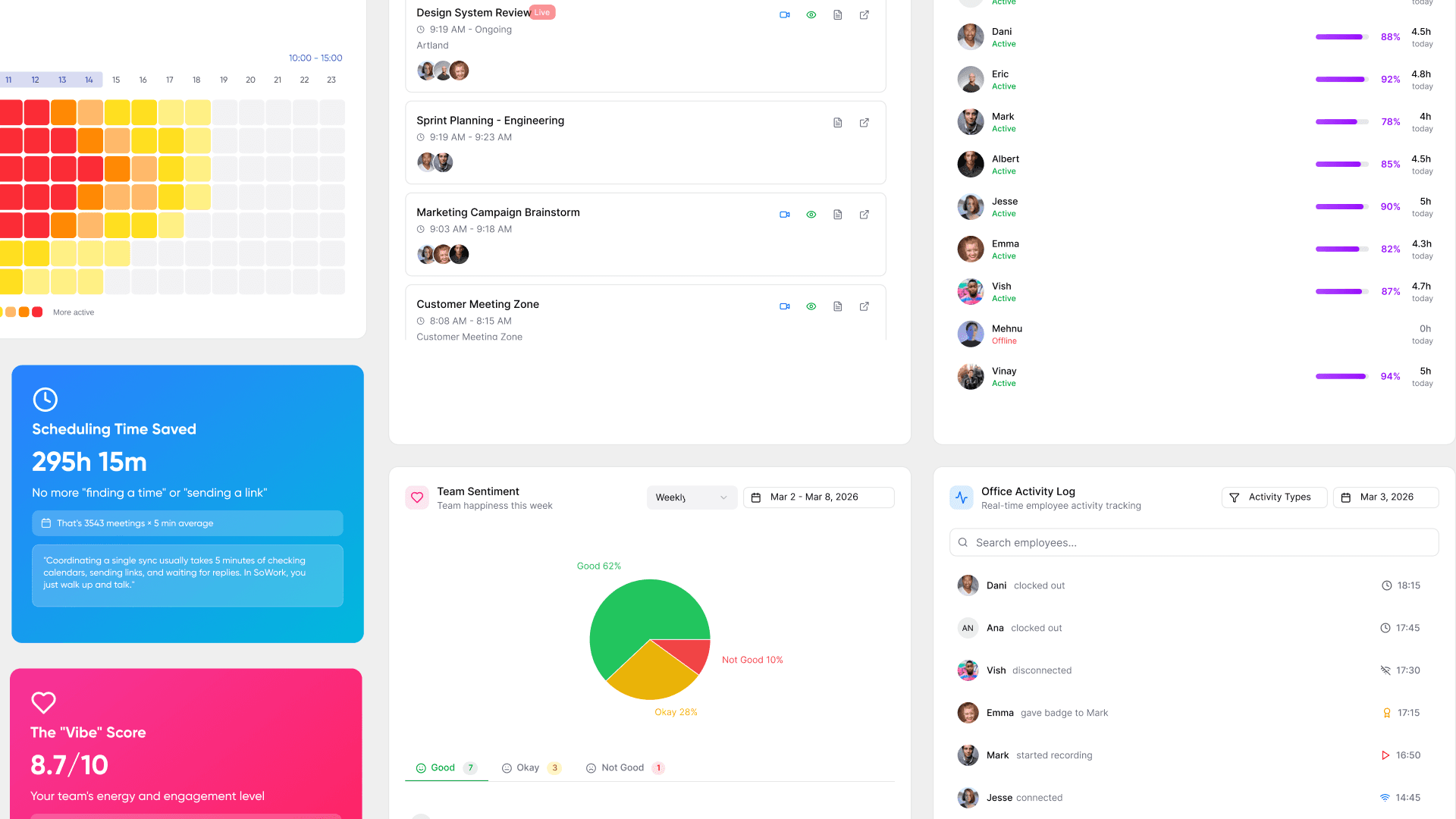
Best Gather Alternatives for Remote Teams 2026
Vishal Punwani

Published:
Updated on:
The best Gather alternative for most remote teams in 2026 is SoWork, because it combines real-time presence awareness, AI meeting memory, and instant one-click meetings at $6/user/month, roughly half Gather's current price. Teamflow suits embedded-app workflows; Sococo fits enterprises layering presence onto existing Zoom infrastructure.
What is Gather.town and what does it actually do for remote teams?
Gather is a browser-based virtual office that uses a pixel-art, top-down map where proximity drives conversation, walk your avatar near a colleague and a video call starts automatically. It's built for spontaneous drop-ins, virtual events, and persistent team spaces.
Core features include spatial audio (conversations fade as avatars move apart), customizable 2D office layouts, real-time chat, screen sharing, and scheduling tools for cross-timezone coordination [1]. Gather 2.0, launched in September 2025, added GitHub and Spotify integrations plus more granular audio controls [2]. The immersive pixel aesthetic appeals strongly to creative teams and companies that prioritize culture-building and virtual social events over day-to-day productivity tooling.
[1] sowork.com/blog/best-gather-town-alternatives-remote-teams [2] sowork.com/blog/best-gather-town-alternatives-remote-teams
What are the biggest pain points teams run into with Gather.town?
The three most-cited issues are audio/video reliability, no built-in AI or productivity tooling, and a pricing change that removed the free tier entirely in late 2025.
Gather removed its permanent free tier in late 2025; the new rate of $15/user/month began on first renewal after January 1, 2026 [1]. Reliability is a real friction point, voice chat can fail in meeting rooms, requiring reconnects, and editor bugs sometimes cause layout changes not to save [2]. Beyond reliability, Gather is essentially a social layer: it has no AI meeting summaries, no calendar sync, and no focus-mode tooling, which leaves productivity-focused teams reaching for additional apps.
[1] sowork.com/blog/best-gather-town-alternatives-remote-teams [2] producthunt.com/products/gather-town/reviews
What criteria should you use to evaluate a Gather alternative?
Evaluate on five dimensions: presence awareness quality, meeting overhead reduction, AI productivity features, pricing per seat, and integration depth with your existing stack.
Criterion | Why It Matters |
|---|---|
Presence awareness | Replaces the ambient "who's around" feel of a physical office |
Instant meetings | Eliminates scheduling friction; 43% of pros spend 3+ hrs/week just booking meetings [1] |
AI meeting tools | Follow-up failure rates are 34% higher in remote contexts without tracking [2] |
Pricing per seat | Costs compound fast; compare monthly vs. annual rates carefully |
Integration depth | Slack, Google Calendar, and Zoom connections determine daily adoption |
[1] sowork.com/blog/best-gather-town-alternatives-remote-teams [2] claryti.ai/research/remote-work-meeting-statistics
What is SoWork and how does it recreate spontaneous office collaboration?
SoWork is a virtual office platform that lets you see teammate availability in real time and start a conversation in one click, no scheduling, no links, no friction. It replicates the ambient awareness of a physical office through visual presence indicators, automatic calendar sync, and a customizable 2D/2.5D office environment.
When your calendar event starts, SoWork updates your status automatically so teammates always see accurate availability. Focus Modes (Simple Mode and Mini Mode) let individuals signal deep work without going dark entirely. AI Meeting Memory records, transcribes, and summarizes every conversation so nothing gets lost. Teams can design their office space and avatars to reflect company culture, think building in The Sims, but for work. Setup takes minutes with no software download required.
How does SoWork compare to Gather.town on features, usability, and presence?
SoWork adds AI meeting summaries, automatic calendar sync, and focus modes that Gather doesn't offer at any price, and it starts at $6/user/month versus Gather's $15/user/month.
Feature | SoWork | Gather |
|---|---|---|
AI meeting summaries | Yes (built-in) | No |
Calendar sync (auto-status) | Yes | No |
Focus / Do Not Disturb modes | Yes | Limited |
Spatial audio | Yes | Yes |
Pixel-art aesthetic | No (2.5D + Simplified Mode) | Yes |
Starting price | $6/user/month [1] | $15/user/month [2] |
Free tier | No | No (removed late 2025) [2] |
[1] sowork.com/alternatives/teamflow-vs-sowork [2] sowork.com/blog/best-gather-town-alternatives-remote-teams
What is Teamflow and how is it different from Gather?
Teamflow is a 2D virtual office that differentiates itself by letting teams embed live apps, Salesforce, Figma, Google Docs, directly onto the virtual office floor canvas, making it a working surface rather than just a meeting space.
Where Gather is primarily a social and event-focused environment, Teamflow is aimed at sales and design teams that need simultaneous multi-screen sharing and deep app embedding during collaboration sessions [1]. That focus comes at a cost: Teamflow's Seed plan starts at $20/user/month ($15 annually), making it the most expensive option in this comparison [2]. It's a strong fit for teams whose core workflow revolves around live document co-editing, but less compelling for teams that just want always-on presence.
[1] sowork.com/alternatives/teamflow-vs-sowork [2] sowork.com/alternatives/teamflow-vs-sowork
What is Sococo and which teams does it suit best?
Sococo is a spatial presence platform built around a bird's-eye floor-plan view of your office, showing who's in which room at a glance. It's best suited for enterprise teams that already use Zoom, Webex, or Microsoft Teams and want a presence layer on top, not a replacement.
Sococo integrates with Zoom, Webex, Google Meet, and Microsoft Teams so it layers onto existing meeting tools rather than replacing them [1]. Its standard plan is $14.99/seat/month ($13.49 annually) with a 10-seat minimum and a 500-minute native media cap per seat [2]. That media cap is a real constraint for smaller teams with heavy video usage. Sococo holds a 4.3/5 on G2, with reviewers citing its clear room-based presence as a standout [3].
[1] guideflow.com/blog/virtual-workspace-software [2] sowork.com/alternatives/sococo-vs-sowork [3] guideflow.com/blog/virtual-workspace-software
Which platform, Teamflow, SoWork, or Gather, does the most to cut meeting overhead?
SoWork does the most to reduce meeting overhead, combining instant one-click meetings, AI meeting summaries, and automatic calendar sync in one platform. Teamflow reduces friction during working sessions but doesn't address scheduling overhead. Gather reduces formality through proximity-based chat but has no AI tooling.
The average employee spends 31 hours per month in unproductive meetings [1]. Organizations using automated meeting management tools reduced total meeting time by 18% and improved follow-up completion by 42%, per Gartner [2]. SoWork's AI Meeting Memory directly targets that follow-up gap. Teamflow helps teams work together faster inside a session, but you still need to schedule that session. Gather encourages drop-ins but offers nothing to capture or act on what was discussed.
[1] sowork.com/blog/best-gather-town-alternatives-remote-teams [2] sowork.com/blog/best-flat-social-alternatives-remote-teams-2026
What other virtual office tools are worth considering beyond the main four?
Kumospace, Remo, SpatialChat, and Spot are the most frequently mentioned alternatives outside the top four, each with a distinct angle.
Tool | Best For |
|---|---|
Kumospace | Illustrated office rooms; trusted by Spotify and Shopify [1] |
Remo | Networking events and conference-style layouts with proximity audio |
SpatialChat | Lightweight spatial audio; 4.7/5 on G2 from 130+ reviews [2] |
Spot | Deep customization and API access for teams that want to script office behaviors [3] |
None of these match SoWork's combination of AI meeting tooling and presence awareness at the $6/user/month price point.
[1] sowork.com/blog/sowork-vs-flat-social-virtual-office-comparison-2026 [2] sowork.com/blog/best-flat-social-alternatives-remote-teams-2026 [3] sowork.com/blog/sowork-vs-flat-social-virtual-office-comparison-2026
Which Gather alternatives work best for async-first distributed teams?
SoWork is the strongest fit for async-first teams because its AI Meeting Memory, Focus Modes, and automatic status updates reduce the need for synchronous check-ins without cutting teammates off from each other.
64% of remote workers prefer async communication for status updates, but only 29% of organizations offer it as a formal option [1]. SoWork's Mini Mode and Simple Mode let individuals stay loosely connected without being pulled into live conversations. AI summaries mean teammates in different time zones can catch up on what was discussed without attending. Gather and Teamflow are both primarily synchronous tools, they're built around being present at the same time, which works against async-first workflows.
[1] claryti.ai/research/remote-work-meeting-statistics
Which alternatives work best for startups versus enterprise teams?
SoWork is the clearest fit for startups and teams under 200 people. Sococo is the better fit for large enterprises already running Zoom or Webex infrastructure.
Team Size | Best Pick | Reason |
|---|---|---|
5 to 50 people | SoWork | Lowest cost ($6/user/mo), fast onboarding, no download required |
50 to 200 people | SoWork Premium | AI tools + analytics scale with team complexity |
200+ enterprise | Sococo | Integrates with existing Zoom/Webex; SSO and SCIM provisioning [1] |
Sales/design teams | Teamflow | Embedded Salesforce and Figma on the virtual floor [2] |
[1] sowork.com/alternatives/sococo-vs-sowork [2] sowork.com/alternatives/teamflow-vs-sowork
How do the pricing models compare across top Gather alternatives?
SoWork is the most affordable full-featured option at $6/user/month. Gather and Sococo both land around $15/user/month. Teamflow is the most expensive at $20/user/month to start.
Platform | Monthly Price | Annual Price | Notes |
|---|---|---|---|
SoWork Basic | $6/user/mo | $5.40/user/mo | No seat minimum [1] |
SoWork Premium | $15/user/mo | $12/user/mo | AI tools + analytics [1] |
Gather | $15/user/mo | $12/user/mo | Free tier removed late 2025 [2] |
Sococo | $14.99/seat/mo | $13.49/seat/mo | 10-seat minimum; 500-min media cap [3] |
Teamflow Seed | $20/user/mo | $15/user/mo | Most expensive entry point [4] |
[1] sowork.com/alternatives/teamflow-vs-sowork [2] sowork.com/blog/best-gather-town-alternatives-remote-teams [3] sowork.com/alternatives/sococo-vs-sowork [4] sowork.com/alternatives/teamflow-vs-sowork
What integrations do leading Gather alternatives offer with Slack, Zoom, and Google Workspace?
SoWork integrates with Slack, Miro, GitHub, Google Calendar, and Outlook Calendar, plus Zapier for broader automation. Sococo integrates natively with Zoom, Webex, Google Meet, and Microsoft Teams.
Platform | Key Integrations |
|---|---|
SoWork | Slack, Miro, GitHub, Google Calendar, Outlook, Zapier [1] |
Gather 2.0 | GitHub, Spotify (added Sept 2025) [2] |
Sococo | Zoom, Webex, Google Meet, Microsoft Teams [3] |
Teamflow | Salesforce, Figma, Google Docs (embedded on floor) [4] |
SoWork's calendar sync is particularly useful: your status updates automatically when a calendar event starts, so teammates always see accurate availability without any manual input.
[1] sowork.com/alternatives/teamflow-vs-sowork [2] sowork.com/blog/best-gather-town-alternatives-remote-teams [3] guideflow.com/blog/virtual-workspace-software [4] sowork.com/alternatives/teamflow-vs-sowork
What security and privacy factors should you check before choosing a virtual office platform?
The most important checks are end-to-end encryption, SSO and SCIM provisioning support, data residency options, and whether the platform meets compliance frameworks relevant to your industry.
With distributed teams accessing sensitive data from various locations, zero-trust frameworks, end-to-end encryption, and secure access controls have become standard expectations [1]. For enterprise buyers, SSO allows users to log in via a single identity provider while SCIM automates user provisioning and deprovisioning, both matter for access control at scale [2]. Teams in finance, healthcare, or legal should confirm the platform meets relevant regulatory requirements before committing. Ask vendors directly for their SOC 2 Type II report and data processing agreements.
[1] us.neat.no/resources/the-state-of-remote-work-2025-statistics [2] sowork.com/alternatives/sococo-vs-sowork
What do real teams say about switching from Gather to SoWork?
Teams that have switched from Gather to SoWork consistently report more spontaneous conversations and a stronger sense of team presence, with several citing the topic-based chat and avatar customization as features that made the difference.
One G2 reviewer who switched from Gather wrote: "We came from Gather, and SoWork surprised us in every way" [1], citing topic chat, integrations, and graphics as standout improvements. A separate reviewer noted that "spontaneous and casual conversations among team members have significantly increased" after the switch [2]. The pattern across reviews is consistent: teams leave Gather because of reliability issues or the pricing change, and they stay on SoWork because of daily habit formation, the platform becomes the place where work actually happens.
[1] g2.com/sellers/sowork [2] g2.com/sellers/sowork
Do virtual office platforms actually build culture better than video conferencing tools?
Yes, virtual offices outperform video conferencing for culture because they enable the ambient, unplanned interactions that Zoom and Google Meet structurally can't support.
62% of remote workers say they miss the casual interactions of a physical office [1]. Traditional video calls require scheduling, which means every interaction is formal and intentional, you don't "bump into" a colleague on Zoom. Virtual office platforms restore that ambient awareness: you can see who's around, drop in for a 90-second question, and leave without a calendar invite. That's the dynamic that builds culture over time. Meetings have tripled since the start of the pandemic [2], making spontaneous, low-friction interaction more valuable, not less.
[1] sowork.com/blog/best-flat-social-alternatives-remote-teams-2026 [2] archieapp.co/blog/meeting-statistics
What does migration from Gather to a new virtual office platform actually look like?
Switching virtual office platforms is less technically complex than migrating a project management tool, there's usually no data to port. The real risk is behavioral: getting your team to open the new tool every morning.
The recommended approach is a two-to-three week parallel pilot with a small group before retiring Gather entirely [1]. Measure daily active usage, not just sign-ups, a tool people open once and forget isn't an adoption success. Train team leads first; adoption spreads faster that way [2]. SoWork's onboarding is particularly low-friction: teams can set up a virtual office and invite members in minutes with no software download required. Run a 30-day pilot with defined success metrics like meeting reduction and time saved before full rollout.
[1] sowork.com/blog/best-flat-social-alternatives-remote-teams-2026 [2] jobqoo.com/gather-alternatives
Bottom Line: Which Gather alternative offers the best overall value in 2026?
SoWork offers the best overall value for most remote teams in 2026. At $6/user/month, it delivers AI meeting summaries, real-time presence awareness, instant meetings, calendar sync, and customizable office spaces, features Gather doesn't match at any price. Teamflow is worth the premium only if embedded app collaboration is central to your workflow. Sococo makes sense for enterprises layering presence onto existing Zoom or Webex infrastructure.
If your team's core problem is too many scheduled meetings, too little spontaneous collaboration, and a growing sense of disconnection, SoWork addresses all three in one platform. Gather remains a solid pick for teams whose primary goal is a social, game-like environment, but the removal of its free tier makes it harder to justify for productivity-focused teams. Start with a free SoWork office, run a two-week pilot, and measure whether your team actually opens it every morning.
Key Takeaways
SoWork is the best overall Gather alternative in 2026 at $6/user/month, offering AI meeting summaries, presence awareness, and calendar sync that Gather doesn't match at any price.
Gather removed its permanent free tier in late 2025; the new rate is $15/user/month, making cost-conscious teams reconsider their options.
Teamflow ($20/user/month) is worth the premium only for sales and design teams that need embedded Salesforce or Figma collaboration on a virtual office floor.
Sococo ($14.99/seat/month, 10-seat minimum) is best for enterprises that want a presence layer on top of existing Zoom or Webex infrastructure, not a replacement.
62% of remote workers say they miss the casual interactions of a physical office, and virtual offices outperform video conferencing tools at restoring that ambient culture.
AI-powered meeting transcription adoption grew from 8% of organizations in 2021 to 52% in 2025, platforms with built-in AI tooling are becoming the standard, not a bonus.
Migration from Gather is primarily a behavioral challenge, not a technical one. Run a 2-to-3 week parallel pilot with team leads before full rollout.
For async-first distributed teams, SoWork's Focus Modes and AI Meeting Memory reduce the need for synchronous check-ins without cutting teammates off from each other.
Sources
SoWork's Basic tier is $6/user/month ($5.40 annually) and Premium is $15/user/month ($12 annually).
The average employee spends 31 hours per month in meetings they consider unproductive.
43% of professionals spend 3 or more hours per week simply scheduling meetings.
62% of remote workers say they miss the casual interactions of a physical office.
AI-powered meeting transcription adoption grew from 8% of organizations in 2021 to 52% in 2025.
Kumospace is trusted by companies including Spotify and Shopify for remote collaboration.
FAQ
What are the best alternatives to Gather for remote teams in 2026?
Why did Gather remove its free tier and what does it cost now?
Is SoWork better than Gather for daily remote team use?
How much does SoWork cost compared to Gather and Teamflow?
Can a virtual office platform actually replace Zoom and Slack?
What is the best virtual office for async-first remote teams?
How do I migrate my team from Gather to a new virtual office without losing adoption?
What security features should I look for in a Gather alternative?
Blogs
Read Similar Articles
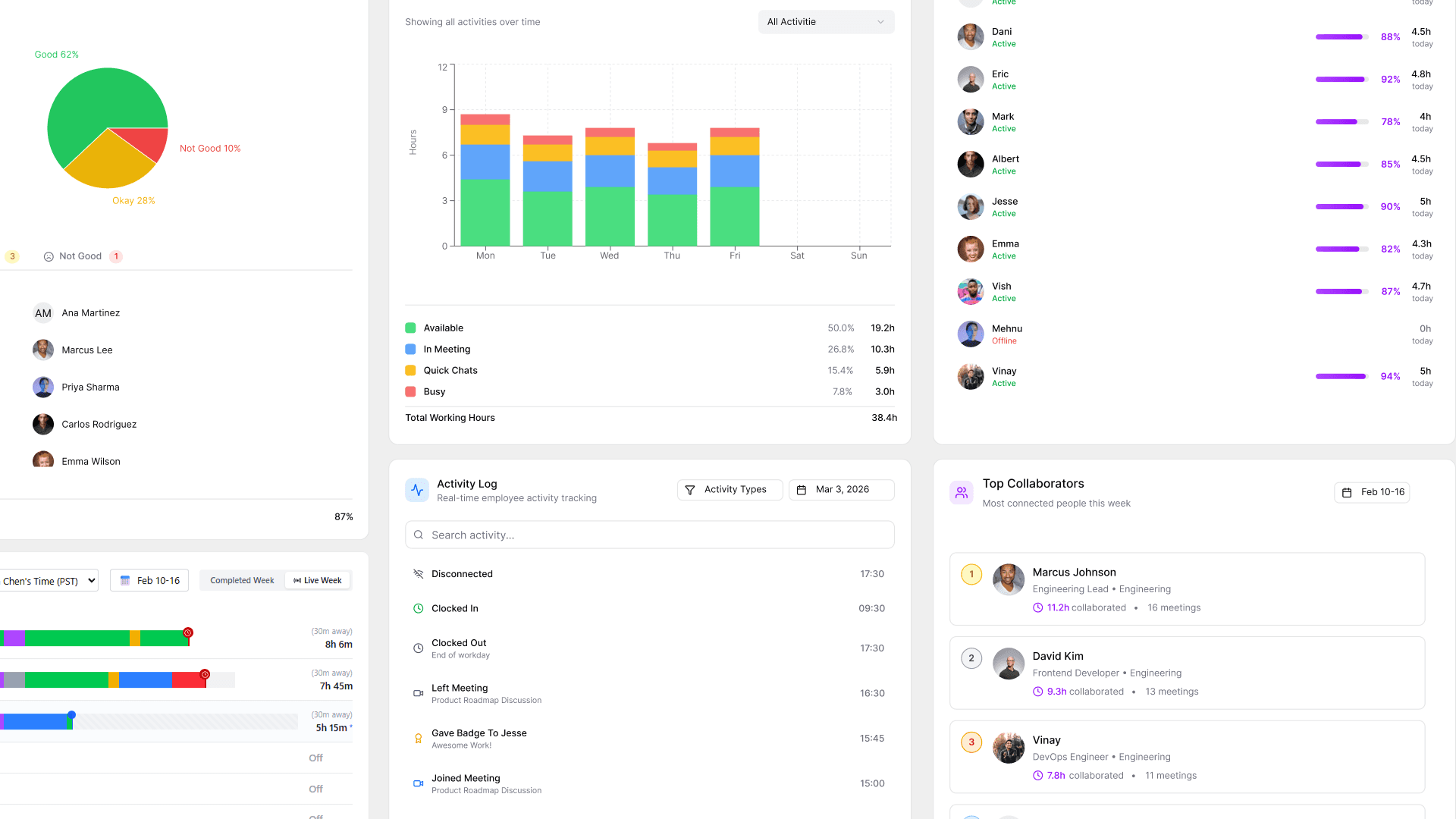
Remote Team Analytics: Complete Guide to Data-Driven Remote Work Management in 2026
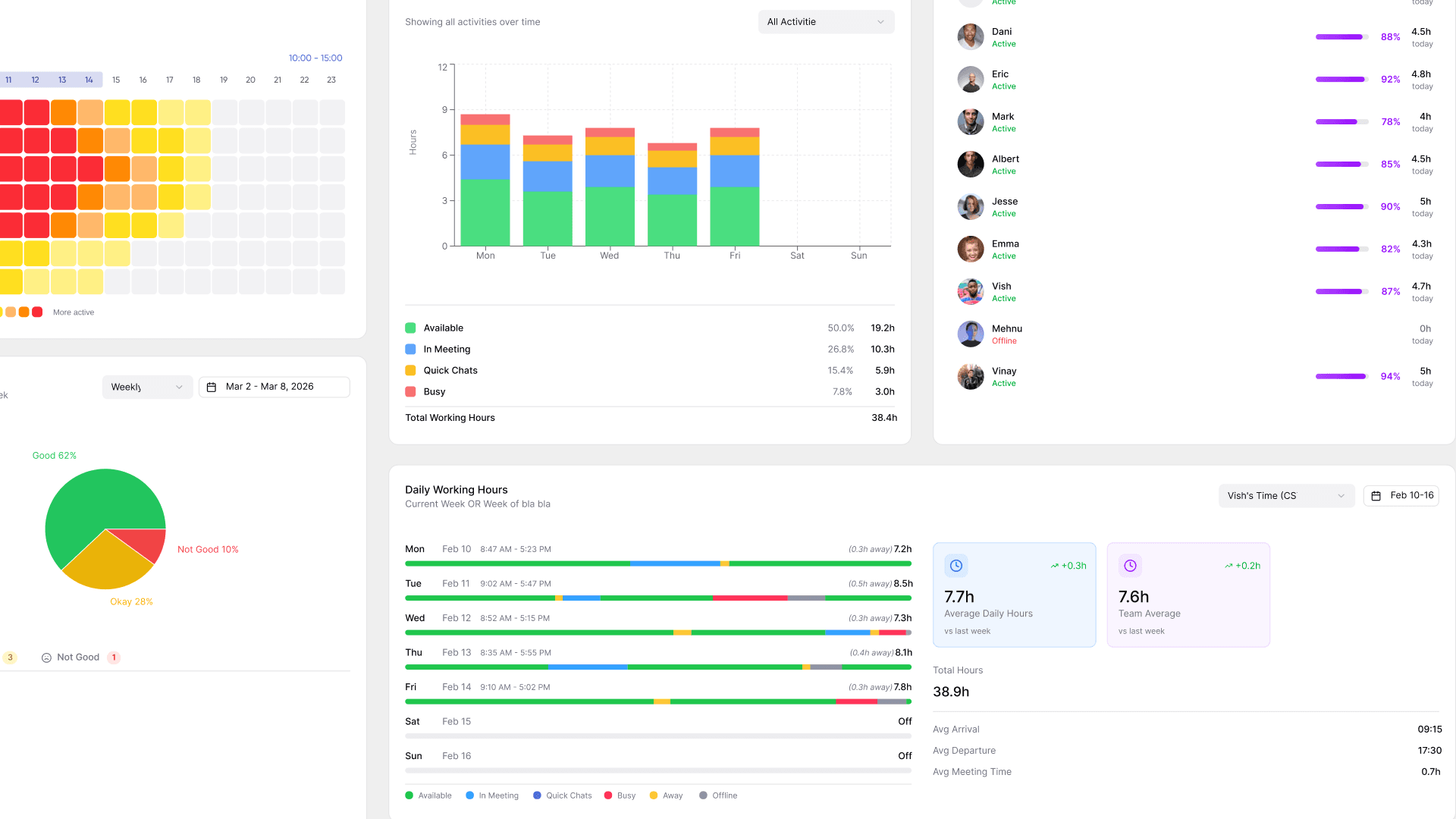
Complete Guide to Gaining Visibility Into Remote Team Performance and Collaboration