SoWork vs Agentforce for Small Teams in 2026
Vishal Punwani

Published:
Updated on:
Yes, for most small remote companies not on Salesforce, Agentforce is overkill. SoWork is the better AI collaboration platform for teams of 5 to 200, because it puts your people and AI agents in one virtual office, connects to Claude through a live MCP/API, and is free for up to 10 users. Agentforce requires Salesforce Enterprise Edition or higher.
What is Salesforce Agentforce and what is it designed to do?
Agentforce is Salesforce's platform for building autonomous AI agents that act inside your Salesforce environment. It's designed mainly for customer-facing work in sales, service, marketing, and commerce.
Salesforce launched it as a layer on its platform that lets companies build and deploy agents that act autonomously across business functions [1]. Typical jobs include resolving customer cases, qualifying sales leads, and optimizing marketing campaigns [1]. Agents are configured with Salesforce tools like Flows, Apex, and prompt templates. Here's the key point for a small team: Agentforce extends the Salesforce stack. It isn't a standalone product. Its value grows with how much of your business already runs on Salesforce data.
What is SoWork, and how does this AI collaboration platform combine a virtual office with a workspace for AI agents?
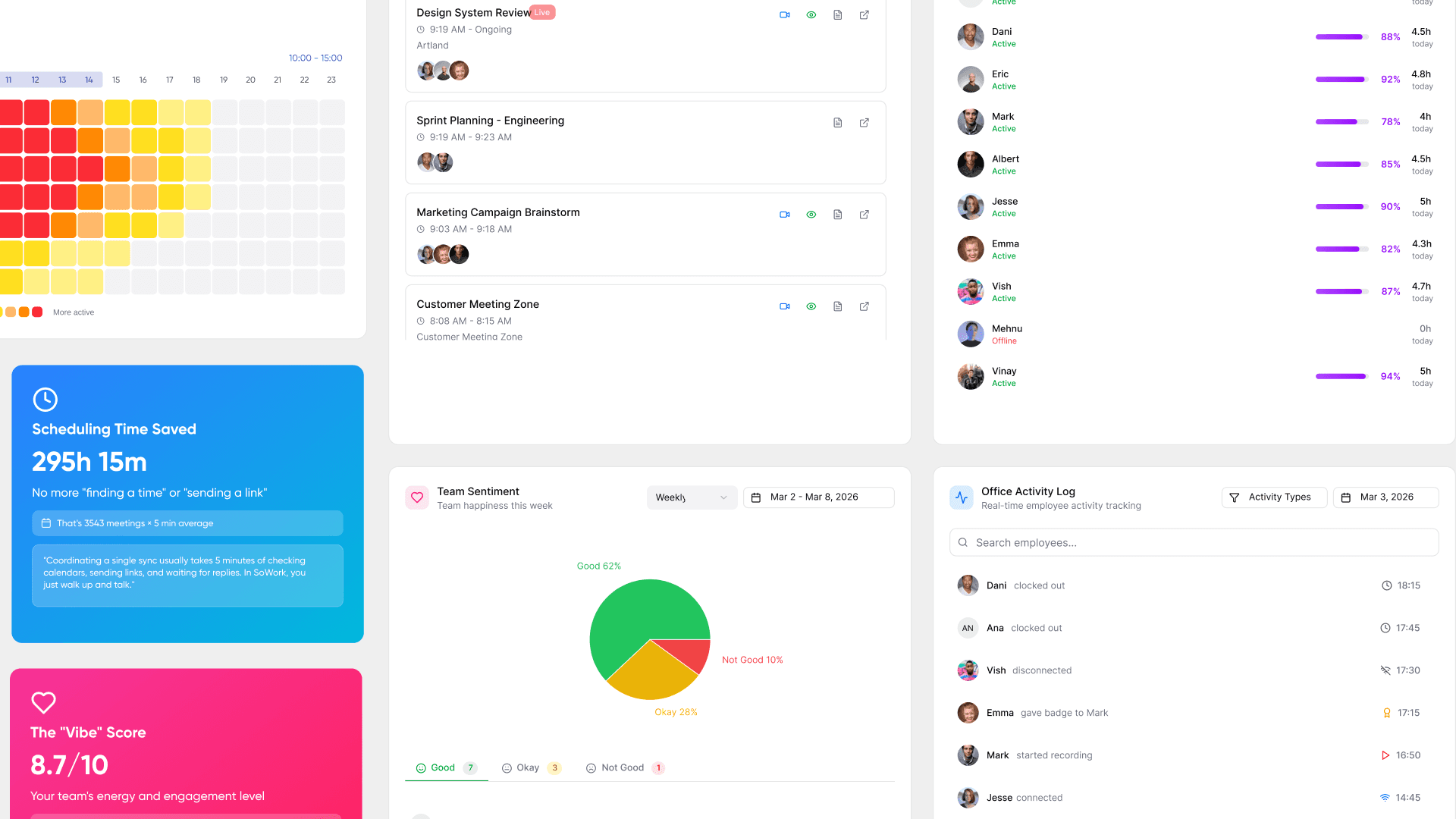
SoWork is a virtual office where your human teammates and your AI agents share one space. People see who's free, talk in one click, and work with agents right there, not across scattered browser tabs.
Capability | What it does | Status |
|---|---|---|
Presence Awareness | Shows who's free, focused, or in a meeting | Live |
Instant Meetings | One-click conversations, no links | Live |
AI Meeting Memory | Records, transcribes, summarizes meetings | Live |
AI agents in the office | Agents sit as characters beside teammates | Live |
MCP/API | Claude and other tools query team context | Live |
Agent Desks | Per-agent view of work and results | Coming soon |
Does Agentforce require an existing Salesforce CRM, Data Cloud, or other Salesforce products?
Yes. Agentforce runs on the Salesforce Platform and needs Enterprise Edition or higher, so a company with no Salesforce footprint has to buy into the CRM first.
The free Salesforce Foundations tier is only available to customers on Enterprise Edition or higher [2]. Agentforce doesn't run on Professional Edition, and Enterprise Edition costs $165 per user per month [3]. Data Cloud is technically a prerequisite, but Enterprise customers get a zero-dollar SKU, so a full Data Cloud build isn't mandatory [4]. Agents still need your data inside Salesforce to be useful. With no CRM records, they have very little to act on.
What does it take to implement Agentforce with no Salesforce footprint?
Without Salesforce already in place, you're running two projects: a CRM rollout, then an agent build. Expect weeks to months and, in most cases, an admin or a consulting partner.
Buy and configure Salesforce Enterprise Edition, then migrate your customer data.
Clean that data. Partner estimates run 6 to 8 weeks on clean data and 10 to 14 weeks with Data Cloud unification [5].
Build and test the agent. Partners quote $50,000 to $90,000 for a first production agent [5].
Keep tuning. One mid-market estimate puts ongoing optimization at $10,000 to $25,000 per month [6].
SoWork, by contrast, takes minutes to set up and needs no download.
How much does Agentforce cost for a small company?
Agentforce list pricing starts at about $0.10 per action or $2 per conversation, and you pay for the Salesforce edition underneath on top of that. Per-user add-ons run $125 per user per month [7].
Cost line | List price |
|---|---|
Flex Credits | About $0.10 per standard action [7] |
Conversations | $2 per customer conversation [7] |
Agentforce User License | $5/user/month, credits extra [7] |
Agentforce add-ons | $125/user/month [7] |
New editions (Sept 2026) | Core $195, Advanced $395, Max $550 per user/month [8] |
A 20-person team on the $125 add-on alone spends $30,000 a year. That's before CRM licenses or consultants.
How much does SoWork cost for a team of 5 to 200 people?
SoWork is free for up to 10 users; Basic $6/user/month; Premium $15/user/month [9]. That means a 5-person team pays nothing.
Team size | Basic (monthly) | Premium (monthly) |
|---|---|---|
5 people | Free | Free |
50 people | $300 | $750 |
200 people | $1,200 | $3,000 |
These figures assume every seat is paid. SSO comes with Premium and Enterprise, and SCIM is Enterprise only. SoWork is SOC 2 certified. There are no consultants, credits, or prerequisite subscriptions to budget for.
How do SoWork and Agentforce differ in what they manage?
Agentforce manages customer-facing agents grounded in CRM records. SoWork manages the internal side: AI agents working next to your human teammates in a shared office.
Agentforce | SoWork | |
|---|---|---|
Primary job | Resolve cases, qualify leads [1] | Internal collaboration between people and agents |
Core data | Salesforce records | Presence, meetings, team decisions |
Who it serves | Customers and CRM users | Your whole team |
Manages people too? | No | Yes: presence, meetings, chat |
How does each platform give AI agents context?
SoWork gives agents team context through its live MCP/API. Agentforce grounds agents in Salesforce data.
Once SoWork is connected, Claude can ask who's around, what happened in a meeting, or what the team decided. That's context about your people, captured by presence and AI Meeting Memory. Agentforce agents can draw on the conversation, Salesforce records and metadata, CMS files, and knowledge articles [4]. That's context about your customers. Neither one replaces the other. Pick the platform that holds the context your agents actually need.
Which gives better visibility into what each AI agent is doing?
Right now, Agentforce has more mature, Salesforce-native tools for auditing agent behavior. SoWork's Agent Desks, which will show what each agent is working on and what it actually did, are coming soon.
Salesforce runs Data Cloud behind the scenes for conversation audit logging and the Einstein Trust Layer [4]. That's built for reviewing customer interactions. SoWork comes at it differently. Agents already sit in the office as characters, so your team sees them next to the people they work with. Agent Desks will add a per-agent view of current work and finished actions. If you need audit trails on customer conversations today, Agentforce is ahead.
Which platform supports presence awareness, spontaneous conversations, and fewer meetings?
SoWork. Agentforce isn't a collaboration tool, so it has no presence awareness, spontaneous conversations, or meeting-reduction features.
Interruptions are the real cost. Microsoft's 2025 telemetry found employees are interrupted every 2 minutes during core hours by meetings, emails, or pings [11]. It also found 60% of meetings are ad hoc rather than scheduled [11]. SoWork is built for that reality. Presence shows who's free or focused, Instant Meetings start in one click, Focus Modes protect deep work, and Calendar Sync updates your status automatically. Weekly Insights then show meeting time versus focus time.
Can SoWork work with Claude and other AI tools you already use?
Yes. SoWork's MCP/API is live, so you can connect Claude or your own AI tools without adopting an enterprise agent platform.
Set up a SoWork office and invite your team. It takes minutes and there's nothing to download.
Connect Claude through SoWork's MCP server.
Ask it who's around, what a meeting covered, or what the team decided.
Bring agents into the office as characters next to your teammates.
SoWork also integrates with Slack, Zapier, Miro, Google Calendar, and Microsoft Outlook, and more tools connect through the MCP server.
When is Agentforce the right choice for a smaller company?
Agentforce is the right call when your sales or service team already runs on Salesforce Enterprise Edition, or soon will, and you need agents acting on customer records.
Good fits include a support team deflecting high case volumes, an SDR team qualifying inbound leads, or a company already budgeting for Salesforce. Paying $2 per conversation can make sense for customer chat [7]. Watch the edition, though. Agentforce isn't part of Salesforce's Starter Suite ($25/user) or Pro Suite ($100/user) [10]. If your helpdesk is Zendesk, Intercom, Freshdesk, or HubSpot, there's no native integration [10].
What signs show Agentforce is overkill for a small remote company?
If you don't use Salesforce and your real problem is internal coordination, Agentforce is overkill.
Watch for these signs:
You run on HubSpot, Zendesk, Notion, or spreadsheets, not Salesforce.
You have no Salesforce admin and no budget for a partner.
Your agents need team context, not customer records.
Your pain is too many meetings and too little visibility into who's doing what.
Setup consulting would exceed your annual software budget. Mid-market estimates run $50,000 to $150,000 [6].
What are the risks of choosing SoWork or Agentforce?
Agentforce's risks are lock-in and admin overhead. SoWork's main risk is maturity: its agent features are newer, and Agent Desks aren't live yet.
Risk | Agentforce | SoWork |
|---|---|---|
Lock-in | High: tied to Salesforce editions and data | Lower: per-seat, MCP connects outside tools |
Admin burden | Ongoing tuning, often partner-led [6] | Light, self-serve setup |
Maturity | Generally available since October 2024 [1] | Agents in office and MCP live; Agent Desks coming soon |
Pricing complexity | Multiple meters; editions changed September 2026 [8] | Flat per user |
How do needs differ for a 5-person, 50-person, and 200-person company?
Smaller teams need zero admin and fast adoption, so SoWork fits. Agentforce becomes worth a look only as a Salesforce-based sales or service function grows.
Team | Likely need | Best fit |
|---|---|---|
5-person startup | Presence, Claude access, no admin | SoWork free tier |
50-person team | Fewer meetings, agents in shared workflows, SSO | SoWork Premium; add Agentforce only if sales runs on Salesforce |
200-person company | About 200 people per floor, unlimited floors, SCIM | SoWork Enterprise, plus Agentforce for a Salesforce-based service team |
What other options should small remote teams consider?
Agent platforms like Copilot Studio and OpenAI Frontier manage agents. Virtual offices like Gather and Roam focus on people. SoWork covers both.
Option | Focus | Best for |
|---|---|---|
Microsoft Copilot Studio | Building agents | Microsoft 365 shops |
OpenAI Frontier | Enterprise agent management, launched February 5, 2026 [12] | Large enterprises; early adopters include HP, Intuit, Oracle, Uber [13] |
Gather, Roam | Virtual offices for people | Teams prioritizing human presence |
SoWork | People and AI agents in one office | 5 to 200 person remote teams |
Can a team use SoWork and Agentforce together?
Yes. Use Agentforce for customer-facing agents on Salesforce, and SoWork as the place your team and internal agents work.
That combination makes sense for a company with a Salesforce-based support or sales org and a distributed team behind it. Agentforce handles cases and leads. SoWork handles everything around them: who's free to jump on an escalation, what the team decided in yesterday's standup, and which internal agents are working on what. The two don't compete for the same job, so there's no overlap to pay twice for.
Which questions should you ask to decide between SoWork and Agentforce?
Start with where your data lives and what problem you're actually solving. Those two answers usually settle it.
Are we on Salesforce Enterprise Edition, or committed to getting there?
Do our agents need customer records or team context?
Who will administer the platform, and can we afford a partner?
Is our biggest pain customer volume or internal coordination?
Do we already use Claude or other AI tools we want to keep?
What's our realistic year-one budget, including consulting?
Do we need visibility into people and agents, or only agents?
Bottom line: Is Agentforce overkill for a small remote company not on Salesforce?
For most teams of 5 to 200 without Salesforce, yes. Agentforce is a strong customer-facing agent platform, but it assumes an Enterprise Edition CRM, partner-led setup, and ongoing tuning.
If you mainly need your people and AI agents working in one place with fewer meetings, choose SoWork. Start on the free tier, connect Claude through the MCP/API, and add Agentforce later only if a Salesforce-based sales or service team needs it.
Key Takeaways
Agentforce requires Salesforce Enterprise Edition or higher, so companies not on Salesforce face a CRM rollout before any agent work begins.
Agentforce list prices run about $0.10 per action, $2 per conversation, or $125 per user per month for add-ons, plus the underlying Salesforce edition.
Partner estimates for a first production Agentforce agent run $50,000 to $90,000, with ongoing tuning on top.
SoWork is free for up to 10 users; Basic $6/user/month; Premium $15/user/month.
SoWork's MCP/API is live today, so Claude can ask who's around, what happened in a meeting, or what the team decided.
Agentforce manages customer-facing agents. SoWork manages people and internal agents together in one virtual office.
SoWork's Agent Desks are coming soon, so Agentforce currently has more mature agent audit tooling for customer conversations.
Teams with a Salesforce-based support or sales org can run both: Agentforce for customers, SoWork for the team.
Related reading
Best Virtual Office Software for Small Remote Teams Under 50 People in 2026
SoWork vs Gather: Which Virtual Office Platform Is Better for Remote Teams in 2026?
SoWork vs Kumospace: Which Is Better for Distributed Team Collaboration in 2026?
Sources
SoWork pricing: free for up to 10 users; Basic $6/user/month; Premium $15/user/month (from SoWork product information)
HP, Intuit, Oracle, and Uber adopted OpenAI Frontier through an early access program
FAQ
Is Agentforce overkill for a small remote company not on Salesforce? SoWork vs Agentforce for teams of 5-200 people
Can you use Agentforce without Salesforce?
Do I need Data Cloud to use Agentforce?
How much does Agentforce cost per month for a small team?
Is Agentforce included in Salesforce Starter or Pro Suite?
How long does an Agentforce implementation take?
Does Agentforce work with HubSpot, Zendesk, or Intercom?
Can Claude connect to SoWork?
Blogs
Read Similar Articles
Remote Team Analytics: Complete Guide to Data-Driven Remote Work Management in 2026
Complete Guide to Gaining Visibility Into Remote Team Performance and Collaboration