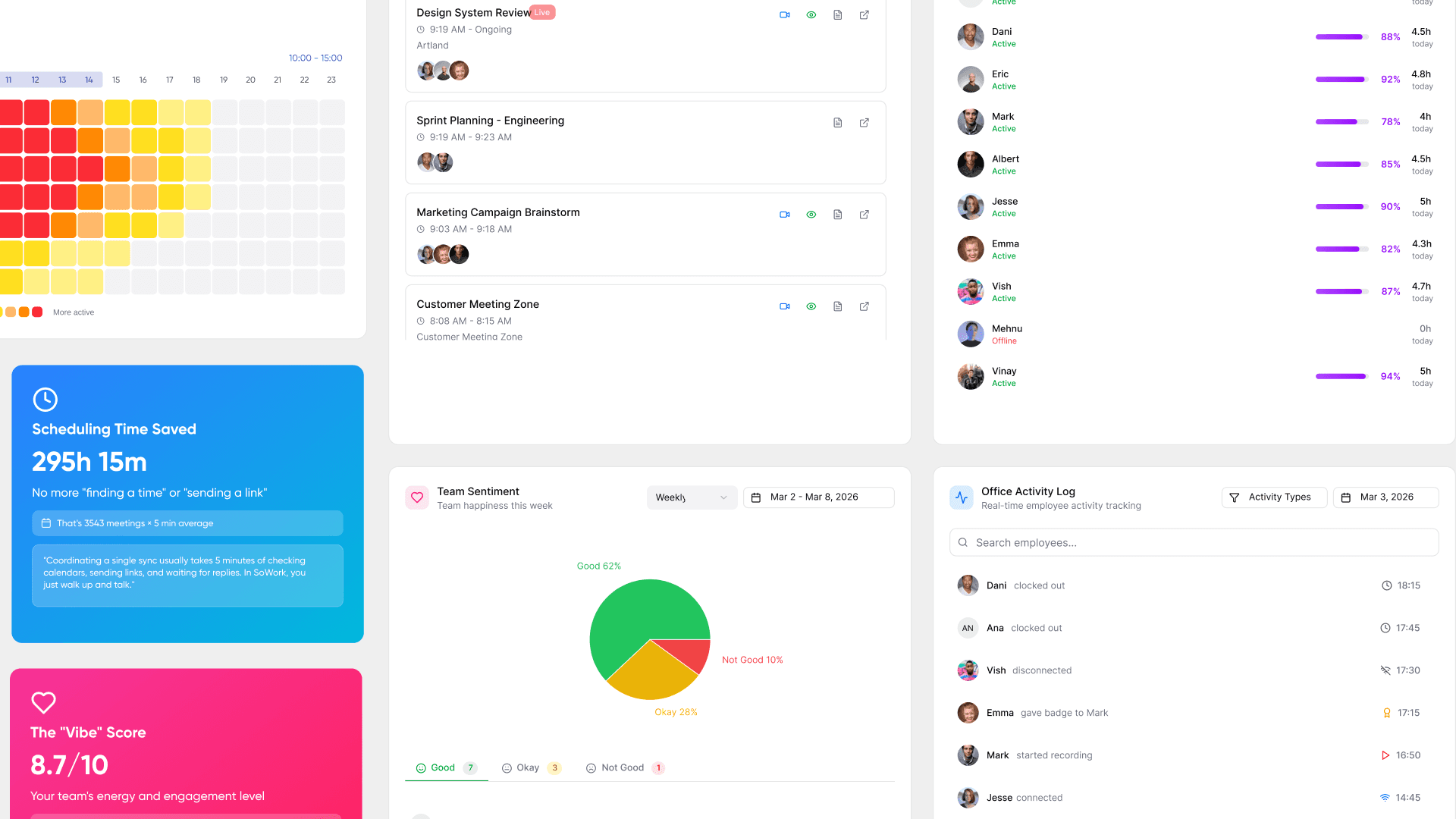
Integrações entre SoWork e Kumospace em 2026
Vishal Punwani

Publicado em:
Atualizado em:
SoWork fits most remote stacks better in 2026. It connects natively to Slack, Google Calendar, Outlook and Miro, adds Zapier automation, and has a live MCP/API so AI tools like Claude can work with your office. SSO starts on its $15/user/month Premium plan. Kumospace is the better pick if your team chats in Microsoft Teams or needs native Linux apps.
What is SoWork and what integrations does it support natively in 2026?
SoWork is a virtual office for remote teams and their AI agents. It integrates natively with Slack, Zapier, Miro, Google Calendar and Microsoft Outlook [1]. Through its live MCP/API, Claude or your own tools can ask who's around, what happened in a meeting, or what the team decided.
That covers both halves of your stack: the people and the AI.
Integration | What it does |
|---|---|
Google Calendar / Outlook | Updates your status automatically when an event starts |
Slack | Keeps your chat connected to the office |
Zapier | Sends meeting summaries and action items to tools like Notion or Asana [8] |
Miro | Whiteboards for visual collaboration |
MCP/API | Lets AI tools look up presence, meetings and decisions |
You can connect more tools through SoWork's MCP server.
What is Kumospace and what integrations does it support natively in 2026?
Kumospace is a spatial virtual office built around spatial audio and spontaneous conversation. It integrates with Slack, Microsoft Teams, Google Calendar and Outlook [2].
Its calendar sync shows your events inside the space, sends meeting reminders and sets your status automatically [3]. Two Google Workspace add-ons attach Kumospace conference rooms to Calendar events [4]. It also has native apps for iOS, Android, Windows, Mac and Linux [7]. The catch is automation. One independent review says Kumospace doesn't connect as easily with Zapier or many other work apps [10].
How do SoWork and Kumospace compare on Slack and Microsoft Teams integration?
Both connect to Slack. Of the two, only Kumospace lists a Microsoft Teams integration [2]. SoWork pairs Slack with Zapier, so your office data can trigger automations in other tools.
Tool | SoWork | Kumospace |
|---|---|---|
Slack | Native [1] | Native. Teammates click a shared room link in a channel to meet [13] |
Microsoft Teams | No native integration listed | Listed integration [2] |
Automation beyond chat | Zapier on Premium [9] | Reviewers say Zapier support is weak [10] |
If your company runs on Teams chat and that won't change, count this gap. If you're on Slack, SoWork gives you more to work with.
How do SoWork and Kumospace work with Zoom and Google Meet?
Both platforms have their own built-in video, so you don't need Zoom or Meet for internal calls. SoWork also records, transcribes and summarizes meetings automatically, so the call and its notes end up in the same place.
Kumospace's homepage has shown a Zoom logo among its integrations [16]. Its Google Calendar add-on puts Kumospace conferencing in the calendar's video options [4]. SoWork takes a different approach and removes scheduled links altogether: you see who's free, click once and start talking. Recordings and AI summaries come with Premium [9]. If clients insist on Zoom or Meet, keep using them for external calls and run your internal work in the virtual office.
Which project management tools do SoWork and Kumospace connect with?
Neither platform has native Asana, Jira, Linear or Notion integrations. SoWork connects to them through Zapier, which can send meeting action items and summaries to Notion or Asana [8]. Reviewers say Kumospace has no comparable automation path [10].
Tool | SoWork | Kumospace |
|---|---|---|
Asana | Through Zapier | Shared links, manual updates |
Notion | Through Zapier | Shared links, manual updates |
Jira / Linear | Through Zapier connectors | Shared links, manual updates |
AI assistants that read team context | Live MCP/API | Not offered |
The practical result is that decisions made on a SoWork call can turn into tracked tasks without anyone copying them over by hand.
How do SoWork and Kumospace handle Google Calendar and Outlook?
Both sync Google Calendar and Outlook and change your status automatically when a meeting starts [1][3]. This is the one area where the two are close to even.
Kumospace syncs both public and private events. For private events it hides the details but still shows whether you're available [3]. You can also RSVP from inside the space. SoWork's Automatic Calendar Sync updates your status the moment an event begins, and that status drives its free, focused and in-a-meeting indicators. One thing to know about Kumospace: syncing rooms to Google Calendar requires admin rights in both Google Workspace and Kumospace [4].
Do SoWork and Kumospace support Zapier, Make or an open API?
SoWork supports both: Zapier on Premium [9] and a live MCP/API that AI tools like Claude can query [1]. We couldn't verify a public Zapier app or open API for Kumospace, and reviewers point to weak Zapier support [10].
This matters more than it sounds. A Harvard Business Review study found workers switch between apps about 1,200 times a day and lose just under four hours a week getting reoriented [11]. Automation cuts out some of that switching. In SoWork, a Zap can send summaries to your docs tool, and the MCP server lets an assistant answer "who's online?" without anyone opening another tab. We didn't find a native Make connector for either platform.
How do SoWork and Kumospace handle SSO with Okta, Google Workspace and Azure AD?
Kumospace offers SAML and OIDC single sign-on only on its custom-priced Enterprise plan [5][6]. SoWork includes SSO on Premium ($15/user/month) and Enterprise, and adds SCIM provisioning on Enterprise only.
Capability | SoWork | Kumospace |
|---|---|---|
SSO plan | Premium and Enterprise | Enterprise only [5] |
Protocols | SSO (confirm your identity provider with sales) | SAML, OIDC [6] |
SCIM provisioning | Enterprise | Not listed |
Certification | SOC 2 | Check with vendor |
Okta, Google Workspace and Azure AD (Entra ID) all support SAML-style SSO. Confirm the exact setup for your provider during a trial.
What criteria should a remote team use to judge virtual office stack fit?
Begin with the tools you already rely on most, which are usually your chat app, calendar and identity provider. Then check automation, security tiers and device coverage.
Chat layer: Is it Slack or Microsoft Teams?
Calendar: Does a calendar event update presence without anyone touching it?
Automation: Is there Zapier, an open API or an MCP server?
Security: Which plan includes SSO and SCIM?
Devices: Does it run in the browser, on desktop and on mobile?
Meeting outputs: Where do summaries and action items go?
Pilot: Have one team use it every day for two weeks before you roll it out.
Which platform fits Google Workspace teams vs. Microsoft 365 teams better?
Google Workspace teams can use either platform, but SoWork is the stronger choice if you also use Slack. If your Microsoft 365 team chats in Teams, only Kumospace offers a native Teams link [2].
Both sync Google Calendar and Outlook. Kumospace adds Google Workspace Marketplace add-ons for booking conference rooms [4]. SoWork combines calendar sync with Slack and Zapier, which suits the common Google-plus-Slack setup. If your company runs Outlook but chats in Slack, SoWork fits right in. If Teams is where your company talks and you don't plan to switch, Kumospace has the edge on paper.
Which platform is better for engineering teams using GitHub, Jira or CI/CD?
SoWork is the better choice for engineering-heavy teams. Zapier and its MCP/API connect it to GitHub, Jira and build tools, and your AI agents can work in the same office as your engineers.
SoWork lists GitHub among its integrations [9]. With Zapier, you can post Jira transitions or failed builds to the team. The bigger win is this: engineers already using Claude can connect it to SoWork through MCP and ask what the team decided in yesterday's architecture sync. AI agents already sit in the office next to people. Agent desks, which will show what each agent did, are coming soon. Kumospace mostly brings engineers together through shared Slack room links [13].
What are the risks of relying on either platform's integrations?
The biggest risk is coverage. Neither platform connects natively to every tool you use, so you'll fill the gaps with Zapier, shared links or manual work.
Kumospace: SSO requires Enterprise [5], and automation options are limited [10].
SoWork: Zapier and MCP need Premium [8][9]. There's no native Teams integration, and SCIM is Enterprise-only.
Both: Every automation you add through a third party is another thing that can break and needs watching.
Video: One SoWork reviewer said its video calls weren't quite as reliable as Google Meet or Zoom [14].
Plan for these gaps before you roll out, not after.
How do setup and onboarding compare for IT administrators?
SoWork is quicker to deploy. You can set up an office and invite your team in minutes, with nothing to install. Kumospace's Google Calendar room sync requires admin rights in both Google Workspace and Kumospace [4].
Step | SoWork | Kumospace |
|---|---|---|
Access | Browser, no download | Browser or native apps [7] |
Calendar | Each user connects Google or Outlook | Each user connects; an admin installs Workspace add-ons [4] |
SSO | Included in Premium | Enterprise, with SAML details exchanged [5] |
Automation | Connect Zapier on Premium | Weak Zapier support, per reviewers [10] |
Fewer setup steps means fewer support tickets in your first week.
What do real teams report about integration reliability and sync speed?
We found no public, independent benchmark of integration sync speed for either platform in 2026, so take vendor claims with some caution.
Here's what user reviews do show. G2 reviewers rate Kumospace's mobile app 7.6, compared with 9.1 for Slack's [12]. One SoWork reviewer said the Zapier and Google Calendar integrations each took one click to set up, but found video calls less reliable than Google Meet or Zoom [14]. During your pilot, measure two things yourself: how fast status changes when a calendar event starts, and whether Zaps fire on time.
How do pricing tiers affect access to advanced integrations?
SoWork costs less for its advanced integrations. Zapier, MCP and SSO all come with Premium at $15/user/month, while Kumospace keeps SSO on custom-priced Enterprise [7].
Tier | SoWork | Kumospace |
|---|---|---|
Free | Up to 10 users | Up to 5 members [6] |
Mid tier | Basic $6/user/month | Business $16/user/month annual, $20 monthly [7] |
Advanced | Premium $15/user/month (Zapier, MCP, SSO) | Enterprise custom (SSO, custom domain, uptime SLA) [7] |
Provisioning | SCIM on Enterprise | Not listed |
For a 25-person team that needs SSO, SoWork's published price is the one you can actually plan around.
Do Gather, Teamflow or Sococo offer stronger integrations?
None of them clearly beats both on integrations. Teamflow embeds the most third-party apps directly in the office canvas.
Teamflow integrates with Slack and Zoom and embeds apps like Google Docs, Trello, Notion, Salesforce and Figma [9]. Gather lets you schedule meetings from Google Calendar and includes AI notes [15]. We couldn't verify a broad integration catalog for Sococo. Among the platforms we checked, none published a live MCP server like SoWork's, which matters if AI agents are part of your plans.
How do SoWork and Kumospace compare on mobile and browser access?
Kumospace has more native apps, covering iOS, Android, Windows, Mac and Linux [7]. SoWork runs in the browser with nothing to download and also has iOS and Android apps [8].
Browser access helps on locked-down company laptops where IT won't approve new installs. Native desktop apps help if your engineers run Linux and want a dedicated window. Mobile quality varies, and G2 reviewers score Kumospace's mobile app 7.6 [12]. Test on the devices your team actually uses, not the ones on the spec sheet.
Which platform fits a typical remote work stack better in 2026?
SoWork is the better fit for a typical 2026 stack built on Slack, Google or Outlook calendars and Zapier, especially if you're bringing in AI agents. Kumospace is the better fit if Microsoft Teams is your chat app or you need native Linux apps.
If you... | Pick |
|---|---|
Run Slack plus Google Workspace | SoWork |
Want tasks to flow to Asana, Notion or Jira | SoWork |
Want Claude or other AI tools to access team context | SoWork |
Need SSO without Enterprise pricing | SoWork |
Chat in Microsoft Teams | Kumospace |
Need native Linux desktop apps | Kumospace |
Bottom line: which virtual office should you choose for your stack?
For most Slack-based remote teams, SoWork fits the existing stack better. You get native calendar and Slack sync, Zapier automation, a live MCP/API for AI tools, and SSO at $15/user/month.
Pick Kumospace only if Microsoft Teams is your chat app or Linux desktop apps are a must. Either way, run a two-week pilot that checks calendar-to-presence accuracy and whether your automations fire.
Key Takeaways
SoWork integrates natively with Slack, Zapier, Miro, Google Calendar and Outlook, and has a live MCP/API for AI tools like Claude.
Kumospace integrates with Slack, Microsoft Teams, Google Calendar and Outlook, but reviewers say its automation support is limited.
Both sync Google Calendar and Outlook and update your status automatically when a meeting starts.
SSO is included in SoWork Premium ($15/user/month). Kumospace keeps SSO on its custom-priced Enterprise plan.
Neither platform connects natively to Asana, Jira, Linear or Notion. SoWork reaches them through Zapier.
Choose Kumospace if your company chats in Microsoft Teams or needs native Linux apps.
Before you commit, pilot for two weeks and measure status sync speed and whether automations fire.
Related reading
Kumospace Vs SoWork: Which Virtual Office Is Best For Your Team?
SoWork vs Kumospace: Which Is Better for Distributed Team Collaboration in 2026?
Sources
Kumospace integrates with Slack, Microsoft Teams, Google Calendar, and Outlook
Kumospace SSO setup requires the Enterprise plan and supports SAML
Kumospace Enterprise plan offers OIDC and SSO; Free plan limited to 5 members
Kumospace has fewer integrations and doesn't connect as easily with many work apps or Zapier
Gather supports scheduling meetings from Google Calendar and AI notes and transcriptions
Kumospace homepage displays integration logos including Zoom, RingCentral, Google Drive and Miro
Perguntas Frequentes
Integrações do SoWork vs. Kumospace: qual escritório virtual se adapta melhor a uma pilha de trabalho remoto já existente em 2026?
O Kumospace se integra ao Zapier?
O SoWork se integra ao Microsoft Teams?
O SoWork ou o Kumospace é mais barato?
Posso conectar o Claude ou outros assistentes de IA a um escritório virtual?
O Kumospace inclui SSO no plano Business?
Um escritório virtual substituirá o Slack ou o Zoom?
As integrações de calendário do escritório virtual mostram detalhes de reuniões privadas?
Blogs
Leia artigos semelhantes
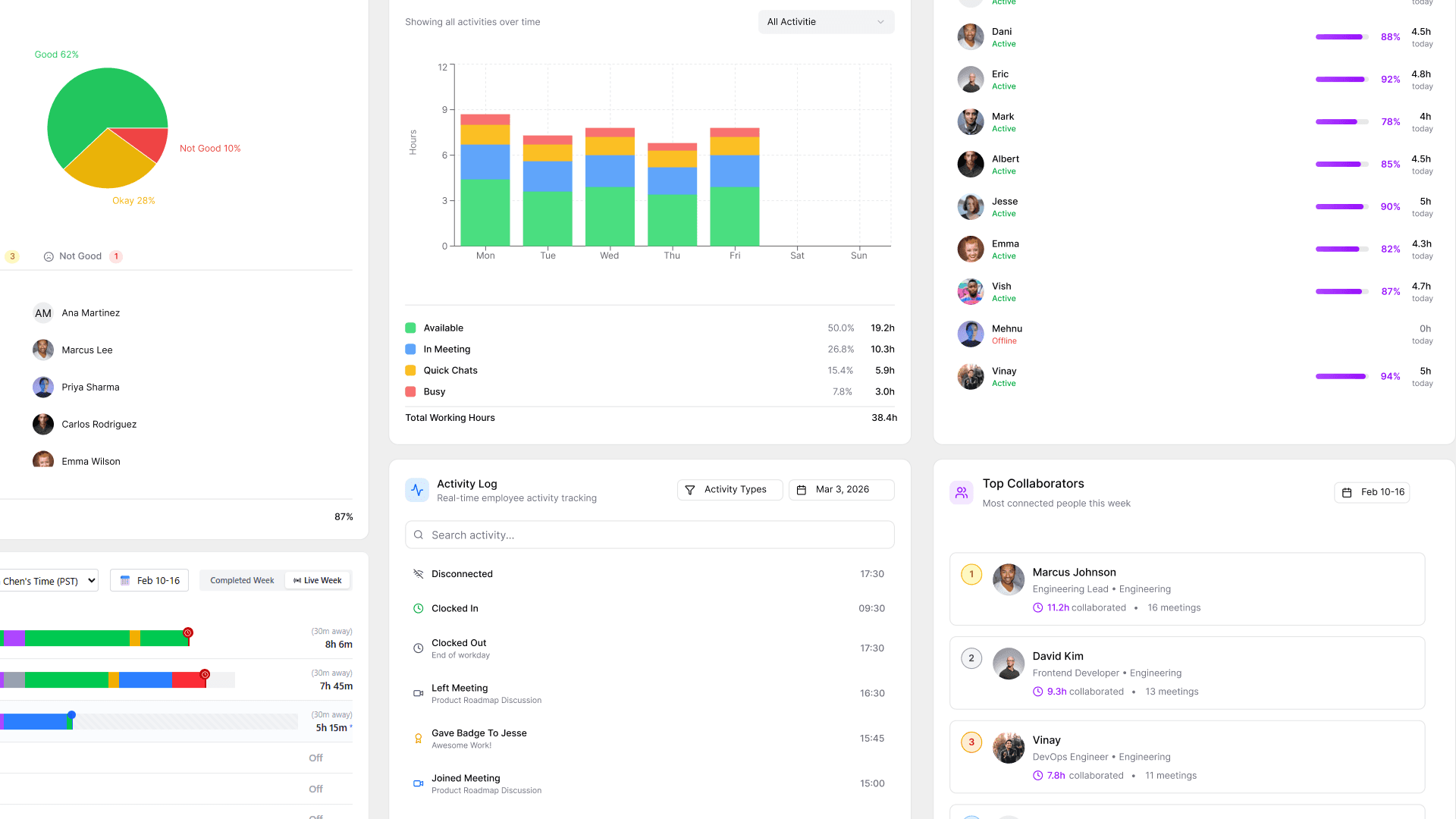
Análise de Equipes Remotas: O Guia Completo para Gestão do Trabalho Remoto Baseada em Dados em 2026
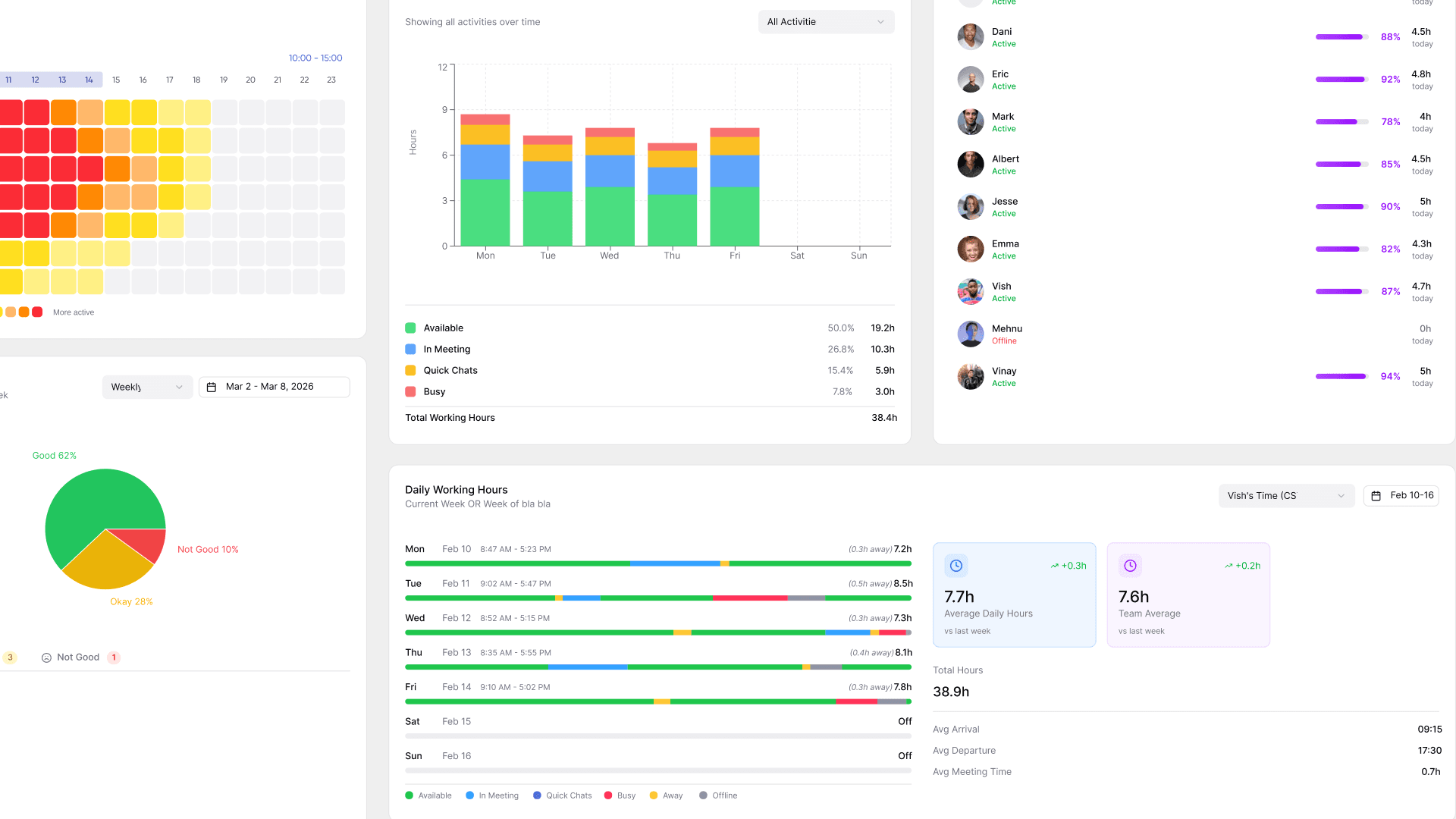
Guia Completo para Obter Visibilidade sobre o Desempenho e a Colaboração de Equipes Remotas