Conversas Virtuais de Corredor para Equipes Remotas
Vishal Punwani

Publicado em:
Atualizado em:
A melhor maneira de recriar conversas espontâneas de corredor para uma equipe remota é uma plataforma de escritório virtual como o SoWork, porque ela combina a percepção de presença em tempo real com reuniões instantâneas em um clique, sem agendamento e sem links. Combine isso com normas culturais que recompensam as visitas rápidas, e sua equipe terá a colisão ambiental de um escritório físico sem o deslocamento diário.
O que exatamente é uma conversa de corredor e por que ela importa?
Uma conversa de corredor é uma troca não planejada e sem grandes cobranças que acontece quando duas pessoas se cruzam, sem pauta, sem convite no calendário. Esses momentos importam porque constroem confiança, trazem à tona impedimentos logo no início e geram ideias que reuniões formais raramente produzem.
Em um escritório físico, as conversas de corredor acontecem constantemente: uma pergunta rápida na mesa de alguém, um balanço de dois minutos após uma reunião, uma ideia aleatória compartilhada perto da máquina de café. Pesquisas confirmam que esses encontros casuais frequentemente geram novas colaborações e soluções inteligentes que não acontecem em reuniões formais [1]. Eles também fortalecem os laços pessoais e criam a sensação de "estar por dentro" que mantém as equipes unidas. Quando eles desaparecem, as equipes sentem isso, mesmo que não consigam nomear exatamente o que está faltando.
[1] buildfixlead.medium.com
Quais dinâmicas de colaboração desaparecem quando uma equipe se torna totalmente remota?
Equipes totalmente remotas perdem a percepção ambiental, as conexões de laços fracos e a serendipidade que impulsiona a inovação multifuncional. Essas perdas são mensuráveis: 66% dos engenheiros remotos relataram uma diminuição na conexão social com os colegas de equipe [1].
Uma pesquisa da Microsoft constatou que 78% dos trabalhadores remotos perceberam uma queda nas atividades sociais de última hora, e 67% disseram que suas necessidades de interação espontânea não foram atendidas [1]. A interação entre equipes também diminui quando o trabalho se torna totalmente remoto, reduzindo o compartilhamento de conhecimento e os "laços fracos" que alimentam novas ideias [2]. O resultado não é apenas a solidão, mas o pensamento isolado, a resolução de problemas mais lenta e uma cultura de equipe que se esvazia gradualmente.
[1] microsoft.com/research [2] worklytics.co
Como um escritório virtual replica a percepção de presença ambiental?
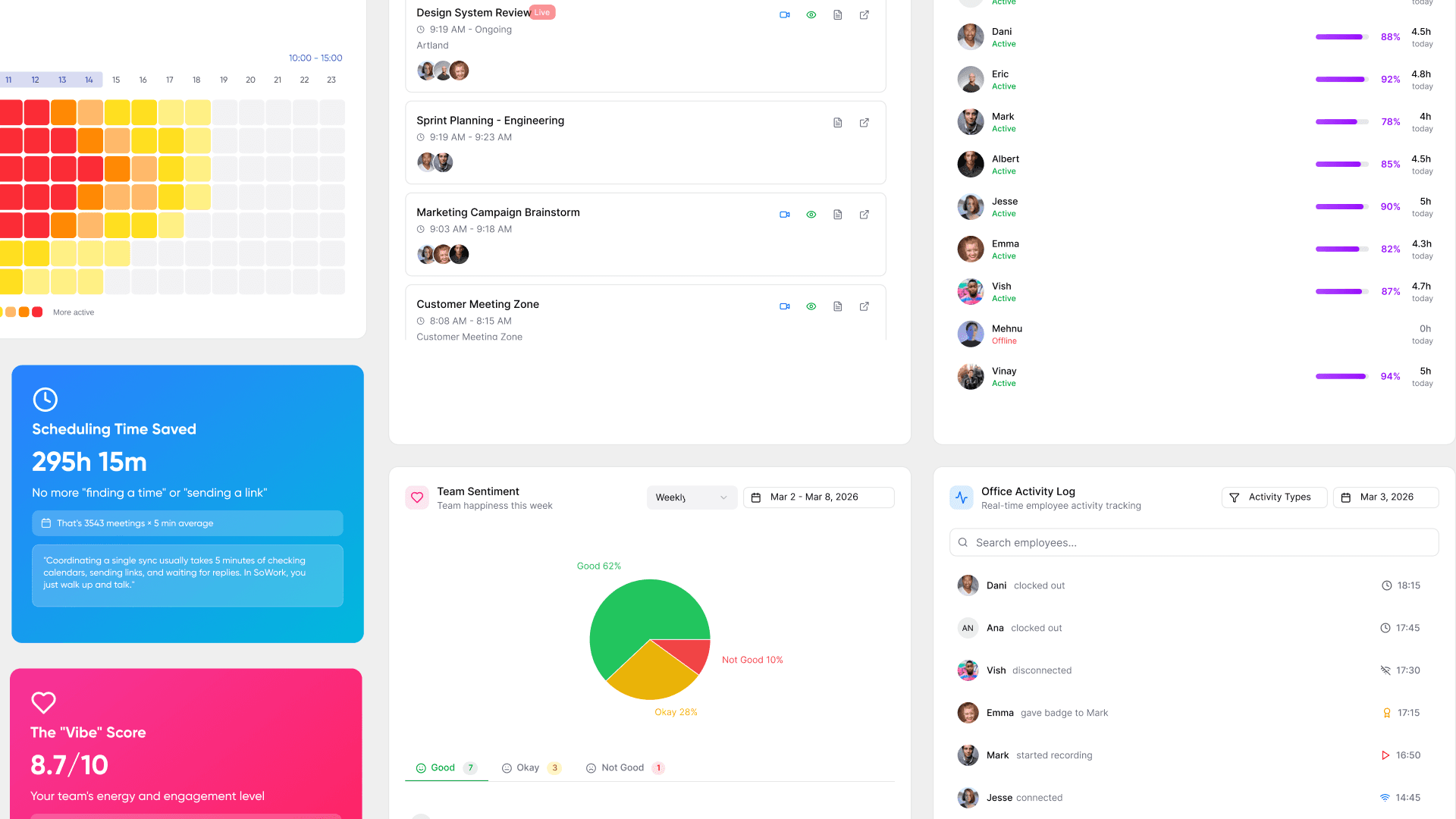
Um escritório virtual mostra, à primeira vista, quem está livre, focado ou em uma reunião, o mesmo sinal ambiental que você recebe ao observar uma sala em plano aberto. O SoWork faz isso com indicadores visuais de presença que são atualizados automaticamente por meio da sincronização do calendário.
Em um escritório físico, você lê a disponibilidade de forma passiva: uma porta fechada, fones de ouvido colocados, alguém caminhando em direção à copa. Os escritórios virtuais replicam isso com sinais de status persistentes. A sincronização automática do calendário do SoWork atualiza seu status no momento em que uma reunião começa, para que os colegas de equipe nunca precisem adivinhar se você pode ser interrompido. Essa percepção passiva é o que faz com que a aproximação espontânea pareça natural, em vez de intrusiva — você pode ver a "porta aberta" antes de bater.
Quais recursos do SoWork fazem com que as conversas não agendadas realmente aconteçam?
As Reuniões Instantâneas do SoWork permitem que você inicie uma conversa em um clique, sem agendamento, sem geração de links, sem atrito. Combinada com indicadores de presença em tempo real e Modos de Foco, a plataforma torna óbvio quem está disponível e facilita o contato.
O atrito do agendamento é o maior vilão da conversa espontânea. O SoWork o remove totalmente: você vê o avatar de um colega de equipe, confirma que ele está livre e clica para conversar. Os Modos de Foco (Modo Simples e Mini Modo) permitem que as pessoas sinalizem momentos de trabalho profundo sem desaparecer completamente do escritório. A Memória de Reunião com IA grava e resume automaticamente o que for discutido, para que um bate-papo de corredor de dois minutos não se perca e não exija uma reunião de acompanhamento para recapitulação.
Como a proximidade espacial em um escritório virtual ativa interações de última hora?
A proximidade espacial funciona tornando a co-localização visível: seu avatar está perto do avatar de um colega de equipe, você pode ver que ele está livre e iniciar uma conversa requer apenas uma ação. Esse gatilho de baixo custo é o que os corredores físicos oferecem, e o que o Slack e o Zoom não conseguem proporcionar.
Em um escritório físico, a proximidade é o gatilho. Você passa por alguém e a conversa começa sozinha. Os escritórios virtuais replicam isso renderizando sua equipe em um mapa ou planta compartilhada. Plataformas como o Gather usam proximidade em pixel-art: caminhe com seu avatar para perto de alguém e uma chamada de vídeo se abre automaticamente [1]. O SoWork usa cartões de presença e botões de conexão instantânea para alcançar o mesmo gatilho com menos esforço de navegação. A chave é reduzir o custo da decisão a quase zero.
[1] gather.town
Como você configura o SoWork para incentivar o movimento natural e encontros casuais?
Projete seu escritório no SoWork com áreas comuns compartilhadas, um lounge, um espaço para café e uma zona multifuncional, posicionados entre as salas das equipes para que as pessoas passem por eles naturalmente. Espaços compartilhados criam o equivalente digital de um corredor.
Comece mapeando seus padrões reais de colaboração: quais equipes mais precisam se encontrar por acaso? Posicione suas salas de forma adjacente, com uma área comum compartilhada no meio. Use o criador de escritórios personalizável do SoWork para criar uma "copa" ou um espaço de "lounge" onde as pessoas possam passar um tempo. Defina uma norma de equipe de que a área comum está sempre aberta para visitas rápidas. A integração leva minutos, sem necessidade de download de software, para que você possa ajustar o layout rapidamente à medida que aprende o que realmente gera as interações.
Reuniões agendadas vs. conversas espontâneas: qual é melhor para a produtividade?
Reuniões agendadas têm alto atrito e muitas vezes são desnecessárias. Conversas espontâneas resolvem os mesmos problemas em uma fração do tempo, sem o desgaste da coordenação. Trabalhadores remotos já participam de 80% mais reuniões por semana do que seus colegas no escritório físico [1].
A Microsoft relata que o tempo semanal de reuniões saltou 252% e o número de reuniões aumentou 153% em comparação com os níveis anteriores a 2020 [2]. Cerca de 67% dessas reuniões são consideradas improdutivas [3]. Um bate-papo rápido de corredor resolve um problema em dois minutos; o equivalente agendado no Zoom leva 30. O objetivo não é ter menos conversas, é ter menos reuniões formais. A interação espontânea é a válvula de escape que evita que os calendários fiquem cheios de chamadas de alinhamento.
[1] sowork.com/blog [2] worktime.com [3] worktime.com
Como o SoWork se compara ao Gather, Teamflow e Sococo para colaboração espontânea?
O SoWork lidera para equipes que desejam conversas espontâneas mais memória de reunião com IA e percepção de presença em uma única plataforma. O Gather é ideal para equipes focadas em uma cultura social, o Teamflow atende a fluxos de trabalho com aplicativos integrados, e o Sococo é voltado para grandes empresas que adicionam presença sobreposta ao Zoom.
Plataforma | Melhor Para | Preço |
|---|---|---|
SoWork | Presença baseada em IA + reuniões instantâneas | A partir de $6/usuário/mês [1] |
Gather | Camada de cultura social semelhante a um jogo | $15/usuário/mês [2] |
Teamflow | Aplicativos integrados (Figma, Salesforce) | A partir de $20/usuário/mês [2] |
Sococo | Presença empresarial sobreposta ao Zoom existente | $15/organizador/mês [3] |
[1] sowork.com [2] sowork.com/blog/best-gather-town-alternatives-remote-teams [3] sowork.com/blog/best-virtual-office-software-in-2026
Quais critérios importam mais ao avaliar ferramentas de escritório virtual para comunicação espontânea?
Os cinco critérios que realmente preveem se uma ferramenta impulsiona a conversa espontânea são: atrito para iniciar uma conversa, qualidade dos sinais de presença, taxa de adoção diária, suporte ao modo de foco e se ela consolida seu ecossistema de ferramentas existente.
Avalie as ferramentas nestas dimensões:
Critério | O que Procurar |
|---|---|
Atrito na conversa | Início com um clique, sem agendamento, sem link |
Sinais de presença | Em tempo real, atualizados automaticamente, fáceis de visualizar |
Adoção diária | Baseado em navegador, sem necessidade de download |
Modo de foco | Pode sinalizar trabalho profundo sem sumir por completo |
Consolidação de ferramentas | Substitui o Zoom + Slack, em vez de se somar a eles |
Uma ferramenta que sua equipe não abre diariamente não gerará interações espontâneas, não importa o quão bom seja o seu áudio espacial.
Quais práticas culturais apoiam a interação espontânea além da própria ferramenta?
As ferramentas criam a infraestrutura; a cultura cria o hábito. A prática mais eficaz é o exemplo: quando os líderes de equipe entram nas conversas sem aviso prévio e recompensam os outros por fazerem o mesmo, o comportamento se espalha.
Práticas específicas que funcionam:
Lidere pelo exemplo. Fundadores e gestores devem ser os primeiros a usar as Reuniões Instantâneas, não apenas aprová-las.
Acabe com a reunião de alinhamento. Substitua as reuniões diárias (standups) recorrentes por horários de atendimento abertos e atualizações assíncronas, liberando tempo para conversas reais.
Dê nome à norma. Diga explicitamente à equipe: 'dar uma passada rápida é incentivado, não é falta de educação.'
Celebre as colisões. Quando um bate-papo de corredor levar a uma boa ideia, mencione isso no canal da equipe.
Proteja o tempo de foco. A espontaneidade funciona quando as pessoas não estão presas em chamadas consecutivas.
Como os líderes de equipe devem projetar layouts de escritórios virtuais para o máximo de pontos de contato orgânicos?
Posicione os espaços compartilhados entre as salas das equipes, não nas bordas do mapa. Áreas comuns que exigem passagem, em vez de uma escolha de entrada, geram muito mais encontros acidentais do que 'salas sociais' dedicadas que as pessoas nunca visitam.
Pense nisso como planejamento urbano: as melhores cidades colocam parques e praças no caminho para algum lugar, não de lado. No SoWork, isso significa um lounge compartilhado entre a engenharia e o design, não uma 'zona de diversão' separada para onde ninguém navega. Defina a norma de que o lounge está sempre ativo e aberto. Use a personalização de avatares para fazer o espaço parecer com a sua empresa; ambientes familiares diminuem a barreira psicológica para uma passada rápida.
Quais são os custos reais do excesso de agendamentos em uma equipe remota?
O excesso de agendamento fragmenta o dia de trabalho e esmaga o tempo não estruturado onde a colaboração espontânea acontece. Os funcionários agora passam cerca de 392 horas por ano em reuniões, e cerca de 67% dessas reuniões são consideradas improdutivas [1].
Quando cada dúvida se torna uma chamada de Zoom, os calendários se enchem e o trabalho focado desaparece. A sobrecarga de reuniões aumenta quando as equipes híbridas substituem atualizações rápidas de corredor por chamadas agendadas para tudo [2]. A solução não é ter menos conversas, é converter reuniões agendadas de baixo valor em interações espontâneas e sob demanda. Um escritório virtual com capacidade de conexão instantânea faz isso estruturalmente: a dúvida é respondida em dois minutos e ninguém perde um bloco de 30 minutos.
[1] worktime.com [2] worktime.com
Existem alternativas assíncronas às conversas de corredor para equipes distribuídas em diferentes fusos horários?
Sim. Para equipes que abrangem vários fusos horários, canais de chat baseados em tópicos e gravações de reuniões resumidas por IA servem como equivalentes assíncronas aos corredores; eles preservam o contexto e convidam a respostas sem exigir que todos estejam online no mesmo momento.
As melhores alternativas assíncronas:
Canais baseados em tópicos (não apenas #geral), organizados por projeto ou tema para que as conversas continuem fáceis de encontrar.
Vídeos curtos, uma gravação de tela de 90 segundos é melhor do que um longo tópico no Slack para perguntas complexas.
Resumos de reuniões por IA, a Memória de Reunião com IA do SoWork captura decisões de chats síncronos para que os colegas de equipe assíncronos possam se atualizar sem uma chamada de acompanhamento.
Tópicos de perguntas abertas, uma postagem fixa sobre 'em que você está travado?' convida à mesma contribuição descompromissada de uma pergunta de corredor.
As ferramentas assíncronas funcionam melhor quando combinadas com uma janela compartilhada de sobreposição para espontaneidade em tempo real.
O que as pesquisas dizem sobre conversas espontâneas e a coesão de equipes remotas?
As evidências são consistentes: a interação espontânea constrói os laços fracos que impulsionam a inovação, e o trabalho remoto torna esses laços mais difíceis de formar. Uma pesquisa do MIT constatou que o trabalho remoto enfraquece as conexões multifuncionais que são essenciais para a geração de novas ideias [1].
A pesquisa da Microsoft constatou que 67% dos trabalhadores remotos disseram que suas necessidades de interação espontânea não foram atendidas [2]. Separadamente, uma pesquisa da California Management Review descobriu que os 'laços fracos' entre diferentes silos, as conexões mais dependentes de encontros casuais, foram os que mais sofreram durante o trabalho remoto prolongado [3]. Esses laços são os que levam novas informações além das fronteiras das equipes. Sem eles, as equipes se tornam mais rápidas na execução do trabalho conhecido e mais lentas na descoberta de novas abordagens.
[1] disasteravoidanceexperts.com [2] microsoft.com/research [3] cmr.berkeley.edu
Como o custo do SoWork se compara ao custo de produtividade da perda de colaboração espontânea?
O SoWork começa gratuito para até 10 usuários e custa $6/usuário/mês no plano Basic [1]. O custo de produtividade da perda de colaboração espontânea — em reuniões extras, decisões mais lentas e menor coesão da equipe — é muito mais difícil de medir, mas consistentemente mais alto.
Considere a matemática: se sua equipe participar de apenas duas reuniões desnecessárias de 30 minutos por semana porque uma conversa rápida de corredor não aconteceu, isso representa 52 horas de tempo de foco perdido por pessoa ao ano. A um custo total de $75/hora para um funcionário de nível médio, isso representa quase $4.000 por pessoa anualmente, contra um custo do SoWork de $72/pessoa/ano no plano Basic. O caso de ROI para reduzir o excesso de reuniões com um escritório virtual é indiscutível.
[1] sowork.com
Quais tipos de equipe mais se beneficiam das conversas virtuais de corredor?
Startups, equipes criativas e squads multifuncionais são os que mais se beneficiam; qualquer equipe onde a velocidade de comunicação afeta diretamente a qualidade das entregas e onde a construção de relacionamentos faz parte do trabalho, não sendo algo separado dele.
Tipo de Equipe | Por que as Conversas de Corredor Importam |
|---|---|
Startups | Velocidade é o produto; cada decisão travada consome tempo de caixa |
Equipes criativas | Ideias se complementam entre disciplinas; os silos matam a criatividade |
Squads de engenharia | Desbloqueios rápidos evitam acúmulo de Pull Requests e reuniões diárias perdidas |
Equipes de vendas | Treinamentos em tempo real e balanços de negociações acontecem na hora |
Novas contratações | A integração acelera quando perguntas e respostas orgânicas substituem sessões formais |
As startups se beneficiam especialmente: comunicação rápida e forte alinhamento de equipe são vantagens competitivas fundamentais [1].
[1] rovaspace.com
Como você mede se a colaboração espontânea está realmente acontecendo?
Acompanhe três sinais: uso ativo diário do seu escritório virtual, proporção de conversas não agendadas em relação às agendadas e número de reuniões por pessoa por semana. A queda no número de reuniões ao lado do aumento de acessos diários é um forte sinal de que a plataforma está funcionando.
Métricas específicas para acompanhar:
Usuários ativos diários no escritório virtual; se as pessoas não o estão abrindo, elas não estão se encontrando por acaso.
Número de reuniões instantâneas vs. reuniões agendadas no calendário; a proporção deve mudar ao longo do tempo em direção às instantâneas.
Duração média das reuniões; bate-papos espontâneos são mais curtos; se a duração média das reuniões cair, isso é um bom sinal.
Pontuações de clima da equipe sobre conexão e comunicação, perguntando diretamente em uma pesquisa mensal.
O painel de análise do SoWork exibe dados de uso para que os líderes de equipe possam identificar lacunas de adoção antes que se tornem lacunas de cultura.
Quais etapas de integração ajudam uma equipe remota a adotar hábitos de corredor virtual rapidamente?
O caminho de adoção mais rápido é um lançamento em três etapas: configure o escritório em uma sessão, faça uma demonstração ao vivo com a equipe no primeiro dia e substitua uma reunião recorrente por uma hora de escritório virtual aberto na primeira semana.
Configure em minutos. O SoWork não requer download de software; convide a equipe por meio de um link e personalize o layout do escritório antes da primeira sessão.
Faça uma demonstração ao vivo. Mostre à equipe como usar as Reuniões Instantâneas e os Modos de Foco em uma sessão de 15 minutos. Ver o líder usando primeiro remove qualquer hesitação.
Elimine uma reunião recorrente. Substitua uma chamada de status semanal por uma hora de escritório aberto no espaço virtual. Isso força o hábito e demonstra o valor imediatamente.
Defina normas de presença. Combine horários principais em que todos estão 'no escritório' e disponíveis para passadas rápidas.
Celebre a primeira vitória espontânea. Quando um bate-papo de corredor resolver um problema real, destaque isso publicamente.
Principais Conclusões
As conversas de corredor constroem os laços fracos e a percepção ambiental que impulsionam a coesão e a inovação da equipe; perdê-los é um problema mensurável, não apenas uma sensação.
67% dos trabalhadores remotos dizem que suas necessidades de interação espontânea não são atendidas, e 78% perceberam uma queda nas atividades improvisadas ao irem para o trabalho remoto.
A solução principal é reduzir o atrito da conversa a quase zero: um escritório virtual com reuniões instantâneas em um clique replica o gatilho que a proximidade física oferece.
O SoWork combina percepção de presença em tempo real, Reuniões Instantâneas, Memória de Reunião com IA e Modos de Foco em uma única plataforma, começando gratuito para até 10 usuários, $6/usuário/mês no plano Basic.
O tempo semanal de reuniões saltou 252% desde 2020; conversas virtuais espontâneas são a válvula de escape que evita que os calendários fiquem cheios de chamadas de status desnecessárias.
O design do layout importa: coloque áreas comuns compartilhadas entre as salas das equipes, não nas bordas do mapa, para que as pessoas passem por elas naturalmente.
A cultura impulsiona a adoção tanto quanto a ferramenta; os líderes de equipe precisam modelar o comportamento de dar passadas rápidas e defini-lo explicitamente como incentivado, não intrusivo.
Meça o sucesso acompanhando o uso ativo diário, a proporção de reuniões instantâneas em relação às agendadas e a duração média das reuniões ao longo do tempo.
Fontes
Perguntas Frequentes
Como recriar conversas espontâneas de corredor para uma equipe remota?
Será que um escritório virtual pode realmente substituir a serendipidade de um escritório físico?
Qual é a diferença entre um escritório virtual e apenas usar o Zoom e o Slack?
Como faço para que minha equipe realmente use um escritório virtual todos os dias?
Vale a pena pagar por uma plataforma de escritório virtual se a minha equipe já usa o Slack e o Zoom?
Qual é o melhor escritório virtual para colaboração espontânea em 2026?
Como você mantém a colaboração espontânea em vários fusos horários?
O trabalho remoto prejudica a inovação devido à perda de conversas de corredor?
Blogs
Leia artigos semelhantes
Análise de Equipes Remotas: O Guia Completo para Gestão do Trabalho Remoto Baseada em Dados em 2026
Guia Completo para Obter Visibilidade sobre o Desempenho e a Colaboração de Equipes Remotas