SoWork vs Slack: Which Wins for Remote Teams?
Vishal Punwani
Published:
Updated on:
SoWork is better for teams that need ambient presence awareness and spontaneous collaboration without scheduling overhead. Slack is better for structured, async-first messaging and deep integrations. Most remote teams under 200 people benefit from using both together, with SoWork as the daily office layer and Slack for async threads.
What is SoWork and what problems does it solve for remote teams?
SoWork is an AI-powered virtual office that replicates the ambient, spontaneous collaboration of a physical office for distributed teams. It directly targets three pain points: too many scheduled meetings, no visibility into teammate availability, and growing team disconnection.
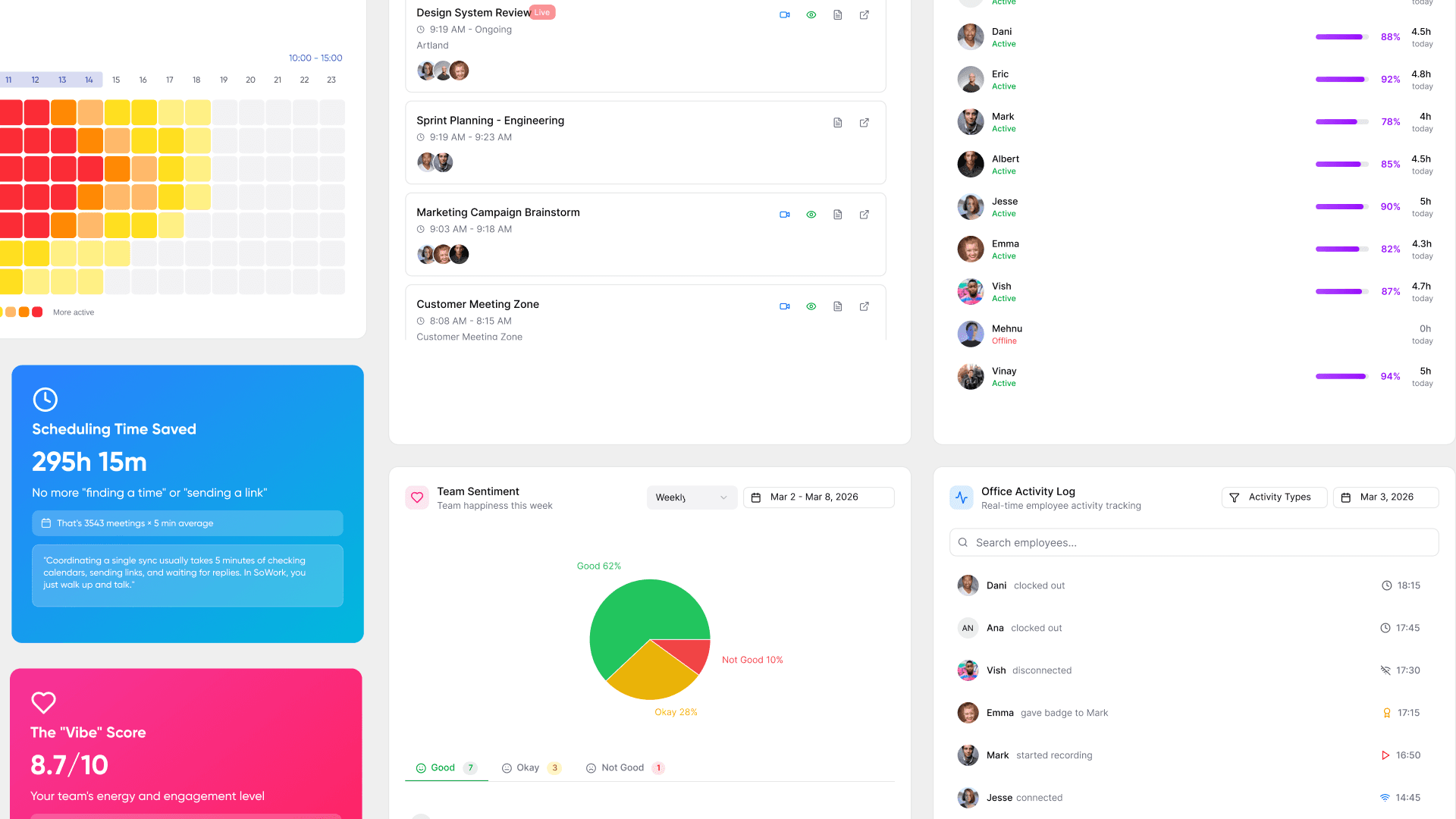
Remote teams relying solely on Slack and Zoom hit a real bottleneck: every quick question requires a calendar invite, and decisions get buried in threads [1]. SoWork puts your whole team in a persistent digital office where you can see who's free, start a conversation in one click, and let AI capture what was said. Key features include Instant Meetings (no links, no scheduling), Presence Awareness with visual status indicators, AI Meeting Memory that auto-records and summarizes conversations, Focus Modes for deep work signaling, and Automatic Calendar Sync so availability is always accurate. Teams can set up a virtual office and invite members in minutes, with no software download required.
[1] SoWork blog, sowork.com
How does Slack approach daily remote team communication?
Slack is a channel-based messaging platform built around organized, persistent text conversations. It excels at structured async communication but does not provide spatial presence or spontaneous meeting capabilities.
Slack had approximately 47.2 million daily active users as of 2025, with users sending an average of 92 messages per person per day [1]. The platform organizes communication into channels, threads, and direct messages, and connects with thousands of third-party tools. Its Huddles feature offers lightweight audio calls, and AI-powered thread summaries launched in FY2025 [2]. Where Slack falls short for daily remote work is presence: its status system is manual, and there's no spatial layer showing who's actually free for a quick conversation. Every interaction starts with a message, not a glance across the (virtual) office.
[1] DemandSage/Speakwise, speakwiseapp.com [2] SQ Magazine, sqmagazine.co.uk
What's the fundamental difference between a virtual office and a messaging platform?
A messaging platform organizes communication into text threads and channels. A virtual office adds a persistent spatial layer where teammates have visible presence, can see each other's availability in real time, and can start conversations without any scheduling friction.
Slack focuses narrowly on channel messaging without spatial presence features [1]. Virtual office platforms like SoWork provide the unified layer where distributed teams experience working in the same space despite physical distance, combining presence, video, chat, and AI tools in one environment [2]. The practical difference: on Slack, you have to ask 'are you free?' and wait. In SoWork, you can see it. That shift from reactive messaging to ambient awareness is the core distinction. It's the difference between sending a text to a colleague and walking to their desk.
[1] SoWork blog, sowork.com [2] SoWork blog, sowork.com
How does SoWork replicate spontaneous, in-office collaboration?
SoWork uses a persistent 2D virtual office where teammates appear as avatars with real-time status indicators, letting anyone start a conversation in one click, the same way you'd tap a colleague on the shoulder.
In physical offices, relationships and decisions develop through hallway conversations and the hundred small interactions that build trust over time [1]. Remote work removes this entirely. SoWork restores it through Presence Awareness (visual indicators showing who is free, focused, or in a meeting), Instant Meetings triggered by clicking a teammate's avatar, and Focus Modes so individuals can signal deep work while staying loosely visible. The office space itself is customizable, similar to building in The Sims, which gives teams a sense of place and identity. AI Meeting Memory means even spontaneous chats produce a written record, so nothing gets lost.
[1] Springworks, springworks.in
How does Slack handle presence and availability signaling vs. SoWork?
Slack's presence system relies on manual status updates and a simple online/away indicator. SoWork's presence layer is automatic, spatial, and synced to your calendar, giving teammates a real-time picture of who's actually available.
Slack's visible presence feature creates a unique form of social pressure: when your status shows you're away, questions arise about whether you're working, feeding FOMO and making people reluctant to disconnect [1]. The system is also manual by default. SoWork's Automatic Calendar Sync updates your status the moment a calendar event starts, so availability is always accurate without anyone touching a status button. Presence indicators are spatial and visual, not just a green dot. The result is that teammates can make a genuine judgment about whether to interrupt, the same intuition you'd use in a real office.
[1] Thread Patrol, thread-patrol.com
Which tool reduces meeting overhead more effectively: SoWork or Slack?
SoWork reduces scheduled meeting overhead more directly because it replaces calendar-dependent calls with instant, frictionless conversations. Slack reduces email overhead but can actually increase meeting volume by surfacing questions that then require a call to resolve.
Meeting volume increased 252% from 2020 to 2025, and remote workers attend 80% more meetings per week than in-office workers (25.6 vs 14.2 per week) [1]. The average remote employee spends roughly 11.3 hours per week in virtual meetings, about 28% of their entire workweek [2]. Slack's channel-based model is good at async updates but doesn't prevent the 'let's jump on a call' reflex when text threads get complicated. SoWork's Instant Meetings let you resolve a question in 90 seconds without a calendar invite. Its AI Meeting Memory also means fewer 'recap' meetings, since summaries are auto-generated.
[1] Claryti, claryti.ai [2] Speakwise, speakwiseapp.com
How do SoWork and Slack differ in building remote team culture?
Slack supports culture through social channels and shared context. SoWork builds culture through shared space: a persistent virtual office your team personalizes, inhabits daily, and uses as a genuine home base.
25% of fully remote employees report feeling lonely every day, compared to 16% of fully on-site workers, per Gallup's 2025 data [1]. Slack's culture tools (social channels, emoji reactions, watercooler threads) are real but text-based. They don't replicate the ambient social time that builds trust in physical offices. SoWork's customizable virtual office, personalized avatars, and always-on spatial environment give teams a sense of place. Seeing your colleagues' avatars in the office, even when no one's talking, creates a low-level sense of togetherness that text channels can't reproduce. Culture is built in the spaces between tasks, and SoWork creates those spaces.
[1] Gallup/LifeStance, lifestance.com
Which types of remote teams are best suited for SoWork vs. Slack?
SoWork fits synchronous-leaning, tight-knit teams that work overlapping hours and want to feel like they share a space. Slack fits async-first or globally distributed teams where time zones prevent real-time overlap.
Team type | Better fit |
|---|---|
Startup (5-50 people), overlapping hours | SoWork |
Async-first, multiple time zones | Slack |
Engineering team needing deep focus + quick syncs | SoWork + Slack together |
Large enterprise, compliance-heavy | Slack Business+ or Enterprise+ |
Remote-first team building culture | SoWork |
Freelancers or contractor-heavy teams | Slack |
SoWork's sweet spot is remote-first companies of 5 to 200 people who want to ship faster, reduce coordination friction, and build genuine team culture without mandating a return to office.
What are the risks of relying solely on Slack for daily remote team communication?
Relying only on Slack creates notification overload, weak presence awareness, and a culture of reactive communication that can increase rather than decrease meeting volume.
78% of employees feel overwhelmed by the volume of notifications they receive across workplace tools [1]. On Slack specifically, a person in a mid-sized organization might receive hundreds of messages per day across dozens of channels, most of which are FYI messages that don't require action but all compete for attention [2]. Without a spatial presence layer, every question starts with a message and often ends with a scheduled call. 29% of remote workers identify communication gaps as their primary challenge, and 22% report loneliness, even with active Slack use [3]. Slack doesn't solve the ambient awareness problem, it just digitizes the inbox.
[1] Speakwise, speakwiseapp.com [2] Thread Patrol, thread-patrol.com [3] Speakwise, speakwiseapp.com
What are the drawbacks or risks of using SoWork as your primary communication tool?
SoWork requires teammates to share overlapping working hours to get full value, and it's less suited for async-heavy or globally distributed teams who rarely work at the same time.
SoWork's core value, ambient presence and instant meetings, only works when people are actually in the office at the same time. Teams spread across many time zones may find the virtual office feels empty most of the day. It's also a newer category than messaging, so some team members may need an adjustment period to adopt a spatial interface over a familiar chat tool. For teams with complex compliance requirements or large-scale enterprise needs, Slack's Enterprise+ tier offers more mature security controls. SoWork is best treated as a daily office layer, not a replacement for every communication need.
How do SoWork and Slack compare on integrations with other tools?
Slack has one of the largest integration ecosystems in enterprise software. SoWork integrates with the core tools most remote teams actually use daily, including Slack itself.
Slack connects with thousands of apps and has become core infrastructure for many organizations [1]. SoWork integrates with Slack, Google Calendar, Outlook Calendar, Miro, GitHub, and Zapier, covering the daily workflow of most remote teams [2]. The practical point: SoWork and Slack are not mutually exclusive from an integration standpoint. SoWork can sit on top of Slack, pulling in calendar data and surfacing presence, while Slack handles async threads and third-party app notifications. Integration depth matters because the average remote worker already switches between too many apps, and a virtual office that doesn't connect to your existing stack just adds another one [3].
[1] SQ Magazine, sqmagazine.co.uk [2] SoWork blog, sowork.com [3] SoWork blog, sowork.com
How do SoWork and Slack compare on pricing for a typical remote team?
Slack's paid plans start at $7.25 per user per month (Pro, billed annually). SoWork's Basic tier starts at $6 per user per month, or $5.40 billed annually, making it comparable or cheaper for most small-to-mid-sized teams.
Plan | SoWork | Slack |
|---|---|---|
Free tier | Yes | Yes (90-day message limit) |
Entry paid | $5.40/user/mo (annual) | $7.25/user/mo (annual) |
Mid tier | Premium (contact for pricing) | $15/user/mo (Business+) |
Enterprise | Custom | Custom (Enterprise+) |
Slack's Business+ plan runs $15 per user per month billed annually [1]. For a 25-person team on Slack Pro, that's roughly $2,175 per year. SoWork at $5.40 annually would be $1,620 for the same team size. The more important cost question is what you're replacing: if SoWork reduces Zoom spend or cuts meeting time, the ROI math shifts significantly.
[1] Vendr, vendr.com
What criteria should a remote team use to choose between SoWork and Slack?
The deciding factor is whether your team's biggest pain is async message overload (Slack solves this) or the lack of spontaneous, real-time collaboration and presence awareness (SoWork solves this).
Ask these questions before deciding:
Do your teammates work overlapping hours most days? (Yes = SoWork adds real value)
Is your biggest frustration too many scheduled meetings or too many unread messages?
Do you feel disconnected from your team despite being 'always on' in Slack?
Does your team struggle to know who's free without sending a message first?
Are you already paying for Zoom separately on top of Slack?
If you answered yes to questions 1, 3, 4, or 5, SoWork addresses your actual problem. If async thread management and app integrations are your core need, Slack is the right anchor tool.
Can SoWork and Slack be used together, and what does that workflow look like?
Yes. SoWork and Slack work well together: SoWork handles real-time presence and instant conversations during the workday, while Slack handles async threads, notifications, and integrations with project tools.
A practical combined workflow looks like this:
Team opens SoWork at the start of the day, establishing presence in the virtual office.
Quick questions and spontaneous syncs happen via SoWork Instant Meetings, no calendar needed.
Longer async updates, decisions needing a paper trail, and cross-team notifications go into Slack channels.
SoWork's AI Meeting Memory auto-summarizes conversations and can post recaps to Slack.
Calendar Sync keeps SoWork status accurate, so teammates know when you're in a Slack-related deep work block.
This stack replaces the Slack + Zoom + scheduling tool trio with two tools that each do their job well.
What do remote teams report after adding SoWork to their workflow?
Teams that add a virtual office layer to their communication stack consistently report fewer scheduled meetings, faster decision-making, and a stronger sense of team presence, though results vary by team size and work style.
Organizations that adopted meeting management tools with automated notes and action item tracking reduced total meeting time by 18% while improving follow-up completion rates by 42% [1]. AI-powered meeting transcription adoption grew from 8% of organizations in 2021 to 52% in 2025, reflecting strong demand for the kind of meeting capture SoWork's AI Meeting Memory provides [2]. Qualitatively, teams using SoWork report that the virtual office makes it easier to replicate the informal check-ins and spontaneous collaboration that remote work typically eliminates. The key driver of adoption is whether teammates actually open the app daily, which SoWork's low-friction browser-based setup supports.
[1] Claryti, claryti.ai [2] Claryti, claryti.ai
What alternatives exist beyond SoWork and Slack for daily remote team communication?
The main alternatives split into two categories: other virtual office platforms (Gather, Kumospace, Teamflow, Sococo, Spot) and other messaging tools (Microsoft Teams, Discord, Twist, Loom for async video).
Category | Tool | Best for |
|---|---|---|
Virtual office | Gather.town | Pixel-art style, event use |
Virtual office | Kumospace | Spatial audio, social events |
Virtual office | Teamflow | Clean UI, small teams |
Virtual office | Sococo | Enterprise floor plans |
Messaging | Microsoft Teams | Microsoft 365 orgs |
Async video | Loom | Replacing sync meetings |
Async messaging | Twist | Thread-first, low noise |
SoWork differentiates from other virtual offices through its AI Meeting Memory, browser-based access with no download, and the combination of presence, chat, and AI in one platform. The remote workplace SaaS market is projected to reach $58.5 billion by 2027, so this category is expanding fast [1].
[1] EasyStaff, easystaff.io
Key Takeaways
SoWork solves presence and spontaneous collaboration; Slack solves async messaging and app integrations. They target different problems.
Remote workers attend 80% more meetings per week than in-office workers. SoWork's Instant Meetings directly cut scheduled call overhead.
25% of fully remote employees report feeling lonely every day (Gallup 2025). A persistent virtual office addresses this in a way text channels cannot.
Slack's Pro plan costs $7.25/user/month (annual). SoWork's Basic plan starts at $5.40/user/month (annual), making SoWork cost-competitive.
78% of employees feel overwhelmed by notification volume. Slack-only teams risk notification fatigue without a presence layer to reduce reactive pinging.
SoWork and Slack work well together: SoWork as the daily office, Slack for async threads and third-party integrations.
Teams spread across multiple time zones with little overlap get less value from SoWork's real-time presence features.
AI meeting transcription adoption grew from 8% to 52% of organizations between 2021 and 2025. SoWork's AI Meeting Memory puts this capability inside the virtual office.
Sources
Remote workers attend 80% more meetings per week than in-office workers: 25.6 vs 14.2 per week
78% of employees feel overwhelmed by the volume of notifications they receive
AI-powered meeting transcription adoption grew from 8% of organizations in 2021 to 52% in 2025
SoWork's Basic tier is priced at $6 per user per month or $5.40 per user per month billed annually
The remote workplace SaaS market is projected to reach $58.5 billion by 2027
SoWork integrates with Slack, Google Calendar, Outlook Calendar, Miro, GitHub, and Zapier
FAQ
SoWork vs Slack: which is better for daily remote team communication?
Can SoWork replace Slack entirely?
Is SoWork worth it for a small remote team already using Slack?
Does Slack have presence awareness like a virtual office?
What are the biggest complaints remote teams have about using only Slack?
How does SoWork handle asynchronous communication for teams in different time zones?
Is a virtual office platform hard for remote teams to adopt?
What is the difference between SoWork and Gather.town?
Blogs
Read Similar Articles
Remote Team Analytics: Complete Guide to Data-Driven Remote Work Management in 2026
Complete Guide to Gaining Visibility Into Remote Team Performance and Collaboration