Remote Disengagement: Early Warning Signs (2026)
Vishal Punwani

Published:
Updated on:
Look for change, not fixed traits. The earliest signs of remote disengagement are shorter and slower replies, going quiet in team channels and meetings, and skipping informal chats. Missed deadlines and slipping quality usually come later. Compare each person to how they normally behave, then ask them directly in a one-on-one before you decide what's going on.
What does employee disengagement look like in a remote team?
Remote disengagement usually looks like a slow fade, not a blowup. The person still logs on and ships the minimum, but they stop offering ideas, asking questions and connecting with teammates.
Only 20% of employees worldwide were engaged at work in 2025 [1]. Most of the rest aren't hostile. They do what's asked and nothing more. On a distributed team, that tends to show up as:
Replies that answer the question and stop there
Camera off and mic muted by default
No ideas offered during planning
Fewer threads, DMs and reactions to teammates' work
What matters is the change. A quiet engineer who has always been quiet isn't a warning sign. A chatty one who suddenly goes quiet is.
Why is disengagement harder to spot in remote teams?
Remote work takes away the passive cues you'd pick up in an office, like body language, hallway chats and who's eating lunch alone. You only see what people decide to send you.
In an office, disengagement shows on its own. Someone sighs in standup or stops joining coffee runs, and you notice without trying. Remotely, the default is invisible. Text strips out tone. Calendars turn every interaction into a scheduled event, so when someone stops reaching out casually, nobody notices.
Gallup describes fully remote workers as more engaged than on-site peers but also more isolated and stressed [3]. That combination lets problems grow behind output that still looks fine. It also puts the burden on managers, who account for 70% of the variance in team engagement [4].
What communication changes signal a remote employee is disengaging?
Watch for replies that get shorter, slower and more formal, plus fewer messages the person starts themselves. Someone who used to post updates and jump into threads now only answers when tagged.
Signal | What it looks like |
|---|---|
Shorter replies | 'ok' or 'done' where they used to add context |
Slower responses | Hours instead of minutes during shared working hours |
Fewer messages they start | They answer questions but never ask any |
Flatter tone | The jokes, emoji and banter disappear |
Missing context | They don't know key project updates they should know |
Always compare against that person's own baseline. A two-word reply from someone who writes essays means something. The same reply from a naturally terse senior engineer may mean nothing.
What meeting behaviors indicate disengagement?
The strongest meeting signals involve a change in participation. Someone who used to speak up goes silent, turns the camera off when they used to keep it on, or starts skipping recurring calls.
A camera that's off doesn't mean much by itself. Plenty of people prefer it, and video fatigue is real. What you're looking for is several signals showing up together:
Silence in planning or retros where they used to push back
No questions in all-hands or demos
Joining late and leaving the moment the call ends
Declining optional meetings with vague excuses
Obvious multitasking, like delayed answers when called on
One quiet meeting is just a bad day. Three weeks of quiet meetings is a pattern worth asking about.
How do changes in work output reveal disengagement?
Output changes are real signals, but they usually show up after the behavioral ones. When a previously reliable person starts missing deadlines or making avoidable mistakes, they've often been disengaging for weeks.
Look for:
Missed deadlines from someone who used to hit them
Avoidable errors they didn't make before
Work that technically meets the request but misses the point
No more flagged risks or suggested improvements
Similar-sized tasks taking noticeably longer
Base this on task history, not gut feel. Pull up their last two months of tickets or pull requests and compare. Disengaged people rarely stop delivering altogether. They stop going beyond the ask, and that's harder to see unless you're looking for it.
What presence and availability patterns suggest someone is pulling away?
Less overlap with the team is a meaningful signal. Watch for someone logging on later, disappearing during core hours, or being away while everyone else is around and collaborating.
Focus time and absence aren't the same thing. Someone who has signaled deep work during core hours is working. Someone who just isn't there, day after day, is a different story.
In a virtual office like SoWork, presence indicators show who's free, focused or in a meeting, and status updates automatically when a calendar event starts. When a regular stops showing up, you notice it the way you'd notice an empty desk. Look at trends over a few weeks, not one day. Everyone has dentist appointments.
How does withdrawal from informal team culture signal disengagement?
Pulling out of informal moments is often the first social signal. Skipping coffee chats, ignoring social channels and no longer volunteering usually happen before any drop in output.
Discretionary effort goes first because nobody makes you do it. Nobody gets written up for missing game night. Watch for:
No more reactions to teammates' wins or announcements
Turning down optional sessions with excuses
No longer helping or mentoring colleagues
Passing on stretch projects they would have grabbed before
Introverts need a fair read here. Someone who never joined socials isn't withdrawing. Someone who used to host them and has quietly stopped is.
How can managers tell disengagement apart from burnout, personal issues, or async preference?
Look at what changed, how fast it changed, and what the person tells you. Disengagement means interest fading. Burnout means exhaustion while they still care. A personal crisis tends to hit suddenly. A preference for async work stays the same, and output stays strong.
Pattern | Output | Communication | Onset |
|---|---|---|---|
Disengagement | Minimal, does exactly the task | Short, reactive | Gradual |
Burnout | Erratic, overwork then crash | Mentions being tired or stressed | Follows heavy load |
Personal circumstances | Temporary dip | May share context | Sudden |
Async preference | Steady and strong | Written, thorough | Always been this way |
You can't diagnose this from data alone. These categories also overlap, and burnout often turns into disengagement. The table helps you decide what to ask. The conversation gives you the answer.
Which disengagement signals show up first, and which mean it's serious?
Social and communication signals show up first. Output and attendance problems show up last. When deadlines slip or someone skips required meetings, the disengagement is usually already serious.
Stage | Typical signals |
|---|---|
Early | Fewer messages they start, skipping optional socials, quieter in meetings, no longer volunteering |
Middle | Slower replies, camera off when it used to be on, less overlap with the team, thinner updates |
Late | Missed deadlines, lower quality, skipped required meetings, unexplained absences |
By the late stage, many people are already looking elsewhere. Gallup found 57% of fully remote workers are actively looking or watching for new jobs [3]. If you catch the early signals, you have time to act.
How should managers use one-on-ones to surface disengagement early?
Use one-on-ones to talk about energy and direction, not status. Gallup recommends at least one meaningful 15 to 30 minute conversation each week with every employee [6].
Keep it weekly and protect the slot. Cancelled one-on-ones tell people they don't matter.
Move status updates to async channels so the call has room for real talk.
Ask open questions: 'What's draining you lately?' 'What would you work on if you could pick?'
Name specific changes you've noticed, without judging them.
Listen more than you talk, and follow up on what they said last time.
The follow-up matters most. If people raise issues and nothing happens, they stop raising them.
Which pulse survey questions work best for detecting remote disengagement?
Short, frequent, anonymous pulses with 3 to 5 questions catch disengagement earlier than long annual surveys. Ask about clarity, recognition, connection and growth, and track how the answers move over time.
Question | What it detects |
|---|---|
I know what's expected of me this week | Unclear priorities |
I've been recognized for good work in the last week | Feeling unseen |
I feel connected to my teammates | Isolation |
I see a future for myself here | Flight risk |
What's one thing slowing you down? (open text) | Friction you can fix |
Run them every two to four weeks and watch for teams trending down, not single scores. Then act on the results where people can see it. A survey that changes nothing teaches people to stop answering honestly.
How can virtual office tools help managers notice engagement changes without extra meetings?
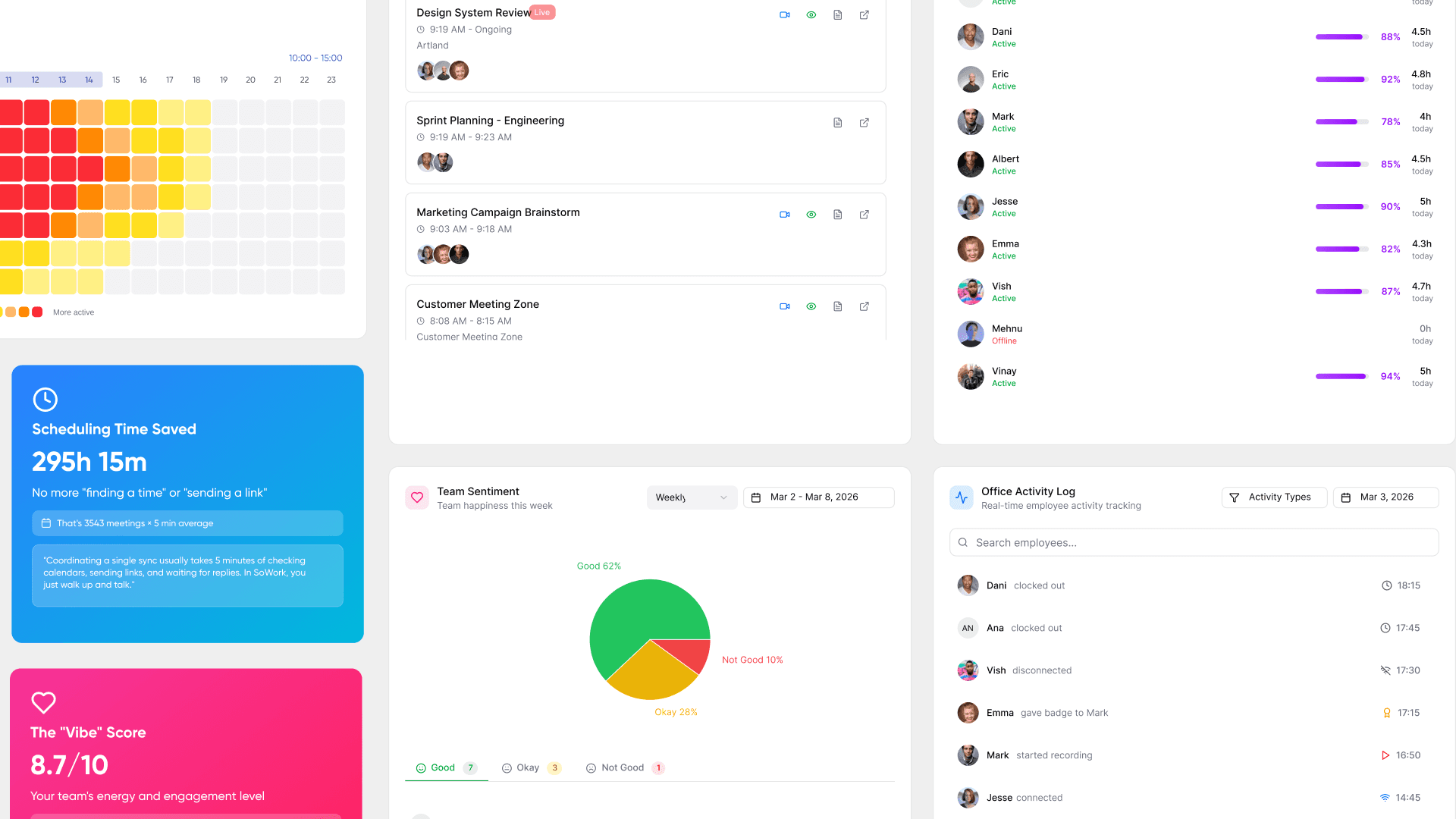
A virtual office gives you back the ambient awareness you lost when the team left the building. You see who's around, who's heads-down and who's quietly drifting, without scheduling another check-in.
In SoWork, presence indicators show who's free, focused or in a meeting, so a teammate who keeps going missing stands out. With Instant Meetings you can start a conversation in one click, so a casual 'how's it going?' takes ten seconds instead of a calendar invite.
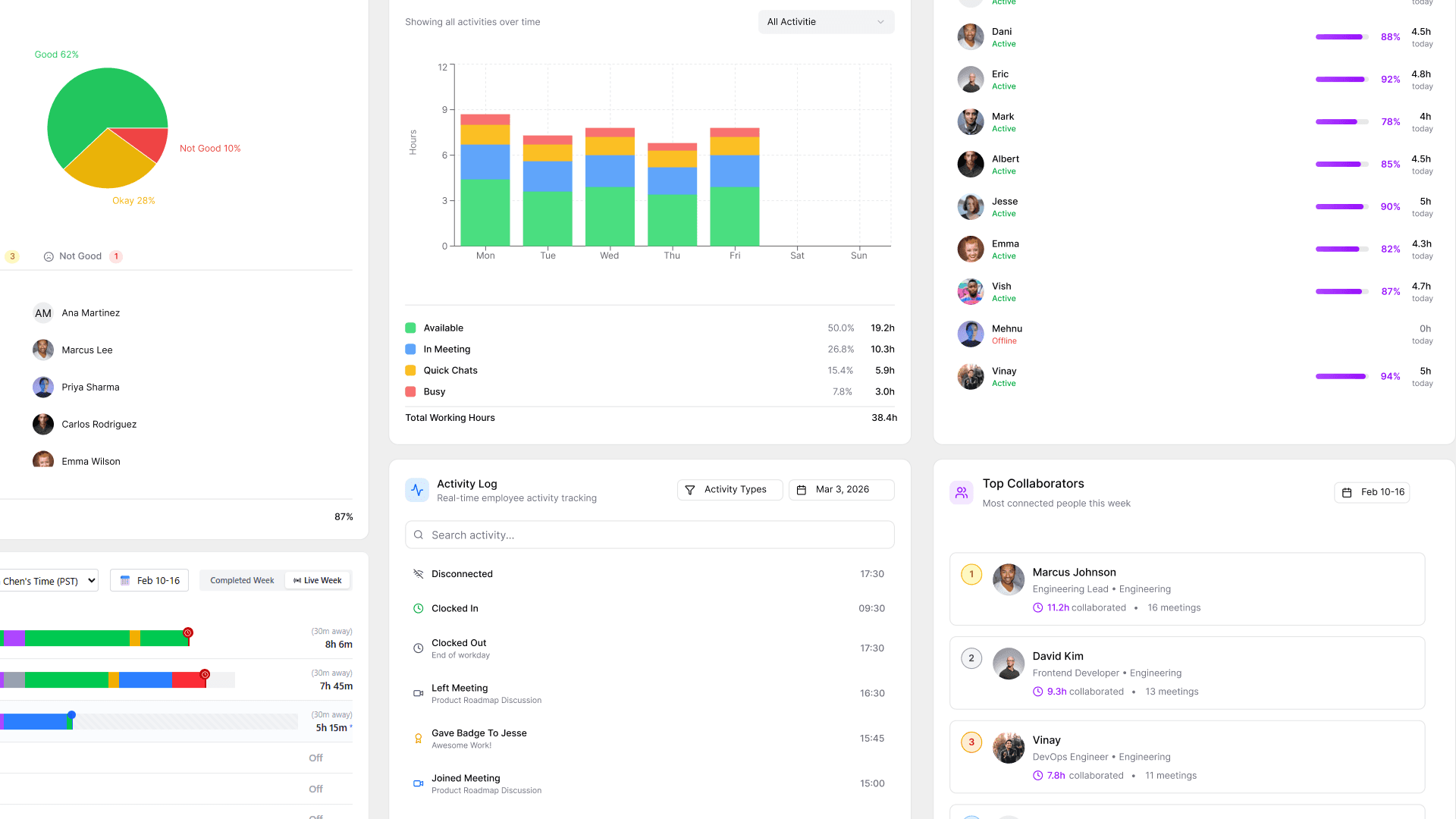
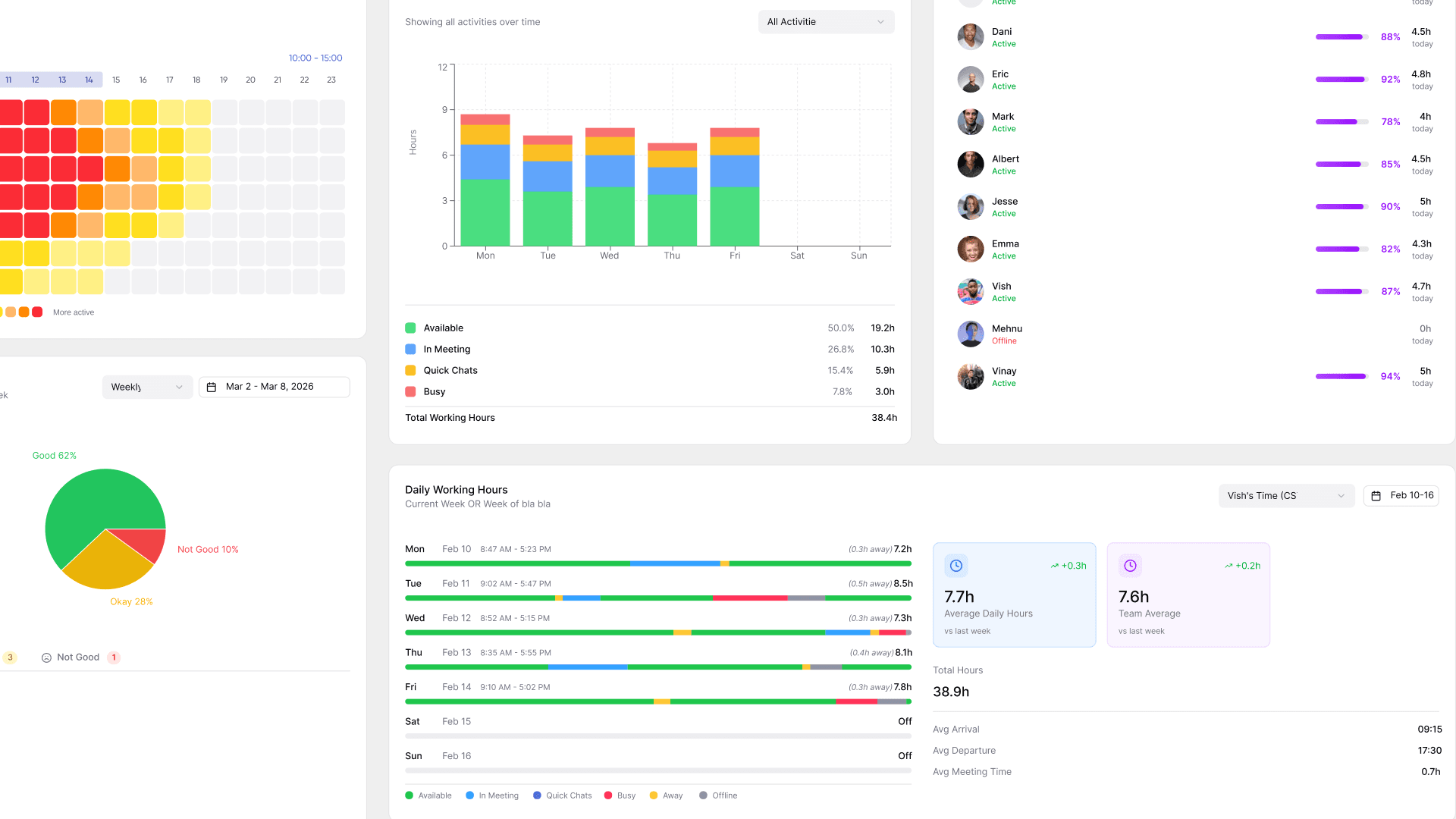
SoWork's Insights adds a weekly report on meeting time, focus time and collaboration, and team analytics come with the Premium plan at $15/user/month [9]. If someone's collaboration connections are thinning week over week, you'll see the trend before it shows up in their output.
How can managers track engagement without invasive monitoring?
Track patterns rather than individual keystrokes, be open about what you look at and why, and treat signals as a reason to start a conversation, never as evidence. Covert surveillance tends to backfire.
In the APA's 2024 survey, monitored workers reported nearly double the quit intent of unmonitored peers (39% vs 21%) [7]. Cornell experiments found the negative effects on autonomy and quit intent disappeared when monitoring was framed as developmental feedback rather than evaluation [8].
Practical rules:
Look at presence and collaboration patterns, not screens or keystrokes
Let employees see the same data you see
Judge trends over weeks, not single days
Start with curiosity, not accusation
Ambient presence works like an office floor. Spyware works like a hidden camera, and your team will know the difference.
What does it cost to miss early disengagement signs?
You pay twice: first in lost productivity while the person coasts, then in replacement costs if they leave. Gallup estimates low engagement cost the world economy about $10 trillion in 2025, roughly 9% of global GDP [2].
Cost | Estimate |
|---|---|
Replacing one employee | One-half to two times annual salary [5] |
Preventable exits | 52% of voluntary leavers say their manager or organization could have done something [5] |
Remote flight risk | 57% of fully remote workers are looking or watching for jobs [3] |
Apply that to a 30-person startup. Losing two engineers on $120,000 salaries could mean $120,000 to $480,000 in replacement costs, and that doesn't count the lost momentum on their projects.
What should a manager do right after spotting early warning signs?
Check whether it's a real pattern, then reach out privately and soon. Name what you've noticed, ask an open question, and agree on one concrete next step.
Confirm the pattern. Has it lasted two weeks or more, and is it a change from their normal?
Check the context: workload, reorgs, recent feedback, anything you already know about their life.
Reach out casually first. A quick drop-in beats a formal 'we need to talk' invite.
Be specific: 'You've been quieter in planning lately. How are things going?'
Agree on one change, such as scope, recognition, a growth project or time off.
Follow up within a week.
Speed matters here, because Gallup says many exits are preventable [5].
What does research show about engagement among remote and hybrid workers?
On average, remote workers are more engaged than on-site workers, but that engagement is fragile. Gallup's 2026 data shows 30% of exclusively remote employees engaged, compared with 25% of hybrid and 24% of on-site remote-capable workers [1].
Being engaged doesn't mean someone will stay. Among fully remote workers, 57% are looking or watching for new jobs, and the figure only falls to 47% among those who are engaged [3]. Global engagement dropped to 20% in 2025 [1].
Managers are part of the problem. Manager engagement fell from 31% in 2022 to 22% in 2025 [10], and managers drive 70% of the variance in team engagement [4]. Remote setups can produce high engagement, but only when managers are paying attention.
Key Takeaways
Disengagement shows up as a change from someone's normal behavior. Compare people to their own baseline, not to teammates.
The earliest signals are social: fewer messages they start themselves, skipping informal chats, and no longer volunteering.
Missed deadlines and falling quality are late-stage signals. By then the person may already be job hunting.
Burnout, personal crises and a preference for async work can look like disengagement. Ask before you conclude.
Hold weekly 15 to 30 minute one-on-ones focused on energy and direction, not status updates.
Track presence and collaboration patterns openly. Covert monitoring increases quit intent and damages trust.
Replacing an employee costs one-half to two times their annual salary, so acting early pays for itself.
Ambient presence tools like a virtual office help you notice drift without adding more meetings.
Related reading
How Remote Managers Can Spot Disengaged Employees Before They Quit in 2026
Teamflow vs SoWork vs Gather: Which Virtual Workspace Should You Use for Your Remote Team in 2026?
How AI Agents Work: What Are AI Employees, and How Do They Work Alongside Human Teams in 2026?
Sources
FAQ
How can I tell if remote employees are becoming disengaged, and what early warning signs should managers watch for?
Is keeping the camera off a sign that a remote employee is disengaged?
What's the difference between quiet quitting, burnout and disengagement?
Are remote workers less engaged than office workers?
Should I use employee monitoring software to detect disengagement?
How do I bring up disengagement with a remote employee without sounding accusatory?
How often should remote managers check in with each team member?
Can a disengaged remote employee be re-engaged?
Blogs
Read Similar Articles
Remote Team Analytics: Complete Guide to Data-Driven Remote Work Management in 2026
Complete Guide to Gaining Visibility Into Remote Team Performance and Collaboration