Best AI Agents for Small Business in 2026
Vishal Punwani

Published:
Updated on:
The best AI agents for small business in 2026 are Claude or ChatGPT for general work, Intercom's Fin for customer support, and the agent built into your CRM for sales. Pick one per job, not one for everything. Then run them inside SoWork, a shared virtual office where agents sit alongside your team, so everyone can see who's doing what.
What is an AI agent, and how is it different from a chatbot or AI assistant?
An AI agent takes a goal, plans the steps, and uses tools to finish the work. A chatbot replies, an assistant helps when prompted, and an agent acts.
Type | What it does | Example |
|---|---|---|
Chatbot | Answers from a script or knowledge base | FAQ widget |
AI assistant | Drafts and summarizes when you prompt it | Chat in a browser tab |
AI agent | Plans multistep work and calls tools | Issues a refund, updates the CRM |
Watch out for "agent washing," where vendors relabel old chatbots and automation as agents. Gartner estimates only about 130 of the thousands of agentic AI vendors are real [9]. Ask any vendor to show you the actions its agent takes, not just the answers it gives.
Which business tasks can AI agents realistically handle for small businesses in 2026?
Agents do well with repetitive, text-heavy work that has clear inputs: support tickets, lead follow-up, content drafts, inbox triage, invoice reminders, and meeting notes. Judgment calls still belong to people.
Small businesses are already using them. In an SBE Council survey, 58% of small employers said they use AI agents regularly or occasionally, and another 14% are considering them [1]. Scaling them is harder. McKinsey's 2026 survey found 22% of smaller organizations scaling agents in at least one function, compared with 40% of large ones [2]. So the real gap is between trying an agent and actually relying on it. Start with tasks where a wrong answer is cheap and easy to catch.
What criteria should a small business use to evaluate and choose an AI agent?
Judge an agent on integrations, pricing model, human handoff, visibility, and security. Benchmark scores matter less. If you can't see what it did, don't let it act.
Criterion | Question to ask |
|---|---|
Integrations | Does it connect to your CRM, inbox, and helpdesk natively or through MCP? |
Pricing model | Is it per seat, per outcome, or per credit? Model it on your real volume. |
Human handoff | Does it escalate cleanly to a person? |
Visibility | Can your whole team see what it did and why? |
Security | SOC 2, SSO, data retention controls? |
Setup time | Days, or months of implementation? |
What are the best AI agents for customer support for small businesses?
Intercom's Fin is the best fit for most small support teams because you pay per outcome and it can run on the helpdesk you already have. Salesforce Agentforce makes sense if you're already on Salesforce.
Fin charges $0.99 per billable outcome. If it runs on another help desk, there's a 50-outcome monthly minimum ($49) [3]. When Fin hands a conversation to a human without reaching an outcome, you aren't charged [3]. Agentforce bills customer-facing conversations at $2 each [5]. Before you sign, multiply your monthly tickets by a realistic resolution rate. A busy month can double the bill, so budget for your peak months, not the average.
What are the best AI agents for sales, lead generation, and CRM follow-up?
Use the agent inside the CRM you already run. If you're not on an enterprise CRM, connect Claude or ChatGPT to your pipeline through Zapier or MCP for follow-ups and lead research.
Agentforce add-on licenses start at $125 per user per month [5]. One estimate puts a 10-person team's first-year Agentforce cost near $140,000 once you add Enterprise licensing, implementation, and training [6]. That's hard to justify for a 15-person company. A lighter option is the stack Reddit small business owners keep recommending: ChatGPT or Claude for writing, plus Zapier for automation [11]. Fin can also qualify inbound leads, at $9.99 per qualification [3].
What are the best AI agents for marketing, content creation, and social media?
Claude and ChatGPT are still the best general agents for marketing drafts, campaign plans, and repurposing content. Pair them with Zapier to publish and schedule.
Marketing content is the most common use case. Among small businesses using AI, 68% use it for marketing content creation, according to NFIB's 2026 survey [12]. A workflow that holds up:
Give the agent your brand guide and your best past posts.
Have it draft a week of posts, emails, or blog outlines.
A human edits anything that goes public.
Zapier pushes approved posts to your scheduler.
Never skip step 3. Brand mistakes cost more than the time you saved.
What are the best AI agents for bookkeeping, finance, and back-office admin?
Start with the AI already built into your accounting software. Add a general agent for reporting and admin prep, and keep a human approving anything that moves money.
Good tasks for agents here: categorizing transactions, chasing missing receipts, drafting overdue invoice reminders, and summarizing the monthly P&L in plain English. Keep payments, payroll changes, and tax filings with people. Give agents read access first and write access only after a month of clean results. Your bookkeeper or accountant should review anything the agent produces before it reaches a lender, investor, or tax authority.
What are the best AI agents for scheduling, email triage, and executive assistant work?
AI calendars like Motion handle auto-scheduling, and Claude or ChatGPT connected to Gmail or Outlook handle inbox triage and replies. For remote teams, a lot of scheduling can simply go away.
Reddit small business users recommend Motion to owners buried in scheduling overhead [11]. Inside a distributed team, though, much of that scheduling only exists because nobody can see who's free. In SoWork you can see teammate availability in real time and start a conversation in one click. Calendar sync updates your status automatically. AI Meeting Memory records, transcribes, and summarizes calls, so your assistant agent doesn't have to chase notes afterward.
How do Claude and ChatGPT compare with Copilot Studio, Agentforce, and OpenAI Frontier for small businesses?
Claude and ChatGPT are the easiest to start with for most small teams. Copilot Studio and Agentforce fit companies already deep in Microsoft or Salesforce. OpenAI Frontier is built for large enterprises.
Option | Best for | Pricing |
|---|---|---|
Claude / ChatGPT | General work, writing, MCP-connected tasks | Per-seat subscriptions |
Copilot Studio | Microsoft 365 shops | $200/month per 25,000 credits, or $0.01/credit [4] |
Agentforce | Salesforce customers | $2/conversation or $125/user add-on [5] |
OpenAI Frontier | Large enterprises | Not disclosed [8] |
Frontier targets Fortune 500-level companies and has no public self-service sign-up [7]. All four manage agents. None of them show your people and your agents in one place.
Should a small business use prebuilt AI agents or build its own?
Buy prebuilt agents for common jobs like support, scheduling, and content. Build with no-code tools only when the workflow really is specific to your business.
Gartner warns that "many use cases positioned as agentic today don't require agentic implementations" [9]. A simple rule: if a vendor already sells an agent for that exact job, buy it. Build when you're stitching together steps no vendor covers, like pulling project status from three tools into one weekly client update. Custom builds need someone who owns them, and a broken agent nobody maintains is worse than no agent.
How much do AI agents cost for a small business?
Costs range from about $49 a month for a low-volume support agent to six figures in year one for a full CRM-native rollout. You'll mostly see three pricing models: per seat, per outcome, and per credit.
Model | Example | Watch for |
|---|---|---|
Per outcome | Fin, $0.99/outcome, $49 minimum off-Intercom [3] | Bills rise when volume spikes |
Per credit | Copilot Studio, $0.01/credit [4] | Reasoning steps burn more credits |
Per conversation or seat | Agentforce, $2/conversation or $125/user [5] | Required base CRM licenses |
Add setup time and a human reviewer's hours to the bill. Those hidden costs often matter more than the sticker price.
How do AI agents connect to your existing tools through integrations, APIs, and MCP?
Agents connect through native integrations, automation tools like Zapier, direct APIs, and more and more through MCP, the open standard for linking AI to tools and data.
Anthropic donated MCP to the Linux Foundation's Agentic AI Foundation in December 2025, and more than 10,000 MCP servers have been published [10]. In practice, one MCP connection lets any compatible agent use that tool. SoWork's MCP/API is live. Claude or your own AI tools can ask who's around, what happened in a meeting, or what the team decided. SoWork also integrates with Slack, Zapier, Miro, Google Calendar, and Microsoft Outlook.
How can a small team manage multiple AI agents alongside human employees?
Put your agents where your team already works. That way people can see them, talk to them, and check their output without opening ten dashboards.
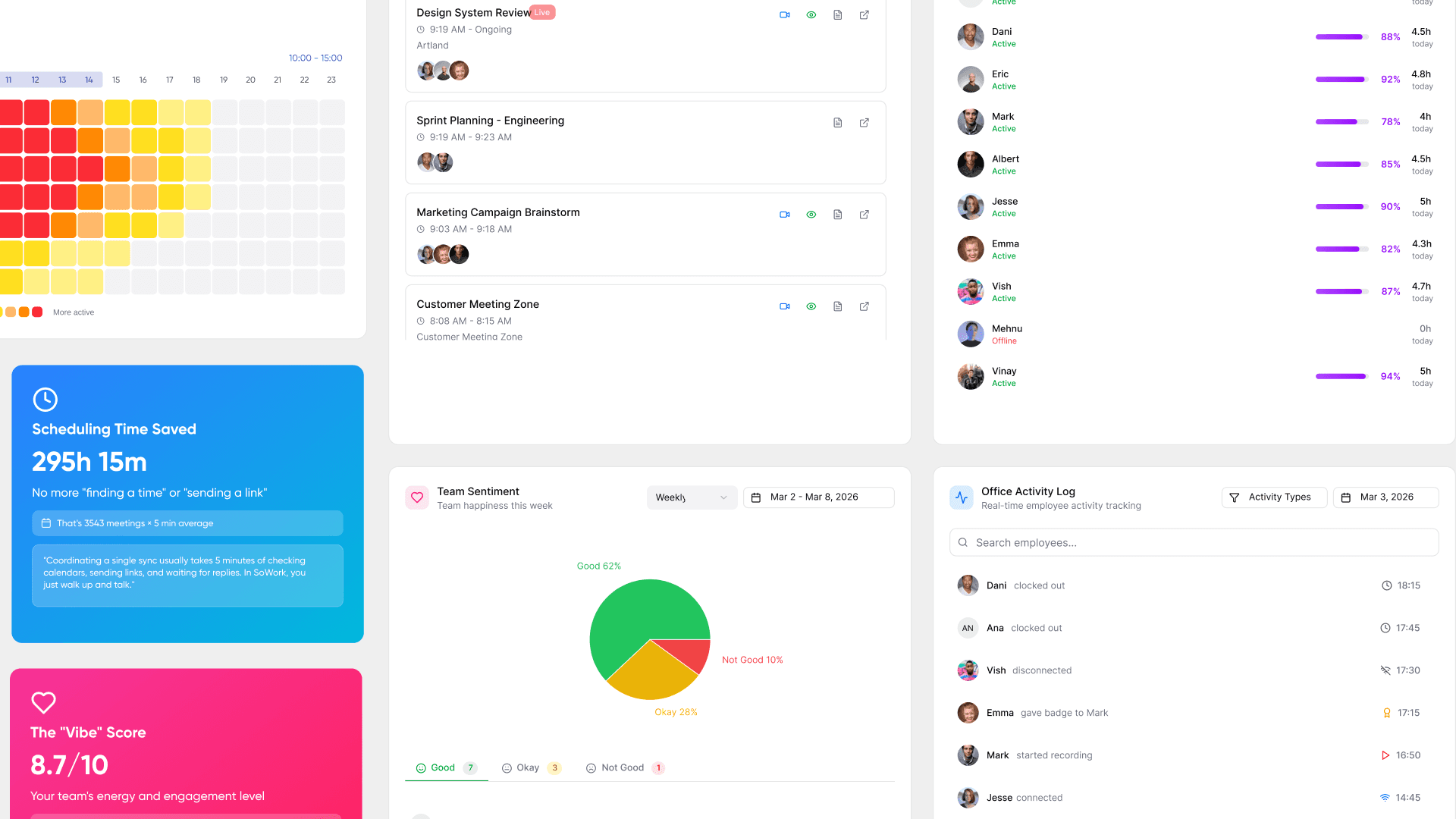
In SoWork, AI agents sit in the company office as characters next to your human teammates, and you work with them there. Agent desks are coming soon. They'll give every agent a desk showing what it's working on and what it actually did. Until then, give each agent a named human owner and review its output weekly. SoWork's weekly Insights report covers time spent in meetings, focus time, and who collaborates with whom.
What are the risks of using AI agents in a small business?
The big risks are data exposure, confident wrong answers, unauthorized actions, compliance gaps, and runaway costs. Most of them come from weak controls, not weak models.
In a June 2025 prediction, Gartner said over 40% of agentic AI projects will be canceled by the end of 2027 because of escalating costs, unclear business value, or inadequate risk controls [9].
Risk | Mitigation |
|---|---|
Data leakage | SOC 2 vendors, least-privilege access |
Wrong actions | Human approval for money and customer commitments |
Compliance | Data retention and audit logs |
Cost overruns | Spending caps, monthly usage review |
What results and ROI have small businesses actually seen from AI agents?
Owners report real time savings and revenue gains. Measurable ROI at scale is still the exception, not the rule.
SBE Council's 2026 survey found 82% of small employers have adopted AI tools, and two-thirds of users reported revenue gains tied to AI [1]. Agent use specifically is growing fast. OpenAI reported that agentic output made up two-thirds of small-business output tokens in August 2026, up from one-third in April [13]. Track your own numbers from day one: hours saved, tickets resolved, response time, and errors caught. Without a baseline, you can't prove ROI.
When should a small business choose automation, freelancers, or new hires instead of an AI agent?
Use plain automation when the steps never change, freelancers for one-off specialist projects, and hires for work that needs relationships and accountability. Agents fit the messy middle.
Situation | Better choice |
|---|---|
Same steps every time, no judgment | Traditional automation (Zapier rules) |
Specialized, one-time project | Freelancer |
Ongoing ownership, client relationships | New hire |
Repetitive work with varied text inputs | AI agent |
Rule-based automation is cheaper and more predictable than an agent. If a simple trigger-and-action rule solves the problem, use that.
How should a small business deploy its first AI agent?
Pick one painful, measurable task, use a prebuilt agent from a tool you already pay for, and run it for 30 days with a named human owner.
Choose one task with a clear metric, like first-response time.
Start with an agent built into your helpdesk, CRM, or AI subscription.
Connect it with read-only access first.
Assign one person to review its output every day.
Measure against your baseline after 30 days.
Put the agent where your team can see it, like a shared SoWork office.
Expand its permissions or add a second agent only after it proves itself.
Bottom line: what are the best AI agents for small business?
For most small teams, the best AI agents for small business are Claude or ChatGPT for general work, Fin for support, and your CRM's native agent for sales.
Skip enterprise platforms like OpenAI Frontier and full Agentforce rollouts unless you're already committed to those ecosystems. Start with one agent, one metric, and one human owner. Then give your agents a visible home next to your people, so a 20-person team doesn't lose track of what five agents are doing.
Key Takeaways
Pick agents by job: Claude or ChatGPT for general work, Fin for support, your CRM's native agent for sales.
58% of small employers already use AI agents, but only 22% of smaller organizations are scaling them [1][2].
Fin costs $0.99 per outcome, while Agentforce charges $2 per conversation or $125/user add-ons [3][5].
OpenAI Frontier targets large enterprises with no public self-serve sign-up, so it's rarely a small business fit [7].
MCP is now the standard way to connect agents to your tools, with 10,000+ published servers [10].
Gartner predicts over 40% of agentic AI projects will be canceled by end of 2027, mostly over cost, value, and risk controls [9].
Start with one task, read-only access, a named human owner, and a 30-day measurement window.
Keep agents visible where your team works, so people can see what each one is doing.
Related reading
AI Agent Observability in 2026: How Do You Monitor What Your AI Agents Actually Do?
AI Governance Framework for AI Agents: How Should a Small Business Keep Humans in Control in 2026?
How Do Small Remote Companies Get the Whole Team Working With AI Agents in 2026?
Sources
Copilot Studio costs $200/month for 25,000 credits or $0.01 per credit pay-as-you-go
OpenAI Frontier targets Fortune 500-level companies with no public self-service sign-up
SoWork pricing: free for up to 10 users; Basic $6/user/month; Premium $15/user/month; SOC 2 certified
FAQ
What are the best AI agents for small businesses in 2026?
Is ChatGPT an AI agent or just a chatbot?
Are AI agents worth it for a small business?
How much does an AI agent cost for a small business?
Can AI agents replace employees in a small business?
Do I need to know how to code to use AI agents?
Are AI agents safe to use with customer data?
How do I keep track of multiple AI agents across my team?
Blogs
Read Similar Articles
Remote Team Analytics: Complete Guide to Data-Driven Remote Work Management in 2026
Complete Guide to Gaining Visibility Into Remote Team Performance and Collaboration