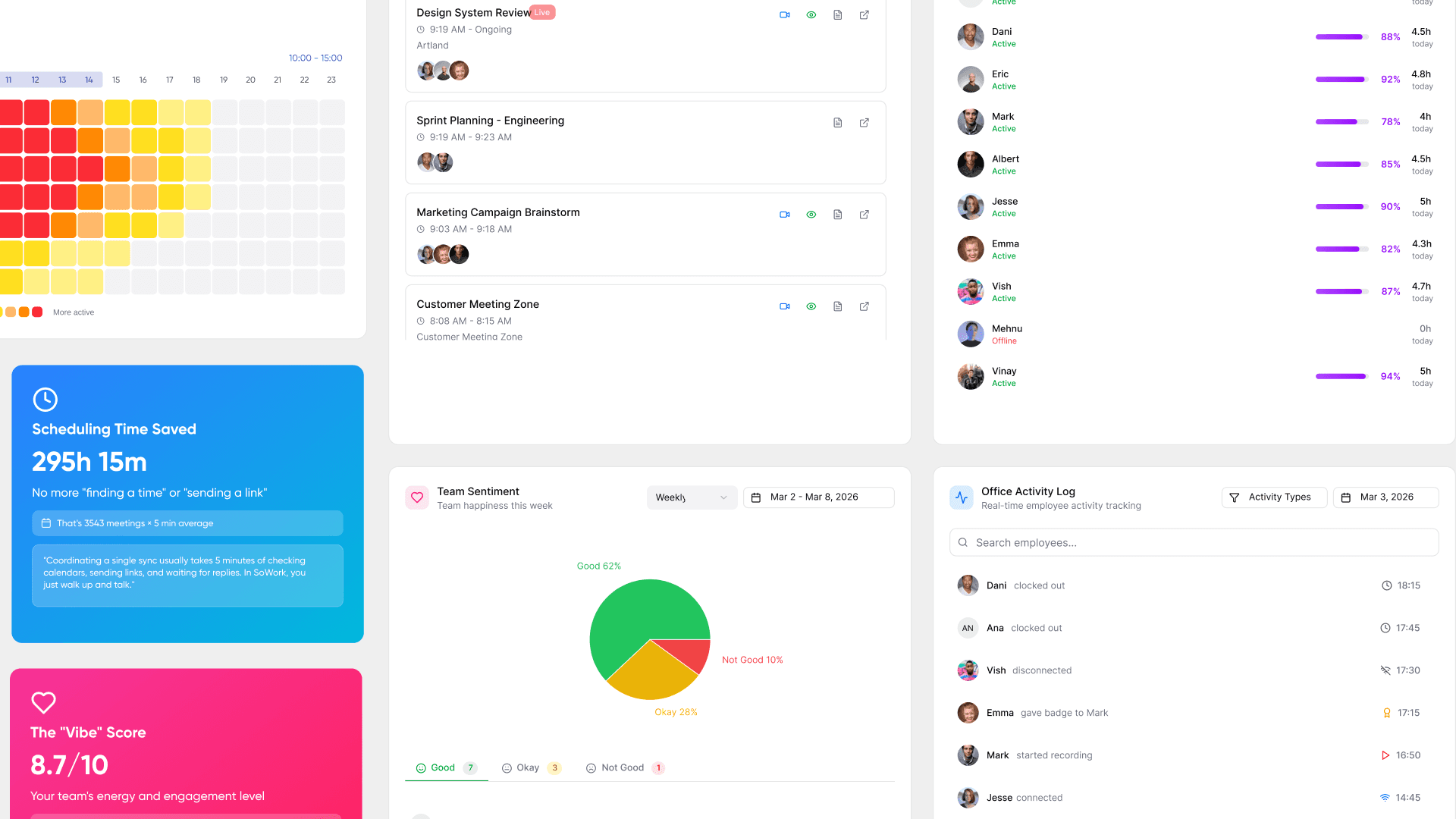
SoWork vs Roam: Best for Remote Culture in 2026?
Vishal Punwani

Published:
Updated on:
SoWork is the better pick for most remote teams under 200 people who want the office to feel physical, because its customizable 2.5D office, personalized avatars, and free plan for up to 10 users make shared space visible and easy to try. Roam suits larger teams that want one bundled tool with a Theater for all-hands.
What is a virtual office platform, and how is it different from video conferencing?
A virtual office platform is a workspace that stays open all day. Your teammates show up in rooms, so you can see who's around and start talking right away. A video conferencing tool only exists while a scheduled call is running.
Factor | Virtual office | Video conferencing |
|---|---|---|
When it exists | All day, persistent | Only during meetings |
Starting a talk | Click a teammate | Schedule, send a link |
Presence | Visible at a glance | Status dot at best |
Culture signal | A shared place with rooms and decor | None |
The gap this fills is real. In Gallup's 2025 data, 27% of exclusively remote employees said they'd felt lonely a lot of the previous day [1].
What core features does SoWork offer to replicate office presence?
SoWork recreates office presence with a customizable 2.5D office, live presence indicators, and one-click Instant Meetings that don't need a calendar link. AI Meeting Memory records and summarizes conversations, so decisions made in a quick chat still get written down.
Instant Meetings: check who's available and start talking in one click.
Presence Awareness: free, focused, or in a meeting, shown visually.
Topic-Based Chat: channels that keep context.
Built-in video and screen sharing.
AI agents in the office: agents sit in the office as characters next to your people. Through SoWork's MCP/API, Claude can ask who's around or what the team decided.
Insights: a weekly report on meeting time, focus time, and who works with whom.
It runs in the browser, so nobody has to download anything.
What core features does Roam offer to replicate office presence?
Roam pairs a company map of rooms with Drop-In Meetings. It bundles nine products, including Theater for all-hands, AInbox chat, Magic Minutes AI notes, and Magicast screen recording [3].
Every Roam member gets a private office, and you knock to drop in. Roam says its average meeting runs 8 minutes [2]. Theater handles all-hands meetings of up to 3,000 people [3]. Magic Minutes writes up every meeting and drop-in without a bot joining the call. You get a summary, a transcript, action items, and a group chat with the attendees [5]. Roam's own feature comparison also lists AI agents on the map and a game room with 18 titles [3].
How does SoWork show who's available without a meeting?
SoWork shows each teammate's status right on the office map: free, focused, or in a meeting. Automatic Calendar Sync changes your status when a calendar event starts, so it stays accurate without anyone touching it.
Focus Modes handle the other half of presence, which is protecting deep work. Simple Mode and Mini Mode let you show you're heads-down while staying loosely connected, so you're still visible without being interruptible. One G2 reviewer said walking over to a colleague in SoWork "takes no more time and somehow feels more connected" [7]. Presence also works for AI tools: through the MCP server, Claude can check who's around before it pings anyone.
How does Roam handle presence and availability?
In Roam, where you are on the map tells people whether you're free: your private office, a meeting room, or away. Teammates knock to drop in, and out-of-office statuses can include a return date and time [3].
Roam also has physical office tags for hybrid teams and a spotlight search that works across floors [4]. Presence is based on rooms, not on where you stand, and Roam doesn't use proximity audio [3]. That's tidier for focus, but you lose the feeling of overhearing a conversation nearby. Some G2 reviewers say push notifications aren't always on time [8], which matters when a knock is how people reach you.
How do SoWork and Roam compare on hallway-style drop-in conversations?
You can start a conversation without a link in either one. Moving your avatar over to someone in SoWork feels like walking up to their desk. Roam's knock feels more like tapping on a closed office door.
Capability | SoWork | Roam |
|---|---|---|
Start a chat | One-click Instant Meeting | Knock or click-to-join drop-in |
Spatial feel | Avatars in a shared 2.5D office | Room-based map, no proximity audio [3] |
Notes afterward | AI Meeting Memory | Magic Minutes [5] |
Scheduling needed | No | No |
If you want casual run-ins to happen, SoWork's open layout makes them more likely. Roam's private-office setup gets you fewer interruptions in exchange.
Which offers more office customization for culture expression?
SoWork gives you more room to design. Teams build and decorate their office and avatars, a bit like The Sims, and Premium teams with more than 30 people get a free custom map [6]. Roam's Map Editor lets you resize rooms, add floors, and add custom logos [6].
Design element | SoWork | Roam |
|---|---|---|
Layout | Custom maps, furniture, decor [6] | Resize rooms, add floors [6] |
Branding | Full office design | Custom logos [6] |
Personal space | Personalized avatars, pets [7] | Private office with personal shelf [3] |
Team games | Tank Wars and more [7] | Game room, 18 titles [3] |
Culture shows up in the details: a team kitchen, a launch room, inside jokes on the walls.
How do SoWork and Roam compare on integrations?
SoWork works alongside your current stack. It connects to Slack, Zapier, Miro, Google Calendar, and Microsoft Outlook, and more tools plug in through its MCP server. Roam is built to replace tools, and Roam says teams can drop Zoom, Slack, Loom, and Calendly [10].
Integration | SoWork | Roam |
|---|---|---|
Slack | Integrates | Positioned as a replacement [10] |
Google Workspace | Google Calendar sync | Google/O365 [6] |
Automation | Zapier, MCP server | Zapier [6] |
Dev and design | Miro; more through MCP | Native GitHub and Figma [4] |
CRM | Through MCP | HubSpot [6] |
If your team lives in Slack, SoWork asks for less change. If you want to consolidate tools, Roam's bundle is built for that.
What teams is SoWork best suited for?
SoWork fits remote-first and hybrid teams of 5 to 200 people that want their culture to feel tangible and want to try before paying. The free plan covers up to 10 users, and each floor holds about 200 people, with no limit on floors.
Strong fits: - Startups and small companies tired of using Slack and Zoom for everything. - Teams with skeptical users, since Simple Mode cuts down the visual load. - Companies already running AI agents that want them in the same space as their people. - Security-conscious buyers: SoWork is SOC 2 certified, with SSO on Premium and Enterprise and SCIM on Enterprise only.
What teams is Roam best suited for?
Roam says it's built for remote-first and hybrid companies of 20 to 500 people that want one platform to replace their distributed work stack [4].
Roam fits teams that: - Hold big all-hands often (Theater supports up to 3,000) [3]. - Want to cut separate subscriptions to chat, video, scheduling, and screen recording [10]. - Prefer usage-based billing that only charges active members [2].
It's a weaker fit for very small teams that want a free tier, because Roam doesn't offer one. New members get a 14-day trial instead [3].
What criteria should you use to pick a virtual office for culture?
The main test is whether people open it every day without being reminded. A feature list only matters if the office actually has people in it.
Criterion | What to test in a pilot |
|---|---|
Presence clarity | Can you tell who's free in three seconds? |
Friction to talk | How many clicks does it take to start a conversation? |
Daily adoption | Is the office full by 10am in week three? |
Culture expression | Can the space reflect your team's personality? |
Memory | Do quick decisions get recorded? |
Cost at your size | Price at 10, 25, and 50 seats |
Focus protection | Can people go heads-down without disappearing? |
How do SoWork and Roam compare on pricing?
SoWork costs less at every team size. It's free for up to 10 users, Basic is $6/user/month, and Premium is $15/user/month. Roam charges $19.50 per active member per month and only bills monthly [2].
Team size | SoWork Basic | SoWork Premium | Roam |
|---|---|---|---|
10 | Free | $150/mo | $195/mo |
25 | $150/mo | $375/mo | $487.50/mo |
50 | $300/mo | $750/mo | $975/mo |
One reviewer reports Roam's rate going to $20.88 in 2027 [11]. Roam's active-member billing can save money when seats sit unused [2]. For a team that uses the office every day, though, SoWork's flat per-seat price ends up cheaper.
What are the drawbacks of SoWork for culture building?
SoWork's biggest risk is about habits: if people keep defaulting to Slack, the office stays empty. Some G2 reviewers also mention occasional performance issues and bugs [7].
Two more to plan for. First, analytics can feel uncomfortable. One reviewer called team interaction data a bit "Big Brother-ish" and said being open about it is key [15]. Tell your team what Insights tracks and why before you turn it on. Second, teams coming from playful pixel-art tools may find SoWork's look more professional than whimsical. Both are fixable, but only if leaders show up in the office and say how it'll be used.
What are the drawbacks of Roam for culture building?
Roam's main drawbacks are cost, a room-based model that feels less spatial, and notifications that aren't always reliable. At $19.50 per active member each month with no free tier, it's the pricier choice [2][3].
G2 reviewers say push notifications aren't always timely, so messages can get missed [8]. Some early reviewers also found the learning curve steep during setup [9]. Members get the full experience in the installed app, while guests can join on the web [14]. And because Roam bundles nine products, it gets harder to leave the more tools you replace with it. That's worth weighing before you cancel Slack and Zoom.
Is there proof that either platform improves team cohesion?
Most of the evidence comes from vendors and user reviews, not independent studies. SoWork holds a 4.8 rating from 50 G2 reviews [7], and Roam reports a 4.9 G2 rating on its pricing page [2].
SoWork reports that its teams cut formal meetings by about 60% [12]. Roam reports an average meeting length of 8 minutes [2]. Customer quotes point the same way. The CTO of CTO Labs said that after switching to SoWork, "Team culture, creativity, and efficiency all went up" [16]. Treat these as signals, not proof. The stakes are real, though: in one large study, about 25% of remote-capable workers who live alone said they'd spent an entire day alone [13].
How do SoWork and Roam compare to Gather, Teamflow, and Sococo?
SoWork and Roam both offer more for working teams than lightweight spatial tools. SoWork has the deepest customization and a free tier. Roam has the broadest bundle.
Platform | Culture strength | Pricing note |
|---|---|---|
SoWork | Customizable 2.5D office, AI meeting memory | Free up to 10 users |
Roam | All-hands Theater, nine-product bundle [3] | $19.50/active member [2] |
Gather | 2D pixel-art map, proximity audio [4] | $12 to $15/user, no permanent free tier [3] |
Teamflow | Spatial office | Free tier available [4] |
Sococo | Presence map that routes calls to Zoom or Webex [10] | Tiered [4] |
How do you onboard a remote team onto a virtual office?
Onboarding works when you swap an existing habit for the office instead of adding one more tool. Pick one ritual to move in during week one and have leaders show up in the office where everyone can see them.
Set up your SoWork office and invite the team. It takes minutes and nobody downloads anything.
Have the team build and decorate the space together in the first week.
Move one recurring ritual in, like standup or Friday coffee.
Agree on norms: open the office at the start of the day, and respect Focus Mode.
Have leaders work from the office every day.
Look at Insights after two weeks and adjust.
Which delivers a stronger sense of shared physical presence, SoWork or Roam?
For most fully distributed teams, SoWork gives the stronger sense of being in the same place. You move an avatar through an office your team designed, instead of clicking between rooms on a map. Roam is stronger for large broadcast moments.
Presence comes from three things: seeing people, running into them, and owning the space. SoWork does well on all three with visual status, one-click conversations, and an office you decorate yourselves. Roam does well on the first two, and Theater gives all-hands a real sense of occasion [3]. If your culture runs on small daily moments, pick SoWork. If it runs on big company-wide gatherings, Roam earns its price.
Key Takeaways
SoWork is the stronger choice for shared physical presence because teams design their own 2.5D office and move avatars through it.
Roam is a nine-product bundle at $19.50 per active member per month, with a Theater that supports all-hands of up to 3,000.
SoWork is free for up to 10 users, Basic is $6/user/month, and Premium is $15/user/month. It costs less than Roam at every team size.
Roam's room-based map has no proximity audio. SoWork's open layout makes chance encounters more likely.
SoWork works alongside Slack and connects AI tools like Claude through MCP. Roam is built to replace Slack, Zoom, Loom, and Calendly.
Remote loneliness is real: 27% of exclusively remote employees reported feeling lonely a lot of the previous day in Gallup's 2025 data.
Adoption beats features. Run a 30-day pilot, move one ritual into the office, and have leaders show up daily.
Related reading
Spot vs SoWork vs Remo: Which Is the Best Virtual Office for Remote Culture Building in 2026?
SoWork vs Roam Pricing in 2026: Which Virtual Office Is Actually Cheaper for a Growing Remote Team?
Sources
Roam G2 reviewers report that push notifications are not always timely or consistent
Some Roam G2 users found the initial setup learning curve difficult
Roam's 2026 price is $19.50 per active user, going to $20.88 in 2027
SoWork reports that teams reduced formal meetings by approximately 60% (vendor-reported)
Roam members use the installed app for full features, while guests can join via the web
CTO Labs' CTO said team culture, creativity, and efficiency all went up after adopting SoWork
FAQ
SoWork vs Roam for remote culture building: which virtual office actually makes your team feel like they're in the same place?
Is a virtual office actually worth it, or is it a gimmick?
Does Roam have a free plan?
Can a virtual office replace Slack and Zoom?
Do I need to download an app to use SoWork or Roam?
Will a virtual office feel like my team is being watched?
How much does Roam cost compared to SoWork for a 25-person team?
How do you get remote employees to actually use a virtual office?
Blogs
Read Similar Articles
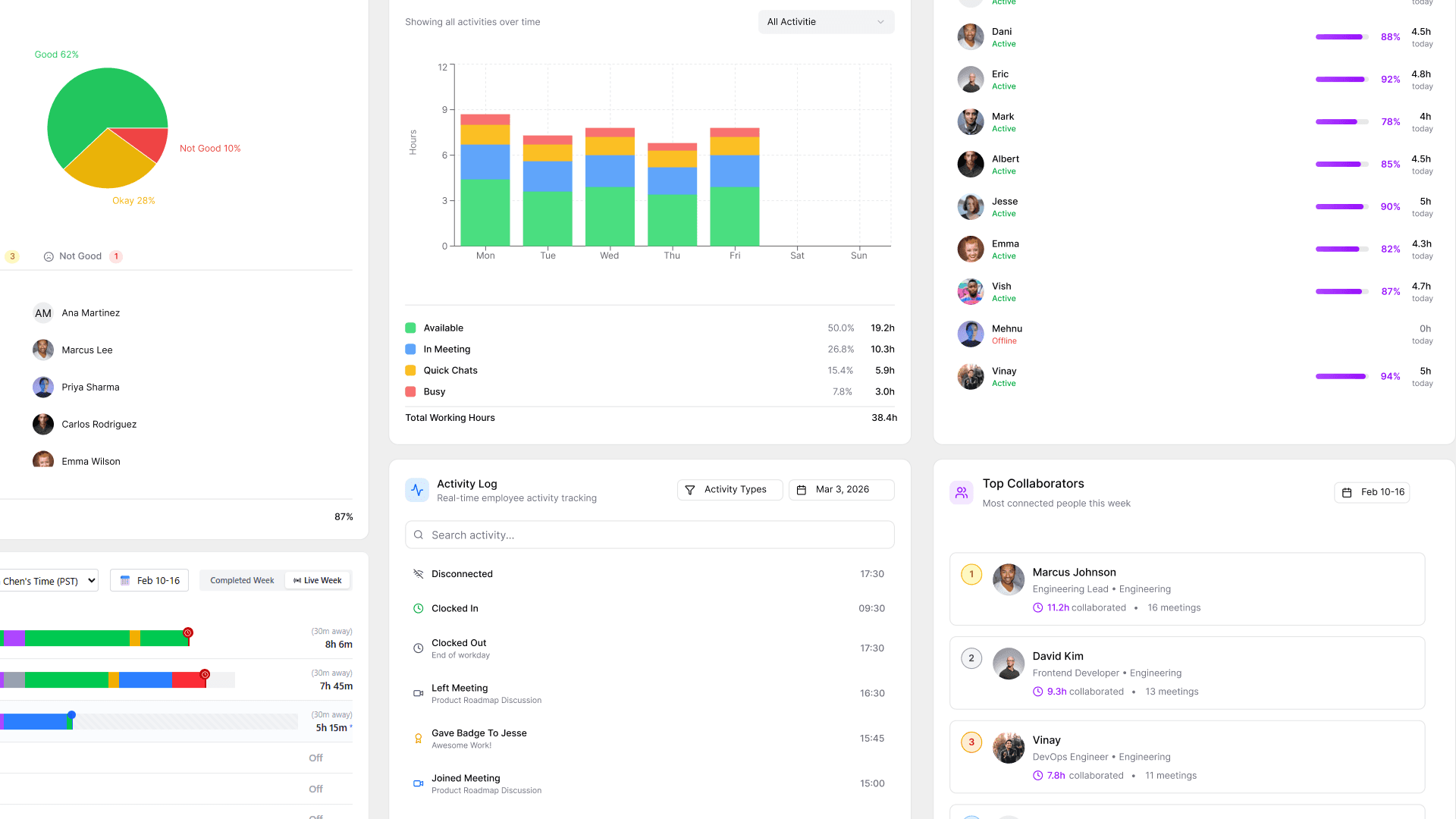
Remote Team Analytics: Complete Guide to Data-Driven Remote Work Management in 2026
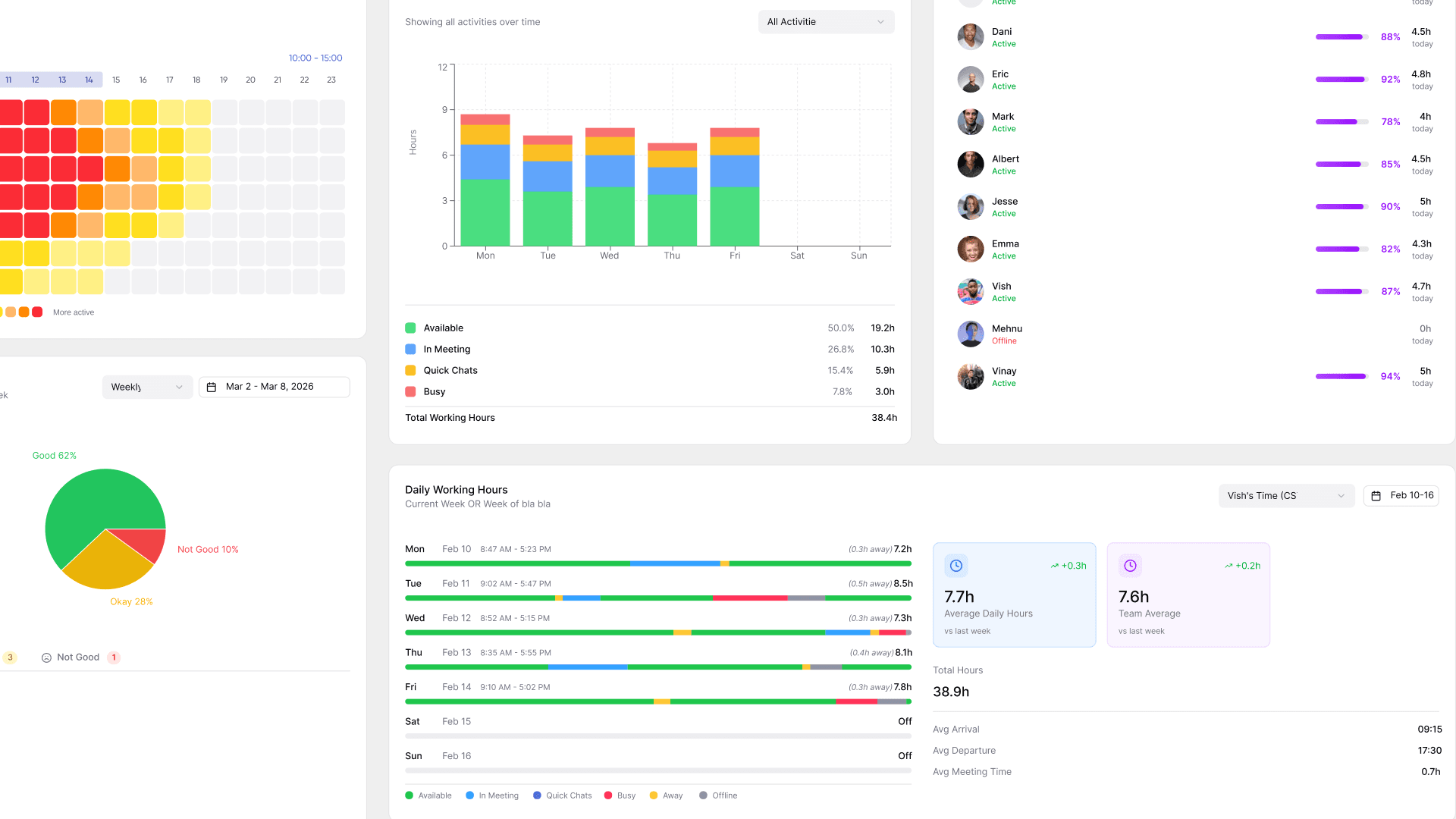
Complete Guide to Gaining Visibility Into Remote Team Performance and Collaboration