Signs of Burnout on Distributed Teams: What Managers Need to Watch For
SoWork Editorial Team

Published:
Updated on:
Signs of burnout on distributed teams include slower message response times, camera-off habits in meetings, missed deadlines, social withdrawal from virtual spaces, and always-on overwork patterns. Fully remote employees report burnout at 61%, higher than hybrid or in-office peers. These signals are harder to catch without the ambient awareness of a physical office.
What is burnout, exactly, for remote and distributed teams?
Burnout on distributed teams is chronic, unmanaged work stress that produces exhaustion, cynicism, and a sense of professional ineffectiveness. It's not just tiredness, it's a systemic breakdown that accumulates quietly without the visible cues a physical office provides.
Social psychologist Christina Maslach, one of the leading burnout researchers, defines it as a combination of exhaustion, cynicism, and organizational inefficacy that drives a persistent feeling of ineffectiveness [1]. For remote teams, that pattern is harder to detect. Managers can't walk the floor, notice who skips lunch, or feel the energy dip on a tough week. Burnout builds in the background until it surfaces in output, and by then, it's already advanced [2].
Why do distributed teams burn out faster than co-located ones?
Distributed teams face a compounding set of pressures that co-located teams don't: invisible workloads, pressure to prove productivity, blurred home-work boundaries, and the absence of informal social recovery. These factors push burnout rates higher for fully remote workers.
Fully remote employees report burnout at 61%, compared to 55% overall across all work models [3]. Remote employees also feel tacit pressure to prove they're working, an unproductive day triggers fear that colleagues assume they're slacking, so they overcompensate with longer hours [1]. Research shows remote workers log a full extra day of work per week compared to co-located counterparts [4]. That's not flexibility. That's a slow slide into exhaustion with no natural stopping point.
What early warning signs should managers watch for on remote teams?
The earliest burnout signals are behavioral, not performance-based. Watch for slower message response times, shorter replies, skipped optional meetings, and inconsistent availability, all before deadlines start slipping.
Key early indicators include: delayed responses to messages, sudden changes in messaging patterns, increased irritability in written communication, and employees sending emails at unusual hours [5]. Missing deadlines or taking longer on routine tasks, reduced participation in team discussions, and inconsistent availability are also early flags [6]. The problem is that managers default to deliverables as the measure of health. But deliverables are a lagging indicator, by the time output drops, burnout is already rooted [2].
What communication pattern changes signal a burning-out remote employee?
A shift in communication cadence is one of the clearest early signals. An employee who usually responds quickly starts taking hours or days to reply, writes shorter answers, or avoids video calls altogether.
Watch for these specific shifts: an employee who typically responds promptly suddenly takes hours or days to reply [5]; responses become shorter and less thoughtful [7]; they stop contributing ideas in group chats; and they avoid or delay check-ins [6]. Irritability in written messages is another tell, a usually collaborative person becomes terse or defensive [8]. These aren't attitude problems. They're emotional exhaustion showing up in the only channel you have visibility into.
How does reduced virtual office presence signal burnout?
When a team member who used to be visibly present in your virtual workspace starts going dark, fewer drop-in conversations, camera consistently off, status always set to 'busy', that pattern is a reliable burnout signal.
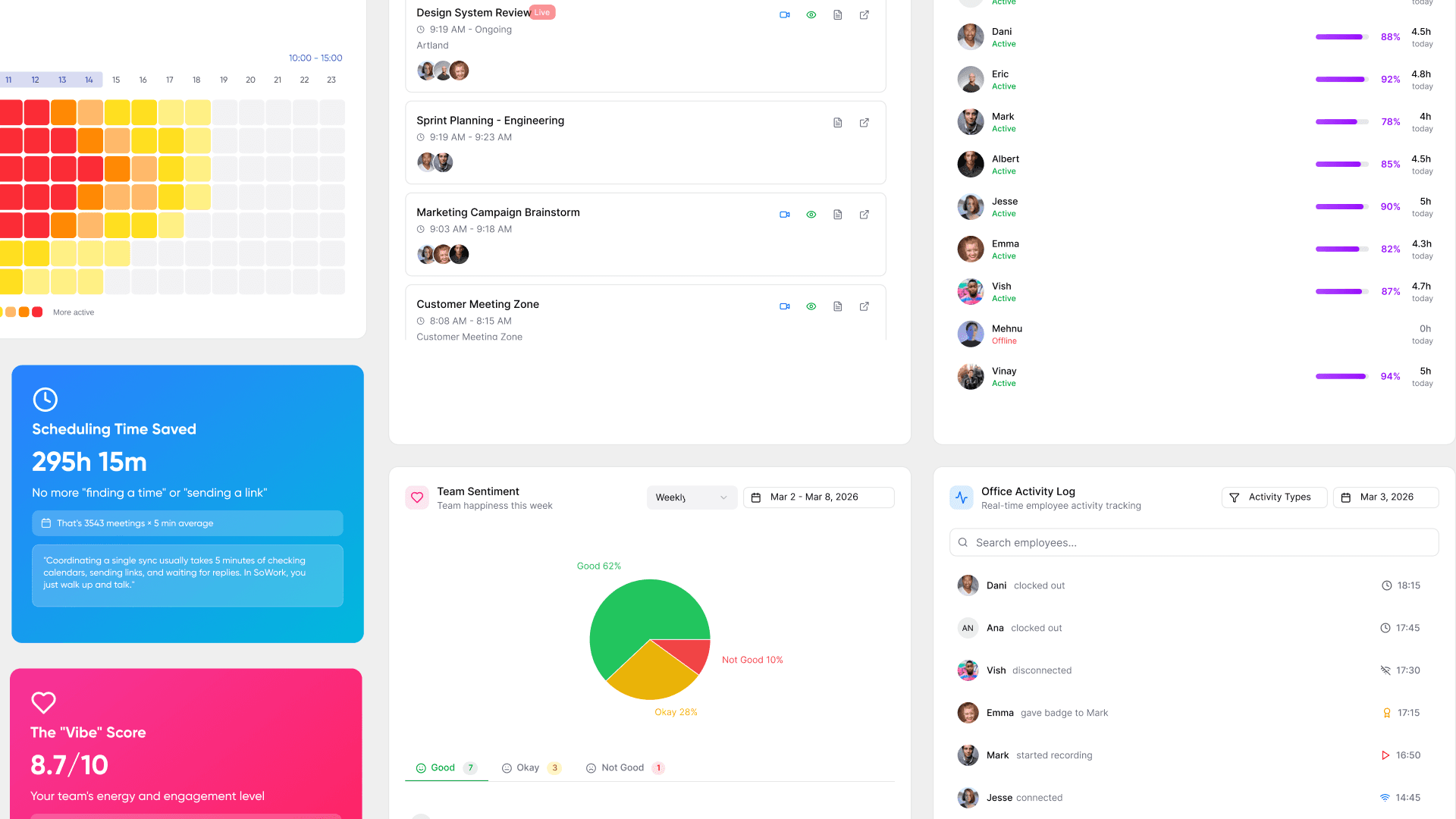
In a virtual office, presence is the equivalent of seeing someone at their desk. A normally active member who stops turning on their camera during meetings, withdraws from group chats, or misses deadlines is likely struggling [5]. Tools like SoWork surface this naturally: when someone who usually has an open-door presence starts spending every hour in Focus Mode or simply disappears from the office map, managers get a visual signal without having to schedule a formal check-in. Presence awareness makes the invisible visible.
What productivity signals suggest a team member is burning out?
Declining output quality, missed deadlines, and an increase in errors are the most visible productivity signs of burnout. But these are lagging indicators, they appear after the problem has been building for weeks.
Tasks that used to take an hour start consuming a day. Errors increase. Deadlines slip [9]. You might also notice frequent task-switching, difficulty staying focused, or a team member logging unusually long hours without proportional output [10]. Burnout doesn't always look like disengagement, sometimes it looks like someone working constantly but producing less. That combination of overwork and declining quality is a clear signal. Address it before it becomes a performance conversation.
How does social withdrawal in virtual workspaces indicate burnout?
Social withdrawal in a virtual workspace looks like a team member who stops initiating conversations, skips optional social events, and goes quiet in channels where they used to be active. It's isolation compounding exhaustion.
25% of fully remote workers report feeling lonely at work, compared to 16% of office workers [11]. That loneliness removes the informal support systems that help people manage stress. In a virtual office, withdrawal shows up as: no spontaneous drop-ins, silence in topic-based chat channels, and opting out of casual team interactions. The catch is that withdrawal both signals and worsens burnout, isolation accelerates emotional exhaustion. Platforms that make ambient social presence easy lower the friction for reconnection before it gets that far.
What emotional and attitudinal signs are hardest to catch on distributed teams?
Cynicism, emotional detachment, and a loss of meaning in work are the hardest burnout signs to detect remotely because they don't show up in output data, they show up in tone, energy, and attitude during interactions.
Burned-out employees may sound distant or cynical in meetings, react defensively to feedback, or seem to go through the motions without genuine engagement [12]. Tasks that once felt meaningful start feeling pointless [13]. These shifts are subtle in person and nearly invisible through a screen. Without the ambient read of body language and hallway energy, managers miss them entirely. The only way to catch attitudinal burnout early is through consistent, low-stakes 1:1 conversations focused on how someone feels, not just what they're shipping.
How does the disappearance of spontaneous collaboration signal burnout?
When a team stops having unscheduled conversations and every interaction becomes a formal meeting, that loss of ambient collaboration is both a symptom and an accelerant of burnout.
In a healthy distributed team, you see spontaneous drop-ins, quick questions answered in seconds, and casual side conversations. When burnout sets in, those disappear. Every interaction gets scheduled. People stop reaching out unless they have to. This is where a virtual office like SoWork makes the signal visible: if your team's Instant Meeting usage drops and everyone's calendar fills with formal blocks instead, the spontaneous connective tissue is gone. That's a team under strain, not a team that's simply heads-down.
How do always-on culture and blurred boundaries fuel remote burnout?
Always-on availability is one of the primary drivers of remote burnout. Without a commute or physical office to create a natural stop, remote workers extend their hours chronically, and the data shows it.
81% of remote workers check email outside of work hours, including 63% on weekends [14]. Nearly one-third of remote workers feel 'always on,' and 45% find it difficult to unplug at the end of the day [15]. The Conference Board found that 47% of remote workers are concerned about blurred work-life boundaries [16]. Remote workers also log an average of 3 extra hours per day compared to office workers [17]. Without team norms and tools that signal when someone is in deep work versus available, the pressure to stay reachable becomes relentless.
How do you tell the difference between burnout and plain disengagement?
Burnout typically comes with overwork and exhaustion, a burned-out employee is often working too much, not too little. Disengagement usually looks like low effort without the exhaustion. The combination of long hours and declining output points to burnout.
Disengagement often shows up as low effort with stable energy. Burnout shows up as high effort, declining output, and visible exhaustion [10]. Meta-analytic research shows disengagement often precedes burnout, especially when it's paired with long hours and work that feels meaningless [18]. A useful diagnostic: is the person working more than usual but producing less? Are they irritable rather than indifferent? Do they seem tired rather than checked out? Those patterns point to burnout. Indifference with normal hours is more likely a motivation or fit issue.
What platform signals can help you catch burnout early?
Virtual office platforms surface behavioral patterns that traditional tools miss: presence drop-off, after-hours activity, reduced spontaneous conversations, and camera-off trends in meetings all show up as observable signals.
Key signals to track in a virtual workspace: sudden spikes in late-night logins or weekend activity; a drop in spontaneous Instant Meeting usage; a team member's status shifting permanently to Focus Mode; and reduced participation in topic-based chat channels. SoWork's Presence Awareness layer makes these patterns visible without requiring surveillance, you're reading ambient signals, not monitoring keystrokes. Pair that with AI Meeting Memory to spot when someone stops contributing in meetings even when they're technically present.
How can team leads monitor for burnout without micromanaging?
The goal is ambient awareness, not surveillance. The best managers create low-friction check-in rhythms, watch behavioral patterns in the tools their team already uses, and ask direct questions about workload, not just output.
Practical approaches that don't feel invasive: weekly async check-ins with a simple 'how's your energy this week?' prompt; watching presence patterns in your virtual office rather than demanding status updates; using 1:1s to ask about workload and boundaries, not just project status. SoWork's Focus Modes let team members signal deep work time without disappearing entirely, that mutual visibility reduces the need for managers to check in constantly. Trust the signals the environment gives you before scheduling another meeting.
What should managers do once they spot burnout signs?
Act quickly, privately, and with curiosity rather than judgment. The first step is a direct 1:1 conversation focused on the person's experience, not their performance. Then address workload, boundaries, and recovery time concretely.
A clear action sequence: 1. Schedule a private 1:1 immediately, frame it around their wellbeing, not performance. 2. Ask open questions: 'How are you feeling about your workload?' not 'Why are you missing deadlines?' 3. Audit their actual hours and task load together. 4. Adjust workload, redistribute tasks, or enforce time-off. 5. Set explicit norms around after-hours availability. 6. Follow up consistently over the next 2 to 4 weeks. Burned-out employees who feel unseen are nearly three times more likely to leave within the year [19]. Acting early is a retention decision, not just a wellness one.
How should you design a virtual office to reduce burnout conditions?
A well-designed virtual office reduces the two biggest burnout drivers: communication friction and always-on pressure. It does this by making availability visible, enabling spontaneous connection, and giving people tools to signal when they need uninterrupted time.
Design principles that help: use presence indicators so teammates know who's free without sending a message; enable Focus Modes so deep work is respected without requiring a calendar block; reduce meeting overhead with Instant Meetings so quick questions don't become 30-minute Zoom calls. SoWork builds all of this into one environment. When teams don't have to context-switch across five tools to stay aligned, cognitive load drops. Lower friction means less stress accumulation over time, which is where burnout starts.
What does the data actually say about remote team burnout rates and causes?
Remote burnout is at record levels. In 2025, 66% of American workers reported burnout, with fully remote employees hitting 61%, higher than hybrid or in-office peers. The top causes are always-on culture, blurred boundaries, isolation, and digital communication overload.
A 2025 Modern Health study found employee burnout has hit an all-time high, with 66% of American workers reporting it [20]. Fully remote employees burn out at 61% versus 55% overall [3]. 69% of remote employees say digital communication tools have made their burnout worse [14]. Burned-out employees are nearly three times more likely to plan to leave their employer within the year [19]. McKinsey has labeled the pattern 'the great exhaustion,' with one in five workers reporting outright burnout [21]. The causes are structural, not personal, and that means they're fixable.
Key Takeaways
Fully remote employees report burnout at 61%, higher than hybrid (57%) or in-office (55%) peers, it's a structural risk, not an individual failing.
The earliest burnout signals are behavioral: slower response times, shorter messages, camera off in meetings, and disappearing from virtual spaces.
Deliverables are a lagging indicator. By the time output drops, burnout has already been building for weeks.
Always-on culture is a primary driver: 81% of remote workers check email after hours, and remote workers average 3 extra hours per day versus office peers.
Burnout and disengagement look different. Burnout combines high effort with declining output and visible exhaustion. Disengagement is low effort with stable energy.
Virtual office presence patterns, drop-in frequency, Focus Mode usage, after-hours logins, are early signals managers can read without micromanaging.
Burned-out employees are nearly 3x more likely to plan to leave within the year. Catching it early is a retention decision.
Fixing burnout requires structural changes: workload audits, explicit after-hours norms, reduced meeting overhead, and ambient presence tools that lower communication friction.
Sources
FAQ
What are signs of burnout on distributed teams?
Why are remote employees more likely to burn out than office workers?
How can managers detect burnout without micromanaging remote employees?
How does always-on availability cause burnout on remote teams?
What is the difference between burnout and disengagement on a remote team?
Blogs
Read Similar Articles
Remote Team Analytics: Complete Guide to Data-Driven Remote Work Management in 2026
Complete Guide to Gaining Visibility Into Remote Team Performance and Collaboration