How to Onboard New Hires Remotely: The Complete Playbook for Distributed Teams
SoWork Editorial Team

Published:
Updated on:
Onboard remote hires by shipping equipment before day one, setting up a virtual workspace, assigning an onboarding buddy, and building a structured 30-60-90 day plan. Strong remote onboarding improves new hire retention by 82% and productivity by over 70%. The biggest gap is replacing the ambient, informal connection that offices provide naturally.
What are the core goals of a remote onboarding program?
Every remote onboarding program has three jobs: make the new hire feel genuinely welcomed, get them productive fast, and connect them to the team and culture before doubt sets in.
Those goals sound simple, but remote settings make each one harder. New hires don't absorb culture by overhearing conversations or watching how colleagues behave. You have to deliver it explicitly. The clearest measure of success is whether the hire still wants to be there at 90 days. Nearly 90% of employees decide whether to stay or leave within their first six months [1], so the window is short. A good program covers four things: clear role expectations, tool access, cultural context, and human connection, in that order of urgency.
How does remote onboarding differ from in-person onboarding?
The goals are identical, but every connection that would happen organically in an office, hallway introductions, overheard conversations, a tap on the shoulder, has to be deliberately designed in a remote setting.
In-person onboarding fills gaps through physical proximity. Remote onboarding requires every single connection to be intentional [2]. There's no reading body language, no popping by a desk to check in. Managers have to be more explicit about communication norms, availability expectations, and cultural cues. The upside: remote onboarding is location-agnostic and, when documented well, it's more consistent and scalable than anything that relies on office osmosis.
What should be in a remote onboarding checklist before day one?
Pre-boarding is where most remote onboarding programs fail. If a new hire logs on day one without equipment, access, or context, you've already lost ground.
Ship hardware early and confirm the delivery address. Then work through this list before their start date:
Pre-boarding task | Why it matters |
|---|---|
Ship laptop, headset, peripherals | 43% of new hires lack equipment in week one [3] |
Provision email, SSO, and key tools | Blocked access kills momentum |
Send a welcome package with org chart | Reduces day-one anxiety |
Share a week-one agenda | Signals structure and care |
Assign onboarding buddy | Gives them a go-to person immediately |
Set up virtual office access | So they can walk in, not just dial in |
How do you set up a new hire's virtual workspace so they feel welcomed on day one?
A new hire's virtual workspace should be ready before they log in, not something they configure themselves on a stressful first morning.
Set up their SoWork virtual office space in advance, avatar, desk location, and team neighborhood. Add them to the right chat channels and shared docs. Send a short loom-style welcome video from their manager the night before. On day one, have a teammate greet them in the virtual office with an instant meeting rather than a calendar invite. The goal is that the first thing they experience is a human face, not a setup wizard. First impressions in remote work are digital, and they stick.
How can a virtual office platform replicate the 'ambient presence' that helps new hires feel part of the team?
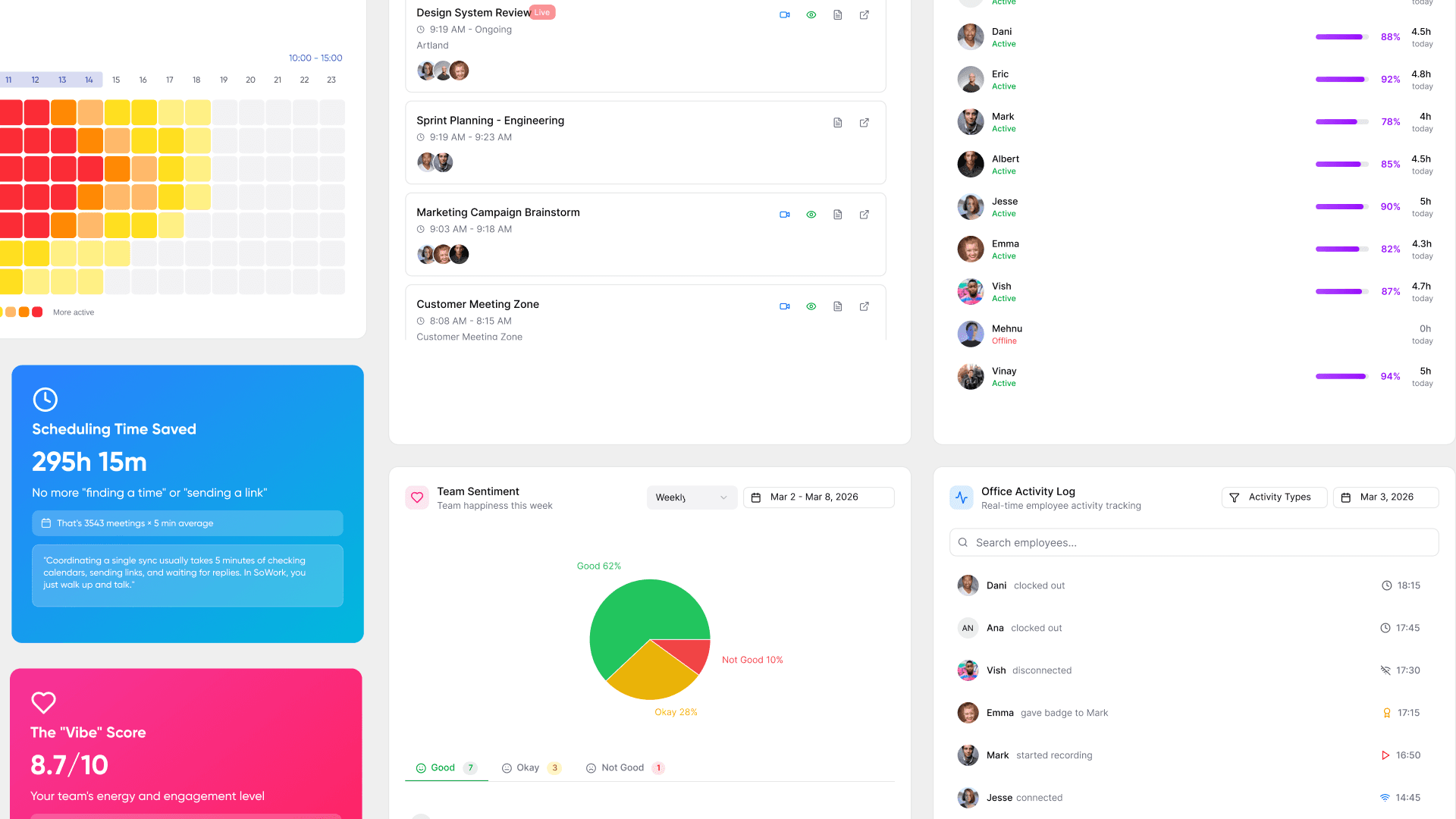
Ambient presence is the sense of knowing who's around, who's busy, and who you can tap, without scheduling anything. SoWork replicates this with real-time presence indicators and instant, one-click meetings.
In a physical office, new hires learn team rhythms by watching. They see who arrives early, who takes long lunches, who's always in a side conversation. SoWork's presence awareness layer gives remote hires that same visibility: green means available, focused mode means heads-down, calendar sync means in a meeting. When a new hire has a quick question, they can see their buddy is free and start a conversation in one click, no scheduling, no link, no friction. That single interaction pattern does more for belonging than a dozen formal welcome calls.
How do you introduce a new hire to teammates without scheduling a flood of formal meetings?
Stagger introductions over the first two weeks and mix formats so the new hire isn't drowning in back-to-back video calls.
Start with a small team welcome on day one, five people maximum. Then introduce cross-functional contacts in week two, one or two at a time. Use async formats for lower-stakes intros: a short Loom, a pinned message in a topic-based channel, or a written "about me" post the new hire controls. In a virtual office like SoWork, organic drop-ins replace many scheduled intros, a teammate sees the new hire is available and pops over. That feels far more natural than a calendar block titled "Meet Sarah."
What role does spontaneous, informal interaction play in remote onboarding?
Spontaneous interaction is where culture actually transfers. It's how new hires learn unwritten rules, build trust, and start to feel like insiders rather than contractors.
Only 39% of remote employees said they received the right level of support during remote onboarding, and 18% said they received none at all [4]. A big reason is the absence of informal moments. You can't manufacture spontaneity with a scheduled "virtual coffee." What you can do is create conditions for it. SoWork's virtual office keeps the whole team visible in one space, so a new hire walking through the office might catch a teammate between tasks and spark a real conversation. That's the mechanism. Presence awareness makes serendipity possible.
How do you structure the first week of a remote onboarding program day by day?
The first week should balance information, connection, and breathing room. Overloading day one is the most common mistake.
Monday: Virtual office setup, manager welcome call, team intro, HR paperwork
Tuesday: Role expectations and 30-60-90 day plan walkthrough, tool training
Wednesday: Job shadow or async deep-dive into a live project
Thursday: Cross-functional intros (one or two), culture and values session
Friday: Buddy debrief, open Q&A, reflection time, no new information
Friday is intentionally light. New hires process information at a slower pace when everything is new [5]. End the week with a win, not a wall of slides.
What criteria should you use to assign an onboarding buddy or mentor?
The best onboarding buddy is someone who knows the culture well, isn't the new hire's direct manager, and has enough bandwidth to actually show up.
56% of new hires say having a buddy at work was very important when getting started [6]. Pick someone who has been at the company at least six months, long enough to know the unwritten rules, not so long they've forgotten what it felt like to be new. Match on role proximity, not just seniority. A buddy from a different team is often better for honest conversations. In SoWork, the buddy relationship works naturally: the new hire can see their buddy's availability at any moment and drop in without the awkwardness of a cold calendar request.
How do you document and share company culture, norms, and processes for remote new hires?
Remote hires can't absorb culture passively, so you have to write it down. A living company handbook, not a static PDF, is the foundation.
GitLab, one of the world's largest all-remote companies, built an onboarding system so detailed it runs over several weeks, with guides, a buddy system, and a fully documented public handbook [7]. That's the benchmark. Your handbook should cover: communication norms (what's async vs. sync), decision-making frameworks, meeting etiquette, and values with real examples. Store it in a searchable wiki, Notion or Confluence work well. Link it from the new hire's first-day SoWork channel so it's one click away, always.
What tools work best alongside a virtual office platform for remote onboarding?
The goal is fewer tools, not more. Every extra app a new hire has to learn on day one adds friction and signals a disorganized team.
Layer | Tool type | Why it helps |
|---|---|---|
Identity & access | SSO provider | One login, instant access |
Documentation | Wiki (Notion, Confluence) | Searchable, living knowledge base |
Async video | Loom or similar | Replaces long written explanations |
HR & payroll | HRIS | Paperwork before day one |
Virtual office | SoWork | Presence, meetings, chat, AI memory in one place |
SoWork's all-in-one design matters here. Consolidating presence, instant meetings, topic-based chat, and AI meeting summaries into one platform means new hires aren't context-switching across five apps before they've shipped their first piece of work.
What are the biggest risks of a poorly executed remote onboarding process?
The biggest risk is early attrition. New hires who have a bad onboarding experience are twice as likely to start searching for another job.
20% of employee turnover happens within the first 45 days [8]. That's before most onboarding programs even finish. The compounding costs are real: recruiting fees, lost productivity, and the institutional knowledge that walks out the door. Beyond turnover, a poor remote onboarding creates a disconnected employee who's technically present but never quite invested. They do the work, but they don't build relationships, don't flag problems early, and don't stay long. The risk isn't just losing the hire, it's the six months of mediocre output before they leave.
How do you measure whether a remote onboarding program is working?
Measure onboarding effectiveness with a combination of retention data, time-to-productivity milestones, and direct feedback surveys at 30, 60, and 90 days.
Run a short pulse survey at the end of week one: Did they have the tools they needed? Did they feel welcomed? Did they understand their role? Then repeat at 30 and 90 days with deeper questions about belonging, clarity, and confidence. Track time-to-first-contribution as a hard metric, when did they ship something real? Also watch 90-day retention rates. If you're losing people before the quarter ends, the onboarding program is the first place to look. SoWork's AI Meeting Memory helps here too: reviewing early 1:1 summaries reveals patterns in what new hires ask and where they're stuck.
How do you build psychological safety for remote new hires who never meet colleagues in person?
Belonging is built through consistency, not grand gestures. New hires need to know they can ask a dumb question, make a small mistake, and still be welcomed back tomorrow.
Start by explicitly naming the culture of safety in the first week, don't assume new hires will infer it. Managers should model it by sharing their own mistakes in early 1:1s. Only 43% of remote employees say their onboarding helped them feel connected to company culture [9], which means most programs skip this entirely. Practically: celebrate small wins publicly in SoWork's team channels, keep cameras on during early meetings so faces become familiar, and make the buddy relationship genuinely two-way. The new hire should feel like they're contributing to someone, not just being managed by them.
What are proven examples of companies that have successfully onboarded employees remotely at scale?
GitLab, Doist, and LinkedIn are the most-cited examples of remote onboarding done well at scale, each with a distinct approach worth borrowing from.
GitLab recommends new hires spend at least two full weeks on general onboarding before any team-specific training, driven by a detailed public handbook and a buddy system [10]. Doist runs a one-week async onboarding bootcamp via their own tool, pairing curated reading with a mentor from day one, the goal is building autonomy fast [11]. LinkedIn sends a physical welcome kit before day one covering culture, values, and system setup, then follows with a virtual office tour on the first morning [12]. The common thread: structure, documentation, and a human point of contact from the start.
How do you onboard remote new hires across different time zones?
Time zone onboarding works when you default to async-first and treat synchronous time as a scarce, high-value resource, not the default mode.
Record all training sessions so hires in different zones can watch on their own schedule. Use SoWork's AI Meeting Memory to auto-transcribe and summarize any live sessions they miss. Set clear "overlap windows", the hours when the new hire and their manager are both available, and protect those for relationship-building, not status updates. Document everything in the team wiki so the new hire can self-serve at 2pm their time without waiting for a 9am reply from HQ. Async-first doesn't mean slow, it means thoughtful.
How long should a remote onboarding program last before a new hire is fully ramped?
Plan for 90 days minimum and up to six months for complex roles. Treating onboarding as a one-week event is the single most common mistake distributed teams make.
Training sessions and paperwork wrap up in a few weeks, but it takes two to six months for a new hire to feel like a fully integrated team member [13]. Only 15% of companies continue onboarding after six months, yet nearly 90% of employees make their stay-or-leave decision within that same window [14]. Top-performing teams use a 30-60-90 model: foundations in month one, real projects in month two, independent contribution by month three [15]. High-complexity roles often don't hit peak productivity until the six-month mark, don't rush the ramp.
What common mistakes do managers make when onboarding remote employees?
The most damaging mistakes are front-loading information, under-communicating, and treating onboarding as an HR task rather than a management responsibility.
Mistake | Fix |
|---|---|
No equipment before day one | Ship hardware the week the offer is signed |
Flooding week one with meetings | Cap formal meetings at 3 hours per day |
Skipping cultural context | Dedicate a full session to values with real examples |
One-and-done check-ins | Use a waterfall schedule, frequent early, tapering off |
Manager as sole contact | Assign a peer buddy from day one |
Ending onboarding at 30 days | Extend structure to 90 days minimum |
The underlying failure is treating remote onboarding as a checklist rather than a relationship. Tools like SoWork reduce the coordination overhead so managers can spend that saved time on the human parts.
Key Takeaways
Strong remote onboarding improves new hire retention by 82% and productivity by over 70%, the ROI is clear.
20% of employee turnover happens within the first 45 days, making the pre-boarding and week-one experience critical.
Ship equipment and provision all tool access before day one, 43% of new hires lack essential equipment in their first week.
Assign an onboarding buddy who isn't the direct manager; 56% of new hires say a buddy was very important to their early success.
Ambient presence, knowing who's around and available, is what remote onboarding most commonly fails to replicate. A virtual office platform solves this.
Plan for 90 days minimum; two to six months is realistic for full integration. Most companies stop too early.
Measure with 30/60/90-day pulse surveys and time-to-first-contribution metrics, not just completion of a checklist.
Default to async-first for cross-timezone onboarding, and record every live session so no one is blocked by a time difference.
Sources
Nearly 90% of employees decide whether to stay or leave within their first six months.
43% of new hires are without essential job equipment for more than a week after they start.
Only 43% of remote employees say their onboarding helped them feel connected to company culture.
20% of employee turnover happens within the first 45 days of employment.
It can take two to six months for a new hire to feel like a fully integrated team member.
Strong onboarding processes improve new hire retention by 82% and productivity by over 70%.
FAQ
How do you onboard new hires remotely?
What are the core goals of a remote onboarding program?
How long should a remote onboarding program last?
What tools work best for remote onboarding?
How do you build belonging for remote new hires who never meet colleagues in person?
Blogs
Read Similar Articles
Remote Team Analytics: Complete Guide to Data-Driven Remote Work Management in 2026
Complete Guide to Gaining Visibility Into Remote Team Performance and Collaboration