Granola vs Fathom: Best for Spontaneous Meetings?
Vishal Punwani

Published:
Updated on:
Granola is the better fit for distributed teams with lots of spontaneous meetings, because it captures system audio directly without a bot, so it records any call the moment it starts, no scheduling or invitations required. Fathom is stronger for teams that want unlimited free recordings and full video playback from planned video calls.
What is Granola, and what problem does it solve for meeting-heavy teams?
Granola is a desktop AI notepad that captures your computer's system audio and turns it into structured meeting notes, without ever joining your call as a bot. It solves the note-taking tax: the time and attention you lose trying to document meetings while also being present in them.
Rather than generating a generic transcript, Granola uses a human-in-the-loop model. You jot rough cues during the meeting, a few words, a name, a topic, and Granola's AI enhances those notes with full context from the transcript afterward [1]. The result is a note that reflects your perspective, not just a word-for-word dump. It works across Zoom, Google Meet, Teams, Slack huddles, and any platform that routes audio through your device [1]. Granola raised $125M in a Series C round in March 2026, reaching a $1.5B valuation [2].
What is Fathom, and what problem does it solve for meeting-heavy teams?
Fathom is an AI meeting assistant that records, transcribes, and summarizes your video calls on Zoom, Google Meet, and Microsoft Teams. It solves the attention split: you stay fully present in the conversation, and a structured summary lands in your inbox within 30 seconds of the call ending.
Fathom's core philosophy is full automation, you show up, focus, and come back to complete notes [3]. Over 1 million professionals now use it [4]. Its free plan is the most generous in the category: unlimited recordings and transcriptions with no storage cap [4]. On paid plans, the 'Ask Fathom' feature lets you query across your entire meeting history, and CRM sync with HubSpot and Salesforce makes it a strong pick for sales-heavy teams [3]. In April 2026, Fathom also launched a bot-less recording mode, closing the gap with Granola on invisible capture [5].
How does Granola handle spontaneous or unscheduled meetings?
Granola handles spontaneous meetings better than almost any competitor. Because it captures system audio directly, not by joining a call as a participant, it records any meeting the moment audio starts on your device, whether or not it was on your calendar.
For planned meetings, Granola syncs with Google Calendar and Outlook and sends a one-minute reminder before any scheduled call [1]. For unplanned calls, you just open the app and hit start, or leave it running in the background and it picks up audio automatically [6]. There's no bot to invite, no link to generate, no permission to request. This is the architectural advantage that makes Granola the right tool when your team's most important conversations happen without warning [7]. The tradeoff: Granola requires its desktop app running on the device where audio plays, so it won't capture calls you join from a phone [7].
How does Fathom handle spontaneous or unscheduled meetings?
Fathom was originally designed around calendar-connected, scheduled video calls, its bot joins automatically when a meeting starts. Spontaneous calls are a known weak point: if the bot isn't invited or the host blocks bots, the meeting goes unrecorded.
For planned meetings, Fathom is excellent, connect your calendar, and it joins Zoom, Google Meet, or Teams calls automatically with no manual action [8]. For unscheduled calls, the bot model creates friction. The host must admit the bot, and if they don't, you lose the recording [9]. Fathom's April 2026 bot-less mode partially addresses this: a local desktop client now captures system audio without a visible participant [5]. But as of August 2026, bot-free video capture for Google Meet is still in development, making the spontaneous-meeting gap narrower but not fully closed [10].
What are the key feature differences between Granola and Fathom for note-taking and transcription?
The core difference is philosophical: Granola augments your own notes with AI context, while Fathom generates notes fully automatically with no input required from you.
Feature | Granola | Fathom |
|---|---|---|
Note model | Human-guided AI enhancement | Fully automated AI generation |
Audio/video retention | Transcript only (audio discarded) | Full video + audio recording kept |
Cross-meeting Q&A | Per-meeting only | 'Ask Fathom' across history (paid) |
Templates | 29+ customizable templates | Post-call templates, less flexible |
Real-time highlights | No | Yes, clickable during the call |
Speaker ID | Basic (weaker at 3+ people) | Strong, consistently attributed |
Granola's template system produces more personal, contextual notes [11]. Fathom's recordings let you verify exact quotes by playing back the original audio [12], which Granola can't do since it discards audio after transcription [12].
How do Granola and Fathom integrate with video conferencing platforms?
Granola works on any platform that routes audio through your computer, Zoom, Google Meet, Teams, Slack huddles, and even in-person conversations with your laptop open. Fathom works natively with Zoom, Google Meet, and Microsoft Teams via its bot or its newer bot-less desktop mode.
Granola's system-audio approach is platform-agnostic by design. If audio plays through your computer, Granola captures it [1]. That's a real advantage for distributed teams who mix platforms or jump between tools throughout the day. Fathom's bot is tightly integrated with the three major video platforms and is highly reliable there [8]. Its bot-less mode, launched in April 2026, adds local capture for Zoom and is rolling out to Google Meet [10]. For teams locked into one platform, Fathom's depth of integration is strong. For teams that move across tools, Granola's breadth wins.
How do Granola and Fathom share meeting summaries across a distributed team?
Both tools can share summaries with teammates, but they approach team collaboration differently. Fathom has more built-in team infrastructure; Granola's sharing is more manual but gives you more control over what gets shared.
Granola organizes notes into shared team folders, you can grant specific members access to only what's relevant to them [13]. Notes are private by default and you choose what to share [14]. Fathom's Team Edition adds shared dashboards, searchable team history, comments, playlists, and keyword alerts [15]. Both integrate with Slack and Notion for pushing summaries into existing workflows [16]. For distributed teams where different sub-teams need different slices of meeting knowledge, Fathom's shared library and cross-meeting search (on paid plans) is more powerful. Granola's folder system is simpler but sufficient for smaller teams.
Which tool offers better real-time transcription during live meetings?
Fathom has an edge in real-time capabilities: it lets you click to highlight key moments during the call, and summaries arrive within 30 seconds of the call ending. Granola's transcription is live but its notes are generated after the meeting, not during.
Granola transcribes live and word-for-word during the meeting, but the AI enhancement step happens after you hit 'Generate Notes' when the call ends [17]. There's no in-meeting highlight tool. Fathom lets you click a button mid-call to flag important moments, which it then organizes into a shareable highlight reel [18]. Both deliver summaries fast post-call, Fathom within 30 seconds [19], Granola nearly as quickly. For teams that need to act on information during a meeting (not just after), Fathom's real-time highlight feature is a genuine differentiator.
What criteria should distributed teams use when evaluating AI meeting assistants?
For high-volume spontaneous collaboration, the most important criterion is zero-friction capture: can the tool record a meeting that wasn't on the calendar, without manual setup? After that, evaluate summary quality, team sharing, and how notes flow into your existing tools.
Here's a practical evaluation checklist:
Spontaneous capture: Does it record unscheduled calls without a bot invite?
Platform coverage: Does it work across every tool your team uses?
Summary quality: Are notes useful without manual cleanup?
Team sharing: Can teammates access relevant notes without friction?
Integration depth: Do summaries flow into Slack, Notion, or your CRM automatically?
Privacy controls: Can you opt out of AI model training?
Cost at scale: What does it cost per user at 20, 50, or 100 seats?
Remote workers attend 80% more meetings per week than in-office workers [20], so friction at any step compounds fast.
How do Granola and Fathom pricing compare for larger distributed teams?
Fathom's free tier is significantly more generous, unlimited recordings and transcriptions at no cost, forever. Granola's free plan caps out at 25 total meetings, making it effectively a trial. At scale, both tools require paid plans, and Fathom's team tiers are more fully featured.
Plan | Granola | Fathom |
|---|---|---|
Free | 25 meetings lifetime | Unlimited recordings + transcripts |
Individual paid | ~$18/user/month | $19/user/month |
Team paid | $14/user/month (Business) | $29/user/month (Team Edition) |
Enterprise | $35/user/month | Custom pricing |
Granola's Business plan at $14/user/month includes shared folders, CRM integrations, and Zapier [21]. Fathom's Team Edition at $29/user/month adds shared dashboards, keyword alerts, and searchable team history [15]. Annual billing saves roughly 20-26% on Fathom [22]. Granola does not currently offer an annual discount [21].
What are the risks of relying on AI meeting assistants for spontaneous meetings?
The biggest risk is missed capture: if the tool isn't running, the bot isn't invited, or the host blocks recording, the meeting goes undocumented. AI note quality also degrades in noisy environments, multi-speaker calls, or when no one types any context cues.
Granola's audio capture approach can struggle with poor audio quality or bad connections, it transcribes whatever it hears [23]. Its speaker identification weakens in meetings with three or more people [24]. Fathom's bot model means a host who blocks bots kills the recording entirely [9]. Neither tool replaces the judgment call of a human note-taker in high-stakes or sensitive conversations. Teams that adopt AI-generated summaries see action-item completion rates rise from 50-60% to 85-95% [25], but only when capture is consistent. The risk isn't the AI, it's the gaps where capture fails.
Are there privacy or data security concerns with Granola or Fathom?
Both tools have real privacy controls, but with important differences. Granola discards audio after transcription and never stores recordings. Fathom retains full video and audio recordings and holds SOC2 Type 2 compliance.
Granola doesn't store audio, only transcripts and your notes [26]. Third-party AI providers can't train on your data, but the opt-out from Granola's own model training is only automatic on the Enterprise plan ($35/user/month); lower tiers require manual configuration [27]. In many jurisdictions, recording audio without consent is illegal, Granola recommends disclosing to participants that you use AI note-taking [28]. Fathom uses end-to-end encryption and SOC2 Type 2 compliance, and your data isn't used for AI training [29]. For regulated industries or teams with strict data policies, Fathom's compliance posture is more clearly documented.
What do user reviews say about Granola for distributed teams with frequent unplanned meetings?
Granola earns strong reviews from distributed teams, particularly for its invisible capture and the quality of notes it produces when users contribute even minimal context cues. The main complaints are the 25-meeting free cap and weaker speaker ID in larger calls.
Granola has a 4.7/5 rating from 34 third-party reviews as of July 2026 [30], and a consensus score of 9.5/10 from 492+ reviews on Tooliverse [31]. Reddit communities in r/productivity and r/remotework describe it as the tool that 'changed how I interact in meetings' because you can actually pay attention instead of typing notes [32]. Teams at Linear, Vercel, and Brex use it [31]. The persistent caveat: the free tier runs out fast for high-volume meeting teams [32], and users who don't type any notes during calls report weaker output [33].
What do user reviews say about Fathom for distributed teams with frequent unplanned meetings?
Fathom reviews are consistently strong for planned, scheduled video calls, users love the zero-effort automation and fast summaries. For spontaneous or unscheduled meetings, the bot-dependency is the most cited limitation.
Fathom has a 4.6/5 rating from 23 third-party reviews as of March 2026 [30]. One Capterra reviewer noted it was '100% accurate in picking up the action points and assigning them to the correct people' [34]. Reviewers consistently praise the speed: summaries arrive within 30 seconds of a call ending [19]. The friction point for distributed teams with spontaneous collaboration is the bot model, if a call starts without inviting Fathom, there's no record [9]. The April 2026 bot-less mode helps, but it's still rolling out across platforms [10]. For teams with mostly scheduled calls, Fathom's automation is hard to beat.
How easy are Granola and Fathom to set up for non-technical team members?
Both tools are genuinely easy to set up, Granola takes under five minutes from download to first meeting, and Fathom is similarly fast. Neither requires technical knowledge to get started.
Granola setup: download the Mac or Windows app, connect Google or Microsoft calendar, grant audio permissions, done in under five minutes [1]. No training required. The app stays quiet until a meeting starts [1]. Fathom setup: install the desktop app, connect your calendar, and it joins scheduled calls automatically [8]. For non-technical users, Fathom's fully automated model is arguably simpler, there's nothing to remember to do. Granola asks users to open the app and optionally type notes, which adds a small habit to form. Both tools have onboarding that cuts unnecessary steps, but Fathom's zero-input model has a lower behavior change requirement for teams that resist new tools.
What alternatives exist for distributed teams struggling with spontaneous meeting overload?
For teams where the root problem is too many unplanned meetings, not just poor documentation of them, the right answer may not be a note-taking tool at all. Virtual office platforms, async-first tools, and purpose-built meeting intelligence platforms each address the problem differently.
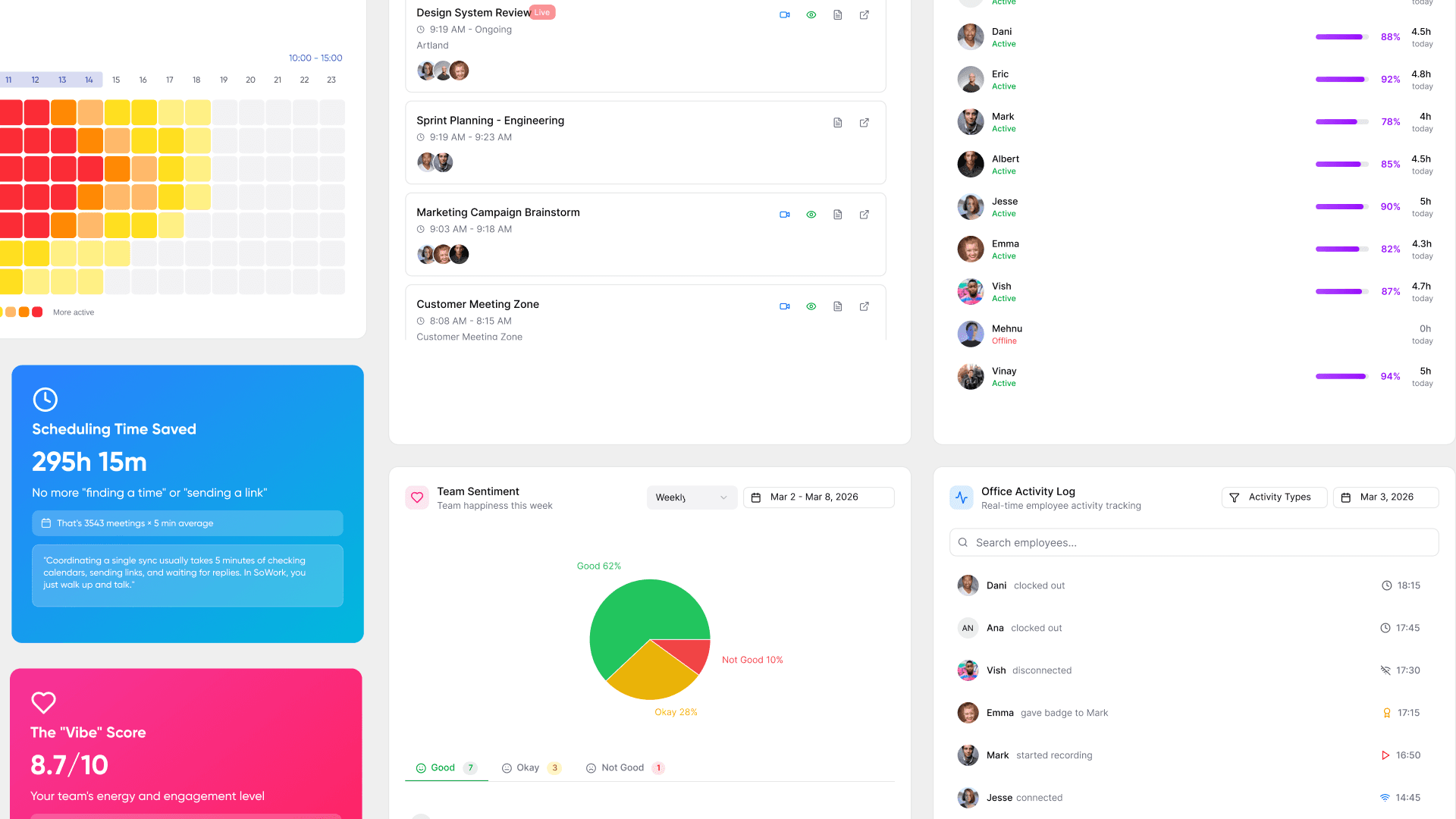
Other AI note-takers worth evaluating: Fireflies.ai, tl;dv, Otter.ai, and Notion AI all record and transcribe meetings. Fireflies and Otter use visible bots like Fathom; tl;dv is strong for video clip sharing. For teams where spontaneous meetings are a symptom of poor presence awareness, people scheduling calls because they can't tell who's free, a virtual office platform addresses the cause, not just the symptom. Tools like SoWork let teammates see who's available in real time and start a conversation in one click, reducing the need for scheduled calls entirely.
How does SoWork address spontaneous meeting overhead differently than Granola or Fathom?
Granola and Fathom solve the documentation problem after a meeting happens. SoWork solves the coordination problem before it happens, by making it as easy to tap a teammate on the shoulder virtually as it is in a physical office.
Most spontaneous meeting overhead isn't about bad notes. It's about not knowing who's available, scheduling a 30-minute Zoom call to ask a two-minute question, and losing the ambient awareness that makes physical offices efficient. SoWork replicates that layer: presence indicators show who's free, focused, or in a meeting in real time, and Instant Meetings let you start a conversation in one click, no link, no calendar invite, no friction. AI Meeting Memory then automatically records, transcribes, and summarizes those conversations so nothing gets lost. It's the combination that distributed teams actually need: fewer unnecessary meetings, and perfect documentation of the ones that matter.
Bottom Line: Granola or Fathom for distributed teams with spontaneous meetings?
Granola is the better fit for distributed teams with frequent spontaneous meetings, because its system-audio capture works without a bot invite, any call that starts on your device gets recorded, planned or not. Fathom is the better fit if your team runs mostly scheduled video calls and wants unlimited free recordings with stronger team-level features.
Pick Granola if: your team has lots of unscheduled calls, you mix platforms throughout the day, you want notes that reflect your own perspective, or bot visibility creates friction with clients. Pick Fathom if: your meetings are mostly calendar-driven, you want a genuinely free unlimited plan, you need full video playback to verify what was said, or your team needs cross-meeting search and CRM sync on a budget. If the real problem is that your distributed team has too many spontaneous meetings and no visibility into who's available, a virtual office platform like SoWork addresses the root cause, not just the documentation.
Key Takeaways
Granola captures system audio directly without a bot, making it the only tool that reliably records spontaneous, unscheduled calls without any manual setup.
Fathom's free plan offers unlimited recordings and transcriptions, the most generous free tier in the AI meeting assistant category, but its bot model can miss unscheduled calls if the host blocks bots.
Fathom launched a bot-less recording mode in April 2026, narrowing the gap with Granola, but full cross-platform bot-free video capture is still rolling out.
Granola's note model is human-guided: your typed cues shape the AI output. If you type nothing, you get a weaker summary. Fathom is fully automated and requires zero input.
Remote workers attend 80% more meetings per week than in-office workers, making consistent, low-friction capture critical for distributed teams.
Teams that auto-summarize every meeting see action-item completion rates rise from 50-60% to 85-95%, but only when capture is consistent and doesn't miss calls.
For distributed teams where spontaneous meetings stem from poor presence awareness, a virtual office platform like SoWork addresses the root cause: making it easy to see who's available and start a conversation in one click, without scheduling.
Sources
Granola raised $125M in a Series C round in March 2026, reaching a $1.5B valuation.
Granola offers 29+ meeting templates to pre-structure notes for specific meeting types.
Granola connects with Notion, Slack, HubSpot, Affinity, Attio, and Zapier.
Fathom delivers a structured summary within 30 seconds of the call ending.
Granola has real gaps for team meetings with weak speaker ID at 3+ people.
Granola has a consensus score of 9.5/10 from 492+ reviews. Teams at Linear, Vercel, and Brex use it.
Users who don't type any notes during Granola calls report weaker output.
FAQ
Is Granola or Fathom better for distributed teams who have lots of spontaneous meetings?
Does Granola work without a calendar event?
Can Fathom record a meeting without joining as a bot?
Is Fathom really free? What's the catch?
What happens if I don't type any notes in Granola?
Which tool is better for a team, not just an individual?
Are there privacy risks with AI meeting tools recording spontaneous calls?
What if my team's real problem is too many spontaneous meetings, not just bad notes?
Blogs
Read Similar Articles
Remote Team Analytics: Complete Guide to Data-Driven Remote Work Management in 2026
Complete Guide to Gaining Visibility Into Remote Team Performance and Collaboration